

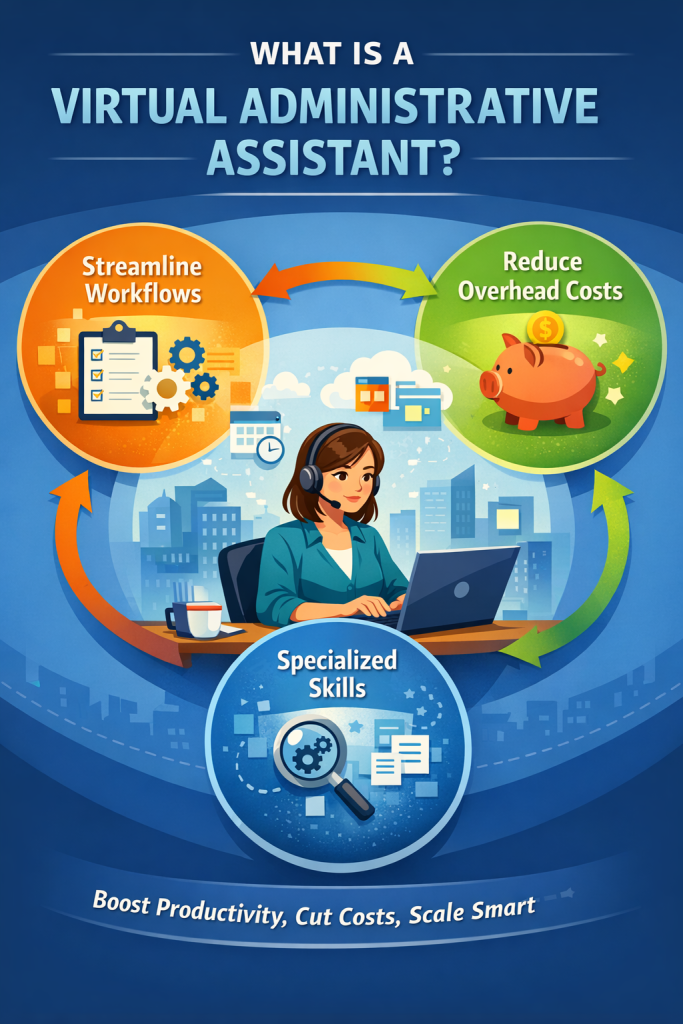
What is a virtual administrative assistant? Well, A virtual administrative assistant is a remote operations professional who takes ownership of the back-office workflows that silently consume a founder or executive’s most productive hours. The critical distinction is between task completion and workflow ownership: a well-placed virtual admin does not wait for instructions to arrive in their queue and then execute them one at a time. They maintain living operating systems, calendars, inboxes, CRM pipelines, document libraries, vendor communications, and keep those systems current and accurate without requiring constant input from the person they support. This model, when structured correctly, protects deep-work time at scale rather than simply adding another set of hands to an already fragmented environment. The goal is not to do more administrative work. The goal is to prevent administrative work from consuming the attention that should be driving revenue, strategy, and growth.
The role travels under a lot of names. Virtual admin assistant, admin assistant, administrative virtual assistant, admin virtual assistant, virtual administrator, virtual office assistant, and general admin virtual assistant all describe the same function, and the phrasing usually reflects who wrote the job scope rather than any difference in the work. Virtual administrative assistants are also routinely called admin VAs in day-to-day use. If you are comparing providers, read the workflow lanes each one commits to owning rather than the job title on the proposal.
The organizational cost of leaving these workflows unmanaged is measurable and consistently underestimated. Gloria Mark’s research at UC Irvine found that it takes an average of 23 minutes and 15 seconds to fully regain cognitive focus after a single workplace interruption, and Atlassian’s workforce productivity research found that knowledge workers experience an average of 31 interruptions per day. Administrative coordination, inbox requests, scheduling conflicts, document retrieval, and vendor follow-ups, drives the majority of those interruptions. A Harvard Business Review analysis found that executives spend approximately 23% of their total working hours on administrative tasks that a trained operator could own entirely. At a fully-loaded executive hourly rate of $150 to $300, that 23% represents tens of thousands of dollars per year in misallocated cognitive capacity, and it compounds across every person on the leadership team running their own admin in parallel.
The solution in most scaling businesses is not to tolerate that drag or replace it with a full-time local hire at $65,000-plus per year. Deloitte’s 2025 Global Outsourcing Survey found that 65% of high-growth businesses use outsourcing specifically to recover internal capacity for strategic decision-making, not primarily to cut costs. A virtual administrative assistant, placed into a documented, SOP-driven role with defined workflow lanes and clear escalation rules, is how that capacity recovery happens at the operational layer without adding local overhead.
What Separates a Virtual Administrative Assistant From a General Virtual Assistant
The distinction matters practically because it determines the scope of the role, the skills you screen for, and the outcomes you should expect within the first 90 days. A general virtual assistant typically operates as a task executor: they receive instructions, complete them, and report back. A Virtual Administrative Assistant operates differently. They own a defined set of recurring workflows, maintain the systems those workflows run through, flag problems before they escalate into missed deadlines or dropped communications, and progressively improve the processes they manage as they accumulate knowledge of your business rules, preferences, and operating patterns.
The operational difference shows up most clearly in how each type of professional handles ambiguity. A task executor presented with an unfamiliar situation will typically wait for instructions. A Virtual Administrative Assistant, working from documented SOPs and a clear understanding of your priorities, will use established decision rules to handle the situation and then document the precedent so it does not require your attention again. Peter Drucker captured the underlying principle precisely: “Nothing is less productive than to make more efficient what should not be done at all.” A virtual admin’s first job is to identify which administrative workflows are worth systematizing and which should be eliminated entirely.
Core Competencies of a Process-Driven Virtual Operator
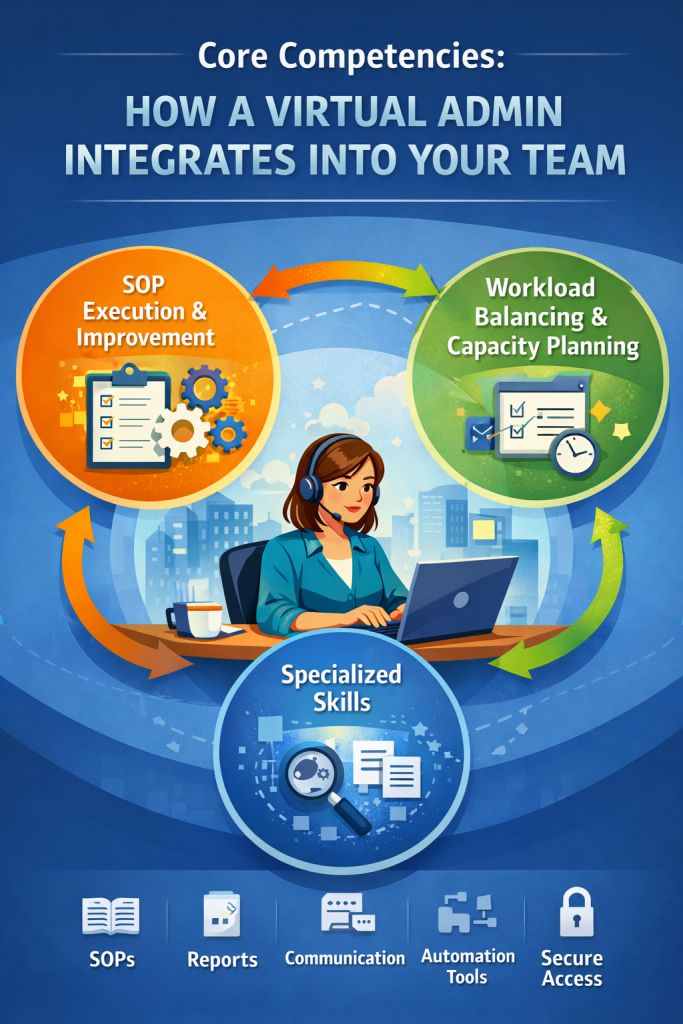
A strong Virtual Administrative Assistant brings three distinct categories of competency that distinguish them from generalist support hires. The first is SOP execution and continuous improvement: they follow documented runbooks reliably, update templates when processes change, and actively improve the procedures they manage as they identify inefficiencies. The second is workload management and capacity awareness: Rather than waiting for random task assignments, they maintain a task backlog, surface priority conflicts before deadlines slip, and give the people they support a clear view of what is active and what is pending at any given time. The third is digital operations fluency: They work natively inside cloud-based operating environments, understand how information flows between tools, and can identify where manual hand-offs are introducing errors or delays that automation could eliminate.
The competency that separates a good virtual admin from an excellent one is what Mads Singers, the management coach and founder of Aristo Sourcing, describes as “operational hygiene ownership”: the discipline of keeping every system accurate, every file current, and every workflow closed-loop without needing to be prompted. Singers’ delegation framework distinguishes between operators who complete tasks and operators who own tracks. A track owner does not just execute the steps in a process — they hold accountability for the outcome of that process and escalate intelligently when the outcome is at risk. When a virtual admin operates at track-ownership level, the business stops depending on the executive to catch dropped balls because the admin is already catching them upstream. This shift, from reactive task-taker to proactive track owner, is the single biggest determinant of whether a virtual admin placement delivers measurable ROI within the first quarter.

The Workflow Lanes a Virtual Administrative Assistant Can Own End to End
Rather than listing tasks in the abstract, mapping the specific workflow lanes a virtual admin can take complete ownership of makes the scope of the role concrete. Ownership, not occasional task completion, is what produces consistent operational outcomes.
1. Inbox Triage and Communication Gatekeeping
A virtual admin working from your inbox labels, routes, and drafts replies using pre-approved templates, maintains follow-up systems so decisions do not stall in unanswered threads, and actively protects your deep-work hours by filtering non-urgent requests into batched review windows rather than letting them interrupt your focus throughout the day. Research from RescueTime found that the average professional checks email 36 times per hour, and a virtual admin operating as the first point of contact for your inbox reduces that to a structured twice-daily review without any critical communication falling through. Platforms like Front and Help Scout, purpose-built for shared inbox management, allow a virtual admin to handle email triage collaboratively with full audit visibility into what has been responded to, what is pending, and what requires escalation. This is significantly more auditable than handing someone direct access to a personal Gmail account. The result is a communication function that runs continuously and accurately without requiring the executive to monitor it.
2. Calendar Operations and Scheduling Logistics
A virtual admin managing your calendar schedules meetings with buffers built in for travel time, preparation, and cognitive recovery between sessions, creates pre-meeting agendas, and sends attendee confirmations in advance. They resolve scheduling conflicts proactively rather than forwarding the problem back to you, and they establish booking rules through tools like Calendly or Google Calendar’s appointment scheduling features so that external parties self-schedule within parameters you define once. The value in this lane is not just time saved on back-and-forth coordination, it is the structural protection of focus blocks that scheduling complexity would otherwise fragment throughout the week. A virtual admin who treats calendar management as a strategic function rather than a clerical one ensures that your highest-value meeting slots are protected and your lower-priority commitments are batched efficiently.
3. Documentation, Files, and Knowledge Base Maintenance
A virtual admin in this lane maintains folder structures, naming conventions, and version control protocols that keep your operating documents findable and current. They capture meeting notes, extract action items, and route tasks to the appropriate owners in your project management system. They maintain an internal SOP library that grows more useful over time as new processes are documented and existing ones are refined. The organizational research firm IDC estimated that employees spend an average of 2.5 hours per day searching for information they cannot find, and a virtual admin who owns the information architecture of a business eliminates most of that friction systematically. Over time, this compounding documentation function transforms implicit institutional knowledge into explicit, searchable, transferable process assets.
4. CRM and Pipeline Administration
A virtual admin keeping your CRM accurate deduplicates contacts, enriches records with information gathered from calls and emails, updates deal stages and next steps after every interaction, and produces weekly pipeline summaries that give sales leadership accurate visibility without requiring manual data entry from the people running deals. HubSpot’s 2024 State of Sales report found that sales representatives spend only 28% of their time actually selling, with the remainder going to administrative tasks including CRM maintenance. A virtual admin absorbing that administrative layer gives quota-carrying team members a meaningful increase in available selling time without any change to the sales process itself. Platforms like HubSpot, Salesforce, and Pipedrive each require consistent data discipline to generate reliable reporting, and a dedicated virtual admin owning that function ensures the data supports accurate forecasting rather than undermining it.
5. Vendor Coordination, Finance Admin Handoff, and Subscription Management
A virtual admin managing vendor relationships chases outstanding invoices, maintains a renewals calendar, updates vendor contact records, and routes approval requests to the appropriate decision-maker rather than letting them sit in an inbox. For finance administration, the role operates as a clean handoff layer into your accounting function: receipt capture and categorization, invoice tracking, payment reminders, and basic reconciliation support that ensures your bookkeeper or CFO works from current, organized data rather than spending billable time on data-gathering. Subscription and SaaS stack management falls naturally into this lane as well, tracking active subscriptions, flagging unused tools for cancellation review, and ensuring renewal decisions receive attention before auto-renewal charges appear on the statement.
The Five Specialist Roles Within Virtual Administrative Support
Matching the role type to the specific operational gap in your business determines whether the placement delivers the outcomes you are hiring for.
Executive Virtual Admin
An executive virtual admin focuses on calendar defense, meeting preparation, action log maintenance, and stakeholder coordination across multiple teams or external parties. They serve as the operational layer between an executive’s time and the demands competing for it, and they require strong communication judgment because they frequently act as a proxy for the executive in scheduling and coordination contexts. This role works best for founders and C-suite operators whose primary constraint is attention management rather than task volume.
Operations Virtual Admin
An operations virtual admin owns the SOP library, task board management, and recurring operational reporting that keeps a scaling team aligned without requiring management to manually chase status updates every week. They hold the operational rhythm of the business, weekly reporting cycles, recurring process reviews, capacity dashboards, and ensure that the management team always has an accurate picture of what is running, what is stalled, and what requires a decision.
Client Services Virtual Admin
A client services virtual admin manages the administrative layer of the client relationship: Client lifecycle documentation, follow-up sequences, response-time monitoring, and the maintenance of client files and status records that ensure nothing falls between delivery and renewal. This role is particularly high-value for agencies, consultancies, and service businesses where client retention depends on consistent communication and reliable follow-through between project milestones.
Sales Support Virtual Admin
A sales support virtual admin handles CRM data entry, proposal preparation from approved templates, meeting scheduling, and post-call summary documentation, giving account executives and business development managers more time in front of prospects rather than behind their keyboards. The measurable output of this role is an increase in selling time as a percentage of total working hours, which is one of the most direct levers on revenue per sales headcount.
Finance Administration Virtual Assistant
A finance administration virtual assistant manages the workflow layer between operational spending and the accounting function: invoice tracking, receipt capture and categorization, payables coordination, and monthly reconciliation handoffs. The goal is to ensure that the accountant or CFO works from clean, current, and correctly categorized data, rather than spending their own time on data-gathering that does not require their level of qualification or cost.

The Tool Stack That Enables a High-Functioning Virtual Admin
The tools a virtual admin uses determine how transparently they operate and how reliably their work integrates with yours.
Security and Access Management
1Password Teams or LastPass Business allow a virtual admin to access shared credentials through encrypted vaults under least-privilege permissions rather than through direct password sharing. This architecture limits each VA’s access to only the systems their specific workflow lanes require, protects the business against credential propagation in the event of a security incident, and creates a full audit trail of who accessed what and when. Two-factor authentication should be mandatory on every system the VA accesses as a baseline security requirement, not an optional enhancement.
Communication and Shared Inbox Operations
Slack configured with Canvas documentation for recurring workflows and dedicated channels per workflow lane creates a significantly cleaner async communication environment than a single general channel. For email triage, Front and Help Scout provide shared inbox management with full visibility, assignment tracking, and response audit trails that direct inbox delegation through Google Workspace cannot replicate. Microsoft Teams serves enterprise environments where the broader Microsoft 365 stack is already in use.
Task, Project, and Process Management
Asana suits process-driven teams running recurring task templates and structured project workflows. ClickUp fits operations-heavy environments needing deep automation between workflow stages. Notion works best for businesses that want to combine task management with their SOP library and internal knowledge base in a single workspace. Loom serves a specific and high-value function in virtual admin onboarding and ongoing operations: asynchronous video walkthroughs of processes reduce misinterpretation and accelerate SOP documentation without requiring a live training session.
Scheduling, Automation, and Finance Operations
Calendly handles external booking with configurable availability rules and buffer protection. Zapier and Make (formerly Integromat) enable the automation of routine hand-offs between tools, such as routing a completed intake form into a CRM record and triggering a calendar event simultaneously. Expensify and QuickBooks serve expense management and finance administration workflows respectively, with the virtual admin operating as the data-entry and categorization layer that keeps the accountant’s input focused on interpretation rather than collection.
Compliance, Data Protection, and Security Protocols Every Hiring Business Needs to Understand
Hiring a virtual administrative assistant means granting a remote professional access to sensitive business data, client communications, financial records, and in some cases personal information covered by data protection legislation. Understanding the applicable compliance framework before the hire, rather than after an incident, protects both the business and the professional being brought in.
For businesses operating in or selling to the European Union, GDPR requires that any third party processing personal data on behalf of the business signs a Data Processing Agreement (DPA) specifying the categories of data being processed, the legal basis for processing, the security measures in place, and the procedures for data subject access requests and breach notification. Failing to execute a DPA with a virtual admin who handles contact lists, client correspondence, or HR data creates direct compliance exposure regardless of where the admin is physically located.
Businesses hiring through Aristo Sourcing’s South African talent pool need to account for POPIA (the Protection of Personal Information Act), which came into full effect in 2021 and carries penalties of up to R10 million for serious violations. A POPIA-aware onboarding process includes a signed confidentiality agreement covering the categories of personal information the VA will access, documented access controls restricting data access to the minimum necessary for their specific role, and a documented breach notification procedure. For businesses in healthcare-adjacent industries, medical practices, health technology companies, personal injury law firms, any virtual admin handling patient records, insurance documentation, or clinical communications may trigger HIPAA obligations in the United States, requiring a Business Associate Agreement (BAA) in addition to the standard NDA. The compliance layer is not bureaucratic overhead. It is what makes remote operational delegation genuinely safe at the level of data and legal exposure.

What a Virtual Administrative Assistant Actually Costs (And What the Benchmarks Miss)
The U.S. Bureau of Labor Statistics reports a median annual wage of $47,460 for administrative assistants in the United States as of May 2024, which becomes $65,000 to $80,000 in total annual cost once employer payroll taxes, benefits, equipment, and office space are included. A marketplace-sourced virtual assistant through platforms like Upwork lists a median hourly rate of $13, with general admin VA rates ranging from $10 to $20 per hour for self-managed freelancers. Philippines-based general admin VA rates typically range from $5 to $8 per hour on the open market, and South Africa-based VA placements typically fall between R225 and R500 per hour depending on experience and specialization.
The figure that marketplace benchmarks consistently omit is the management overhead cost of an unvetted freelancer hire. When a business sources a virtual admin through an open marketplace, the hiring manager carries the full cost of screening candidates, conducting interviews, running test assignments, documenting onboarding SOPs from scratch, monitoring daily output, providing performance feedback, and replacing the hire if the fit fails, which it does at a significant rate for marketplace hires without a structured placement process. Aristo Sourcing’s internal placement data, drawn from over 500 VA placements, shows that the total operational cost of a self-managed marketplace hire typically runs 40 to 60% higher than the hourly rate suggests once management time, turnover, and ramp time are accounted for. An agency-placed virtual admin through Aristo Sourcing arrives pre-vetted against role-specific competencies, matched to your specific tool stack and workflow requirements, and supported by account management that handles performance gaps and provides continuity cover if the VA becomes unavailable. The per-hour cost is higher than an unvetted marketplace rate. The total cost of a successful, stable placement at a 12-month horizon is consistently lower.
Virtual Administrative Assistant vs. Local Temporary Staff: The Real Operational Comparison
| Factor | Local Temp Admin | Virtual Administrative Assistant |
|---|---|---|
| Speed to hire | Limited by local availability | Broader talent pool, faster match |
| Overhead | Office, equipment, payroll burden | Remote-first, tool-equipped |
| Systems fit | Dependent on internal training | SOP-driven by design |
| Coverage | Local hours only | Time zone-matched |
| Institutional knowledge | Leaves with the person | Stays in documented SOPs |
| Best use case | On-site, physical presence | Inbox, scheduling, CRM, documentation |
The systems question is what matters most for growing businesses. A local temp placed into an undocumented role learns by observation and informal knowledge transfer, which means institutional knowledge leaves with them when the placement ends. A Virtual Administrative Assistant placed into a documented, SOP-driven role builds and maintains the documentation as part of the job, so the operational knowledge stays in the business regardless of personnel changes. This compounding of documented process over time transforms a VA placement from a cost line into an operational infrastructure investment that the local temp model structurally cannot replicate.

How to Implement the Role Using the Mads Singers Delegation Framework
Mads Singers’ delegation framework identifies the core failure mode in most VA implementations: Hiring a capable operator and then managing them like a task executor. The framework requires the hiring manager to make four decisions before the VA’s first day, not after their first month of trial and error.
First, identify the specific workflow lane you are delegating, not a general category of work but the precise set of recurring processes with defined inputs, outputs, and escalation triggers. Second, define what “done” looks like for each workflow within that lane, so the VA has a measurable standard rather than a subjective impression of what you want. Third, document the existing process through a Loom walkthrough or written SOP before handoff, because a VA onboarded through observation will replicate your current process including its inefficiencies. Fourth, establish a weekly reporting rhythm from day one: what was completed, what is blocked, what decisions require the manager’s input.
Aristo Sourcing’s recommended 14-day launch structure begins with a single workflow lane rather than full-scope delegation. The hiring manager identifies the workflow creating the most administrative drag, hands it off first, monitors output against the documented standard for two weeks, then expands scope to additional lanes once the first lane runs consistently without intervention. This sequenced approach, drawn from the Singers framework’s principle that trust scales with verified output rather than assumed competence, prevents the common failure mode of overwhelming a new VA with the full scope of a role before the systems, tools, and communication patterns are established. Within a typical 90-day onboarding window structured this way, Aristo Sourcing placements move from single-lane ownership to full-role independence, with the hiring manager’s direct involvement in administrative workflows dropping from daily to weekly by the end of the third month.
Virtual Admin Terminology and Scoping Questions
What is a virtual admin assistant?
A virtual admin assistant is the same role as a virtual administrative assistant, shortened. The abbreviation is more common in job adverts and marketplace listings, where it is often shortened again to admin VA. The scope is identical: remote ownership of inbox, calendar, documentation, CRM, and vendor administration.
What is an administrative virtual assistant?
An administrative virtual assistant is the same role with the words reversed, and admin virtual assistant is the same again. None of the three orderings signals a different seniority, scope, or rate. Treat them as one search for the same hire, and compare the actual task list rather than the word order.
What is a virtual office assistant?
A virtual office assistant is an older term for the same function, carried over from when the comparison point was a physical office rather than a remote team. Some providers still use it for a narrower remit focused on reception-style duties: call handling, mail, and basic scheduling, without the CRM or vendor work. Where that narrower reading applies, the scope will say so.
What is a virtual administrator?
Virtual administrator is used two ways, and the difference matters when you are hiring. In an operations context it means the administrative role described on this page. In an IT context it means somebody who administers systems, servers, or user accounts, which is a different job with a different skill set and a different rate. Check which sense a listing intends before you shortlist.
What does a virtual administrative assistant do?
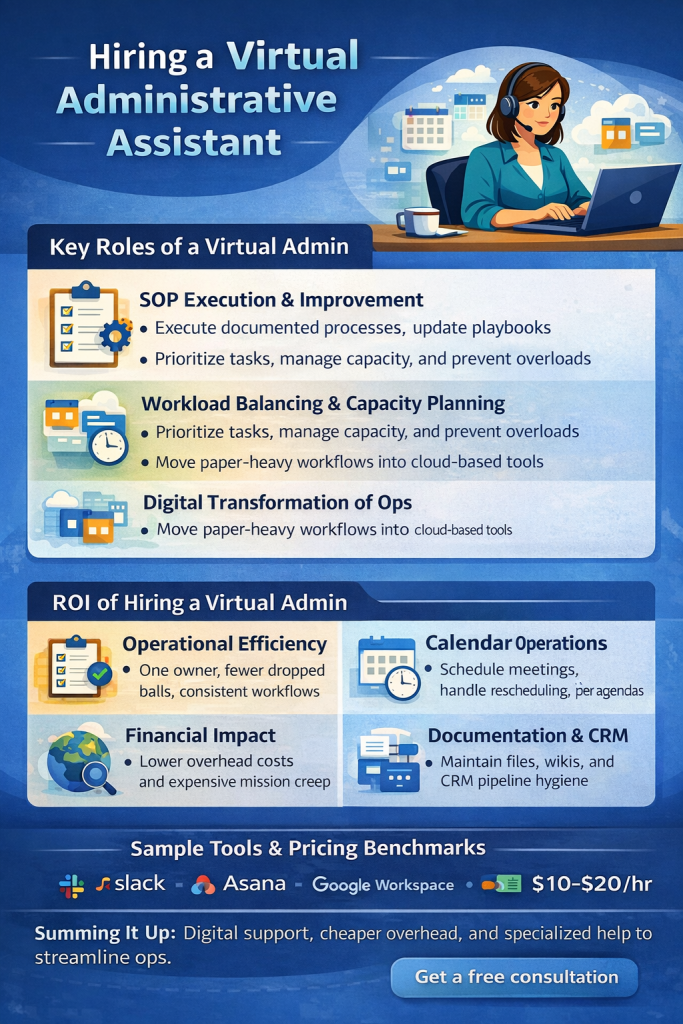
A virtual administrative assistant owns five recurring lanes: inbox triage and communication gatekeeping, calendar operations and scheduling, documentation and knowledge base maintenance, CRM and pipeline administration, and vendor coordination with the finance admin handoff. The distinction that matters is ownership rather than task completion. A well-scoped admin assistant runs each lane to an agreed standard without being asked twice.
What should a virtual administrative assistant job description include?
Write the job description around the lanes you want owned, not around a list of software. Name the workflows, the standard each must hit, the tools already in your stack, the hours of overlap you need with your own working day, and who the assistant reports to. A description built that way filters out generalists at the application stage, which is where most of the hiring time is lost.
Schedule an Operational Discovery Call
If your inbox is managing you instead of the reverse, your scheduling burns 45 minutes of coordination for every 30-minute meeting, your CRM is running on stale data, and your documentation lives in someone’s head rather than a shared system, you are experiencing the standard symptoms of an administrative function that nobody owns.
Schedule an Operational Discovery Call with our placement team. We will map your specific workflow gaps, define your ideal track-owner profile, and provide a transparent cost structure tailored to your organization’s tool stack, time zone, and operational requirements.
