

Back office Business Process Outsourcing (BPO) is a business model where companies outsource internal operational tasks to external service providers. These functions usually include payroll, accounting, HR administration, procurement, IT support, and data management services that support business operations behind the scenes.
Unlike front office outsourcing, back office BPO focuses on internal workflows instead of customer-facing activities. Businesses use back office outsourcing to reduce operational costs, improve process efficiency, increase scalability, and access specialized expertise without expanding internal departments.
Common types of back office outsourcing include finance and accounting outsourcing, HR outsourcing, IT outsourcing, and administrative support services. According to Grand View Research, the global BPO market was valued at over $328 billion in 2025 and is projected to reach nearly $696 billion by 2033.
What Is Back Office Business Process Outsourcing?
Back office Business Process Outsourcing (BPO) is a business model where companies outsource internal administrative and operational functions to third-party service providers. These functions typically include payroll processing, accounting, HR administration, procurement, IT support, compliance management, and data processing. Unlike front office outsourcing, back office BPO focuses on internal workflows that support business operations rather than direct customer interactions.
Businesses adopt back office outsourcing to improve efficiency, lower operational costs, and access specialized expertise without expanding internal infrastructure. According to Deloitte, nearly 34% of companies outsource primarily to reduce costs, while many organizations also use BPO to improve scalability, process standardization, and operational flexibility in competitive markets.
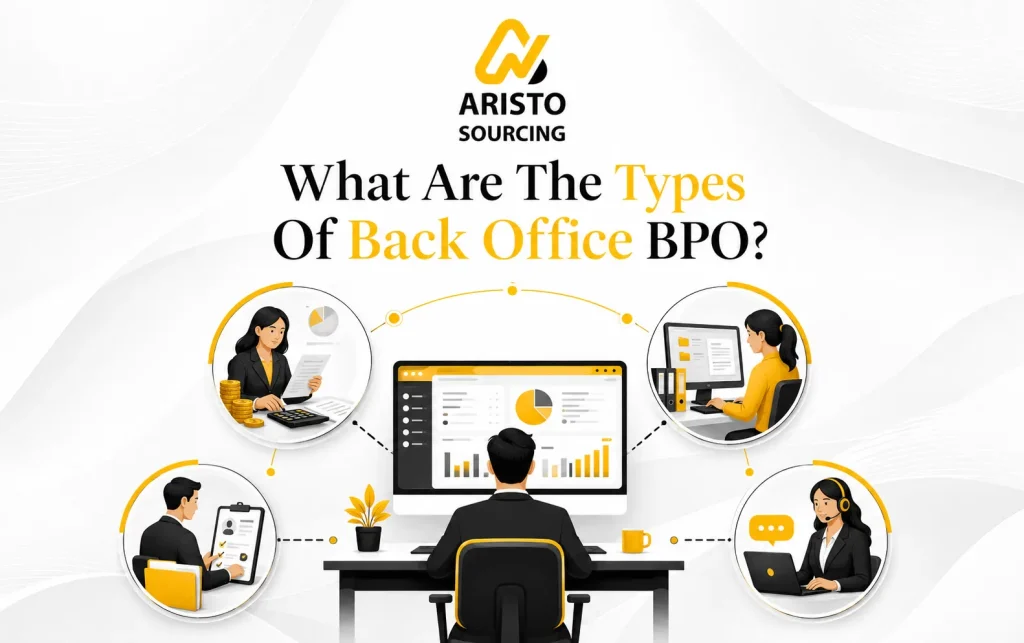
What Are The Types Of Back Office BPO?
Back office BPO covers internal business functions that support operations, administration, compliance, and workflow management behind the scenes. Companies outsource these functions to improve efficiency, reduce operational costs, and access specialized expertise without expanding internal departments.
Accounting and Finance Outsourcing
Accounting and finance outsourcing includes payroll processing, bookkeeping, tax preparation, accounts payable, accounts receivable, and financial reporting services. Businesses often outsource these functions to improve accuracy, reduce compliance risks, and streamline financial operations through specialized external teams.
This type of back-office outsourcing also helps companies lower staffing costs and improve reporting efficiency during business growth. Since financial operations are closely connected to workforce management, many organizations also outsource human resource functions alongside accounting support.
Human Resources (HR) Outsourcing
Human Resources outsourcing covers recruitment support, payroll administration, employee onboarding, benefits management, training coordination, and compliance documentation. Businesses use HR outsourcing to simplify employee management processes while reducing the administrative workload on internal HR departments through back-office workforce support services.
External HR providers also help companies manage labor law compliance, workforce scaling, and employee record management more efficiently. Beyond workforce administration, businesses increasingly outsource technical support and cybersecurity operations to strengthen internal infrastructure and operational security.
IT Support and Cybersecurity Outsourcing
IT support and cybersecurity outsourcing includes help desk services, network monitoring, cloud management, system maintenance, threat detection, and cybersecurity compliance support. Companies often outsource IT functions to access specialized technical expertise and maintain continuous back office operational support without building large internal IT teams.
Cybersecurity outsourcing also helps businesses strengthen data protection and reduce operational risks related to cyber threats and system vulnerabilities. Along with technical support, organizations frequently outsource data-heavy administrative tasks that require accuracy, speed, and process standardization.
Data Entry and Document Processing Outsourcing
Data entry and document processing outsourcing involves managing invoices, digital records, forms, databases, document indexing, and administrative data workflows. Businesses use these services to improve processing speed, reduce manual errors, and maintain organized back office operational records across departments.
External providers often use automation tools and standardized workflows to handle high-volume document management efficiently. Since operational data directly supports purchasing and logistics decisions, many businesses also outsource procurement and supply chain management functions for greater efficiency.
Supply Chain and Procurement Outsourcing
Supply chain and procurement outsourcing includes vendor management, inventory tracking, sourcing support, order processing, logistics coordination, and procurement administration. Companies outsource these operations to improve back office supply chain visibility, reduce operational delays, and optimize purchasing costs through experienced external providers.
This outsourcing model also helps businesses improve scalability during periods of fluctuating demand and global supply chain disruption. Besides operational support, organizations often outsource specialized legal and compliance-related administrative functions that require technical expertise and documentation management.
Legal Support Outsourcing
Legal support outsourcing includes contract management, legal research, compliance documentation, case preparation, intellectual property support, and litigation administration services. Businesses use legal outsourcing to strengthen back office legal operations while reducing administrative pressure on internal legal teams and improving access to specialized expertise.
External legal support providers help companies manage large document volumes, compliance workflows, and repetitive legal tasks more efficiently. This allows internal legal departments to focus more on strategic decision-making, negotiations, and high-priority legal matters.
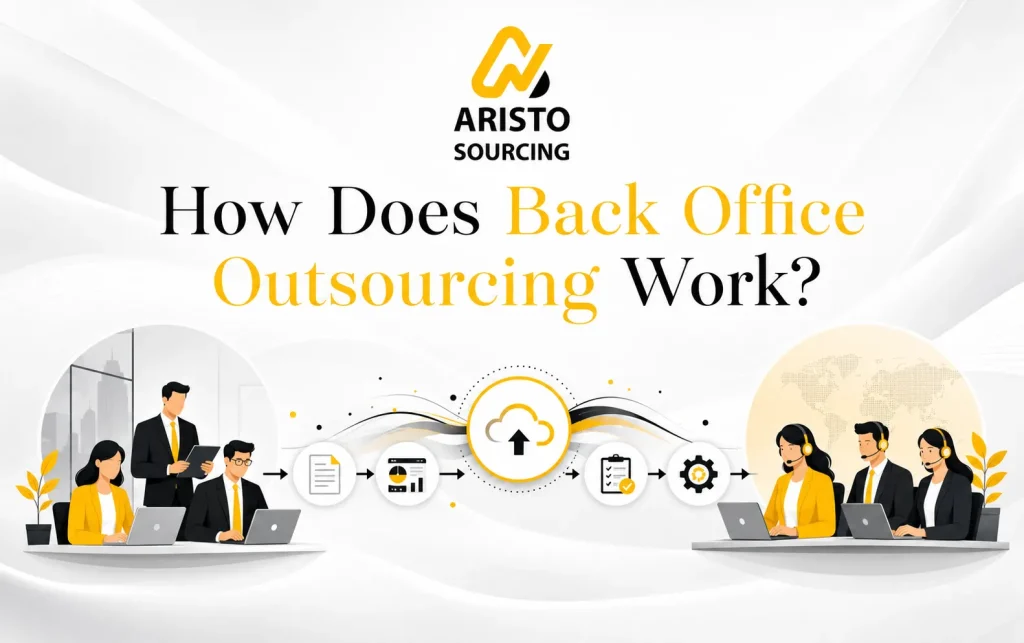
How Does Back Office Outsourcing Work?
Back office outsourcing works by transferring specific internal business functions, operational processes, or administrative projects to external service providers under clearly defined agreements. Companies usually outsource these operations to improve efficiency, reduce operational costs, increase scalability, and access specialized expertise without expanding internal teams or infrastructure.
Defining Scope and Service Level Agreements (SLAs)
Defining scope and service level agreements (SLAs) is one of the first steps in any back-office outsourcing arrangement. Businesses identify which functions, workflows, responsibilities, and operational tasks will be managed by the outsourcing provider. This scope may include accounting operations, HR administration, IT support, procurement processing, data management, or compliance-related activities depending on business requirements.
Service Level Agreements establish measurable expectations for performance, delivery quality, response times, data security, reporting standards, and operational accountability. SLAs help both parties define responsibilities clearly while reducing the risk of operational confusion or service gaps. Businesses also use SLAs to monitor vendor performance through KPIs, compliance reporting, and operational reviews throughout the outsourcing relationship. Once expectations and responsibilities are defined, companies select the outsourcing structure that best fits their operational needs.
Function-Based, Process-Based, and Project-Based Models
Function-based, process-based, and project-based models are the most common structures used in back office outsourcing. Function-based outsourcing transfers an entire operational department or business function to an external provider. Examples include finance outsourcing, HR outsourcing, or IT outsourcing where the vendor manages ongoing operational activities independently.
Process-based outsourcing focuses on specific workflows or repetitive operational tasks within a department rather than outsourcing the entire function. Businesses may outsource invoice processing, payroll administration, document management, procurement workflows, or compliance reporting while keeping the broader department internal. This model gives companies greater flexibility and operational control over selected business activities.
Project-based outsourcing is used for temporary or specialized initiatives with defined deliverables, timelines, and business objectives. Companies often outsource system migrations, software implementation, large-scale data processing, compliance audits, or operational transformation projects under this model. Each outsourcing structure offers different levels of control, scalability, vendor involvement, and operational responsibility depending on the organization’s goals and long-term business strategy.
What Are the Benefits of Back Office Business Process Outsourcing?
Back office Business Process Outsourcing helps businesses improve operational efficiency by transferring administrative and internal support functions to specialized external providers. Companies use back office BPO to reduce costs, improve scalability, strengthen compliance, and allow internal teams to focus more on strategic business priorities and long-term growth.
Cost Reduction and Predictable Spending
Cost reduction and predictable spending are major reasons businesses adopt back-office outsourcing. Companies reduce expenses related to staffing, infrastructure, office space, software, and operational management by shifting repetitive administrative work to external providers. Many outsourcing agreements also use fixed or performance-based pricing structures that improve budget planning and long-term financial predictability.
Lower operational costs allow businesses to invest more resources into growth initiatives, digital transformation, and process improvement. However, reducing costs alone is not enough for many organizations, which is why businesses also prioritize access to specialized expertise and advanced operational technologies.
Access to Specialized Skills and Technology
Access to specialized skills and technology helps companies improve operational quality without building large in-house departments. Back office outsourcing providers often employ experienced professionals in finance, HR, compliance, cybersecurity, IT management, and administrative processing while using automation tools, AI systems, and cloud-based platforms to improve efficiency.
This expertise allows businesses to improve accuracy, reporting speed, operational consistency, and service reliability across internal workflows. As companies grow, they also need the flexibility to scale operations quickly, which makes scalability another important advantage of back office outsourcing.
Scalability and Operational Flexibility
Scalability and operational flexibility help businesses adjust operational capacity based on workload changes, seasonal demand, or business expansion. Outsourcing providers can quickly increase staffing, processing capacity, and operational support without forcing companies to hire permanent employees or invest heavily in internal infrastructure.
This flexibility improves business agility and helps organizations respond faster to changing market conditions while maintaining cost control. Once operational pressure decreases internally, businesses can dedicate more attention to innovation, customer experience, and strategic growth initiatives.
Sharper Focus on Core Business Activities
Sharper focus on core business activities becomes possible when companies outsource repetitive administrative and support functions. Internal teams spend less time handling payroll, data management, compliance paperwork, procurement administration, and technical support tasks, allowing leadership to prioritize revenue generation, strategic planning, and customer-focused operations.
Reducing operational distractions also improves internal productivity and management efficiency across departments. While business focus improves internally, companies must also maintain strong governance, regulatory compliance, and operational risk management across outsourced processes.
Stronger Compliance and Risk Management
Stronger compliance and risk management are valuable benefits of back office outsourcing, especially in regulated industries. Outsourcing providers often maintain expertise in compliance reporting, industry regulations, cybersecurity standards, and operational auditing requirements across multiple business functions and jurisdictions.
External providers also use structured governance frameworks, monitoring systems, and security controls to reduce operational risks and improve process consistency. This support helps businesses minimize compliance violations, administrative errors, data security risks, and operational disruptions while maintaining more stable long-term business operations.
What Are the Risks and Drawbacks of Back Office BPO?
Back office Business Process Outsourcing improves operational efficiency and scalability, but it also creates challenges related to oversight, security, and communication. Businesses must carefully manage vendor relationships, operational visibility, and compliance risks to maintain stable long-term outsourcing performance.
Quality Control and Oversight Challenges
Quality control and oversight challenges are common in back-office outsourcing because businesses lose some direct visibility into daily operational workflows. External providers may follow different quality standards, reporting structures, or operational processes that do not fully align with the client’s internal expectations. This can create inconsistencies in service quality, turnaround times, and workflow accuracy.
Monitoring outsourced operations also requires strong governance frameworks, regular audits, and clearly defined performance metrics to maintain operational consistency. Without active oversight, businesses may face delays, processing errors, or declining service quality over time. Along with operational visibility concerns, companies must also address growing data security and privacy risks in outsourced environments.
Data Security and Privacy Risks
Data security and privacy risks increase because outsourcing providers often receive access to sensitive financial records, employee information, customer data, and internal operational systems. Businesses operating across multiple regions may also face additional exposure related to cross-border data transfers, regulatory compliance, and third-party vendor access.
Cybersecurity incidents, unauthorized access, or vendor-related data breaches can create financial, legal, and reputational damage for the client organization. Companies often reduce these risks through NDAs, security audits, access controls, compliance monitoring, and data processing agreements. Beyond security concerns, businesses outsourcing globally must also manage communication barriers caused by geographic and time zone differences.
Time Zone and Communication Barriers
Time zone and communication barriers can affect workflow coordination, response times, and operational collaboration between businesses and outsourcing providers. Offshore outsourcing teams may operate in completely different working hours, making real-time communication and issue resolution more difficult during urgent operational situations.
Language differences, cultural misunderstandings, and inconsistent communication processes can also create confusion around project expectations, reporting standards, and workflow execution. Businesses often use centralized communication tools, overlapping work schedules, and structured reporting systems to improve coordination across distributed teams. Managing these operational barriers effectively is important for maintaining outsourcing efficiency and long-term service reliability.
Hidden Costs and Contract Pitfalls
Hidden costs and contract pitfalls are common risks in back-office BPO agreements, especially during long-term outsourcing relationships. Businesses may face unexpected expenses related to onboarding, technology integration, workflow transitions, compliance management, scope expansion, and vendor change requests. Some contracts also include termination penalties, minimum service commitments, or additional fees for operational modifications outside the original agreement scope.
Poorly structured outsourcing contracts can reduce operational flexibility and create long-term vendor dependency risks. Businesses often minimize these issues through detailed SLAs, transparent pricing models, compliance clauses, and regular contract reviews. Along with financial risks, companies must also evaluate how outsourcing impacts long-term operational control and internal business continuity.
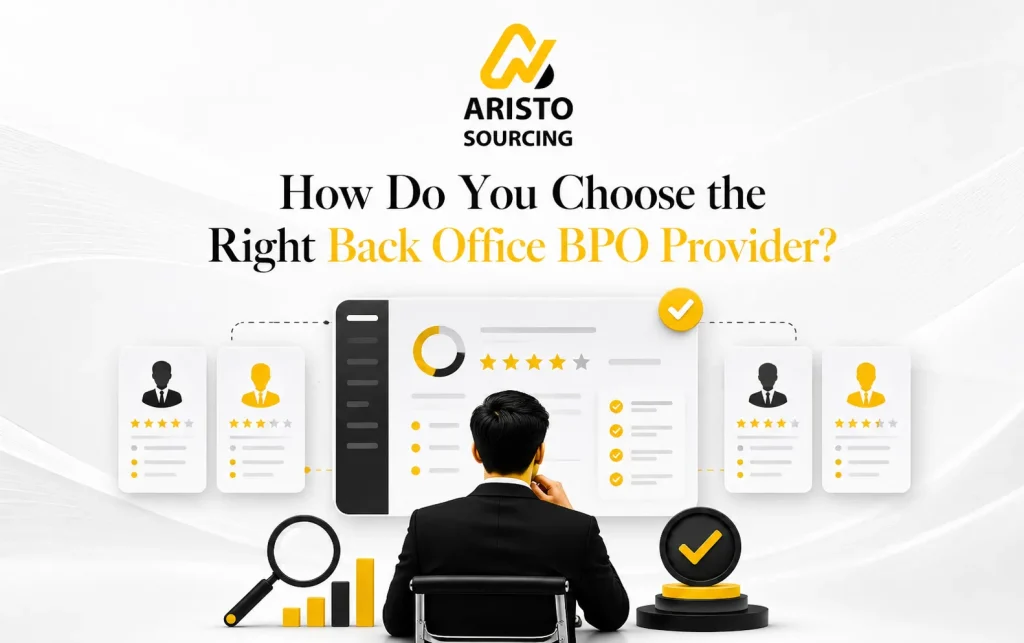
How Do You Choose the Right Back Office BPO Provider?
Choosing the right back office BPO provider requires evaluating operational goals, security standards, industry expertise, scalability, and long-term business compatibility. Businesses should carefully compare providers to improve operational efficiency while reducing outsourcing risks and compliance challenges.
Define Your Needs, Objectives, and SLAs
Defining your needs, objectives, and SLAs is the first step when selecting a provider for back office outsourcing services. Businesses should identify which operations will be outsourced, expected performance standards, reporting requirements, compliance obligations, and operational goals before finalizing any outsourcing agreement.
Clear SLAs help measure response times, workflow accuracy, operational quality, and vendor accountability throughout the partnership. Once expectations are properly defined, companies can more effectively evaluate the provider’s operational capabilities and industry-specific expertise.
Evaluate Provider Capabilities and Industry Expertise
Evaluating provider capabilities and industry expertise helps businesses determine whether the outsourcing partner can manage operational demands efficiently. Companies should review technical infrastructure, workflow processes, scalability capacity, service experience, and industry knowledge before selecting a long-term outsourcing provider.
Industry-specific expertise is especially important for regulated sectors such as healthcare, finance, legal services, and compliance-driven operations. Experienced providers often reduce onboarding challenges and improve operational efficiency. Beyond operational expertise, businesses must also prioritize strong security controls and compliance certifications before outsourcing sensitive functions.
Prioritize Security and Compliance Certifications
Prioritizing security and compliance certifications is critical because back-office BPO providers often access sensitive business data, financial records, employee information, and operational systems. Businesses should verify whether providers follow standards such as ISO 27001, SOC 2, GDPR, HIPAA, or PCI-DSS, depending on industry requirements.
Strong cybersecurity frameworks, audit procedures, and access management systems help reduce data breaches and regulatory risks. Security evaluations also improve visibility into how vendors manage third-party access and compliance responsibilities. Alongside security protection, businesses should also carefully review pricing structures and outsourcing contract terms.
Clarify Pricing Models and Contract Terms
Clarifying pricing models and contract terms helps businesses avoid hidden operational costs and long-term outsourcing risks. Providers may use fixed-price, usage-based, time-and-material, or performance-based pricing depending on the outsourcing scope and service structure.
Businesses should also review onboarding costs, termination clauses, scope expansion fees, compliance responsibilities, and escalation procedures before signing agreements. Transparent contracts improve vendor accountability and reduce operational misunderstandings throughout the outsourcing relationship. Besides financial considerations, companies should also evaluate communication efficiency and geographic compatibility.
Assess Location, Time Zone, and Cultural Fit
Assessing location, time zone, and cultural fit helps businesses maintain smoother coordination with outsourcing providers across daily operations. Offshore, nearshore, and onshore outsourcing models each offer different advantages related to cost efficiency, communication speed, workforce availability, and regulatory alignment.
Time zone overlap improves response times, workflow collaboration, and operational support during critical business activities. Cultural compatibility and communication style also influence long-term partnership quality and operational efficiency. Businesses that evaluate both operational strength and collaboration fit often build more stable outsourcing relationships.
Back Office BPO vs. Front Office BPO: What Is the Difference?
Back office BPO and front office BPO differ mainly in customer interaction, operational responsibilities, communication requirements, and business objectives. While back office outsourcing focuses on internal administrative operations, front office outsourcing manages customer-facing activities and external communication processes.
| Area | Back Office BPO | Front Office BPO |
| Focus | Internal operations | Customer-facing services |
| Examples | Payroll, HR, accounting | Customer support, sales |
| Customer Interaction | Minimal or none | Direct communication |
| Primary Goal | Efficiency and cost reduction | Customer satisfaction and growth |
| Skills Required | Technical and administrative | Communication and service skills |
| Technology Used | ERP, automation, data systems | CRM, call center platforms |
1. Customer Interaction
Customer interaction is the biggest difference between back office and front office BPO. Back office outsourcing handles internal business operations such as accounting, payroll, HR administration, procurement, and data processing without directly communicating with customers.
Front office BPO focuses on customer-facing services, including customer support, technical assistance, sales, telemarketing, appointment scheduling, and help desk operations. Because customer communication directly impacts brand reputation, front office outsourcing usually requires stronger communication and service management processes.
2. Operational Focus
Operational focus also differs significantly between both outsourcing models. Back office BPO supports internal workflows, operational efficiency, compliance management, and administrative processing that keep business operations running behind the scenes.
Front office outsourcing mainly concentrates on customer experience, sales performance, client engagement, and service responsiveness. Since both models support different business functions, companies often use separate performance metrics and operational structures for each outsourcing strategy.
3. Skill and Technology Requirements
Skill and technology requirements vary because both models manage different types of business operations. Back office outsourcing often requires analytical, technical, administrative, and compliance-related expertise along with workflow automation and data management systems.
Front office BPO prioritizes communication skills, multilingual support, CRM platforms, customer service tools, and real-time interaction management. Beyond workforce capabilities, businesses also compare how both models influence operational goals and long-term business strategy.
4. Business Objectives
Business objectives differ because back office BPO mainly focuses on reducing operational costs, improving efficiency, streamlining workflows, and supporting internal business operations. Companies often use this model to improve scalability and administrative productivity.
Front office outsourcing is more focused on improving customer satisfaction, increasing sales performance, strengthening customer retention, and enhancing overall customer experience. Many organizations combine both models to balance operational efficiency with stronger customer engagement and business growth.
Is Back Office Outsourcing the Same as BPO?
Back office outsourcing is a type of Business Process Outsourcing (BPO), but it is not the entire BPO category. BPO includes both back office and front office outsourcing services. Back office BPO focuses on internal operational functions such as accounting, HR, payroll, IT support, procurement, and data processing. Front office BPO, on the other hand, manages customer-facing activities like customer support, sales, and technical assistance. Businesses often use both outsourcing models together to improve operational efficiency and customer experience simultaneously.
Which Industries Rely on Back Office BPO the Most?
Industries that rely heavily on back office BPO include healthcare, finance, banking, insurance, legal services, retail, eCommerce, logistics, and technology companies. These industries often outsource payroll, accounting, compliance management, IT support, procurement, document processing, and administrative workflows to improve efficiency and reduce operational costs. Healthcare and financial sectors especially depend on back office outsourcing because they manage large amounts of sensitive data, regulatory compliance requirements, and repetitive administrative processes that require accuracy, scalability, and specialized operational expertise.
Is Back Office BPO Right for Your Business?
Back office BPO is the right choice for businesses that want to reduce operational workload, improve efficiency, lower administrative costs, and access specialized expertise without expanding internal teams. It works especially well for companies managing repetitive administrative tasks, rapid business growth, seasonal workload changes, or compliance-heavy operations. Businesses that need scalability, process automation, and stronger operational support often benefit from outsourcing internal functions. However, companies should carefully evaluate security requirements, communication processes, vendor expertise, and long-term operational goals before outsourcing critical business operations.