
Data Entry Virtual Assistant | Hire a Data Entry VA
Clean data. Dedicated operators. Zero HR overhead.
Your CRM has duplicate records. Your product catalog has incomplete fields. Your finance tracker hasn’t been touched in three weeks because no one owns it. These are not volume problems. They are ownership problems.
Aristo Sourcing places dedicated, pre-vetted data entry operators into your existing systems. Each operator works from your documented workflows, follows your validation rules, and flags exceptions before they become errors. You get a trained professional running your data layer, not a freelancer guessing their way through your Salesforce instance.
Trusted by agencies, legal firms, and eCommerce businesses across the US and UK.

Is This Built for Your Business?
Aristo Sourcing places data entry operators into businesses that process structured information at volume and need that information to be accurate, current, and usable.
This service fits you if you run:
A digital marketing agency managing client CRM pipelines, contact databases, and campaign performance records across HubSpot or Salesforce.
An eCommerce operation processing product catalog uploads, inventory updates, order records, and supplier data across Shopify, WooCommerce, or Amazon Seller Central.
A legal or professional services firm handling matter records, client intake data, billing entries, and document indexing under strict confidentiality requirements.
A healthcare or allied health business managing patient records, appointment data, and administrative entries within HIPAA-compliant operating boundaries.
A finance or operations team running invoice processing, expense records, reconciliation support, and data preparation for Power BI or Tableau reporting pipelines.
A real estate operation maintaining listing data, lead records, transaction tracking, and CRM field population across property management platforms.
If your business does not appear here but you process structured data at volume, your discovery call will confirm a fit within 20 minutes.

What Aristo Sourcing Actually Does
Placing a data entry operator through Aristo Sourcing is not the same as posting a job on Upwork.
Every placement goes through four managed stages before an operator touches your systems:
- Vetting. Candidates complete practical assessments across the platforms relevant to your stack. Accuracy, formatting discipline, and exception-handling judgment are all tested before any candidate reaches our shortlist.
- Matching. We match you with operators based on your specific tool ecosystem, data volume, complexity level, and time zone requirements. You review shortlisted profiles. You make the final call.
- Onboarding. We run a structured workflow definition session with you before your operator starts. Your data dictionary, validation rules, field standards, and exception escalation protocols are documented and handed to your operator before day one.
- Ongoing Management. Your operator submits weekly output reports. Aristo Sourcing monitors placement performance. If something is not working, we fix it or replace the operator. You do not carry that management burden.
This is the difference between a managed operator and a freelance hire. You own the output. We own the placement.
Where Your Operator Comes From

Aristo Sourcing draws from two managed talent pools. Each serves a distinct operational profile.
South African Operators
South African operators handle complex data operations: multi-system migrations, CRM architecture maintenance, and tasks that require analytical judgment alongside data entry. English is a first language. Tertiary education standards are high. Written communication is clear and precise.
The GMT+2 time zone gives UK clients full business-hours overlap with zero scheduling friction. US East Coast clients get a four to six-hour morning overlap window, enough to brief, review, and iterate within a standard working day.
A UK legal firm placing a South African operator into Clio and NetDocuments typically reduces its data operations cost by 40 to 60 percent compared to a London hire, with no reduction in accuracy, confidentiality, or communication quality.
Filipino Operators
Filipino operators set the global standard for high-volume data entry, eCommerce catalog management, and fast-paced ETL execution. The Philippines carries over 30 years of BPO infrastructure and a workforce deeply familiar with US business systems and time zones.
For businesses processing thousands of SKUs, invoices, or form entries per week, Filipino operators deliver precision at scale. US-aligned businesses benefit from time zone coverage that extends operational hours without an overnight shift premium.
Neither pool operates through a gig marketplace. Every operator passes Aristo Sourcing’s vetting and matching process before they reach your shortlist.
Your Engagement Options
Full-Time Dedicated Operator: One operator in your systems, five days a week, working your hours. Best for businesses with consistent daily data volume across one or more platforms. Your operator builds institutional knowledge of your specific data rules over time.
Fractional Operator: A part-time placement across two to four days per week. Best for businesses with cyclical volumes, project-based migration work, or businesses scaling toward a full-time requirement. The vetting standard and onboarding process are identical to a full-time placement.
Both options include weekly reporting, Aristo Sourcing’s ongoing placement management, and the same replacement guarantee if a placement does not perform.
What Your Operator Handles
Data Capture and Input: Your operator processes form submissions, email threads, PDF exports, scanned documents, and raw spreadsheet inputs, entering each record against your defined field structure and naming conventions.
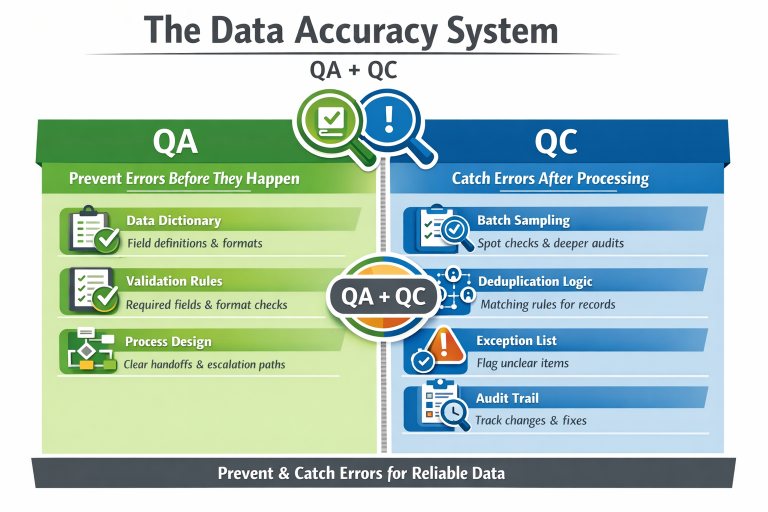
Data Cleaning and Standardization: Your operator runs deduplication logic, validates field entries against your data dictionary, normalizes formats, and flags null values or inconsistent records before they reach your live system.
CSV Optimization and Bulk File Management. Your operator prepares bulk files for migration, maps CSV columns to target field structures, parses XML inputs, verifies JSON layout integrity, and maintains bulk migration error logs to catch format conflicts before they corrupt a live import.
CRM Hygiene and Pipeline Accuracy: Your operator updates contact records, corrects deal stage entries, populates custom properties, and maintains lifecycle field accuracy across HubSpot, Salesforce, Zoho, and Pipedrive. Accurate CRM data produces reliable pipeline reporting.
System Uploads and Platform Updates: Your operator pushes structured records into eCommerce platforms, BI dashboards, ERP systems, and database tools using your established upload rules and validation standards.
Exception Flagging and Weekly Reporting: Your operator does not guess. Ambiguous entries, format conflicts, missing required fields, and data anomalies get flagged and escalated through your agreed reporting protocol. Every weekly report covers records processed, exceptions raised, and issues resolved.
The ETL Operator Framework
Every Aristo data entry operator works inside a three-stage ETL process: Extract, Transform, Load.
Extract. Your operator pulls source data from its origin: form exports, CRM reports, supplier feeds, scanned files, or API outputs. Before transformation begins, your operator identifies gaps, missing fields, and format inconsistencies in the source data and logs them.
Transform. Your operator standardizes raw data against your data dictionary. Field formats, naming conventions, date structures, and category tags all align to your defined rules. Your operator runs deduplication logic, resolves conflicts, and builds an exception list for any records that cannot be cleanly transformed.
Load. Your operator pushes clean, validated records into the target system following your established upload rules. Post-load batch sampling confirms record integrity. Your operator flags any discrepancies before the dataset goes into active use.
This is Database Normalization applied by a trained operator to your specific stack, documented in your workflow, and repeatable without you in the room.

Platform Coverage
| Category | Platforms |
|---|---|
| Spreadsheets | Google Sheets, Microsoft Excel |
| Project and Database Tools | Airtable, Notion, Trello |
| CRM Systems | HubSpot, Salesforce, Zoho, Pipedrive |
| eCommerce | Shopify, WooCommerce, Amazon Seller Central |
| BI and Reporting | Power BI, Tableau, Google Looker Studio |
| Finance and Operations | Xero, QuickBooks, NetSuite |
The Economics of the Operator Layer
Every placement is scoped to your tool stack, data volume, and complexity. What the model compares against:
| Hire Type | Estimated Monthly Cost | Overhead |
|---|---|---|
| In-house data entry clerk (US) | $3,500 to $4,500 per month | Benefits, payroll tax, office space, HR overhead |
| In-house data entry clerk (UK) | £2,800 to £3,800 per month | Employer NI, pension contributions, recruitment fees |
| Aristo Managed Remote Operator | Custom-scoped placement | Zero HR liability, zero overhead, managed replacement guarantee |
Most clients reduce data operations costs by 60 to 70% compared to an equivalent in-house hire. Pricing is confirmed on your discovery call, scoped to your actual requirements, before any placement begins.
Data Governance and Security
Data entry work requires direct access to business-critical systems. Aristo Sourcing treats security as a structural requirement built into every placement.
Least-Privilege Access Controls: Every operator receives system permissions scoped to the modules and records their role requires. Broad admin access is never granted by default.
Encrypted Credential Management: Operator credentials are managed through enterprise password tools such as 1Password or LastPass. No raw passwords change hands via email or messaging platforms.
Regulatory Compliance Alignment: Operators work within the compliance frameworks relevant to your jurisdiction and industry:
- GDPR for UK and EU clients handling personal data
- HIPAA for US healthcare-adjacent data operations
- POPIA for South African data processing obligations
- Data Processing Agreements (DPA) available upon request for enterprise clients requiring formal contractual data governance
SOC 2 Aligned Infrastructure: Operators work within secure remote desktop environments and follow access control protocols aligned with SOC 2 principles. Enterprise clients can request full security documentation during onboarding.
Non-Disclosure Agreements: Every operator signs a role-specific NDA before accessing client systems. This is a standard part of every placement.

There was initial skepticism about giving a remote operator access to the CRM. Still, within six weeks, the HubSpot pipeline was the cleanest it had been in two years, with accurate deal stages, complete contact records, and no duplicates. The sales team noticed the difference before any formal update was shared. What could that level of accuracy do for your business if you brought in a data entry virtual assistant?
The Onboarding Process
Step 1: Define the Workflow. Your discovery call maps data sources, target systems, field structures, validation rules, and exception handling protocols. Nothing starts until the workflow is documented.
Step 2: Get Matched. Aristo Sourcing selects candidates from the appropriate talent pool based on your tool stack, volume, complexity, and time zone. You review shortlisted profiles and confirm the placement.
Step 3: Run a Pilot Batch. Your operator processes a defined pilot batch against your validation rules. You review accuracy, flag any process gaps, and confirm the workflow before volume scales.
Step 4: Scale with Weekly Reporting. Your operator submits weekly output reports covering records processed, exceptions flagged, and anomalies identified—full visibility without micromanagement.
Book a Discovery Call
Tell us your data volume, your tools, and where your current process breaks down. Aristo Sourcing will map your workflow, recommend an operator profile, and confirm a scoped placement within five business days.
Aristo Sourcing places managed data entry operators from South Africa and the Philippines into US and UK businesses. Pre-vetted. Fully managed. Operationally ready from week one.
Frequently Asked Questions
Virtual assistant data entry is the process of hiring a remote professional to capture, clean, validate, and manage structured information across your business systems. A data entry virtual assistant handles the full data lifecycle: inputting records from source documents, standardising formats against a defined data dictionary, running deduplication and field validation, and loading clean data into your CRM, eCommerce platform, ERP, or database tool.
Unlike a traditional in-house data entry clerk, a virtual data entry assistant operates remotely, works within your existing software ecosystem, and scales up or down based on your volume requirements. Modern data entry VAs cover a wide range of back-office operations, from bulk CSV migration and document digitisation to master data management support and real-time CRM hygiene.
At Aristo Sourcing, data entry virtual assistants function as dedicated remote operators placed inside your specific tech stack, not as anonymous task workers pulling from a shared queue.
Aristo Sourcing data entry virtual assistants stand apart from freelance marketplaces and offshore BPO vendors in six specific ways:
- Pre-vetted for your stack. Every operator completes practical assessments on the platforms relevant to your business before reaching your shortlist. HubSpot, Salesforce, Shopify, Airtable, and NetSuite proficiency is tested, not assumed.
- Managed placement model. Aristo Sourcing handles operator vetting, onboarding, performance monitoring, and replacement if needed. You carry zero HR liability.
- Regional talent advantage. Operators sourced from South Africa and the Philippines bring native English proficiency, strong analytical accuracy, and time zone alignment with US and UK business hours.
- Documented workflow from day one. Every placement starts with a workflow definition session. Your data dictionary, validation rules, and exception protocols are documented before your operator touches a single record.
- Compliance-ready operations. Operators work within GDPR, HIPAA, and POPIA frameworks with least-privilege access controls and encrypted credential management built into every placement.
- No gig economy risk. Aristo Sourcing does not operate a freelance marketplace. Every placement is a dedicated, managed remote professional accountable to defined service standards.
A data entry virtual assistant handles a broad range of back-office data operations, including:
- CRM data entry and hygiene: Contact record creation and updates, deal stage corrections, pipeline field population, and deduplication across HubSpot, Salesforce, Zoho, and Pipedrive
- eCommerce catalogue management: Product listing creation, SKU updates, inventory data entry, and attribute population across Shopify, WooCommerce, and Amazon Seller Central
- Document digitization and OCR processing: Converting scanned documents, PDFs, and paper forms into structured digital records
- CSV optimization and bulk data migration: File preparation, column mapping, error log management, and post-migration validation
- XML parsing and JSON layout verification: Structured data format checking before system imports
- Data enrichment: Appending missing fields, cross-referencing sources, and updating incomplete records against verified data sets
- Financial data entry: Invoice processing, expense record input, and reconciliation support for Xero, QuickBooks, and NetSuite
- Reporting and BI data preparation: Structuring raw data for Power BI, Tableau, and Google Looker Studio dashboards
- Exception flagging and audit trails: Identifying and escalating data anomalies before they reach live systems
- Master data management support: Maintaining data consistency across multiple platforms through defined data stewardship protocols
The specific task scope for your operator is confirmed during your discovery call and documented before placement begins.
Most clients have a confirmed data entry operator placement within five to seven business days of their discovery call. The process runs in four stages:
- Discovery call (Day 1 to 2). Aristo Sourcing maps your data sources, target systems, volume, and validation requirements. Your workflow definition is drafted in this session.
- Candidate shortlisting (Days 2 to 4). Aristo Sourcing selects candidates from the relevant talent pool based on your stack, complexity, and time zone requirements. You receive shortlisted profiles to review.
- Placement confirmation (Day 4 to 5). You select your preferred operator. NDA signing, access provisioning, and onboarding documentation are completed.
- Pilot batch (Day 5 to 7). Your operator processes a defined pilot batch against your validation rules. You review accuracy before full volume begins.
Turnaround time varies based on the specificity of your platform requirements. Clients with common CRM or eCommerce stacks are typically operational within five days. Clients with complex ERP or multi-system environments may require up to ten business days to configure a fully documented workflow before the pilot begins.
Aristo Sourcing data entry virtual assistants are assessed and selected against a defined qualification framework before any candidate reaches a client shortlist:
Technical proficiency. Candidates complete practical assessments on the platforms relevant to your stack, including CRM systems, spreadsheet tools, eCommerce platforms, and database software. Platform familiarity is verified through task-based testing, not self-reporting.
Data accuracy standards. Operators are assessed for keystroke accuracy, field validation discipline, and exception identification under time pressure. Aristo Sourcing targets a data accuracy rate above 99 percent as a placement threshold.
English language proficiency. South African operators are native English speakers. Filipino operators complete structured English assessment covering written communication, field labelling interpretation, and exception reporting clarity.
Process discipline. Candidates demonstrate the ability to follow documented SOPs, maintain audit trails, and escalate ambiguous entries through a defined protocol rather than making unsupported assumptions.
Compliance awareness. Operators placed into regulated industries receive additional briefing on GDPR, HIPAA, or POPIA requirements relevant to their client’s jurisdiction. Data handling protocols and least-privilege access principles are covered before day one.
Systems adaptability. Operators are assessed on how quickly and accurately they can learn an unfamiliar platform, since client tech stacks evolve and operators need to adapt without extended retraining cycles.
You should hire a data entry virtual assistant when the cost of inaccurate, incomplete, or delayed data inside your business systems exceeds the cost of a dedicated operator to manage it.
For most scaling US and UK businesses, that threshold arrives well before they hire a full-time in-house data entry clerk.
The core case for outsourcing data entry to a virtual assistant:
Cost reduction. A managed remote data entry operator costs 60 to 70 percent less than an equivalent in-house hire once you account for salary, employer contributions, office overhead, and recruitment fees. You pay for output, not a seat.
Accuracy and data integrity. A dedicated operator working from documented validation rules and a defined data dictionary maintains higher data integrity than a task shared across multiple team members with competing priorities. Consistent ownership drives consistent accuracy.
Time recovery for your core team. Data entry pulls your sales, operations, and marketing teams away from the work that generates revenue. A dedicated operator removes that drag permanently.
Scalable data operations. Remote data entry operators scale with your volume. A fractional operator handles lower-volume periods. A full-time dedicated operator supports high-growth phases. You do not carry excess headcount during slower cycles.
Business continuity. A managed placement through Aristo Sourcing includes a replacement guarantee. If an operator leaves or underperforms, the managed placement model fills the gap without you restarting a recruitment process.
Reduced data latency. Operators working defined daily schedules reduce the gap between data entering your business and that data appearing accurately inside your systems. Faster, cleaner data means faster, more reliable business decisions.
Yes, provided the placement model includes proper data governance controls built in from the start. Reliability for sensitive data handling depends entirely on the security infrastructure around the operator, not just the individual.
Aristo Sourcing builds the following controls into every data entry placement:
Least-privilege access. Operators receive system permissions scoped only to the modules and records their role requires. No operator receives broad administrative access by default.
Encrypted credential management. All system credentials are managed through enterprise password tools such as 1Password or LastPass. No raw passwords are shared via email, messaging apps, or unencrypted files.
Non-disclosure agreements. Every operator signs a role-specific NDA before accessing client systems. This is a standard placement requirement, not an optional add-on.
Compliance framework alignment. Operators working with sensitive business data are briefed on the regulatory framework governing that data: GDPR for UK and EU client records, HIPAA for US healthcare-adjacent data, and POPIA for South African data processing obligations.
Data Processing Agreements. Enterprise clients requiring formal contractual data governance receive a Data Processing Agreement (DPA) as part of their placement documentation.
SOC 2-aligned operating protocols. Operators work within secure remote desktop environments with access logging and session controls aligned to SOC 2 principles.
Audit trails. Every operator maintains a documented exception log and weekly output report. You have a traceable record of every record processed, every anomaly flagged, and every escalation raised.
Sensitive data handling, including financial records, legal matter data, healthcare administration, and personal contact information, is a standard part of Aristo Sourcing placements when the correct governance infrastructure is in place.