
utsourcing means hiring an external third party to perform business tasks; offshoring means relocating operations to another country. A US company hiring a domestic payroll firm is outsourcing; moving its customer service team to the Philippines is offshoring.
The main difference between outsourcing vs offshoring is that outsourcing is about who does the work, while offshoring is about where it is done. When deciding between outsourcing and offshoring, the right choice depends on cost structure, control requirements, function type, and time horizon. The global outsourcing market reached $855 billion in 2025 and is projected to surpass $1 trillion by 2030.

What Is Outsourcing?
Outsourcing is the practice of delegating tasks to an external third-party provider, domestic or international, rather than performing them in-house. The vendor assumes responsibility for execution, staffing, and quality control, while the client pays under a variable-cost model.
Types of outsourcing include business process outsourcing (BPO), IT outsourcing, manufacturing outsourcing, and project-based outsourcing. According to Prialto’s 2025 Executive Productivity Report, 46% of organizations outsource at least 15% of their workforce.
What Are the Examples of Outsourcing in Practice?
The examples of outsourcing in practice are presented below.
- Payroll processing and HR administration: Companies delegate payroll, benefits management, and compliance tasks to specialized HR service providers.
- Customer service and call center operations: Businesses route inbound support to third-party call centers, often to reduce response costs.
- IT support and helpdesk services: Internal IT functions are outsourced to managed service providers who handle tickets, maintenance, and monitoring.
- Cybersecurity: Organizations like Starbucks outsource cybersecurity functions to firms with dedicated threat-detection infrastructure.
- Software development: WhatsApp famously outsourced its early development to an Eastern European team to accelerate its launch.
- Marketing functions: Marketing is the most outsourced business function according to Prialto’s 2025 data, spanning content, paid media, and SEO.
- Accounting and finance back-office tasks: Bookkeeping, accounts payable, and tax preparation are routinely handled by third-party accounting firms.
What Are the Benefits of Outsourcing?
The benefits of outsourcing are listed below.
- Reduces costs through a variable-cost model: Outsourcing converts fixed labor expenses into on-demand service costs, lowering the financial commitment per function.
- Accesses specialized skills not available in-house: Vendors bring ready expertise in niche areas like cybersecurity, UX design, legal compliance, which would take years and significant cost to build internally.
- Accelerates talent access vs. traditional hiring: A vendor can assemble a capable team within weeks, compared to the approximately four months required to complete a full US hiring cycle.
- Focuses internal resources on core competencies: Delegating non-core tasks such as payroll and customer service frees leadership bandwidth for revenue-generating activities.
- Reduces administrative overhead: Outsourcing eliminates the cost and effort of hiring, onboarding, training, and managing the outsourced function’s personnel.
- Scales rapidly with workload demand: Businesses can scale the engagement up or down without the constraints of fixed headcount or infrastructure.
There are some potential risk involves with outsourcing, but they can easily be avoided with proper management.
What Are the Common Risks of Outsourcing?
The common risks of outsourcing are listed below.
- Vendor quality inconsistency: Because the outsourcing problems often originate in vendor handoffs, deliverable quality can vary across teams or subcontractors.
- Data security vulnerabilities: Sharing proprietary processes or customer data with an external party increases exposure to breaches and non-compliance, making this one of the primary disadvantages of outsourcing.
- Loss of operational control: The risks of outsourcing include reduced visibility into day-to-day execution, which is very different from offshoring, where the company retains direct oversight.
- Communication and alignment gaps: Time zone differences, unclear contracts, and misaligned KPIs can delay projects and erode vendor relationships.
- Hidden transition and oversight costs: Switching providers, enforcing contracts, and managing vendor performance can offset the cost savings anticipated at the outset.
What Is Offshoring?
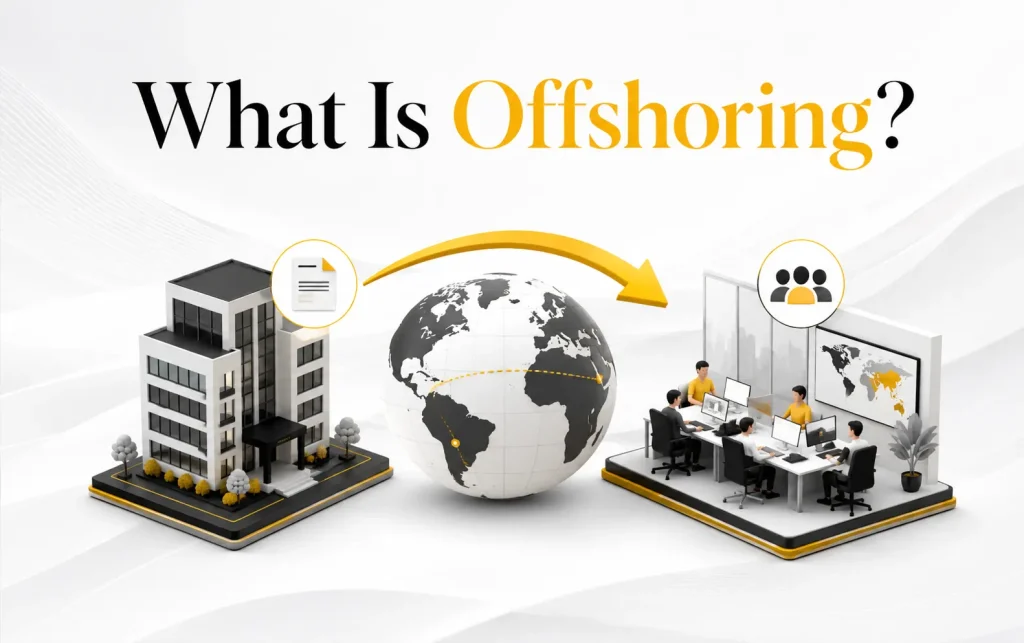
Offshoring is the practice of relocating business operations to a foreign country, with the company retaining direct internal control. Unlike outsourcing, offshoring is primarily a geographic activity; the company owns a subsidiary abroad or employs staff directly in the offshore location, with those staff integrated into its culture and reporting structure. uxis reported in 6 IT Outsourcing Trends Impacting 2026 and Beyond that 34% of companies cited cost reduction as a reason for offshoring.
There are two main offshoring models. Captive offshoring involves establishing a company’s own subsidiary in another country, where the business owns the operation entirely and employs the workforce directly. Offshore outsourcing, on the other hand, is a hybrid model in which a foreign third-party vendor is hired to perform tasks abroad, combining the geographic cost advantages of offshoring with the operational model of outsourcing.
What Are the Examples of Offshoring in Practice?
The examples of offshoring in practice are presented below.
- Manufacturing offshoring: Companies relocate production facilities to lower-cost beneficiary countries, for example, electronics manufacturers moving factories to Vietnam or Mexico.
- Captive R&D centers: Technology companies establish their own research and development subsidiaries in India or Eastern Europe to access deep engineering talent pools.
- IT delivery centers offshored to India: India’s IT offshoring industry has grown to a $100 billion sector, making it one of the top offshoring destinations globally.
- Offshore BPO call centers in the Philippines: According to the IT and Business Process Association of the Philippines (IBPAP), the Philippines hosts a $40 billion BPO industry and ranks 15th globally in the Tholons Global Business Innovation Sustainability Index (TBIS). They are fully driven by English proficiency and cultural compatibility with Western markets.
- Engineering and design offshoring: Aerospace, automotive, and semiconductor firms offshore complex engineering work to talent-dense markets in Eastern Europe and Southeast Asia.
What Are the Advantages of Offshoring?
The advantages of offshoring are listed below.
- Reduce labor costs significantly: With 34% of businesses citing cost reduction as their primary driver, offshoring delivers savings that compound over a multi-year horizon once infrastructure is established.
- Access a broader and deeper talent pool: Offshore markets, particularly in India, the Philippines, and Eastern Europe, offer large volumes of specialized engineers, IT professionals, and manufacturing workers that domestic markets cannot match.
- Sustain round-the-clock productivity: Time zone differences, often viewed as a challenge, can be leveraged to enable 24/7 operations across global teams.
- Retain greater control than outsourcing: Because the company directly manages offshore employees, it applies its own quality control standards and processes without relying on a vendor’s judgment. Avoiding the mistakes of poorly managed transitions is key to going beyond any disadvantages.
- Integrate staff directly into company culture: Direct employment means offshore teams adopt the company’s values, workflows, and communication norms, producing stronger alignment than vendor-managed staff.
- Capture tax advantages in certain jurisdictions: Some offshore destinations offer favorable corporate tax structures, special economic zones, or investment incentives that reduce the overall cost of operations.
- Expand into new geographic markets: An offshore subsidiary creates a physical presence in a target country, which can serve both operational and commercial market-entry objectives.
- Achieve higher consistency in quality control: Compared to outsourcing, where quality depends on vendor oversight, direct management of offshore teams allows the company to enforce its own QC standards uniformly.
What Are the Disadvantages of Offshoring?
The common disadvantages of offshoring are listed below.
- Cultural and communication barriers: Differences in language, business norms, and work expectations can slow collaboration and create friction, one of the most cited offshoring problems in practice.
- Time zone coordination challenges: Managing real-time decisions across significant time differences requires deliberate scheduling and can delay critical workflows.
- Political and geopolitical instability: The risks of offshoring include exposure to regulatory changes, trade disputes, or political instability in the host country that can disrupt operations with little warning.
- High upfront infrastructure investment: Establishing an offshore subsidiary requires capital outlay for facilities, legal entity formation, HR infrastructure, and IT systems before the cost savings begin to materialize.
- Reputational risk with consumers: A Journal of Consumer Research study by Wharton researchers analyzed 35,000 cases across nine studies, finding that offshoring jobs triggers the highest consumer backlash due to violations of social contracts, while automation produces only moderate reactions.
- Intellectual property exposure: Placing proprietary technology, processes, or data in a foreign jurisdiction increases IP risk, particularly in countries with weaker enforcement frameworks.
Are Offshoring and Offshore Outsourcing the Same?
No, offshoring and offshore outsourcing are not the same because they differ in who controls and employs the workforce. Offshoring means a company moves its own operations to a foreign country and retains direct ownership and management of those operations.
Offshore outsourcing means a company hires a foreign third-party vendor to perform tasks abroad, relinquishing day-to-day management to that vendor. The core distinction is that offshoring focuses on where the work is done, while outsourcing focuses on who performs the work.
What Is the Difference Between Outsourcing and Offshoring?
The differences between outsourcing and offshoring span control, cost, personnel, and strategic intent.
The difference between outsourcing and offshoring is presented below.
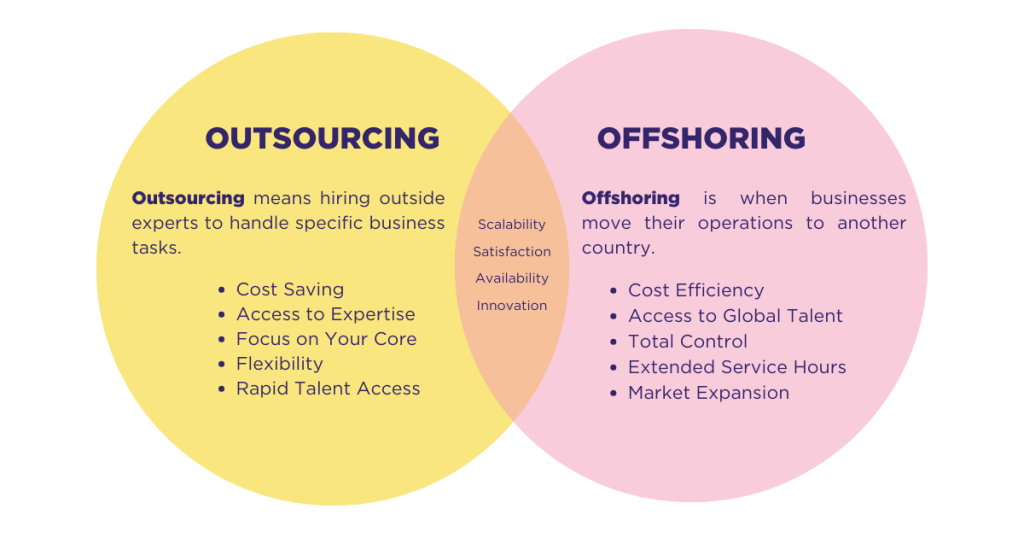
- Difference in Vendor Relationship: Outsourcing transfers task ownership to a third-party vendor, while offshoring retains the work within the company’s own organizational structure in a foreign location.
- Difference in Geographic Relocation: Outsourcing is location-agnostic and can involve domestic or international providers, while offshoring specifically requires moving operations to another country.
- Difference in Cost Structure: Outsourcing uses a variable-cost, pay-for-service model with lower upfront investment; offshoring involves a fixed, long-term investment in infrastructure and personnel with different costing dynamics at scale.
- Difference in Quality Control: Outsourcing delegates quality responsibility to the vendor; offshoring allows the company to apply its own QC standards directly.
- Difference in Personnel Model: Outsourcing uses the vendor’s employees, who have no formal integration with the client company; offshoring involves the company’s own direct employees, fully integrated into its culture.
- Difference in Ownership: In outsourcing, the third party assumes responsibility for execution and staffing; in offshoring, the company retains ownership of all processes, people, and output.
- Difference in Scalability and Timeframe: Outsourcing suits project-based or fluctuating needs with rapid deployment; offshoring is a strategic, long-term commitment that requires multi-year planning to break even.
How Much Does Outsourcing Cost Compared to Offshoring?
The cost difference between outsourcing and offshoring is presented below.
Outsourcing cost model: Outsourcing operates on a variable-cost basis; the client pays only for services rendered, with no upfront infrastructure expense. Vendor margin is built into the pricing, switching costs are low, and the engagement can be terminated without stranded assets. However, hidden costs, including transition management, contract enforcement, oversight, and vendor quality remediation, can reduce the apparent savings.
Offshoring cost model: Offshoring requires a fixed, long-term investment covering infrastructure build-out, legal entity setup, HR systems, and direct personnel costs upfront. Per-unit costs are significantly lower at scale, but the model requires a multi-year horizon to break even on the initial investment.
Outsourcing is cheaper in the short term, for projects under 12 to 18 months, the variable cost model and zero setup costs give it a decisive advantage. Offshoring becomes cheaper over a multi-year horizon, once the offshore operation is fully ramped and fixed costs are amortized across high-volume workloads. When comparing outsourcing vs offshoring cost, the decision should be anchored to the expected duration and scale of the function.

How Should You Choose Between Outsourcing and Offshoring?
To choose between outsourcing and offshoring, a business must ask several questions about function type, control requirements, budget constraints, and strategic horizon.
The key questions to ask before choosing between outsourcing and offshoring are listed below.
- Is this function core or non-core to the business?
- Is the need temporary and project-based, or long-term and ongoing?
- How much direct control over quality and personnel is required?
- Is upfront infrastructure investment feasible, or is a variable-cost model necessary?
- What is the organization’s tolerance for cultural, geopolitical, and reputational risk?
When Should You Choose Outsourcing?
The circumstances when you should choose outsourcing are mentioned below.
- The function is non-core: Payroll, HR administration, customer service, and IT helpdesk are examples of functions that do not differentiate the business and are well suited to outsourcing for small businesses and large enterprises alike.
- The workload is temporary or project-based: Outsourcing for temporary projects avoids the overhead of building permanent capacity for a finite scope of work.
- Workloads fluctuate seasonally or unpredictably: Variable-cost vendors can scale headcount up or down without the company bearing the full cost of idle capacity.
- Specialized skills are needed without full-time commitment: Outsourcing provides access to niche expertise in areas such as tax compliance, UX research, or cybersecurity on an as-needed basis.
- Speed to deployment matters more than long-term ownership: Vendor teams can be operational in weeks, which is critical when time-to-market is the primary constraint.
- Upfront infrastructure investment is not justified: When capital is limited or the function’s permanence is uncertain, you should outsource rather than build.
- The organization is an SMB without internal team-building capacity: Smaller businesses typically lack the operational infrastructure required to set up and manage an offshore subsidiary.
When Should You Choose Offshoring?
The circumstances when you should choose offshoring are mentioned below.
- Long-term cost reduction is the primary driver: Offshoring for manufacturing, IT delivery, or back-office operations delivers compounding savings once the offshore infrastructure matures.
- Quality control must be retained in-house: Direct employment and direct management are necessary when the function’s quality standards cannot be delegated to a third party.
- Round-the-clock productivity is required: Industries with 24/7 operational requirements, finance, IT support, and logistics benefit from offshore teams operating in complementary time zones.
- Direct employment of foreign staff is preferred: When cultural integration, employee loyalty, and institutional knowledge retention are priorities, direct offshore employment outperforms a vendor relationship.
- Access to a broader, deeper talent pool is critical: Offshoring for software development or engineering in markets like India or Eastern Europe opens access to talent volumes unavailable domestically.
- Infrastructure investment is justified by a multi-year horizon: When the function is permanent, large-scale, and high-volume, the fixed investment required to establish an offshore operation becomes economically rational.
- Expanding into a new geographic market: A captive offshore subsidiary also serves as a market-entry vehicle, establishing a local legal, operational, and commercial presence.
When Does a Hybrid Outsourcing-Offshoring Model Make Sense?
The circumstances when you should choose a hybrid outsourcing-offshoring model are mentioned below.
- Offshore economics are desired without the operational ownership: Offshore outsourcing delivers geographic cost arbitrage while leaving staffing, infrastructure, and management to the vendor.
- Speed to setup is a priority: A managed offshore vendor can deploy teams within weeks, compared to the months required to establish a captive offshore subsidiary.
- Vendor expertise is needed alongside cost arbitrage: When the function requires specialized capability that the company does not possess, combining a foreign vendor with an offshore location captures both advantages.
- Workloads are scalable and infrastructure ownership is a liability: Variable-volume functions are better served through a managed offshore partner than through a captive operation that cannot flex without capital investment.
- Testing a new offshore market before committing to a captive: Offshore outsourcing provides a low-risk entry point for validating a geography’s talent quality, regulatory environment, and operational feasibility before making a permanent investment
This model is different from nearshoring, which focuses on proximity rather than combining ownership models.
.
How Do Outsourcing and Offshoring Compare to Nearshoring and Reshoring?
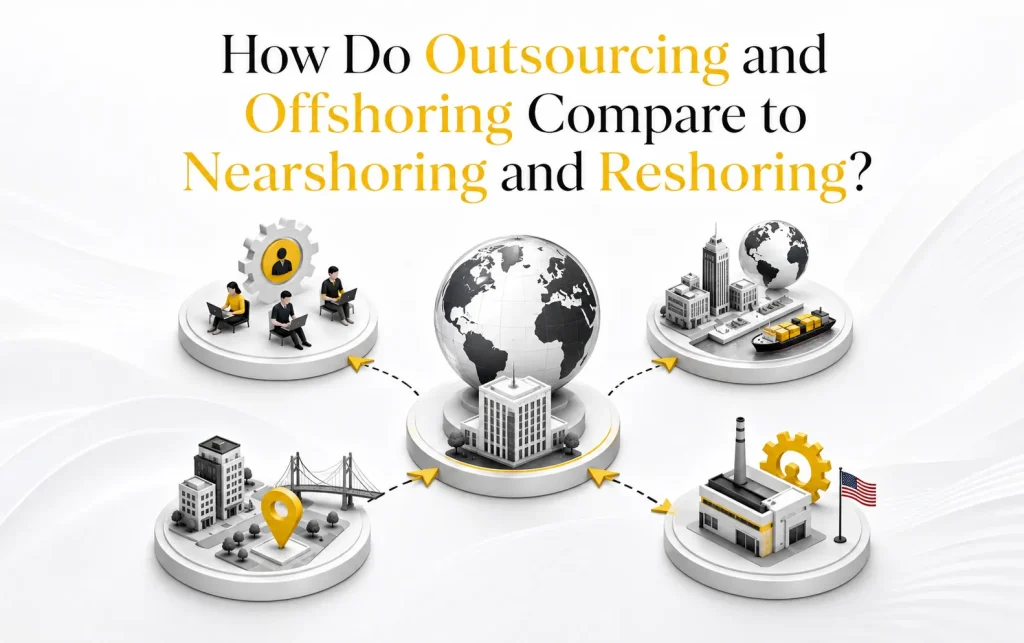
The comparison of outsourcing, offshoring, nearshoring, and reshoring is presented in the table below.
| Model | Definition | Location | Control | Cost | Best For |
|---|---|---|---|---|---|
| Outsourcing | Delegating tasks to an external third party | Domestic or international | Low — vendor-managed | Variable, pay-per-use | Non-core tasks, SMBs, temporary projects |
| Offshoring | Relocating operations to a foreign country | Must be international (distant) | High — company-managed | Fixed, long-term investment | Cost reduction, quality-sensitive, long-term functions |
| Nearshoring | Relocating operations to a nearby or same-region country | International but geographically close | High to moderate | Moderate | Time-zone-sensitive collaboration, cultural alignment |
| Reshoring | Bringing operations back to the home country | Domestic | High — fully internal | Higher labor cost, lower risk | Supply chain resilience, IP protection, regulatory compliance |
What Is Nearshoring and How Does It Differ from Offshoring?
The difference between nearshoring and offshoring is that nearshoring relocates business operations to a nearby country within the same region or time zone, while offshoring moves operations to a distant country, often to achieve significantly larger labor cost reductions.
A US company using a software development team in Mexico or Colombia is nearshoring; moving the same team to India or the Philippines is offshoring. Nearshoring sacrifices some of the cost savings of distant offshoring in exchange for time-zone alignment, cultural proximity, and easier travel for in-person collaboration. Nearshoring is also different from reshoring, which involves returning operations to the company’s home country entirely.
What Is Reshoring and Why Is It Gaining Momentum?
Reshoring is the practice of bringing manufacturing and production operations back to a company’s home country, representing the direct reversal of offshoring. Companies are reshoring because they want more resilient supply chains, fewer shipping delays, lower geopolitical risks, and stronger intellectual property protection, concerns that became acute after supply chain disruptions in 2020 and 2021.
The US CHIPS and Science Act (2022) allocated approximately $53 billion to encourage domestic semiconductor production, signaling a government-level commitment to reshoring critical manufacturing. Reshoring differs from outsourcing because the work returns to the company’s own domestic operations rather than moving to a third party. It differs from offshoring because the geographic direction is reversed, bringing operations home rather than sending them abroad. To choose between outsourcing, offshoring, and reshoring, businesses must weigh cost savings against supply chain resilience, geopolitical exposure, and long-term strategic control.