

Most Amazon sellers hand their VA a software license the same way they handed over their first spreadsheet: quickly, without thinking through what the person actually needs to accomplish. Six months later, they either pay for a Diamond subscription so a part-time assistant can run basic product lookups, or they discover their VA cannot complete a core task because the tool simply does not support it.
This happens because sellers evaluate tools by checking review scores and feature lists. The right question is more specific. Which platform handles the tasks your VA executes during an 8-hour shift without requiring them to export CSVs, switch tabs, or rebuild data manually in a spreadsheet?
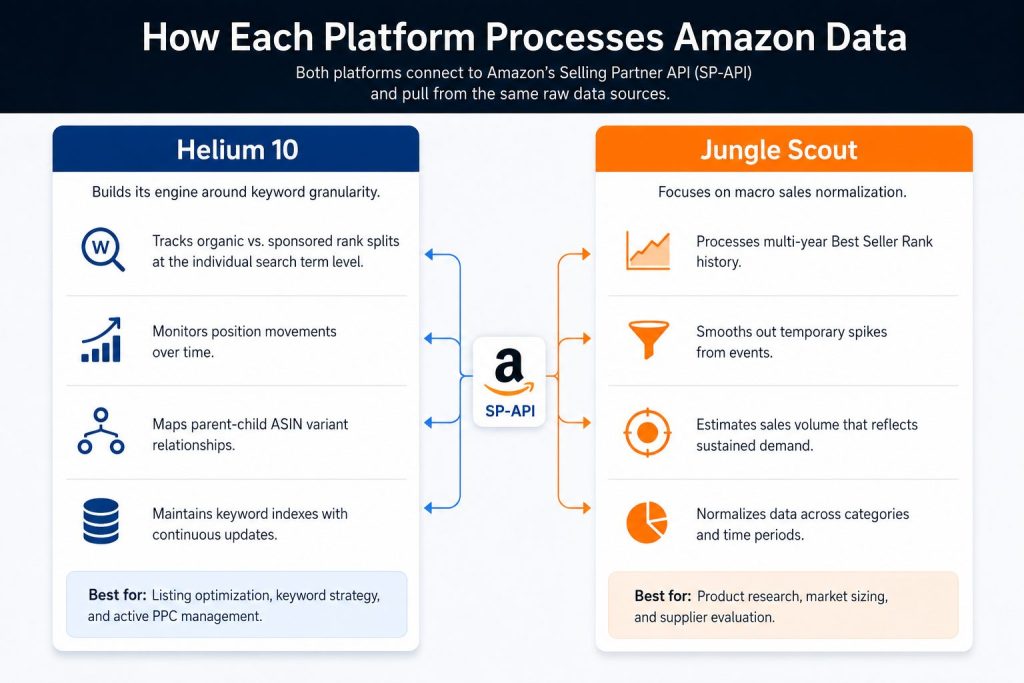
Helium 10 and Jungle Scout both connect to Amazon’s Selling Partner API (SP-API) and pull from the same raw data sources. What differs entirely is how each platform processes that data and which daily workflows it supports without operational friction.
How Each Platform Processes Amazon Data
The raw data entering both systems is identical. The processing architecture behind them is not.
Helium 10 builds its engine around keyword granularity. It tracks organic versus sponsored rank splits at the individual search term level, monitors position movements over time, and maps parent-child ASIN variant relationships within keyword indexes. That architecture directly supports a VA who spends most of their shift on listing optimization, keyword strategy, and active PPC management.
Jungle Scout’s AccuSales engine focuses on macro sales normalization. It processes multi-year Best Seller Rank history and smooths out temporary spikes caused by lightning deals, out-of-stock competitors, or viral social media moments. The result is a sales volume estimate that reflects genuine sustained demand rather than an anomalous two-week surge. That architecture suits a VA focused on product research, market sizing, and supplier evaluation.
Both approaches solve real problems. Which one your VA benefits from depends entirely on what they actually do each day.
Product Research: Where Jungle Scout’s Accuracy Matters
Helium 10: Black Box and Trendster
Black Box is Helium 10’s product research engine. A VA builds a query using multi-attribute filters: monthly revenue floors, review count ceilings, specific phrases in the title, BSR ranges within a category. Black Box returns every ASIN matching those parameters.
The limitation is temporal. Black Box captures demand at a single point in time. A product showing $28,000 in monthly revenue could reflect two years of stable sales or a six-week spike from a trending post. To distinguish between the two, the VA must manually open Trendster to overlay Google Trends data alongside historical performance. The combination works. It also adds steps to every product evaluation, which compounds when a VA works through large lists.
Jungle Scout: Opportunity Finder and AccuSales
Jungle Scout’s Opportunity Finder groups individual products into consumer niches and assigns each niche a score built from demand level, competition intensity, and average listing quality. The AccuSales engine normalizes that data across multi-year BSR windows, filtering out anomalous spikes from temporary events.
A VA evaluating fifteen product categories in a single morning can scan niche scores and reach reliable conclusions without building custom filter queries for each one. The demand estimates reflect actual sustained demand because the engine was built specifically around accuracy over time rather than precision at a snapshot.
Product research verdict: Jungle Scout wins for speed and discovery. Its niche scoring and AccuSales smoothing produce faster, more reliable outputs for market validation. Helium 10 remains the stronger choice only when a VA requires hyper-precise, custom multi-parameter filter extractions.
Keyword Research: The Largest Functional Gap
This is where the operational difference between the two platforms becomes most consequential for a VA managing an active storefront.
Helium 10: Cerebro, Magnet, and Frankenstein
Cerebro performs reverse ASIN lookups and processes up to ten competing ASINs simultaneously in a single query. It returns every keyword those listings rank for, along with organic rank position, sponsored rank position, monthly search volume, and the Cerebro IQ Score, which weights volume against competition intensity. The VA can then filter specifically for keyword gaps: search terms where multiple top competitors rank in the top fifteen organically but the client’s listing does not appear at all.
That multi-ASIN analysis in a single query forms the backbone of a serious keyword strategy session. It is the capability Jungle Scout cannot replicate natively.
Magnet handles forward keyword discovery from seed terms. Frankenstein then processes the raw output, removing duplicate strings, stripping forbidden brand names, and cleaning tracking characters, so the final keyword list goes straight into listing copy without a cleanup pass.
Jungle Scout: Keyword Scout
Keyword Scout performs reverse ASIN lookups and forward research from a clean, single interface showing two years of historical search volume. That historical window helps a VA distinguish growing search terms from declining ones, which is genuinely useful context when building a keyword strategy.
The operational constraint is sequential processing. Keyword Scout handles one ASIN at a time. A VA who needs to compare keyword profiles across eight top competitors must run eight separate lookups, export eight CSV files, and manually combine them in a spreadsheet. What Cerebro completes in a single query translates into hours of administrative data assembly in Jungle Scout.
Keyword research verdict: Helium 10 wins clearly. For a VA running keyword strategy on active listings, Helium 10 eliminates the manual export and merge work that quietly eats up hours of a VA’s week.
Listing Optimization: Precision vs. Speed
Helium 10: Scribbles
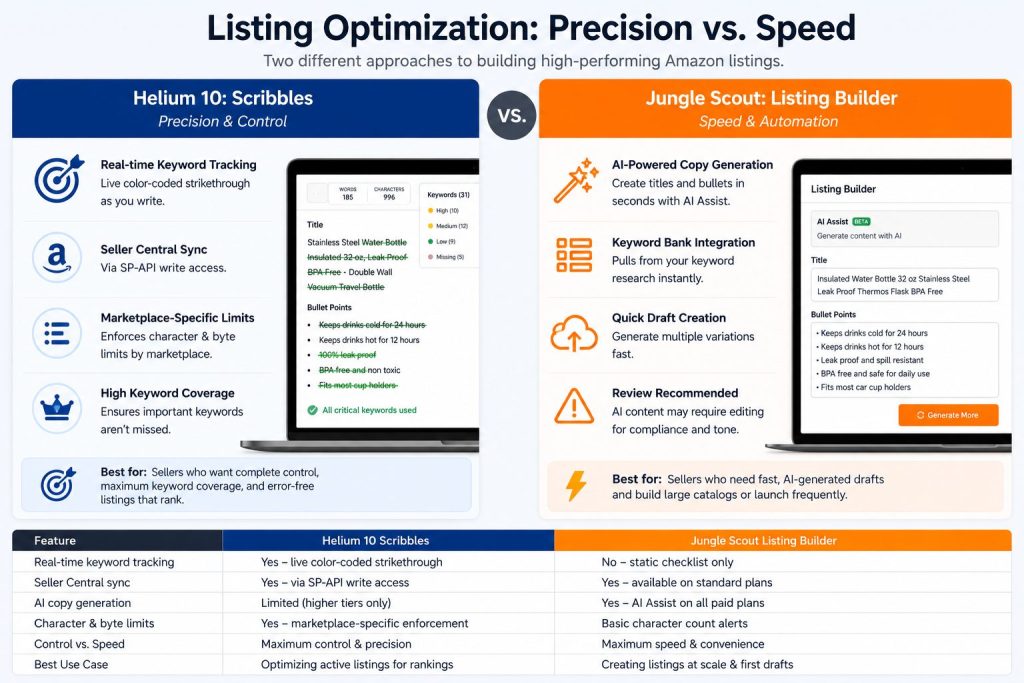
Scribbles prevents high-value keywords from being accidentally omitted from listing copy. As a VA writes the title, bullet points, and description, Scribbles strikes each keyword from the target list in real time. Keywords are color-coded by search volume so the VA sees at a glance which high-priority terms are confirmed and which still need placement. The tool also enforces marketplace-specific character and byte limits, catching copy that would get truncated on upload to Amazon Seller Central before it becomes a problem.
Nothing slips through unnoticed. That precision has a direct impact on organic indexing.
Jungle Scout: Listing Builder with AI Assist
Jungle Scout’s Listing Builder connects to a keyword bank and uses a native AI Assist integration, powered by OpenAI, to generate title and bullet point drafts within seconds. For agencies or brands building listings at high volume, that automation delivers a usable first draft immediately.
The practical risk is review burden. AI-generated Amazon copy tends toward generic phrasing and occasionally produces language that conflicts with Amazon’s restricted terms policy. A VA still needs to read, edit, and verify every line before publishing, which erodes a significant portion of the time saved on the initial generation.
| Optimization Feature | Helium 10 Scribbles | Jungle Scout Listing Builder |
|---|---|---|
| Real-time keyword tracking | Live color-coded strikethrough | Static checklist validation |
| Seller Central sync | Yes, via SP-API write access | Yes, available on standard plans |
| AI copy generation | Restricted to higher tiers | Native via AI Assist across plans |
| Character and byte limits | Marketplace-specific enforcement | Generic length alerts |
Listing optimization verdict: Helium 10 for precision on active listings. Jungle Scout for speed when launching large catalogs at volume.
PPC Management: Reporting vs. Active Optimization
Earlier comparisons of these platforms incorrectly claimed Jungle Scout has no advertising functionality. It does. The distinction lies in execution depth, and getting that distinction right matters for anyone making a purchasing decision.
Jungle Scout: Advertising Analytics
Jungle Scout’s Advertising Analytics dashboard connects to Amazon Advertising via SP-API and pulls campaign data across Seller Central and Vendor Central accounts. It maps ad spend alongside organic revenue to calculate TACoS (Total Advertising Cost of Sale), which measures advertising investment as a proportion of total store revenue rather than only ad-attributed sales. A high ACoS paired with a low TACoS often signals that advertising drives meaningful organic ranking lift, a distinction that changes how a VA should interpret campaign performance. Jungle Scout displays this metric clearly and provides basic rule-based budget suggestions based on performance patterns.
What it lacks is execution depth. A VA who needs to harvest keywords, move non-converting search terms to negative exact match lists, or schedule dayparted bid adjustments must execute those steps manually inside Amazon Campaign Manager.
Helium 10: Adtomic
Adtomic actively manages and optimizes campaigns through conditional automation rules rather than just reporting on them. A VA configures logic directly inside the platform: if a search term spends above a defined threshold without generating a conversion, Adtomic automatically moves it to a negative exact match list. When a broad or phrase match term reaches consistent profitability, the system graduates it into its own exact match campaign through automated keyword harvesting.
Adtomic also supports dayparting natively. A VA schedules higher bids during peak shopping hours and lower bids overnight. The system handles those adjustments automatically, eliminating a daily manual task while reducing wasted spend.
The core distinction: Jungle Scout reports on PPC performance. Adtomic manages and optimizes it. For a VA running large or complex advertising accounts, that gap shows up in ACoS reduction every single month.
PPC management verdict: Helium 10 for active campaign execution and automation. Jungle Scout for TACoS visibility and performance reporting.
Supplier Research: Jungle Scout’s Clearest Advantage
This is the one category where the verdict fully reverses, and business owners who dismiss Jungle Scout for sourcing cycles pay for that decision.
Jungle Scout: Supplier Database
Jungle Scout’s Supplier Database pulls directly from verified global customs manifests and maritime shipping bill records, not from easily manipulated online directories. A VA drops a competitor’s ASIN into the tool and the platform returns the actual factories that manufactured and shipped those units to Amazon fulfillment centers. The results include verified shipment volume history, the factory’s client concentration, and direct contact details.
That level of transparency changes the quality of sourcing decisions in a way Alibaba searches cannot match. A VA who identifies a manufacturer through customs manifest data knows the factory has a verifiable track record of shipping to FBA operations at scale. A VA who finds a supplier through an Alibaba listing knows only that someone created a profile.
Helium 10
Helium 10 does not have a supplier research tool with this capability. Its Chrome extension overlays basic Alibaba supplier profiles when a VA browses Amazon product pages, providing rough pricing benchmarks but no shipment verification and no competitor factory tracing.
Supplier research verdict: Jungle Scout wins decisively. For sourcing, sample procurement, and factory vetting, the Supplier Database is genuinely unmatched.
Listing Protection: Buy Box and Hijacker Monitoring
This task appears in Amazon VA job descriptions regularly and rarely receives adequate coverage in tool comparisons.
Helium 10’s Alerts tool monitors live listings around the clock and notifies a VA when specific events occur: a new seller joins a listing (a potential ASIN hijacker), a Buy Box ownership change happens, a listing gets suppressed by Amazon, a negative review posts, or product images change without authorization. Managing a catalog of 20 or more ASINs manually every day is not realistic. Alerts makes that monitoring systematic and closes the window where a hijacker captures Buy Box share for 48 hours before anyone notices.
Jungle Scout provides listing change notifications covering price shifts and Buy Box changes effectively. It does not match Helium 10’s depth on suppression detection and content change tracking.
A VA who catches an ASIN hijacking attempt within hours can escalate a case to Amazon Seller Support and protect the listing before significant revenue transfers to an unauthorized seller.
Listing protection verdict: Helium 10 wins on breadth.
Financial Tracking and Inventory Management
Helium 10: Profits and Refund Genie
Helium 10’s Profits dashboard tracks gross margin by factoring in COGS inputs, FBA storage fees, referral fees, return processing costs, and inbound shipping charges. A VA updates product cost fields directly and sees accurate per-ASIN profitability rather than gross revenue figures.
Refund Genie adds a capital recovery function no other tool in either platform replicates. Amazon loses and damages inventory inside fulfillment centers regularly without automatically issuing reimbursement. Refund Genie scans inventory history, identifies those cases, and generates structured reports a VA submits as reimbursement requests inside Amazon Seller Central. Active sellers who run this process monthly consistently recover capital that would otherwise go unnoticed and unclaimed.
Jungle Scout: Sales Analytics and Inventory Manager
Jungle Scout’s Sales Analytics covers the same financial overview with a cleaner interface. Its Inventory Manager calculates a rolling demand average and generates a days-of-supply figure for each SKU, flagging products approaching a stockout before it disrupts sales velocity. That predictive reorder system is straightforward to operate without any financial expertise.
Both tools handle financial tracking competently. Helium 10’s Refund Genie adds a recovery function Jungle Scout does not match.
User Access, Security, and VA Onboarding
Sharing a primary account login with a remote assistant is a genuine security risk. It exposes payout details, credit card information, and sensitive financial logs to a third party without access controls. If the working relationship ends, revoking access requires a full password reset that disrupts every connected API integration simultaneously.
Helium 10: Updated Access Structure
Helium 10’s baseline Platinum plan now includes two user seats (one primary account plus one additional user). This means a business owner can give a single VA their own secure login without sharing master credentials and without upgrading to Diamond.
The important distinction is what Diamond actually unlocks: granular permission partitioning. If a business owner wants to give a VA access to keyword and listing tools while completely blocking visibility into the Profits financial dashboard, payout data, and account financials, Diamond tier is required. For most single-VA setups where full access is acceptable, Platinum covers the need.
Jungle Scout: Seat Allocation
Jungle Scout handles multi-user access cost-effectively. The Growth Accelerator plan allows seat additions at a modest monthly increment. The Brand Owner tier includes ten user seats natively, making it straightforward to scale a remote team without per-seat cost calculations at each addition.
Training Resources
| Training Feature | Helium 10 Freedom Ticket | Jungle Scout Academy |
|---|---|---|
| Amazon FBA strategy depth | Comprehensive, multi-module | Platform navigation only |
| Onboarding timeline | 30 to 60 days | 5 to 7 days |
| Course creator | Kevin King | Jungle Scout internal team |
| Included in plan | Yes, Platinum and above | Yes, all plans |
Helium 10 includes Freedom Ticket with paid subscriptions. Kevin King built this as a structured multi-module Amazon FBA program covering both platform mechanics and broader marketplace strategy. A new VA who works through Freedom Ticket builds Amazon knowledge alongside tool proficiency simultaneously, which reduces the direct training time a business owner needs to invest.
Jungle Scout’s Academy covers platform navigation well through short tutorial videos. It gets a VA productive with the software faster. It does not build the same depth of foundational marketplace knowledge.
2026 Pricing
Helium 10 retired its Starter plan at the beginning of 2026. The base tier is now Platinum. Jungle Scout updated its plan structure under the Catalyst pricing framework. Both platforms adjust pricing based on promotional cycles and annual versus monthly billing. Confirm current rates on each platform before committing.
| Plan Level | Helium 10 | Jungle Scout Catalyst | Primary Use Case |
|---|---|---|---|
| Entry | Discontinued | Starter ~$29/mo annual | Basic product validation and Chrome extension research |
| Standard | Platinum ~$99/mo annual | Growth Accelerator ~$49/mo annual | Full keyword tools, listing optimization, 2 users (H10) / 1 user + seat additions (JS) |
| Advanced | Diamond ~$279/mo annual | Brand Owner + CI ~$299/mo annual | Granular permission partitioning (H10) / 10 user seats + full feature access (JS) |
At the advanced tier, the platforms approach price parity. Jungle Scout’s Brand Owner plan includes ten user seats natively, which makes it highly cost-effective for agencies or sellers running multiple VAs. Helium 10’s Diamond tier at a comparable price point focuses its value on permission granularity and Adtomic’s advanced PPC automation rather than seat volume.
The Verdict
The right platform matches the role. There is no universal answer.
Choose Helium 10 if your VA manages a live storefront day to day. If their 8-hour shift covers monitoring keyword ranks, auditing listings, running multi-ASIN competitor gap analyses, managing PPC campaigns, and watching for listing hijackers and Buy Box threats, Helium 10 provides the connected toolset for all of it without requiring manual data assembly. Cerebro’s multi-ASIN queries, Scribbles’ real-time keyword tracking, Adtomic’s automated rules, and Alerts’ catalog monitoring cover the full daily workflow of an active store management VA.
Choose Jungle Scout if your VA focuses on product discovery and sourcing. If their primary work involves evaluating new product opportunities using AccuSales-normalized data, verifying manufacturers through customs manifest records, and managing inventory reorder cycles, Jungle Scout is the stronger platform. It also onboards a new VA faster when speed of deployment matters.
The hybrid setup that works best for a scaling operation: Helium 10 Platinum or Diamond as the operational engine for daily store management, alongside a Jungle Scout Starter or Growth Accelerator subscription kept active specifically for supplier research and product discovery cycles. That combination covers every task without paying for duplicated features.
If you can only choose one and your VA manages an active store, Helium 10 handles more of the daily work.
Frequently Asked Questions
Can a VA run a multi-ASIN keyword gap analysis in Jungle Scout?
No. Jungle Scout’s Keyword Scout processes ASIN records one at a time. It does not support the simultaneous multi-ASIN reverse lookups that Helium 10’s Cerebro executes in a single query. A VA who needs to compare keyword profiles across five to ten competitors uses Cerebro or manually exports and merges individual CSV files, which adds significant administrative time to the weekly workflow.
Does a business owner need to upgrade to Diamond just to give a VA their own login?
No. Helium 10’s Platinum plan now includes two user seats, one primary and one additional. A single VA can receive their own secure login on Platinum without sharing master credentials. Upgrading to Diamond becomes necessary only when the business owner needs granular permission controls, such as blocking VA access to financial dashboards and payout data while keeping keyword and listing tools accessible.
What is TACoS and which platform tracks it better?
TACoS stands for Total Advertising Cost of Sale. It measures advertising spend as a percentage of total store revenue, not just ad-attributed sales. A high ACoS paired with a low TACoS often indicates that paid advertising drives significant organic ranking lift. Jungle Scout’s Advertising Analytics dashboard displays TACoS as a primary metric. Helium 10 calculates it across the combination of Adtomic and Profits.
Does Jungle Scout offer automated PPC optimization rules?
No. Jungle Scout’s Advertising Analytics dashboard tracks campaign performance, spend, ACoS, and TACoS and provides basic rule-based budget recommendations. It does not support automated keyword harvest rules, dayparting scheduling, or multi-campaign bid automation. Those capabilities belong to Helium 10’s Adtomic platform.
Is Refund Genie worth running monthly for a VA?
Yes. Amazon loses and damages inventory inside fulfillment centers more frequently than most sellers track. Refund Genie identifies those cases and generates structured reports a VA submits as reimbursement requests in Amazon Seller Central. The process takes under an hour and consistently recovers unclaimed capital. Instruct the VA to verify each case manually before submitting to avoid filing duplicate claims.
Which platform gets a new VA productive faster?
Jungle Scout’s Academy gets a VA comfortable with the software interface within a week. Helium 10’s Freedom Ticket course takes 30 to 60 days to complete but builds deeper foundational Amazon knowledge alongside tool proficiency. For a VA with no prior Amazon experience, Freedom Ticket significantly reduces the direct training time the business owner needs to invest during the first two months.