
Back-office outsourcing basically refers to hiring a third-party provider to handle a business’s non-client-facing functions. Services commonly outsourced include data entry and document processing, accounting and bookkeeping, payroll, HR and recruitment administration, IT support, and order processing. The main benefits include lower operating costs, reduced technology spend, access to specialized talent, scalability, round-the-clock coverage, fewer payroll errors, and more time for core revenue work.
Costs of back-office outsourcing typically run $500 to $2,500 per month for small-to-medium businesses, with hourly rates generally falling between $7 and $25 depending on the function and provider location. The main risks of back-office outsourcing are data security exposure, quality drift, reduced day-to-day control, communication barriers, and compliance exposure, all of which are manageable with the right contract and provider.
What Is Back-Office Outsourcing?
Back-office outsourcing is the practice of hiring a third-party provider to handle a company’s internal, non-client-facing administrative and operational work rather than staffing it in-house. The provider takes on tasks like payroll, bookkeeping, data entry, and IT support, freeing internal staff to focus on work that touches customers or drives revenue directly.
It’s a subset of business process outsourcing (BPO), which covers both back-office functions and front-office ones. Front-office work involves direct customer contact, such as sales or support, while back-office work keeps operations running without customers ever seeing it.
Because back-office functions don’t generate revenue on their own, businesses typically treat the back office as a cost center, meaning the goal is to run it as efficiently and cheaply as possible without compromising accuracy, which is exactly the trade-off outsourcing is built to address.
What Counts as a Back-Office Operation?
Functions that qualify as a back-office operation are administrative, transactional, and regulatory tasks that never involve direct customer contact. Common examples include payroll, bookkeeping, data entry, HR administration, IT support, and compliance reporting. Work that keeps the business running internally rather than facing outward. The qualifying test for whether a function belongs in the back office comes down to three traits: it’s high-volume, it follows consistent rules rather than case-by-case judgment, and it can be documented into a repeatable process. Back-office services that meet all three tend to be the easiest and lowest-risk functions to hand off to an outside provider.
What Back-Office Services Can You Outsource?
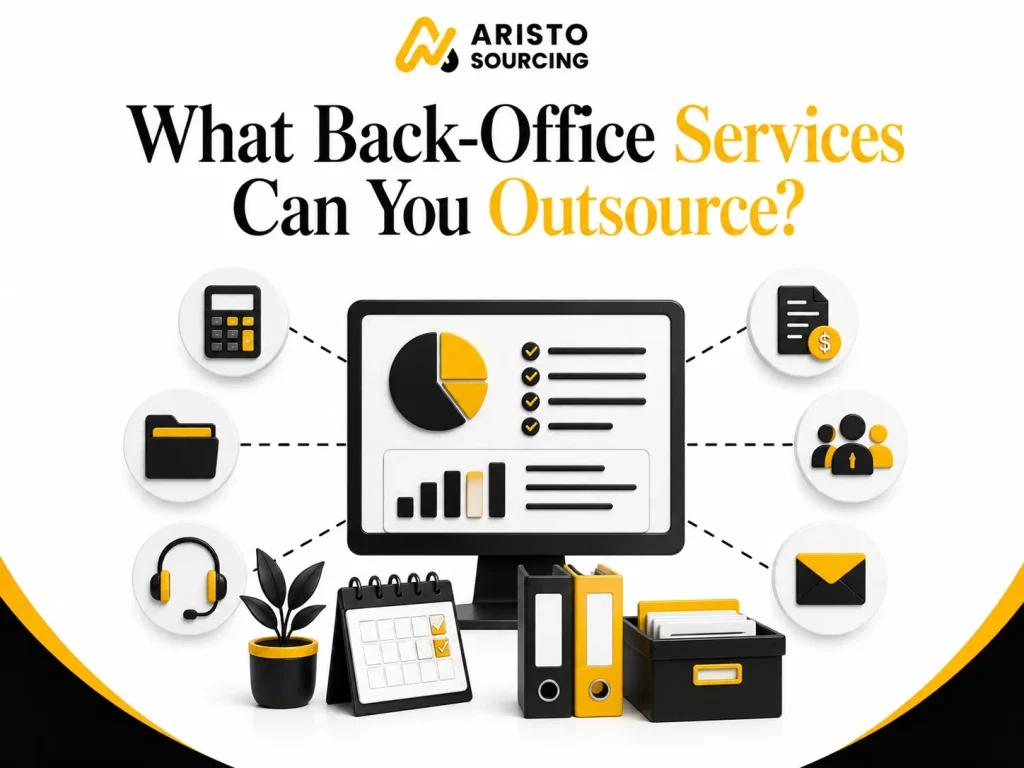
Back-office services that you can outsource include data entry and document processing, accounting, bookkeeping, tax preparation, payroll processing, human resources and recruitment administration, IT support, help desk, and order processing and logistics support.
Back-office services that you can outsource are listed below.
- Data Entry and Document Processing
- Accounting, Bookkeeping, and Tax Preparation
- Payroll Processing
- Human Resources and Recruitment Administration
- IT Support and Help Desk
- Order Processing and Logistics Support
1. Data Entry and Document Processing
Data entry and document processing covers the day-to-day work of getting information out of raw documents and into a business’s systems accurately. It typically includes transcribing handwritten or scanned documents, entering claims, invoices, and product data, digitizing paper records, and maintaining document management systems.
Businesses hand over high-volume tasks like invoice entry, form processing, and database updates, keeping only the exceptions that need judgment in-house. This is one of the easiest back-office tasks to outsource, since it’s high-volume, rules-based, and easy to measure for accuracy. Many businesses outsource back-office support to a dedicated remote team for this function first.
2. Accounting, Bookkeeping, and Tax Preparation
Accounting, bookkeeping, and tax preparation covers the recurring financial recordkeeping and filing work that every business needs regardless of size. Day-to-day, it includes reconciling bank statements, categorizing transactions, managing accounts payable and receivable, and preparing the documentation needed for tax filings.
Companies hand over routine bookkeeping and reconciliation work while keeping strategic financial decisions and final sign-off in-house. It suits outsourcing well because the underlying processes- reconciliation, categorization, filing— follow consistent rules and standards that a remote provider can be trained on and audited against.
3. Payroll Processing
Payroll processing covers calculating and distributing employee pay along with the tax withholdings and filings that go with it. Day-to-day, it includes running pay cycles, calculating overtime and deductions, filing payroll taxes, and keeping records current as employees join, leave, or change status.
Firms hand over the full processing cycle to a provider while retaining approval authority over the final numbers before disbursement. It suits outsourcing because errors here are costly and the rules, tax rates, filing deadlines, and deduction formulas are well defined and consistent enough for a specialized provider to manage reliably.
4. Human Resources and Recruitment Administration
Human resources and recruitment administration covers the paperwork and process side of managing a workforce, separate from strategic HR decisions. Day-to-day, it includes onboarding paperwork, benefits administration, maintaining employee records, screening resumes, and scheduling interviews.
Organizations commonly delegate over the administrative load, data entry, scheduling, and first-pass resume screening, while keeping hiring decisions and culture-setting work internal. It suits outsourcing because most of this work is process-driven and repeats in a predictable pattern from one hire or one pay period to the next.
5. IT Support and Help Desk
IT support and help desk covers the technical troubleshooting and system maintenance that keeps a business’s technology running day to day. It typically includes responding to help desk tickets, resetting passwords, managing software updates, and handling routine hardware or network issues.
Businesses transfer first- and second-line support tickets while keeping strategic IT planning and security architecture decisions in-house. It suits outsourcing particularly well because ticket volume is easy to measure and a provider can offer round-the-clock coverage that would be expensive to staff internally.
6. Order Processing and Logistics Support
Order processing and logistics support tasks cover the operational steps between a customer placing an order and that order being fulfilled. Day-to-day, it includes order entry, inventory updates, shipment tracking, returns processing, and coordinating with carriers or warehouses.
Businesses tend to assign the transactional volume of order entry and tracking updates while keeping supplier negotiations and inventory strategy in-house. It suits outsourcing because order volume tends to be high, the steps are standardized, and providers can scale capacity up or down with demand more easily than an internal team can.
Which Back-Office Tasks Should You Outsource First?
Back‑office tasks you should outsource first include the ones that are high‑volume, rules‑based, and already well documented, such as data entry or routine bookkeeping, rather than in‑house strategic or compliance‑driven work. Low-risk functions like these go before anything regulated or judgment-heavy because the provider can be trained against a clear, testable process, and any errors are easy to catch and correct without exposing the business to compliance or strategic risk.
Once that first function stabilizes and the provider has proven reliable on it, a business can expand into more complex or sensitive functions with more confidence, rather than handing off several unproven functions at once.
Which Back-Office Tasks Should Stay In-House?
Back-office tasks that should stay in-house include judgment-heavy or strategy-setting work that doesn’t reduce to a repeatable rule set. Functions tied directly to competitive advantage, proprietary processes, strategic financial planning, and key vendor negotiations are worth keeping internal.
Their value depends on control and institutional knowledge that’s hard to hand off cleanly, all clear signs of work that belongs in‑house.on control and institutional knowledge that’s hard to hand off cleanly. The same goes for any process that’s undocumented or changes constantly, since a provider can’t be trained reliably against a moving target, and the churn of retraining tends to outweigh any savings from outsourcing it too early.
What Are the Signs Your Business Is Ready to Outsource?
Signs that your business is ready to outsource are listed below.
- Admin workload growing faster than headcount: The volume of back-office work is increasing month over month, but hiring hasn’t kept pace, leaving the same team stretched across more transactions than before.
- Senior staff stuck on low-value operations: Experienced employees are spending hours on data entry or paperwork instead of the higher-value work they were hired for, which is a costly use of their time.
- Errors or backlogs showing up in payroll, billing, or records: Mistakes or delays are starting to surface in routine processes, a sign that current capacity can’t keep up with accuracy standards.
- Hiring cost or talent shortage blocking an in-house fix: Local hiring for the role is slow, expensive, or simply unavailable, making outsourcing a more beneficial route to capacity than continuing to search for an in-house hire.
What Are the Benefits of Back-Office Outsourcing?
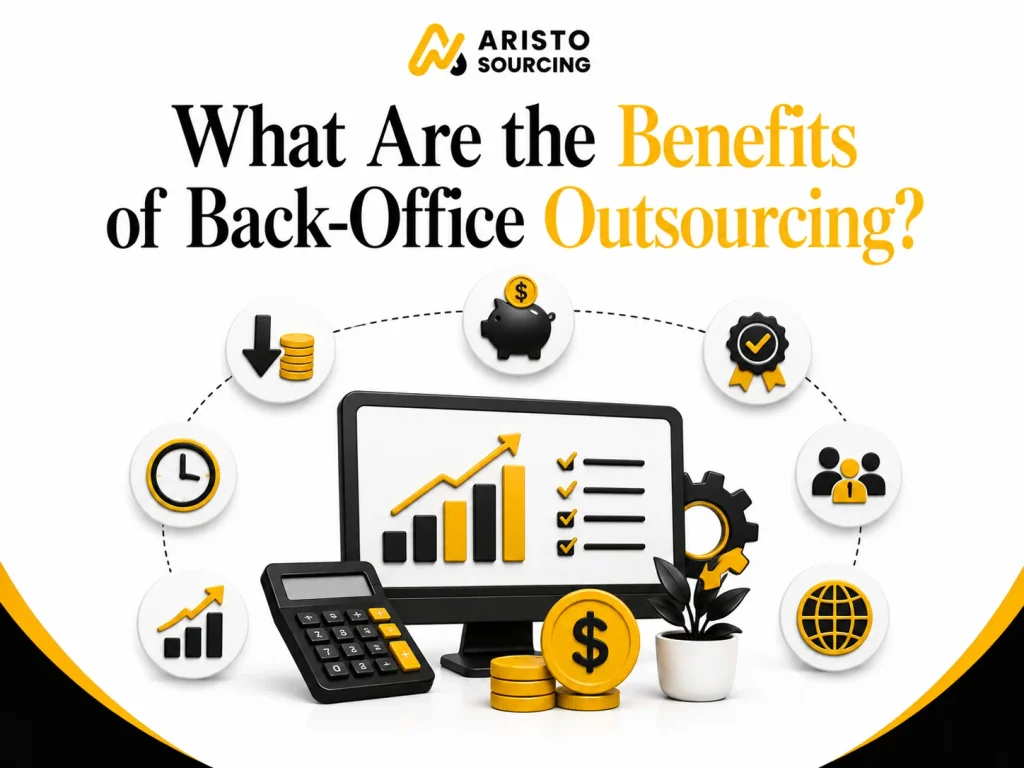
The benefits of back-office outsourcing include lower costs, reduced technology spend, access to specialized talent, scalability, extended coverage, fewer errors, and sharper focus on revenue-generating work.
The benefits of back-office outsourcing are listed below.
- Lower Operating and Labor Costs
- Reduced Technology and Infrastructure Spend
- Access to Specialized Talent Without Recruiting
- Scalability During Demand Swings
- Round-the-Clock Time-Zone Coverage
- Fewer Costly Payroll and Tax Errors
- Full Focus on Core Revenue Activities
1. Lower Operating and Labor Costs
Lower operating and labor costs are the most immediate benefit, since outsourcing converts a fixed salary, benefits, and overhead package into a variable cost tied to actual work performed. From a business standpoint, this entails no recruiting costs, no benefits obligations, and no office overhead for the outsourced role, only the agreed rate for output delivered.
The cost of back-office outsourcing for standardized, high-volume functions like data entry can run significantly lower than staffing the same role in-house, with some offshore arrangements delivering savings toward the higher end of that range for the most repetitive processes.
2. Reduced Technology and Infrastructure Spend
Reduced technology and infrastructure spend comes from the provider supplying its own software licenses, hardware, and office infrastructure rather than the client purchasing them separately.
In business terms, this means avoiding the upfront and recurring costs of specialized accounting software, payroll systems, or IT ticketing platforms that an in-house team would otherwise need. A provider that already runs these systems across multiple clients spreads that infrastructure cost, so the client only pays for access rather than ownership.
3. Access to Specialized Talent Without Recruiting
Access to specialized talent without recruiting means a business can tap into skills, advanced bookkeeping, specific payroll compliance knowledge, and technical IT support without running its own hiring process for each one.
This means shortening the time between identifying a need and having someone qualified doing the work, since the provider already has vetted staff with the relevant experience. It also removes the risk of a bad local hire, since providers typically offer a replacement if a placement doesn’t work out.
4. Scalability During Demand Swings
Scalability during demand swings means a business can add or reduce back-office capacity as workload changes, rather than being locked into a fixed headcount.
Operationally, this translates to handling seasonal spikes, tax season, holiday order volume, and year-end reporting without a permanent hiring and layoff cycle for each swing. Outsourced capacity can typically flex up or down within a contract’s terms far faster than internal hiring or termination processes allow.
5. Round-the-Clock Time-Zone Coverage
Round-the-clock time-zone coverage comes from placing outsourced staff in different time zones, so back-office work continues outside the client’s normal business hours. For a business, this means faster turnaround on tasks like data entry or IT ticket resolution, since work can be processed overnight and be ready by the start of the next business day. This is a common reason businesses source back-office staff from regions like the Philippines or South Africa, which offer meaningful overlap with Western business hours while extending coverage beyond them.
6. Fewer Costly Payroll and Tax Errors
Fewer costly payroll and tax errors result from working with a provider whose staff specialize in payroll rules, filing deadlines, and withholding calculations rather than handling payroll as one task among many.
From a corporate perspective, this represents fewer compliance penalties and correction cycles, since specialists are less likely to miss a filing deadline or miscalculate a deduction than a generalist handling payroll alongside other responsibilities. Consistency here compounds; one missed deadline or miscalculation can trigger penalties that outweigh months of the savings outsourcing was meant to deliver.
7. Full Focus on Core Revenue Activities
Full focus on core revenue activities means internal staff and leadership spend their time on the work that actually grows the business, rather than administrative processing.
Meaning that senior staff previously stuck on data entry or paperwork redirect that time toward sales, product, or client relationships, the activities that generate revenue rather than support it. Outsourcing the back office is ultimately a reallocation of attention as much as it is a cost decision.
How Much Does Back-Office Outsourcing Cost?
Back-office outsourcing costs range between $500 and $2,500 per month for small-to-medium businesses, while hourly rates generally range from $7 to $25 for standard services. Pricing varies based on business size, the scope of services outsourced, the provider’s location, and how complex the outsourced function is.
Specialized work like tax preparation or financial reporting sits toward the higher end, while high-volume, standardized tasks like data entry sit toward the lower end. The two most common pricing models are a monthly retainer for ongoing, predictable support and hourly rates for project-based or more flexible outsourcing needs, and many businesses looking to hire a back-office virtual assistant will see both options offered side by side depending on how steady the workload is.
What Does Each Back-Office Function Cost to Outsource?
The cost range of each back-office function is presented in the table below.
| Function | Typical Cost | Source |
|---|---|---|
| Blended back-office support | Around $25/hour | Global Response |
| Outsourced IT support | $9–$25/hour | Unity Communications (2026 pricing) |
| Small business monthly spend | $500–$2,500/month | Global Response |
| Specialized finance work (tax prep, financial reporting) | $500–$1,500/month | Global Response |
These are provider-published estimates rather than independent industry benchmarks, so treat them as a starting range for proper calculation rather than a guaranteed quote; actual pricing will depend on the provider, location, and scope agreed on.
How Are Back-Office Outsourcing Fees Calculated?
Back-office outsourcing fees are calculated based on one of three pricing models, including per FTE, per transaction, or outcome-based, combined with several factors that move the final quote. Per-FTE pricing charges a fixed monthly rate per staff member regardless of exact output, per-transaction pricing charges per unit processed, such as per invoice, claim, or record, and outcome- or project-based pricing ties payment to a defined deliverable rather than time or volume.
What moves the quote within any of these models includes the headcount required, the skill and experience level needed, the length of the contract longer terms typically price lower, and the delivery location, since local labor rates vary significantly by country and region. Locking into a long-term contract purely to get a lower rate can be risky if the provider hasn’t yet proven reliable, so it’s worth confirming quality on a shorter initial term before committing longer.
What Are the Risks of Back-Office Outsourcing?
The risks of back-office outsourcing include exposure to data security issues, declining quality, reduced day-to-day control, communication friction, and compliance gaps.
The risks of back-office outsourcing are listed below.
- Data Security and Privacy Exposure
- Quality Control and Accuracy Drift
- Loss of Day-to-Day Control
- Language and Cultural Barriers
- Compliance and Regulatory Exposure
1. Data Security and Privacy Exposure
Data security and privacy exposure happens when sensitive business or customer data is shared with a third party that has its own systems, staff, and access points outside the client’s direct control. This risk grows with the volume and sensitivity of data changing hands and with how many people at the provider can touch it. Back-office outsourcing agreements manage this risk through an NDA, a confidentiality clause backed by a defined breach-notification process, and an audit right that lets the client review the provider’s security practices directly rather than taking them on faith.
2. Quality Control and Accuracy Drift
Quality control and accuracy drift happens when the standard of work slips gradually after an initial strong start, often as staff turns over or volume increases faster than oversight can keep up. This tends to go unnoticed until errors accumulate into a visible backlog or a client-facing mistake. The control that prevents it is a defined SLA with measurable accuracy targets, paired with a regular reporting cadence so drift shows up in the numbers before it becomes a larger problem.
3. Loss of Day-to-Day Control
Loss of day-to-day control happens because the provider, not the client, directly supervises the people doing the work, which can leave a client feeling one step removed from how tasks actually get done. This is a bigger risk for functions that require frequent judgment calls than for highly standardized ones. A structured onboarding pilot, combined with a clear reporting cadence and a single point of contact on the provider’s side, gives the client enough visibility to catch issues without having to manage staff directly.
4. Language and Cultural Barriers
Language and cultural barriers happen when communication style, tone, or working norms between the client and an offshore or nearshore team don’t fully align, which can slow down feedback or cause instructions to be misread. This risk is highest for functions requiring nuanced written communication or judgment calls that depend on business context. Providers reduce it through staff training on the client’s specific processes and terminology, plus a trial or pilot period that surfaces communication issues before they affect a larger volume of work.
5. Compliance and Regulatory Exposure
Compliance and regulatory exposure happens when outsourced functions like payroll or data handling touch legal requirements the client remains ultimately responsible for, even though a third party is doing the work. This is a particular risk of back-office outsourcing for cross-border engagements, where the provider’s location may have different data-protection or labor rules than the client’s own jurisdiction. The control that prevents it is a contract that names the applicable compliance standards explicitly, backed by regular compliance reporting and an audit right so the client can verify the provider is actually meeting them.
Is Back-Office Outsourcing Worth It for Your Business?
Back-office outsourcing is worth it for your business if your admin workload is outpacing your headcount and the work in question is non-core and high-volume rather than strategic. It’s generally not worth it for very low-volume tasks, where the setup and management overhead outweighs the savings, or for processes that are undocumented or heavily dependent on judgment, since those are harder to hand off reliably to an outside team. Weighing in-house hiring against outsourcing usually comes down to volume, documentation, and how central the function is to the business’s competitive position, the next sections cover how to compare providers and choose the right partner for the functions that do make sense to outsource.
Should You Outsource or Automate Your Back Office?
Whether to outsource or automate your back office depends on the types of tasks being performed rather than being a single either-or decision for the whole department. Outsourcing tends to be the more appropriate choice for tasks that require human judgment, exception handling, specialized expertise, or strategic decision-making, situations where rules alone can’t cover every case that comes up.
Automation is the better choice for work that’s repetitive, predictable, and rule-based, such as data entry, invoice matching, or other routine workflows that follow the same steps every time. Most industries or businesses run both, since automation fits into outsourced operations naturally, an outsourced team often uses automation tools to handle the predictable parts of a function while reserving human attention for the exceptions.
Which Industries Outsource Back-Office Operations?
Industries that outsource back-office operations are listed below.
- Construction: Outsources bookkeeping, payroll, and permit or compliance documentation to keep project-based admin running without a full internal back office.
- Financial services: Outsources data entry, compliance reporting, and transaction processing, often to providers with specific regulatory experience in the sector.
- Asset management: Outsources fund administration, reporting, and reconciliation tasks that are high-volume and follow consistent regulatory formats.
- IT and technology: Outsources help desk support, payroll, and HR administration to stay focused on product development rather than internal operations.
A good partnership in any of these industries tends to come down to the provider having actual experience in that industry’s specific documentation and compliance patterns, not just general back-office capability.
How Do You Choose a Back-Office Outsourcing Provider?
To choose a back-office outsourcing provider, follow the tips listed below.
- Relevant industry experience and references: Ask for references from businesses similar in size and industry, since a provider’s general experience doesn’t always translate to your specific compliance or documentation needs.
- Security and compliance credentials: Verify what data-security certifications or compliance frameworks the provider actually holds, rather than taking security claims at face value.
- Communication cadence and reporting: Confirm how often you’ll get updates and in what format, since a mismatch in reporting frequency is a common source of frustration after signing.
- Contract clarity on scope, SLAs, and exit: Make sure scope, service-level targets, and exit terms are all written into the agreement rather than discussed verbally, since these are the terms disputes tend to center on later.
Choosing a remote staffing partner often means comparing generalist BPOs against smaller, more specialized agencies. Aristo Sourcing, for example, is one such provider that places dedicated remote team members for back‑office and administrative roles rather than running a large call‑center‑style operation.
How Do You Manage an Outsourced Back-Office Team?
You can manage an outsourced back‑office team by relying on the provider to handle day‑to‑day supervision while you focus on outcomes and key performance indicators (KPIs) rather than task‑level oversight. The provider typically manages scheduling, quality checks, and staff issues on their end, while the client supplies one internal point of contact to handle questions, approvals, and escalations rather than spreading communication across multiple people. On top of that, a regular performance reporting and review cycle, weekly or monthly, depending on volume, keeps both sides aligned on how the team is actually performing against the agreed targets.
Which KPIs and SLAs Should You Set for Back-Office Outsourcing?
KPIs and SLAs you should set for back-office outsourcing are listed below.
- Accuracy rate: The percentage of completed work that’s error-free, typically the single most important metric for back-office functions.
- Turnaround time: How long it takes from receiving a task to completing it, measured against an agreed target per function.
- Volume handled: The number of transactions, records, or tickets processed in a given period, used to confirm capacity matches workload.
- Exception and escalation rate: How often work gets flagged as an exception requiring judgment, which signals whether a process is well-suited to outsourcing.
- Availability window: The hours during which the outsourced team is actively working and reachable, particularly important for time-zone-dependent functions.
Which Back-Office Function Should You Outsource Next?
The back-office function you should outsource next is whichever remaining function is the next-highest-volume, best-documented candidate once your first outsourced function has stabilized. The sequencing rule stays the same at every stage: start with one high-volume, well-documented function, prove it out, and only then move to the next one rather than outsourcing several functions at once.
As your organization gains experience, you can gradually outsource additional functions with greater confidence. If you need support in building and managing a capable offshore team, Aristo Sourcing is one option to consider for sourcing experienced back-office professionals. Following this phased approach helps control costs, reduce implementation risks, and maximize the benefits of back-office outsourcing services over time.