
The choice between using an outsourcing agency and hiring an employee directly comes down to more than cost alone, and a third middle option, staff augmentation, gets missed by most guides comparing only these two paths.
This guide covers a quick comparison table, what each option actually involves, real cost figures, the pros and cons of each, when each option fits, and a decision framework to apply against a specific hiring need. Business owners deciding how to add capacity to their operations are the audience here, not job seekers evaluating employment options.
According to SHRM’s Benchmarking Report, the average cost per hire for a non-executive role in the US runs $4,700 to $5,475, before accounting for the productivity gap while a role sits vacant. Getting this decision wrong carries real cost either way: overpaying for a direct hire that didn’t need to be full-time, or mismanaging an outsourcing relationship without the internal process to support it.
Outsourcing Agency vs Hiring Directly: Quick Comparison
The main difference between an outsourcing agency and hiring directly is flexibility and cost versus control and long-term commitment.
| Dimension | Outsourcing Agency | Hiring Directly |
| Speed | Days to weeks to staff | Weeks to months to fill a role |
| Cost | Lower upfront, ongoing fee | Higher upfront, fixed salary and benefits |
| Flexibility | Scale headcount up or down easily | Harder to adjust once hired |
| Control | Shared with the provider | Full, direct day-to-day oversight |
| Culture fit | Looser integration with the team | Deeper alignment over time |
| Loyalty/retention | Provider manages retention | Higher long-term commitment to the business |
| Best for | Variable, non-core, or specialized work | Core, ongoing, strategic roles |
Outsourcing wins on speed and flexibility, since a provider already has vetted talent ready to deploy. Hiring directly wins on control and retention, since an employee answers only to the business and builds institutional knowledge over time. Which option fits depends mainly on how core the work is and how long the need is expected to last.
What Is an Outsourcing Agency?
An outsourcing agency is a third-party provider that supplies talent or takes over an entire business function on a client’s behalf. The vendor typically handles recruiting, payroll, day-to-day management, and replacement if a placement doesn’t work out, removing that administrative burden from the client entirely.
Businesses commonly turn to an outsourcing agency for non-core tasks, specialized skill gaps they can’t easily fill internally, or simply to scale capacity up or down without a full hiring cycle. For the broader concept this model sits within, see the outsourcing pillar page.
What Does Hiring Directly Mean?
Hiring directly means employing someone on the business’s own payroll, under direct management, with full control over how the work gets done. That control comes with cultural integration and institutional knowledge that builds over time, since the employee works exclusively for the business.
It also means carrying every cost an outsourcing agency would otherwise absorb: recruiting, benefits, payroll taxes, equipment, and turnover risk all sit with the employer directly. Hiring directly is essentially insourcing applied at the individual role level.
Is There a Middle Option? Staff Augmentation Explained
The middle option between an agency and a direct hire is staff augmentation, also called outstaffing, which is a model where a provider legally employs the person, handling payroll, compliance, and benefits, while the client directs their daily work as a functioning member of the team.
This arrangement offers the best of both models: a dedicated person the client manages closely, much like a direct hire, without the employer overhead, legal entity setup, or turnover risk that comes with employing someone directly, much like using an agency.
Staff augmentation differs from pure outsourcing, where the vendor owns the outcome and manages the work itself, and from pure hiring, where the client owns every part of the employment relationship. Here, the client owns direction and daily oversight, while the provider owns the employment infrastructure underneath it.
This model fits ongoing roles where a business wants real control over how the work gets done without formally employing the person. Aristo Sourcing operates on exactly this model, placing dedicated offshore virtual assistants that the client directs directly, while Aristo carries the employment relationship itself.
Outsourcing Agency vs Hiring Directly: The Real Cost Comparison
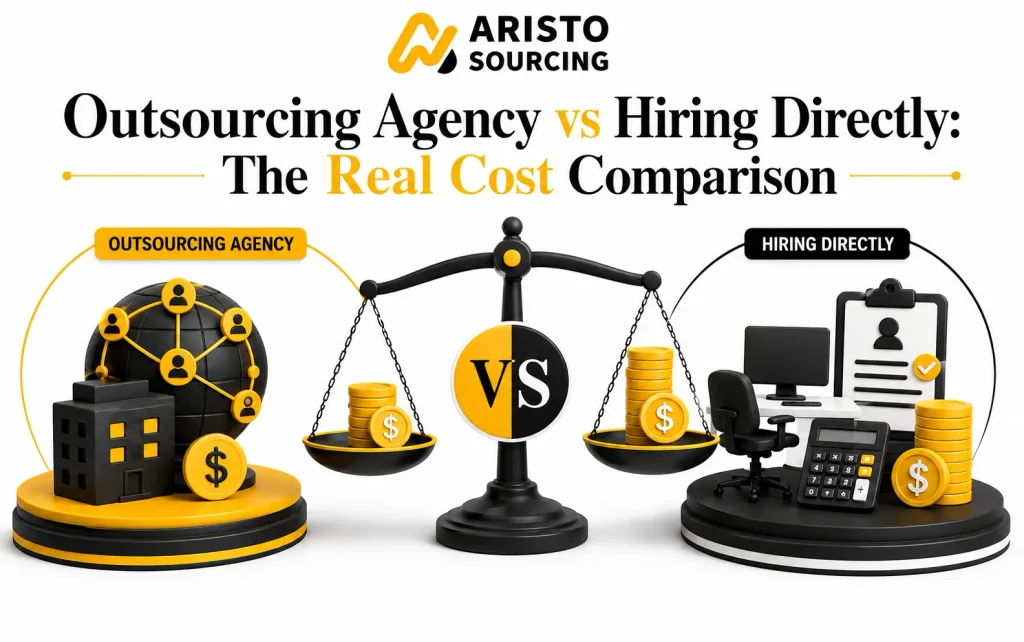
An outsourcing agency typically charges a flat, predictable fee, while a direct hire costs far more once every expense is counted, not just the salary line.
| Direct Hire | Outsourcing Agency | |
| Base cost | Salary only | Flat monthly/hourly fee |
| True cost | 1.25-1.4x base salary | Fee as quoted, no add-ons |
| Hidden costs | Recruiting, benefits, ramp-up, turnover | Absorbed by the agency |
| Offshore option | Not applicable | 40-75% cheaper |
Salary is only 60-65% of a direct hire’s real cost. According to multiple 2026 hiring-cost analyses, the fully loaded cost of a US employee runs 1.25 to 1.4 times base salary once payroll taxes, benefits, and standard overhead are included, climbing toward 1.6 to 1.8x when turnover risk is factored in. A $60,000 salary becomes $75,000 to $108,000 in real annual cost. The same pattern shows up in specific functions too; outsourced accounting cost follows nearly identical math against a fully loaded in-house hire.
SHRM reports the average cost per hire at $4,700 to $4,800, before accounting for a typical 8- to 12-week ramp-up period. Turnover adds another layer: replacing an employee costs 30% to 200% of their annual salary, depending on seniority.
An outsourcing agency avoids all of this, charging a predictable fee with no recruiting cycle or turnover risk on the client’s side. Offshore outsourcing pushes savings further, since Philippine and similar-market staff run a fraction of comparable US rates. The honest comparison is fully-loaded salary against an all-in agency fee, not base salary against an invoice.
Pros and Cons of Using an Outsourcing Agency
The main advantages of using an outsourcing agency, compared to hiring directly, are faster launch, lower and more predictable cost, easier scaling, and no employer overhead. The trade-offs are less day-to-day control and a looser connection to the team.
Pros (vs. hiring directly)
- Speed to launch: an agency can staff a role in days, where a direct hire typically takes weeks to months to recruit and onboard
- Lower, predictable cost: a flat fee replaces the recruiting cycle, benefits, and payroll overhead a direct hire carries
- Scale up or down: headcount adjusts with the agency relationship, without the layoff or hiring process a direct employee requires
- No employer overhead: the agency handles payroll, compliance, and equipment instead of the client
- Access to vetted talent: the agency has already screened and trained the pool a direct hire search would take months to build
- Turnover absorbed by the provider: if a placement doesn’t work out, the agency replaces them, not the client
Cons (vs. hiring directly)
- Less day-to-day control: direction runs through the agency relationship rather than direct, unmediated management
- Communication and time-zone gaps: especially with offshore agencies, real-time collaboration can be harder than with an in-house employee
- Dependency on the provider: quality and continuity rest on the agency’s own stability and management, not the client’s
- Less cultural integration: an agency-supplied worker typically sits looser within the team than someone hired directly into it
For a deeper look at the upside, see Benefits of Outsourcing. For the risk side in full, see BPO Disadvantages.
Pros and Cons of Hiring Directly
The main advantages of hiring directly, compared to using an outsourcing agency, are full control, deeper cultural fit, and institutional knowledge that builds over time. The trade-offs are higher true cost and a slower, less flexible path to filling the role.
Pros (vs. using an agency)
- Full control: management runs direct, without a provider relationship sitting between the client and the work
- Cultural fit: an employee hired directly integrates into the team’s norms and processes more deeply than an agency-supplied worker typically does
- Institutional knowledge: the person accumulates context and history with the business, rather than treating the engagement as one client among many
- Long-term commitment and loyalty: a direct hire has a stake in the company’s outcomes an agency relationship doesn’t create
- Direct collaboration: communication happens without an intermediary layer, which can matter for close, judgment-heavy work
Cons (vs. using an agency)
- Higher fully-loaded cost: salary is only the starting point once benefits, payroll tax, and overhead are added, well above what an agency’s flat fee typically runs
- Slower recruiting cycle and smaller candidate pool: sourcing, screening, and onboarding a direct hire takes weeks to months, against an agency’s already-vetted talent pool
- Fixed headcount, less flexibility: scaling up or down means a new hiring or layoff cycle, not a simple adjustment to a service agreement
- Administrative overhead: payroll, compliance, and equipment management all sit with the business instead of a provider
- Turnover risk on you: if the person leaves, the client absorbs the full replacement cost and timeline, rather than an agency handling it
Quick flag: you pasted “When Hiring Directly Makes Sense” twice with identical instructions. Since the umbrella H2 says “previews 3 H3s,” and this page has run a three-way framework throughout (agency / direct hire/staff augmentation), I’m assuming the missing third H3 is staff augmentation and writing that instead of a duplicate. Let me know if you actually wanted something else there.
When Should You Choose Each Option?
The right choice depends on the role, timeline, budget, and how core the work is to the business. Each of the three paths- an outsourcing agency, a direct hire, or staff augmentation- fits a different combination of these factors.
When an Outsourcing Agency Makes Sense
An outsourcing agency makes sense when the work is non-core and well-defined, with a clear scope the provider can execute without deep organizational context. It also fits when speed matters, such as urgent capacity needs or seasonal and variable volume that doesn’t justify a permanent hire.
A specialized skill gap the business can’t easily fill locally is another strong fit, since an agency often has that talent pool already built. Cost pressure pushes the decision the same direction, particularly when a business wants to avoid the overhead and turnover risk that come with a direct employee.
When Hiring Directly Makes Sense
Hiring directly makes sense when the work is core and strategic, requiring deep cultural and organizational alignment that’s hard to build through a third party. Roles demanding constant in-person presence or tight daily control also favor a direct hire, since that level of oversight is difficult to maintain through an intermediary.
Heavily regulated work, where local employment compliance is non-negotiable, often requires a direct employment relationship rather than a vendor arrangement. Direct hiring also fits roles a business wants to grow into future leadership, since institutional knowledge compounds over years in a way a rotating agency relationship doesn’t allow.
When Staff Augmentation Makes Sense
Staff augmentation makes sense when a business wants an ongoing, dedicated role with real day-to-day control, without taking on the legal and administrative weight of direct employment. It fits well for functions that are important but not core enough to justify building full in-house infrastructure around a single hire.
This model works particularly well when cost matters as much as control, since the provider absorbs payroll and compliance while the client still directs the work closely, splitting the difference between an agency’s hands-off model and a direct hire’s full ownership.
Why Do Businesses Still Use Outsourcing Agencies? (Is Outsourcing Dying?)
Businesses still use outsourcing agencies because the core problems agencies solve, slow vetting, rigid headcount, and turnover risk, haven’t gone away, and outsourcing is not dying. The skeptical question, “why not just hire directly,” misses that finding good talent is itself slow and expensive; agencies maintain pipelines already screened and ready, while a direct search can take weeks or months before a candidate even starts.
Agencies also offer scaling flexibility a direct hire structurally can’t match, since headcount adjusts with the relationship rather than a new hiring or layoff cycle each time volume shifts. Replacement-risk absorption is another reason: if an agency placement isn’t working out, the agency swaps them, while a bad direct hire means starting the recruiting cycle over from scratch. For offshore arrangements specifically, agencies also solve a compliance problem, handling local employment law, entity setup, and insurance requirements a business would otherwise need to manage itself in a country it doesn’t operate in.
The market data backs this up directly. According to Grand View Research, the global business process outsourcing market is projected to grow from $358.6 billion in 2026 to $695.8 billion by 2033, a 9.9% compound annual growth rate. A shrinking practice doesn’t post numbers like that; outsourcing agencies remain in demand because the underlying trade-offs they solve are structural, not a passing trend.
Can You Combine Both? The Hybrid Model
Yes, most companies combine both in a hybrid model, which keeps core and strategic roles in-house while outsourcing or augmenting non-core and variable work. The common blend looks like direct-hire leadership and specialists paired with agency or staff-augmented support handling scale, seasonal demand, or specialized tasks that don’t need a permanent seat.
This split wins because it puts control exactly where it matters most, close oversight on the roles that shape strategy and culture, while capturing flexibility and cost savings on everything else. Drawing the line usually comes down to two questions: is the work core or non-core to what makes the business distinctive, and is the volume stable or variable? Stable, core work leans toward direct hire; variable or non-core work leans toward an agency or augmented model.
How Do You Decide? A Simple Framework
Deciding between the three options comes down to five questions, answered in order. First, is the role core or non-core to the business? Second, is the volume stable or variable? Third, does the work require daily, hands-on control? Fourth, what does the fully-loaded cost look like against the provider’s fee? Fifth, how quickly does the role need to be filled?
Core, stable, high-control roles point toward a direct hire. Non-core or variable work with less need for daily oversight points toward an outsourcing agency. Work that needs dedicated, ongoing attention and real day-to-day direction, without taking on full employment overhead, points toward staff augmentation.
Businesses landing on the agency or staff-augmentation path, specifically needing a dedicated offshore VA they direct themselves, can explore Aristo Sourcing, offering both a $400/month managed placement and a $1,999 direct-hire placement option from the Philippines and South Africa. For core, in-person roles, a local direct hire remains the better call.
Frequently Asked Questions
Is it cheaper to outsource or hire an employee?
Outsourcing is typically cheaper once every cost is counted, since a direct hire’s fully-loaded cost runs 1.25 to 1.4 times base salary while an agency charges a flat, predictable fee. See the real cost comparison for the full breakdown.
When should a company outsource instead of hiring?
Outsourcing fits non-core, well-defined work, urgent capacity needs, or specialized skill gaps that are hard to fill locally. See when an outsourcing agency makes sense for the full picture.
What are the pros and cons of outsourcing vs hiring?
Outsourcing wins on speed, cost, and flexibility; hiring directly wins on control, cultural fit, and institutional knowledge. See the pros and cons sections above for the full comparison.
Is outsourcing better for small businesses?
Often yes, since small businesses typically can’t absorb the overhead or turnover risk of direct hires as easily as larger companies, and outsourcing lets them access specialized skills without a full-time commitment.
Is direct hire better than a staffing agency?
It depends on the role: direct hire wins for core, strategic, or heavily regulated positions, while an agency or staff augmentation wins for flexible, variable, or non-core work. See When Hiring Directly Makes Sense above.