
Outsourced accounting typically costs $500 to $ 5,000+ per month, depending on service level, business size, and provider location. That range covers the gap between basic monthly bookkeeping and a full-service engagement bundling a fractional controller or CFO.
Pricing by service tier, business size, common billing models, cost drivers, offshore versus US rates, in-house comparison, hidden costs, and budgeting are all covered below.
According to Grand View Research, the global finance and accounting business process outsourcing market reached $70.2 billion in 2025, projected to hit $76.5 billion in 2026 and $142.7 billion by 2033. That growth shows how mainstream outsourced accounting has become across business sizes.
This guide is for business owners pricing outsourced accounting before contacting providers, as of 2026, since pricing in this space shifts quickly.
How Much Does Outsourced Accounting Cost?
Outsourced accounting costs $500 to $5,000 or more per month for most small and mid-sized businesses, with full in-house-replacement departments running up to $12,000 monthly. A commonly cited rule of thumb, echoed by SDO CPA and OneBridge Accounting, puts total finance and accounting spend at 1-4% of annual revenue, with the percentage typically falling as revenue grows.
Three factors move the number most: service level, from basic bookkeeping up to controller or CFO-level oversight; business size, measured by transaction volume more than revenue alone; and location, since offshore providers price noticeably below US-based teams for comparable work. The breakdown below sorts pricing by tier so the number attached to each service level is clear before comparing quotes.
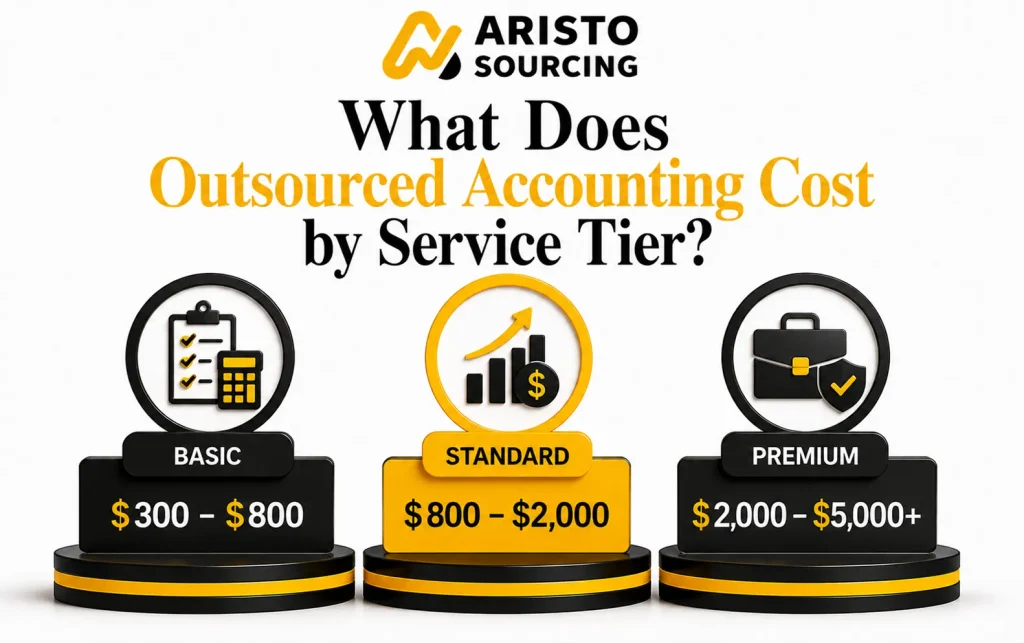
What Does Outsourced Accounting Cost by Service Tier?
Service level drives outsourced accounting cost more than any other factor. Four standard tiers exist, from basic transaction recording up through executive-level financial strategy, each priced for a different scope of work.
| Tier | Monthly Range | What’s Included |
| Bookkeeping | 200-1,500 | Transaction recording, bank reconciliations, basic statements |
| Full-Service Accounting | 800-2,500 | AP/AR management, payroll processing, monthly close |
| Controller-Level | 2,500-6,000 | GAAP compliance, internal controls, audit prep |
| Fractional CFO | 3,500-8,000+ | Forecasting, strategic planning, board reporting |
Bookkeeping Cost ($200-$1,500/mo)
The bookkeeping tier costs $200 to $1,500 monthly and covers the recording layer of accounting: transaction categorization, bank and credit card reconciliations, and basic monthly financial statements. Price within the band moves mainly with transaction volume, with businesses under 100 transactions monthly landing at the low end.
This tier fits solo founders and small businesses with straightforward, low-complexity finances. Full-service accounting is the next tier up, adding payables, receivables, and payroll to the recording work covered here.
Full-Service Accounting Cost ($800-$2,500/mo)
Full-service accounting costs $800 to $2,500 monthly and manages accounts payable, accounts receivable, payroll processing, and the full monthly close, on top of everything bookkeeping covers. Cost within the range shifts with transaction volume and whether payroll is included.
This tier fits growing small businesses that need day-to-day financial operations managed, not just recorded. Controller-level service is the next step up, adding GAAP compliance, internal controls, and audit preparation.
Controller-Level Cost ($2500-$6,000/mo)
Controller-level service costs $2,500 to $6,000 monthly and controls the financial function at a higher standard: GAAP-compliant reporting, internal control design, and audit preparation support. Price moves with company complexity, including multi-entity structures or industry-specific reporting needs.
This tier fits mid-sized businesses preparing for outside investment, lender requirements, or an eventual audit. Fractional CFO service is the top tier, adding forward-looking strategy on top of controller-level oversight.
Fractional CFO Cost ($3500-$8,000+/mo)
Fractional CFO service costs $3,500 to $8,000 or more monthly and advises on financial strategy: forecasting, board-level reporting, and high-stakes decisions like fundraising or acquisitions. Cost climbs with the complexity of the business and how much strategic involvement is required.
This tier fits businesses generating $5 million or more in revenue that need executive financial leadership without a full-time hire. Beyond this tier, businesses typically build an in-house finance team rather than outsource further.
What Does Outsourced Accounting Cost by Business Size?
Outsourced accounting costs vary by business size: startups and small businesses under $1 million in revenue typically pay $500 to $1,500 monthly, mid-sized businesses between $1 million and $5 million pay $1,200 to $4,000 monthly, and larger businesses between $5 million and $20 million or more pay $4,000 to $7,500 or more monthly.
| Business Size | Annual Revenue | Monthly Cost |
| Startup / Small | Under $1M | 500-1,500 |
| Mid-Sized | 1M-5M | 1,200-4,000 |
| Larger | 5M-20M+ | 4,000-7,500+ |
Cost scales with size mainly because transaction volume, entity count, and reporting complexity all grow together as a business expands. A larger company processes more invoices, manages more bank accounts, and often operates across multiple entities or locations, each adding work the outsourced CFO cost figure needs to account for. Reporting requirements shift too: a $500K business needs basic monthly statements, while a $10M business typically needs board-ready reporting, multi-entity consolidation, and audit-level documentation.
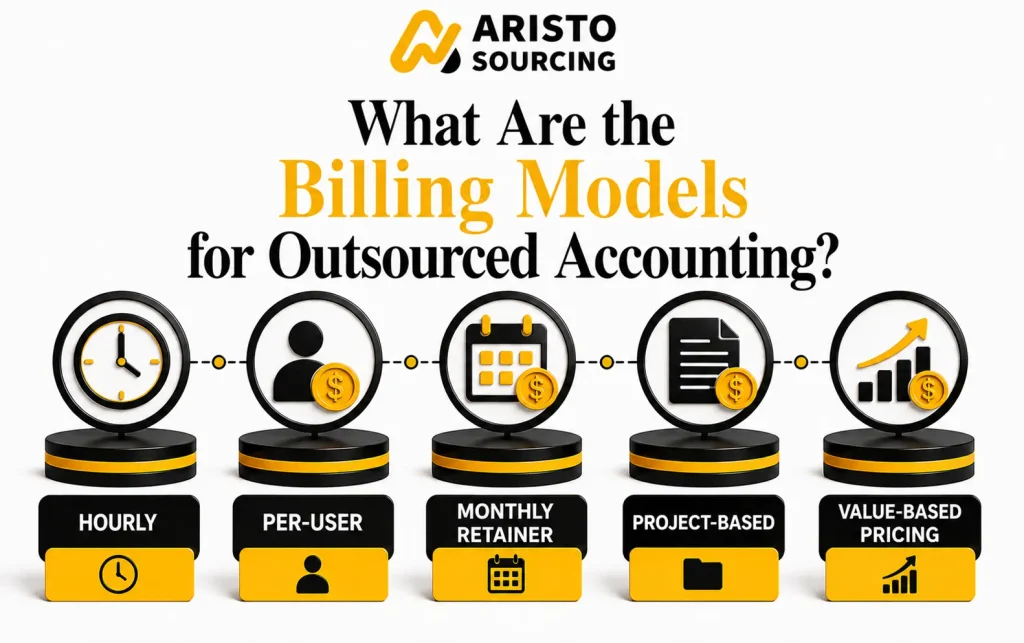
What Are the Billing Models for Outsourced Accounting?
Providers price outsourced accounting in four main ways: fixed monthly retainer, hourly billing, per-transaction pricing, and one-time project fees. Each shapes cost predictability differently, and most businesses land on one primary model with a secondary model layered in for edge cases.
Fixed Monthly Retainer
The fixed retainer model works by scoping a set of services upfront and charging one flat fee each month, regardless of hours actually worked. Rates typically scope to transaction volume and service level rather than time spent.
This model suits ongoing bookkeeping and accounting needs specifically, since it gives predictable budgeting and removes the incentive misalignment hourly billing creates on recurring work. It isn’t the right fit for one-off projects with unclear scope, where a fixed fee is hard to estimate accurately. Predictability is the retainer’s core advantage: the bill doesn’t move even in a busy month.
Hourly Billing
Hourly billing charges by time spent rather than scope delivered, typically running $30 to $80 per hour for a bookkeeper and $100 to $300 or more per hour for a CPA or controller-level professional.
This model suits project work, historical cleanup, or engagements with genuinely uncertain scope, where a flat fee can’t be reasonably set in advance. It isn’t the right fit for ongoing monthly bookkeeping, since it creates a built-in incentive for the work to take longer rather than get more efficient. The predictability trade-off runs the opposite direction from a retainer: cost varies month to month based on actual hours logged.
Per-Transaction Pricing
Per-transaction pricing charges a fixed amount for each transaction processed, generally $0.50 to $2.00 per transaction depending on complexity and provider.
This model suits very low-volume businesses where a flat monthly retainer would overcharge for minimal activity. It scales poorly for high-volume businesses, since cost climbs directly with transaction count and can exceed a flat-rate plan once volume grows past a few hundred transactions monthly. The predictability trade-off sits in between the other models: the per-unit rate is fixed, but the total bill still shifts with volume.
One-Time and Project Fees
Project-based fees cap a defined, one-time scope of work at a set price, commonly $1,500 to $5,000 for a bookkeeping cleanup or catch-up engagement.
This model suits historical cleanup, system migrations, or due-diligence support, where the work has a clear start and end rather than an ongoing monthly cadence. It isn’t suited to recurring accounting needs, since a new project fee would apply each time. The predictability trade-off here is upfront: the price is capped once scoped, but only for that specific project, not for anything beyond it.
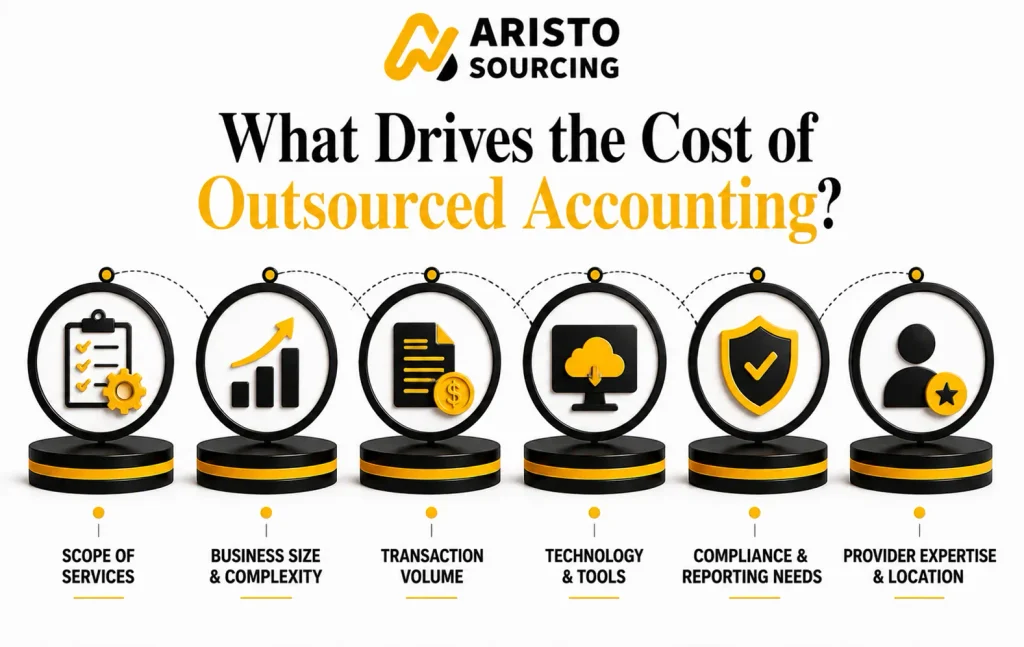
What Drives the Cost of Outsourced Accounting?
The cost of outsourced accounting is driven by six factors, most of which have nothing to do with revenue alone. Transaction volume is the number one driver, and most providers price on it even when the quote doesn’t say so explicitly, since every additional transaction adds categorization, review, and reconciliation work.
Entity complexity moves the number next: a business with multiple entities or intercompany consolidations requires more work than a single-entity operation at the same revenue level. Multi-state or multi-jurisdiction operations add another layer, since each additional state or country typically brings its own tax filing and compliance requirement. Industry complexity and regulatory needs push costs up further, as e-commerce reconciliation, construction job costing, or healthcare compliance each demand specialized expertise a generalist bookkeeper doesn’t have.
The condition of existing books matters just as much as ongoing work: a business handed over with a year of miscategorized transactions or unreconciled accounts often costs more to clean up than several months of standard service. Accounting method, cash versus accrual, rounds out the list, since accrual accounting adds deferrals, prepaids, and accounts receivable and payable tracking that cash-basis bookkeeping skips entirely.
This is why two businesses that look similar on paper get very different quotes: $1,500 a month from one provider isn’t the same scope as $1,500 from another, since transaction volume, entity structure, and book condition all shift what that number actually buys.
Offshore vs US-Based Accounting: How Much Can You Save?
Offshore accounting costs roughly 50 to 90% less than US-based accounting because offshore staff rates run $8 to $35 per hour compared to $30 to $300 or more per hour for US-based bookkeepers, accountants, and CPAs. According to Madras Accountancy, entry-level offshore accountants in India and the Philippines cost $8 to $14 per hour, while equivalent US roles run $35 to $85 per hour.
What businesses gain from offshore accounting is real cost reduction, dedicated staff rather than shared capacity, and the ability to scale a team up or down without a full US hiring cycle. The trade-offs are equally real: time-zone gaps that can slow same-day turnaround, communication friction on nuanced or judgment-heavy work, and the need for a quality-review layer since offshore staff typically execute rather than sign off on final numbers.
Offshore fits best for high-volume transactional work, standard bookkeeping, and accounts payable or receivable processing, where the task is well-defined and repeatable. US-based or credentialed providers still matter for complex GAAP reporting, audit preparation, and strategic CFO-level advisory, where judgment and licensed sign-off carry more weight than hourly cost.
Aristo Sourcing places dedicated offshore accounting-support staff, bookkeeping, AP/AR, and data entry, from the Philippines and South Africa at staff-augmentation rates, with managed placements starting around $400 per month. The honest limitation: Aristo Sourcing provides staff, not a CPA firm’s GAAP close, audit, or CFO advisory work; that strategic layer belongs with a credentialed accounting provider.
Outsourced vs In-House Accounting: The True Cost Comparison
Outsourced accounting costs 40-60% less than a US in-house team, and 60-75% less through offshore accounting staff, because a fully-loaded salary carries costs a monthly fee doesn’t.
| In-House (Loaded) | Outsourced (US) | Outsourced (Offshore) | |
| Bookkeeper | 70K-100K/yr | 9K-18K/yr | 10K-22K/yr |
| Controller | 130K-195K/yr | Custom | Limited fit |
| CFO | 350K-500K/yr | 42K-96K/yr | Not typical |
Robert Half puts a bookkeeper’s base salary at 63,000-82,500; BLS data adds roughly 30% for benefits and payroll tax on top. Outsourcing removes recruiting, equipment, and turnover risk, significant given Northstar Financial Advisory’s cited 17.4% turnover rate in finance roles.
Break-even runs by revenue: outsourced bookkeeping wins below $2M, a controller pencils out near $5M, and a CFO only justifies itself past $15-25M. Outsourcing to the Philippines is one common route to the deeper offshore savings shown above.
What Costs Are Billed Separately?
Costs usually billed separately from the monthly accounting fee include tax preparation and filing, treated as a separate annual engagement by most providers. Historical cleanup or catch-up bookkeeping runs $1,500 to $5,000 as its own project fee, since untangling a backlog takes more work than ongoing maintenance.
Setup and onboarding fees often apply at the start, covering chart-of-accounts review and system access. System implementation or software migration typically falls outside the base retainer too. Special projects, financial modeling, due diligence, or acquisition accounting, are billed separately since they fall outside routine monthly scope.
As SDO CPA and OneBridge Accounting both note, “all-inclusive” rarely means everything. Asking a provider upfront what’s included protects against surprise invoices. See BPO Benefits (Cost Savings) for the broader savings picture.
How Much Should You Budget? The 1-4% of Revenue Benchmark
You should budget 1 to 4% of annual revenue for accounting, a benchmark cited by SDO CPA and OneBridge Accounting, with the percentage falling as revenue grows. A $250K business at 2% budgets roughly $5,000/year, about $417/month. A $1M business at 1.5% lands near $15,000/year, about $1,250/month. By $5M, that share typically drops closer to 1.5% as fixed costs spread across more revenue.
To sanity-check current spend, compare it against this range. Spending above 4% while only receiving basic bookkeeping, without tax planning, payroll, or advisory work, signals the engagement is worth re-evaluating rather than accepted as normal.
How Do You Choose an Outsourced Accounting Provider?
Match the tier to your actual need first, since overpaying for CFO-level advisory when bookkeeping is all that’s required wastes budget. Evaluate credentials (CPA licensing), security certifications (SOC 2, ISO 27001), client references, and the provider’s tech stack before comparing price.
Compare quotes on scope, not headline number, since $1,500 from one provider rarely matches $1,500 from another. Ask explicitly what’s included versus billed separately, and what happens to pricing as volume rises.
For US versus offshore, match the decision to work type: offshore for high-volume transactional work, US-credentialed for GAAP-heavy or audit work. Businesses needing offshore accounting-support staffing, bookkeeping or AP/AR from the Philippines or South Africa, can start with Aristo Sourcing at $400/month; credentialed CPA-level work still needs a licensed firm.