
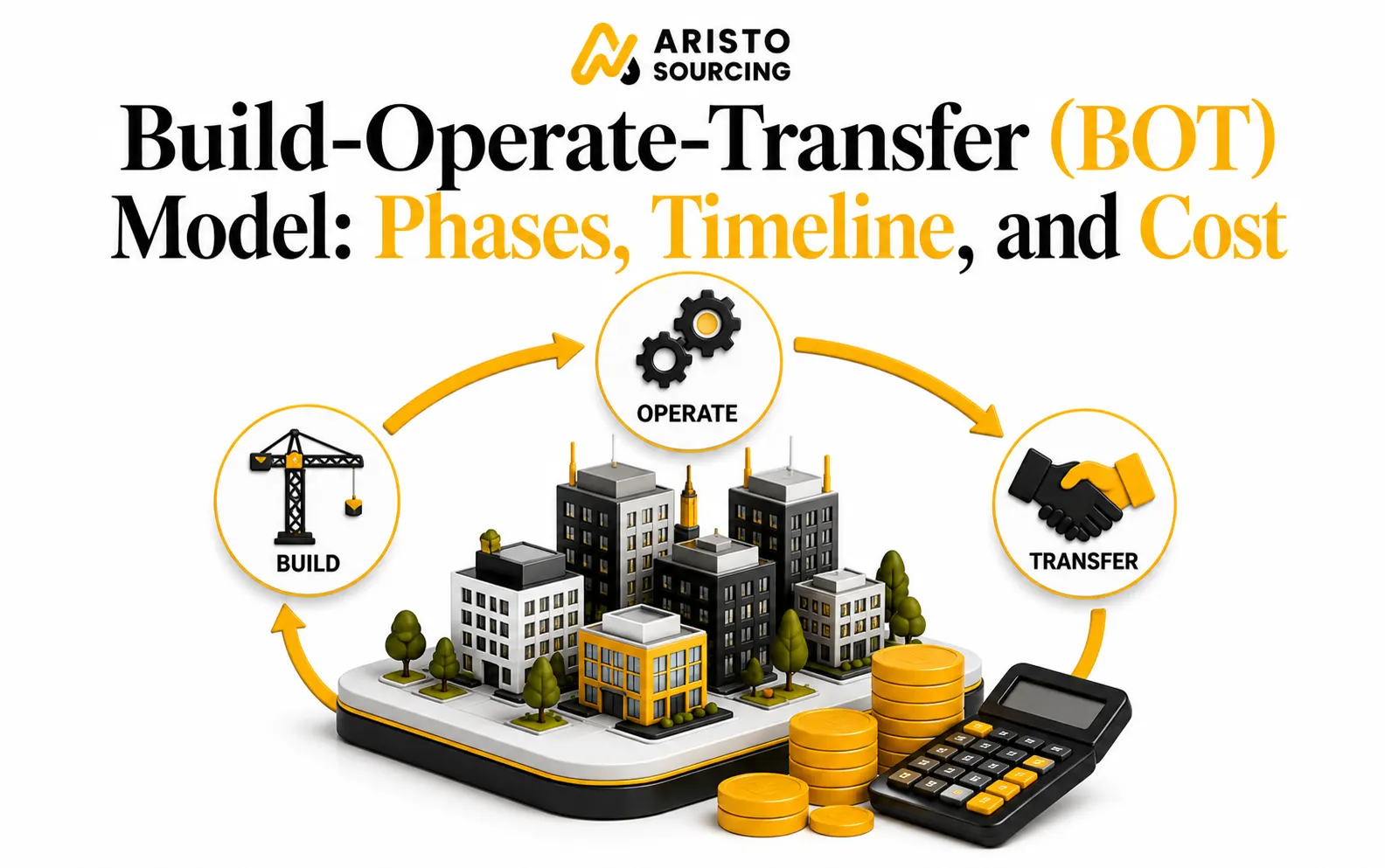
The BOT model basically refers to a partnership where a provider builds and runs an offshore development center, then completes an ownership transfer to the client. The BOT model moves through three distinct phases, including build, operate, and transfer. The full engagement typically runs between 18 months and 5 years, depending on scope and readiness triggers.
The cost of the BOT model is between $4,000 and $8,000 per developer per month, with reported savings of 40–60% against onshore hiring. Key benefits of the BOT model include lower upfront capital outlay, faster market entry, and full ownership after transfer. The main risks are employee attrition during handover and vague asset valuation terms, both of which are manageable through contract-stage specificity, retention incentives, and written decision rights.
What Is the Build-Operate-Transfer (BOT) Outsourcing Model?
The Build-Operate-Transfer (BOT) outsourcing model is a structured partnership in which a service provider builds an offshore team, operates it against agreed targets, and eventually transfers ownership to the client. The model has three phases, including build, operate, and transfer. The two parties are the client, which defines the mission and standards, and the service provider, which manages local execution.
At the transfer stage, several elements move to the client. Staff may move to the client’s payroll, while assets, vendor accounts, and contracts are reassigned or re-signed. Operational control also shifts to the client. The defining feature of the BOT model is its planned transition to client ownership. Unlike open-ended outsourcing, BOT has a defined endpoint, meaning the client takes over the operation. This structure makes BOT suitable for offshore development centers, global capability centers, and back-office teams that are intended to become permanent internal capabilities.
One clarification is important, and that is BOT has two distinct meanings. In infrastructure, Build-Operate-Transfer refers to a model in which a private entity finances, builds, and operates a facility before transferring it to a public authority. That infrastructure model is separate from the outsourcing model described here.
How Does the BOT Model Work, Step by Step?
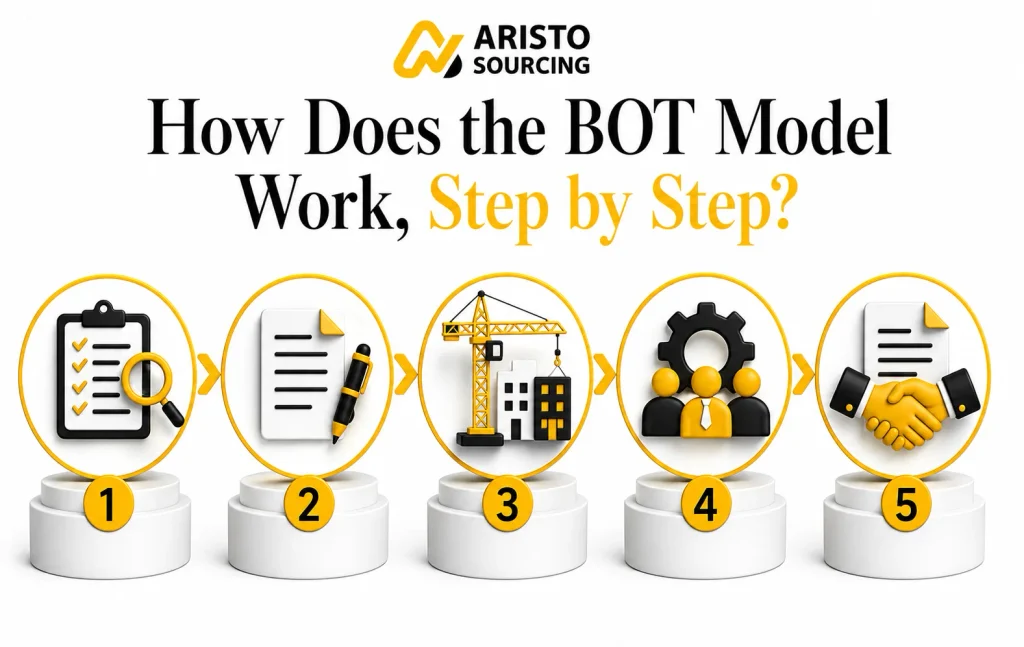
The BOT model works in phases, including build, operate, and transfer.
The 3 phases of the BOT model are listed below.
- Phase 1: Build — Entity Setup, Infrastructure, and Hiring
- Phase 2: Operate — Running the Team Against KPIs and SLAs
- Phase 3: Transfer — People, Assets, Contracts, and Control
Phase 1: Build — Entity Setup, Infrastructure, and Hiring
During the build phase of the BOT model, the partner handles legal entity setup and the operational groundwork needed to get an offshore team running. This typically covers legal entity registration and local compliance setup, selecting the target location and labor market, recruiting the founding team, standing up workspace, equipment, and IT security infrastructure, and arranging payroll, tax, and employment contracts. Even while the provider handles execution, the client should still own the hiring bar and final hiring decisions, its engineering or operational standards, and its product and delivery priorities; outsourcing the mechanics of setting up an offshore team doesn’t mean outsourcing what “good” looks like.
Duration depends on what you are building. A lean, team-only build can move from first requisition to onboarding in roughly 2–8 weeks, according to Saigon Technology. A full entity-plus-team build typically takes 6–9 months, according to ANSR.
Phase 2: Operate — Running the Team Against KPIs and SLAs
In the operate phase of the BOT model, the partner runs day-to-day HR, payroll, facilities, and compliance administration while the client directs the actual work. The provider manages performance against agreed KPIs and SLAs, maintains a delivery cadence and reporting rhythm, and builds documentation and knowledge capture so expertise doesn’t sit with any one individual. As the first cohort of hires stabilizes, the partner also scales the team to meet growing scope. A team is ready to transfer once it delivers predictable output, has repeatable onboarding, and has clear decision rights, not once a fixed date arrives.
One point buyers should not leave unresolved is who owns the intellectual property the team produces during the operate phase. No available source states a standard default, so this is a question to get answered in the contract rather than an assumption to carry into negotiations, alongside a related structural question, co-employment risk, since the provider is technically the legal employer of record until transfer.
Phase 3: Transfer — People, Assets, Contracts, and Control
Transfer is the phase where ownership formally changes hands, and it succeeds or fails based on planning done at the contract stage, not effort spent during the handover itself. A complete transfer moves through four tracks, including staff transfer, where team members move onto the client’s entity or payroll; asset transfer, covering equipment, tooling, and vendor accounts; legal handover, covering licenses, contracts, and local compliance responsibility; and control transfer, where management, budget, and hiring authority pass to the client.
Where the contract includes it, the partner also provides a stabilization period of post-transfer support to keep operations steady through the handover. Reported transfer durations also diverge by scope, meaning that Saigon Technology cites a 4-12 week transfer window, while ANSR cites 3-6 months. As with the build phase, the shorter figure reflects a narrower staff-and-systems handover, while the longer figure includes a full legal entity transition.
How Long Does a BOT Engagement Take?
A BOT engagement takes between 18 months and 5 years, depending on which source you read and what scope they are measuring. Some cover only the operate phase, others the full build-to-transfer cycle, and build scope itself varies from a lean team-only setup to a full legal entity build.
BOT engagement timeline ranges are presented depending on different sources in the table below.
| Source | Timeline | Notes |
|---|---|---|
| Google AI Overview, citing build-operate-transfer.com | 18–36 months | Full engagement, team-only build scope |
| Innowise | 2–3 years total | Full build-to-transfer cycle |
| ANSR | 2–4 years for the operate phase alone | Operate phase alone, not the full engagement |
| Outsource Accelerator | 3–5 years end-to-end | Full engagement, including entity-based builds |
| RBM Soft | 18–48 months | Range spans BOT and related variants (e.g., BOOT) |
Engagement length has a direct bearing on cost, since management fees run for the length of the operate phase; the longer the timeline, the more that phase’s fees add to the total. Transfer is often triggered by operational readiness rather than a fixed calendar date. The cost of rushing the timeline is usually a failed handover.
How Much Does the BOT Model Cost?
The BOT model costs between $4,000 and $8,000 per developer per month, and offers 40–60% savings against onshore hiring, according to vendor-published figures. Those numbers are not independently studied. They vary by region, seniority, and team size. Treat both numbers as directional and confirm actual offshore team cost against your target country and role mix before budgeting.
Three cost components make up the total. Setup costs cover entity registration, recruitment, and infrastructure during the build phase. Ongoing operational management fees apply throughout the operate phase and bundle the provider’s margin on top of local salaries, a proper calculation separates the underlying labor arbitrage (the wage gap between your home market and the delivery country) from the vendor margin layered on top, since the two behave differently as the team scales. Transfer-related costs apply at handover and are covered separately below.
How Is the Transfer Fee Calculated and Negotiated?
The transfer fee is calculated and negotiated according to whatever formula the provider specifies in the original contract, no publisher in this space discloses a standardized transfer-fee formula, so this is a term to get in writing before signing
It typically bundles asset costs, entity or employment transfer expenses, and a contractual buyout component covering the provider’s remaining margin on the engagement. Because vague asset valuation is widely cited as the model’s most common failure point, the benefit of defining the calculation method in the original contract is that it prevents ambiguity during end-of-term negotiation, when the client has the least leverage. Buyers should also confirm what happens to the fee if they transfer earlier or later than the planned date, since an accelerated or delayed transfer changes how much of the provider’s investment has actually been recovered.
What Are the Benefits of the BOT Model?
The benefits of the BOT model include lower upfront cost, faster market entry, access to offshore talent at scale, and full ownership after transfer.
The benefits of the BOT model are listed below.
- Lower Upfront Cost and Legal Risk
- Faster Market Entry
- Access to Offshore Talent at Scale
- Full Ownership After Transfer
1. Lower Upfront Cost and Legal Risk
BOT reduces capital outlay and legal exposure at the start of an engagement because the provider fronts the setup work and absorbs the early compliance risk instead of the client. Choosing BOT means the company avoids entity registration, a real estate commitment, direct exposure to local labor law, and the cost of building hire-to-retire HR processes from nothing.
2. Faster Market Entry
A partner-led launch beats a solo entity setup on speed because the provider already has the local registrations, banking relationships, and recruiting networks in place, a company building its own entity has to establish all of that from scratch before hiring a single person.
3. Access to Offshore Talent at Scale
Talent access, rather than cost, now drives most BOT adoption, since the war for talent in specialized fields has made it harder to hire fast enough through direct recruiting alone. The most common delivery locations are India, Vietnam, the Philippines, Eastern Europe, and Mexico and the wider LATAM region, chosen for depth in data, AI and machine learning, cloud, and cybersecurity skills.
4. Full Ownership After Transfer
Full ownership after transfer means the client holds the team, the IP, and the operational infrastructure outright, with no further dependence on the provider. This is the model’s defining payoff, since it’s the one benefit traditional outsourcing structurally cannot offer. Once transfer completes, the vendor margin ends and the institutional knowledge the team built up during the operate phase stays inside the client organization instead of leaving with the vendor relationship. That payoff only materializes if the handover itself is managed well, which is where some risks of the model come in.
What Are the Risks of the BOT Model?
The risks of the BOT model include employee attrition during handover, vague transfer and asset valuation terms, cultural and governance misalignment, and partner dependency before transfer.
The risks of the BOT model are listed below.
- Employee Attrition During Handover
- Vague Transfer and Asset Valuation Terms
- Cultural and Governance Misalignment
- Partner Dependency Before Transfer
1. Employee Attrition During Handover
Staff leave at the moment of transfer because a change in legal employer raises real uncertainty about pay, title, and job security, and the people with the strongest institutional knowledge are often the ones with the most external options. Holding onto them takes early role clarity about what changes and what doesn’t, retention incentives timed to carry staff through the transition, and matching compensation and benefits across the move so no one takes a de facto pay cut by staying.
2. Vague Transfer and Asset Valuation Terms
Unclear handover clauses turn into disputes over code ownership, equipment, and office leases because neither side has a documented baseline to point to once the relationship turns adversarial. Vague asset valuation is widely flagged as the BOT model’s headline failure point, and the fix is contract-stage specificity, itemized asset lists and an agreed valuation method, rather than relying on end-of-term goodwill between the parties.
3. Cultural and Governance Misalignment
Cultural and decision-rights problems tend to surface late because the operate phase runs smoothly as long as the provider is making the day-to-day calls; misalignment only becomes visible once the client has to take those decisions over. ANSR identifies cultural misalignment carried through the operate phase as the model’s most common failure point. The standard fixes are written decision rights defined from the start, shared KPI visibility so both sides see the same performance data, and a local leader who can bridge both organizations’ working styles.
4. Partner Dependency Before Transfer
If the partner underperforms or changes strategic direction mid-engagement, the client has limited options unless the contract already anticipated it, the team, the entity, and the operational relationships all still sit with the provider until transfer. The standard protections are performance remedies tied to the agreed KPIs, step-in rights that let the client take over management without waiting for a full legal transfer, and early-exit terms that define a path out if the partnership breaks down. The related vetting rule when choosing a BOT provider: ask for references from clients who completed a full transfer, not from clients still mid-engagement, since a provider’s performance often looks different once real ownership is on the line.
BOT vs Traditional Outsourcing, Staff Augmentation, and Captive Centers
The difference among BOT, traditional outsourcing, staff augmentation, and captive centers involves who owns the team, who controls daily management, how fast you can start, and where institutional knowledge ends up.
The difference among BOT, traditional outsourcing, staff augmentation, and captive centers is presented in the table below.
| Model | Who Owns the Team and Entity | Who Controls Day-to-Day Management | Setup Speed and Upfront Cost | Contract Duration and Exit Path | Where Institutional Knowledge Ends Up |
|---|---|---|---|---|---|
| BOT | Provider initially; client after transfer | Provider during operate phase; client after transfer | Medium speed; low upfront cost | Fixed term with planned transfer to client ownership | Client, after transfer |
| Traditional Outsourcing | Provider | Provider | Fast; minimal upfront cost | Open-ended or project-based; no ownership transfer | Provider |
| Staff Augmentation | Client | Client | Fast; minimal upfront cost | Flexible; terminate anytime | Client |
| Captive Center | Client | Client | Slow; high upfront cost | Permanent; no exit needed | Client |
| Employer of Record (EOR) | EOR provider | Client directs work; EOR handles compliance | Fast; low upfront cost | Flexible; no ownership transfer | Client |
Two quick notes on variants that can be important for your business. BOOT is a BOT variant in which legal ownership of the entity remains with the partner until transfer. BOTT is Deloitte’s Build-Operate-Transform-Transfer, which adds a transformation step during the operate phase. Both are flavors of the same model, not separate categories.
Is the BOT Model Right for Your Business?
BOT model is right for your business if you need long-term capability, a sizeable headcount, and genuine intent to own the team at the end of the engagement. It fits companies planning a multi-year offshore build where ownership is the end goal, not just delivery. It does not fit short projects, narrow-scope work, or an urgent need for headcount right now, for those cases, a traditional outsourcing engagement model, or staff augmentation is the better fit, since BOT’s payoff only shows up once the partnership has run long enough to reach transfer.
How to Evaluate a BOT Partner?
To evaluate a BOT partner, prioritize providers who have completed full-cycle transfers, not just builds, because a provider that has never handed a team over hasn’t proven the hardest part of the Build-Operate-Transfer model.
Vendor due diligence should also confirm local recruitment depth in your target market, legal and compliance capability in that specific country, and a transfer roadmap supplied in writing upfront, before you sign. Weighing these factors against the BOT phases, timeline and cost outlined above gives a realistic basis for comparing providers rather than taking their marketing claims at face value.