

Every scaling business needs specific virtual assistant positions to solve one problem: The founder has become the bottleneck. Revenue outpaces the calendar, task volume outpaces attention, and growth hits a ceiling that has nothing to do with market demand and everything to do with who is doing the actual work.
A virtual assistant is a remote professional who takes ownership of a defined set of tasks for your business, working from outside your office and, in most cases, outside your country. The role offers your business real operating capacity, without adding headcount, payroll tax, office overhead, or a six-month hiring cycle. Filling the right virtual assistant positions, in the right order, starts with knowing exactly which tasks drain your time versus which decisions only you can make.
Most businesses searching for virtual assistant positions start in the wrong place: A generalist hire meant to cover everything at once. That approach burns through the first few months of a hire’s tenure on trial and error instead of measurable output. The three roles below fix that by targeting the exact three points where a scaling business bleeds time, revenue, and attention.
What Is a Virtual Assistant?
A virtual assistant, or VA, handles administrative, technical, sales, or creative tasks for your business remotely, using their own equipment and internet connection instead of sitting in your office. Some work as independent freelancers juggling multiple clients at once. Others work through an agency that vets, places, and manages them full-time against a single account, the model most businesses scaling past their first few hires actually want: One dedicated person, fully briefed on your business, not split five ways across other clients.
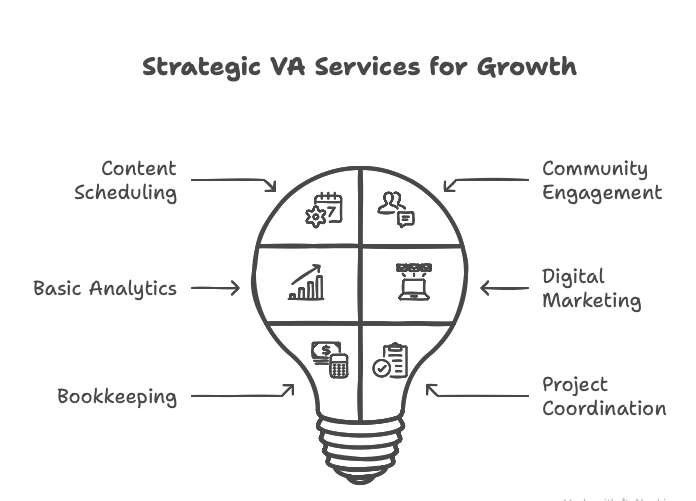
The role offers remote work capacity across a wide range of specialties: inbox and calendar management, sales outreach, bookkeeping, customer support, or technical troubleshooting. What separates a strong hire from a weak one has little to do with the specialty and everything to do with the fundamentals. The role requires organizational skills above almost anything else, since nobody stands over a remote hire’s shoulder checking their work in real time. When you screen candidates, weight organization, follow-through, and independent judgment over a polished résumé.
The Operator vs. Strategist Framework: Why You Hire in This Order
Before you fill any virtual assistant position, split your workload into two categories. Operator work follows a repeatable process, skips your personal judgment entirely, and only demands correct execution. Strategist work carries high leverage, ties directly to revenue or product decisions, and cannot move to someone else at your current stage.
Your hours belong in the strategist category. The three positions below make up the operator layer: the delegation foundation that frees you to actually work as a strategist instead of executing tasks a system could handle. Each role performs only as well as the system supporting it. Hire without documented workflows, and you create a new bottleneck instead of removing the old one.
3 Virtual Assistant Positions Every Scaling Business Should Fill First
Most founders default to hiring a generalist first. That default wastes the first few months of a hire’s tenure on trial and error. Filling these three virtual assistant positions in order, matched to your biggest operational gap, gets you a measurable return inside the first 30 days.
Role 1: Executive Administrative VA, the Gatekeeper and Operator
Your inbox, calendar, and meeting schedule fall squarely into operator work. They demand high volume and constant attention, but none of them require your strategic judgment. Most founders still spend two to three hours daily managing these tasks personally, hours that add up fast at any real founder billing rate.
An Executive Administrative VA manages:
- Inbox triage, prioritization, and drafting responses
- Calendar management, scheduling, and meeting coordination
- Travel booking and logistics
- Meeting preparation, agendas, and follow-up notes
- Document management and filing systems
- Client onboarding coordination
Delegating this layer moves you from operator to strategist in practice, not just on paper. Once your VA manages the inbox and calendar, your hours go to decisions only you can make.
This role typically works with the following tool stack: Google Workspace or Microsoft 365, Calendly for calendar management, a password manager like 1Password, Slack for asynchronous communication, Zoom for calls, and Notion for SOP documentation.
Explore this hire in more depth on our virtual personal assistant page.
Role 2: Lead Generation and Sales VA, the Revenue Engine
A pipeline that runs on the founder’s personal follow-up habits will always underperform. Lead generation and outbound sales work follow defined, repeatable processes: Research a prospect list, execute a cold outbound campaign, log every touchpoint in a CRM, and hand off qualified leads at the right stage. None of it requires the founder personally, yet founders routinely hold onto it long after it stops making sense.
A Lead Generation and Sales VA drives:
- Prospect research and list building
- Cold email and outbound campaign execution
- CRM updates and pipeline hygiene, maintained daily rather than batched
- Appointment setting and calendar coordination for the sales team
- Follow-up sequencing and lead nurturing
- Basic reporting on conversion rates by stage
This role turns inconsistent, founder-dependent outreach into a predictable revenue engine that runs on its own schedule. See how this works in practice on our virtual lead generation assistant and virtual sales assistant pages.
Tool stack this role typically runs on: HubSpot or a comparable CRM, Apollo or a similar prospecting tool, LinkedIn Sales Navigator, and Slack for coordination with the sales team.
Role 3: Customer Experience and Back-Office VA, Retention and Operations Support
Customer churn rarely announces itself in advance. It builds quietly through slow response times, unresolved tickets, and invoices that go unpaid because nobody followed up. A dedicated Customer Experience and Back-Office VA catches these problems before they compound.
A Customer Experience and Back-Office VA resolves and tracks:
- Customer support tickets, live chat, and email responses
- Order status updates and issue resolution
- Invoice generation, tracking, and follow-up
- Basic bookkeeping tasks like expense coding and bank reconciliation
- SLA compliance tracking and response-time reporting
- KPI tracking against retention and satisfaction targets
This role protects revenue you already earned instead of chasing new revenue, which makes it just as valuable as the other two, even though it gets less attention in most hiring conversations. Explore this role further on our customer service virtual assistant and virtual bookkeeping assistant pages.
Tool stack this role typically relies on: Zendesk or Intercom for support tickets, QuickBooks or Xero for bookkeeping, Stripe for payment tracking, and Airtable for reporting dashboards.
Already know which of these three gaps is costing you the most? Book a free 30-minute consultation, and we’ll scope the exact role and start sourcing candidates within days.
SOP-First Hiring: The System Behind the Role
Most hiring mistakes start with the same assumption: that the hire alone fixes the problem. It doesn’t. The system does. The VA just executes it.
Before you place any of these three virtual assistant positions, document the following for each function:
- The recurring task list: every repeatable action the VA handles, with frequency and expected output clearly defined.
- The tool access map: every platform the VA needs, with permission levels defined upfront.
- The escalation path: which decisions require your approval, and how the VA should surface them to you.
- The KPI set: how you measure success at 30, 60, and 90 days.
Standard Operating Procedures, or SOPs, turn a hire into an Operator Layer that runs independently and only surfaces genuine exceptions. Skip this step, and you end up hiring someone to ask you questions all day instead of someone who solves problems for you.
South Africa and the Philippines are the two talent pools we source from, and each solves a different problem. South Africa offers native English proficiency and a near-zero time difference with the UK and Europe, which matters most for roles that need real-time collaboration with a European team. The Philippines offers deep alignment with US business culture and a workforce accustomed to night-shift schedules, which matters most for US-based businesses that need coverage during their own working hours without asking a domestic hire to work nights. Both regions run on BPO delivery models, so candidates already expect SOP-driven systems instead of constant hand-holding.
What to Expect in the First 30 Days
The first month determines whether a hire becomes a real Operator Layer or just another task on your plate. In week one, the VA works through the tool access map and shadows your current process, asking clarifying questions upfront instead of guessing later. By week two, they own the recurring task list independently, with you checking output against the KPI set rather than walking through each task live. By week four, you should see the specific time recovery you hired for, hours back on your calendar, a pipeline moving without your daily input, or tickets closing inside your SLA window.
If a hire is still asking you basic process questions past week two, that’s rarely a sign of a weak candidate. It’s almost always a sign the SOP wasn’t documented clearly enough before day one. Fix the system, and the same hire usually turns around fast.
Why These Virtual Assistant Positions Come First
Admin, sales support, and customer experience are not the flashiest hires a founder makes, but they address the three vulnerabilities that hit every scaling business at the operational level: founder time erosion, an inconsistent revenue pipeline, and unresolved customer and financial issues that quietly compound. These three virtual assistant positions target each vulnerability directly.
The Opportunity Cost of Admin Work
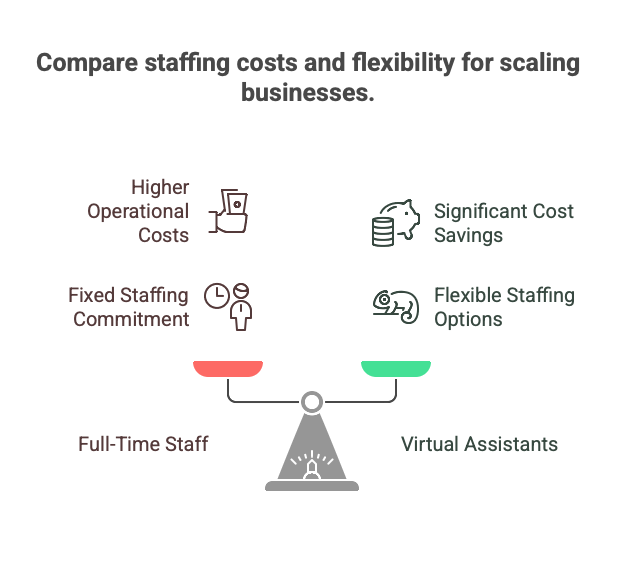
A founder spending 15 hours a week on admin, outreach follow-up, and support tickets combined loses real money to that time, not just hours. At a conservative $75 USD hourly opportunity cost, that adds up to over $58,000 USD a year spent on work a properly trained VA team can absorb for a fraction of the cost. Virtual assistant support in the $20 USD to $35 USD per hour range for pre-vetted remote professionals typically pays for itself within the first month, once you count the founder hours it frees up for revenue-generating work.
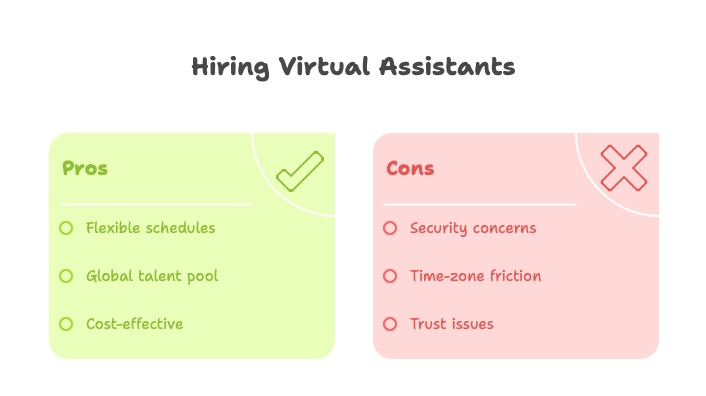
The flexibility compounds the return further. Virtual assistant positions scale with actual demand. During a slower quarter, you are not stuck carrying a full-time salary for a role running at 40% capacity, the way you would with a traditional in-house hire.
Security and Data Handling
Security concerns come up in nearly every conversation about hiring remote support, and they deserve a direct answer, not a dismissal. The fix is a process, not avoidance: assign role-specific access permissions, require encrypted systems, use a password manager with a shared vault instead of shared passwords, and source candidates through an agency that runs background verification before placement. A staffing partner with a defined vetting process closes this gap at the point of hire, well before it becomes a problem.
Time Zone and Communication Friction
An asynchronous-first communication model solves most time zone friction before it starts. Define clear response-time SLAs, run documented async standups instead of daily live meetings, and reserve synchronous calls for decisions rather than status updates. South African and Philippine talent pools both offer meaningful daily overlap with US Eastern and Pacific time zones, typically four to six hours of shared working time, enough for real-time collaboration whenever a task actually requires it.
Start With Your Highest-Cost Bottleneck
Scaling without an Operator Layer isn’t a growth strategy. It’s founder burnout with revenue attached.
The three virtual assistant positions above- Executive Administrative, Lead Generation and Sales, and Customer Experience and Back-Office- build the operational foundation that lets a founder actually function as a strategist. They aren’t support roles sitting on the sidelines. They’re the infrastructure that makes everything else in the business possible.
Start with the role that addresses your highest-cost bottleneck. Document the SOP before your hire’s first day. Measure results against defined KPIs from day one.
Aristo Sourcing places pre-vetted remote professionals across all three functions, sourced from South Africa and the Philippines, with placements completed in 10 to 14 days.
Frequently Asked Questions
How do I calculate the ROI of hiring a virtual assistant?
Compare your own hourly billing rate against the VA’s hourly cost. If your time is worth $120 USD an hour and you outsource 10 hours of admin work weekly to a $20 USD an hour VA, you save $1,000 USD in labor value every week, or roughly $50,000 USD a year in recovered opportunity cost. The true ROI is measured by what you do with those recovered 10 hours: whether that means closing three additional deals a month or accelerating a product launch.
Is it better to hire a virtual assistant from South Africa or the Philippines?
It depends on the problem you’re solving. South Africa offers native English proficiency and near-zero time difference with the UK and Europe. The Philippines offers deep alignment with US business culture and a workforce comfortable with night-shift coverage for US business hours. Match the region to your time zone and communication needs rather than assuming one country is universally better.
What is the difference between an “Operator” and a “Strategist” in business scaling?
An Operator handles process-driven, repeatable tasks that follow a documented SOP. A Strategist makes high-leverage decisions tied directly to revenue and product direction. Scaling successfully requires you to delegate Operator tasks to virtual assistants so you can stay focused on Strategist-level work.
Why are SOPs essential before hiring a VA?
Without a documented SOP, a new hire spends their first weeks asking you questions instead of solving problems for you, which defeats the point of delegating in the first place. A clear task list, tool access map, escalation path, and KPI set let a VA operate independently from day only flag genuine exceptions.
How do I ensure data security when working with a remote VA?
Treat security as a process, not a risk you avoid by not hiring. Use role-specific access permissions, encrypted systems, and a password manager with shared vault architecture instead of shared passwords. Source through a staffing partner that runs background verification on every candidate before placement.
