

Here’s the problem with most outsourcing comparison articles: they end the same way they started. Both countries are great. Both have English speakers. Both will save you money. You close the tab having learned nothing actionable.
This piece is structured differently. If you run a business and you’re evaluating where to hire your next executive assistant, financial analyst, marketing coordinator, or customer support team, the choice between South Africa and the Philippines has direct operational consequences. This breakdown covers the real cost differentials, timezone mechanics, infrastructure reality, communication dynamics, and skill specializations, mapped against the actual work that growing businesses need done.
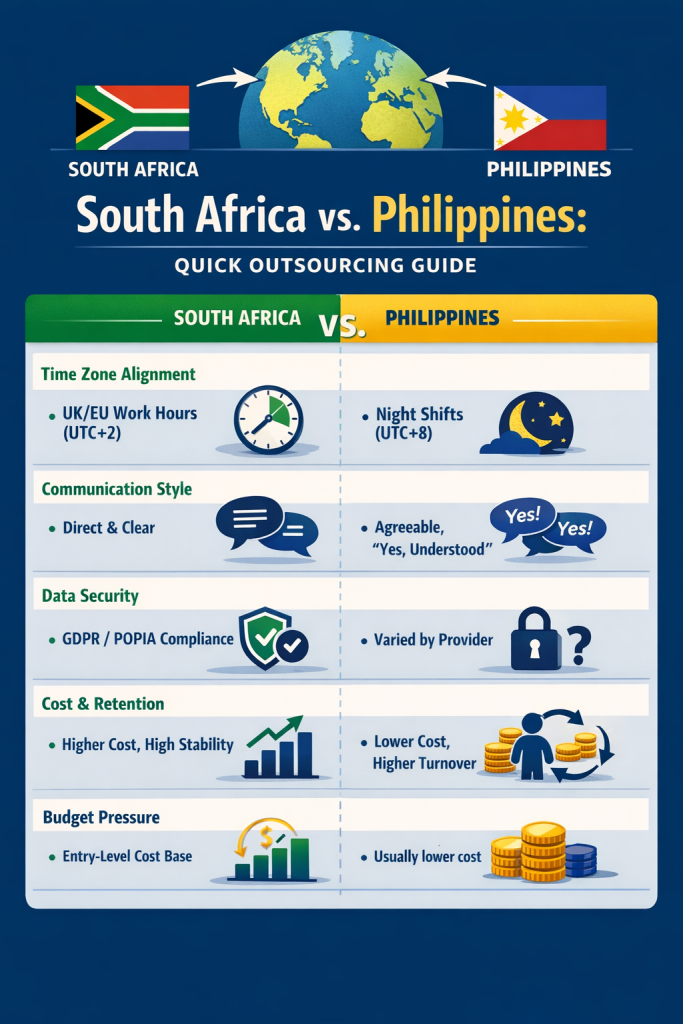
Quick Reference: The Decision at a Glance
Before diving into the full breakdown, here’s where each market stands:
| Factor | South Africa | Philippines |
|---|---|---|
| Monthly cost range | $900 to $3,200+ | $500 to $1,800+ |
| Best timezone match | UK, Europe, East Africa | US, APAC, Middle East |
| Core strengths | Finance, legal, executive support, complex problem-solving | Admin volume, CX, data ops, e-commerce, structured back-office |
| Communication style | Outcome-based, direct, Western-aligned | Process-driven, SOP-strong, service-oriented |
| Grid stability (2026) | Stabilized — 300+ consecutive days free of load-shedding | Solid fiber in major cities; typhoon season risk June through November |
| Regulatory alignment | POPIA aligns directly with GDPR | Data privacy frameworks continue developing |
The Market Context: Two Very Different BPO Histories
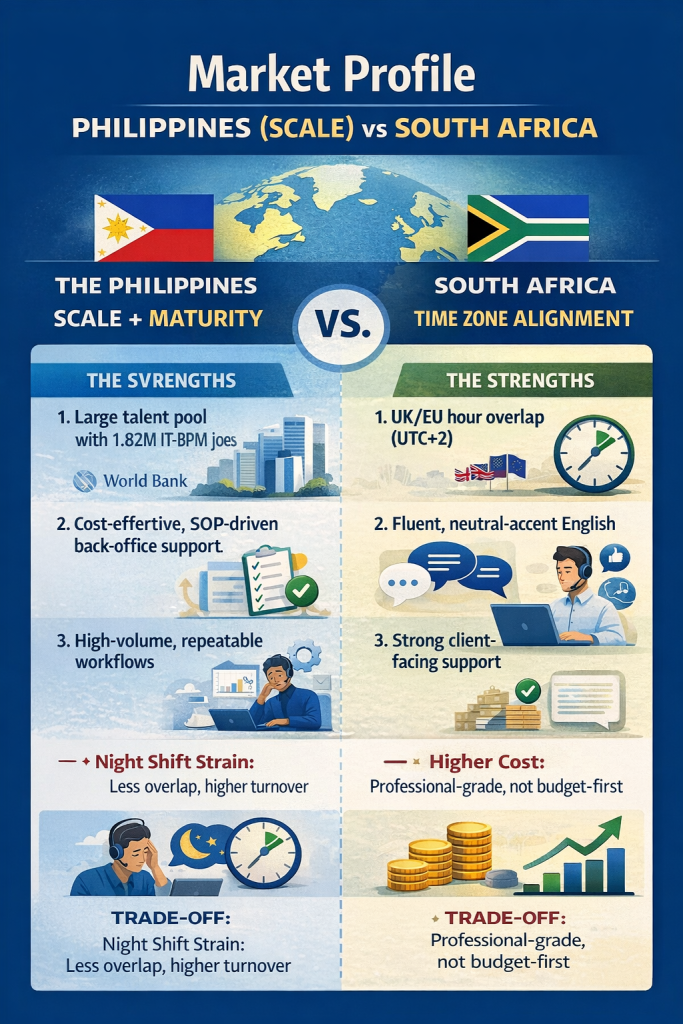
The Philippines built its outsourcing reputation on scale. IBPAP (IT-Business Process Association of the Philippines) reports the sector generated over $40 billion in revenue in 2025 and now employs approximately 1.9 million professionals. That’s not a niche talent market. That’s a mature industrial ecosystem that has been the world’s top voice-based BPO destination for more than two decades.
The country got there by leaning hard into what it does best: English-language customer service at volume. The model that built the industry was American multinationals needing overnight call center coverage, and Filipino workers proved exceptionally suited to it. They’re culturally service-oriented, highly trainable, and comfortable with American idioms, references, and communication styles.
South Africa took a different path. The country’s outsourcing sector, anchored by industry body BPESA, employs roughly 270,000 people directly, a fraction of the Philippines’ footprint. But it hasn’t tried to compete on volume. Ryan Strategic Advisory, which runs one of the most cited annual surveys in offshore customer experience, ranked South Africa the top offshore CX destination for English-language markets for four consecutive years. The differentiator isn’t price. It’s accent, cultural alignment with European and British clients, and the communication style that works for complex, judgment-heavy interactions.
These aren’t the same market. One optimized for scale; the other for quality in specific segments. Understanding that difference tells you most of what you need to know before you look at a single CV.
What Things Actually Cost
The persistent myth in outsourcing is the “50-70% cost savings” figure that has appeared in industry articles for 15 years. It’s not inaccurate, it’s just useless on its own, like saying real estate is “much cheaper outside New York.” What matters is the specific number for the specific role you’re hiring.
Here’s a realistic breakdown, based on current market rates:
Filipino talent (monthly, full-time):
- General administrative VA: $500 to $900
- Executive assistant or project coordinator: $800 to $1,400
- Social media manager or content coordinator: $700 to $1,200
- Bookkeeper or accounts payable support: $700 to $1,100
- Technical support or software QA: $1,000 to $1,800
- E-commerce VA (Amazon Seller Central, Helium 10, Jungle Scout-proficient): $700 to $1,300
South African talent (monthly, full-time):
- General administrative VA: $900 to $1,400
- Executive assistant: $1,200 to $2,000
- Financial analyst or senior bookkeeper (Xero, Sage, QuickBooks): $1,500 to $2,800
- Legal or compliance support: $1,800 to $3,200
- Marketing strategist: $1,400 to $2,400
- Operations coordinator or project manager: $1,300 to $2,200
Compare those figures to hiring equivalent roles in the UK, US, or Australia and the savings run 40 to 65% across most categories. That holds up. The more pointed question is how the two markets compare to each other.
South Africa runs 20 to 40% more expensive than the Philippines across equivalent roles. Whether that premium is justified depends entirely on what the role demands. For high-volume, repeatable tasks, inbox management, CRM hygiene in HubSpot or Salesforce, data entry, basic ticket resolution, you don’t need a more expensive hire. But for roles requiring independent judgment, complex client interaction, or deep domain expertise, the South African market carries a skills premium that frequently pays for itself.
The ZAR-to-USD dynamic matters here too. The rand has weakened consistently against hard currencies over the last decade. As a USD or GBP employer, your purchasing power in the South African market is structurally strong. You’re hiring someone earning a professional wage within their own economy while your cost in hard currency stays competitive.

Timezones, Business Type, and Where Each Market Wins Operationally
South Africa operates on SAST, South Africa Standard Time, GMT+2, year-round. No daylight saving, which makes scheduling predictable. For a UK-based business, a South African team member is two hours ahead in winter and one hour ahead during BST. They share your working day almost entirely. A 9am standup in London is 11am in Cape Town. No scheduling gymnastics, no late-evening overlap sessions.
For mainland European businesses on CET (GMT+1) or CEST (GMT+2), the alignment is even tighter. A South African executive assistant handling European client calls, financial reporting, or calendar coordination works an essentially equivalent business day. East African and Middle Eastern businesses on UAE time (GMT+4) get roughly six hours of daily overlap with a South African hire on standard hours.
The Philippines runs on PHT, GMT+8. For a UK-based business, Manila starts work at 1am London time. For a US East Coast business on EST (GMT-5), the gap is 13 hours. These numbers aren’t disqualifying, they define a different operational use case. A US SaaS company needing overnight CX coverage uses Filipino day shifts to solve a problem that would otherwise require expensive US-based night shift premiums. An APAC-focused business managing vendors across Singapore and Hong Kong finds Manila’s timezone directly aligned with their entire client base.
This timezone logic maps cleanly to work type:
South African talent in your UK or EU timezone handles executive functions, client-facing coordination, and judgment-heavy tasks during your business hours. Work gets assigned, executed, and reviewed the same day.
Filipino talent covering your US or APAC timezone handles structured, process-driven operations, customer support queues, data entry runs, CRM maintenance, e-commerce back-office work, while you’re offline. You start the next day with completed work.
Most growing businesses eventually need both.
Operational Reality: Infrastructure
South Africa: The Grid Has Turned
Load-shedding was, for years, the most cited operational risk of hiring in South Africa, and the concern was legitimate. At its worst, Eskom’s rolling blackouts reached Stage 6 in 2022 and 2023, meaning scheduled outages of up to six hours per day affected workers across the country.
The picture in 2026 is fundamentally different. Eskom has now achieved over 300 consecutive days free from load-shedding, driven by a sustained generation recovery and improved plant availability. The structural vulnerabilities that created the crisis haven’t completely disappeared — South Africa still needs new generation capacity, but the daily operational disruption that defined 2022 through 2023 doesn’t reflect current ground reality.
At Aristo Sourcing, we still require backup infrastructure verification for every South African candidate. Not because load-shedding is an active daily crisis, but because operational resilience is a baseline standard regardless of national grid status. Fiber internet (which stays active during any power disruption, since the fiber infrastructure itself isn’t shed) alongside inverter or UPS backup power are standard requirements in our vetting process. This ensures our South African hires maintain full connectivity through any edge-case disruption, not just the grid conditions of a particular month.
Philippines: Weather Risk and Regional Variation
The Philippines sits in the Pacific typhoon belt. Typhoon season runs June through November, and a severe storm can knock out power and connectivity across entire regions for days. Typhoon Odette in late 2021 left parts of Cebu and Visayas without power for weeks, grounding remote teams mid-project with little warning.
This is a different risk profile from South Africa’s historical load-shedding. Lower frequency, higher severity when it hits. The mitigation is largely geographic: Metro Manila and Cebu City have solid fiber infrastructure and faster recovery capacity. Some second-tier cities where labor costs are lower carry more connectivity risk during major weather events.
The Philippines’ internet infrastructure has improved substantially over the last five years through targeted government investment in fiber rollout. But regional variation remains real, and location verification during hiring matters as much as skills verification.
How Work Actually Gets Done: Culture Without the Academic Framing
Strip out the textbook frameworks and here’s what actually matters for day-to-day management:
Filipino VAs excel when you give them structured, well-documented playbooks. Feed them a clear SOP, a consistent workflow inside Asana or ClickUp, and a defined scope, and they’ll execute with precision and consistency. They’ll run HubSpot or Salesforce exactly the way you’ve configured it, follow the escalation path you’ve documented, and deliver reliably within established parameters. The communication style is service-oriented. They complete the task as instructed and don’t default to challenging the process.
The management implication: build explicit feedback loops into your rhythm. Don’t wait for a Filipino team member to surface a problem unprompted. A weekly process check with a direct question “is there anything in the current workflow creating friction?” gets more useful answers than hoping issues rise organically.
South African professionals naturally adopt an outcome-based, consultative approach. Give them the goal and the context, and they navigate to the result without needing every step prescribed. They’re more likely to raise a concern before it becomes a problem, suggest a better process, or push back on an instruction that doesn’t make sense for the objective. The communication style sits closer to British or European professional norms; direct, proactive, and comfortable with horizontal dialogue.
The management implication: Give them room. Micromanaging a South African executive assistant who is capable of owning outcomes creates friction and turnover. Set the objective, define the constraints, and let them work.
Neither style is inherently superior. Both require intentional management. The difference is in what management structure you’re building and which one fits your leadership style.
Skill Alignment by Role: Where Each Market Has Real Depth
The Philippines’ talent pool deepened in specific directions through two decades of US-centric BPO work. The market has genuine depth in:
- High-volume customer support: ticket resolution, live chat, inbound CX managed through Zendesk or Freshdesk
- Data operations: entry, cleansing, CRM management, Salesforce and HubSpot administration
- E-commerce: Amazon VA work using Helium 10, Jungle Scout, and Seller Central; Shopify order management and product listing
- Social media management: scheduling, community engagement, basic content coordination
- Administrative coordination under structured SOP frameworks
- Bookkeeping support for clean, procedural accounts on QuickBooks or Wave
South Africa’s talent pipeline built differently, shaped by a university sector that produces graduates with rigorous training in finance, law, and business. The market has genuine depth in:
- Financial analysis and management accounting using Xero, Sage Business Cloud, and advanced QuickBooks
- Legal research, contract review, and compliance support — particularly relevant for businesses operating under GDPR or POPIA-adjacent requirements
- Executive assistance requiring sophisticated judgment, stakeholder management, and proactive initiative
- High-end copywriting and content strategy in British English
- Marketing strategy and campaign management with independent creative contribution
- Complex project coordination across multi-stakeholder environments
Matching the market to the role isn’t a nice-to-have. It’s the difference between a hire that compounds your capacity and one that adds a management burden you weren’t expecting.
The Hybrid Advantage: Why the Best Answer Is Usually Both
Here’s the point that most comparison articles never deliver.
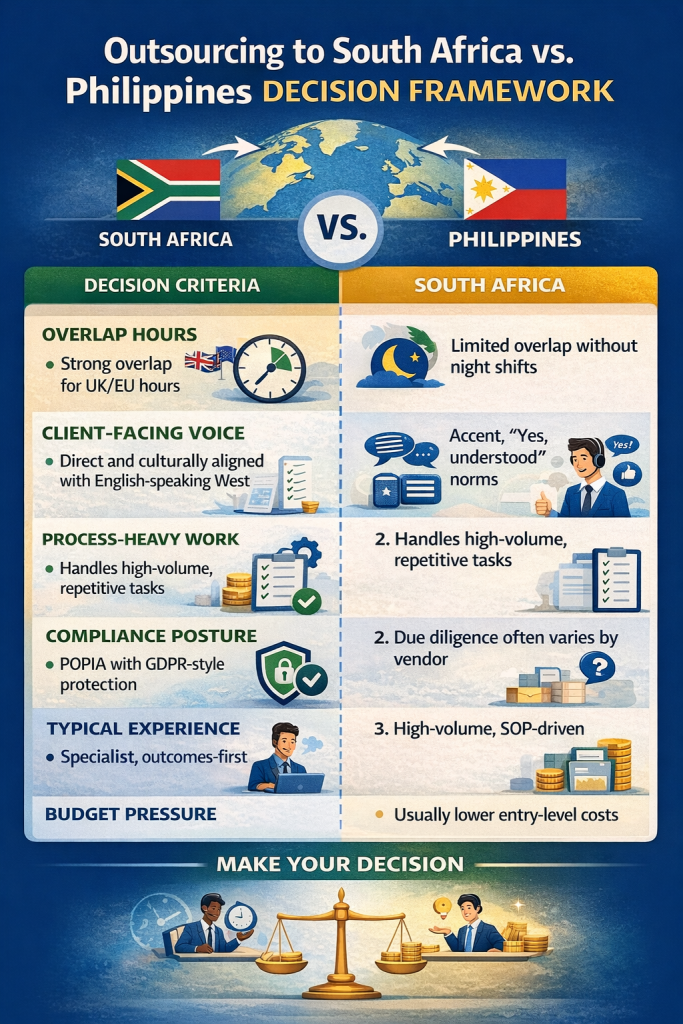
By 2026, the companies scaling most efficiently with remote talent aren’t choosing between South Africa and the Philippines. They’re running hybrid teams that match each talent market to the work it does best.
A UK-based financial services firm uses a South African senior financial VA working full UK business hours in Xero, producing client reports, coordinating with accountants alongside a Filipino data operations team processing transaction records, maintaining the CRM, and handling tier-one client queries during their overnight. One remote team. Two talent markets. Structured around work type rather than geography as a standalone filter.
A US e-commerce brand uses a Filipino VA managing Amazon Seller Central during Pacific business hours, a second Filipino VA handling customer support overnight on EST, and a South African marketing strategist whose Cape Town afternoon maps neatly onto US morning hours. The timezone arithmetic works. The skill profiles align. The cost structure is tiered against actual role complexity.
This is where Aristo Sourcing’s model differs from running parallel searches across two countries. We manage talent pools in both South Africa and the Philippines, and we build hybrid teams under a single engagement. One account relationship. Two talent markets. Calibrated to your specific function mix before the first hire goes out.
You don’t need to find a BPO agency in Manila and a separate staffing firm in Cape Town and manage two contracts with different vetting standards and different operational protocols. We apply consistent infrastructure requirements, skills assessments, and onboarding frameworks across both markets. The structure which talent type for which work gets built into the team design from day one, not discovered six months in when something isn’t working.
The Bottom Line
South Africa and the Philippines are not interchangeable. The article telling you both are excellent destinations with unique advantages isn’t wrong. It just does nothing for you.
South Africa is the right market when your clients are in Europe, when the work demands independent judgment, and when you need someone who operates like a genuine professional partner rather than a task executor. The cost premium is real and modest, and for the right roles, it’s not a premium at all — it’s the market rate for what you actually need.
The Philippines is the right market when cost optimization on volume drives the decision, when timezone alignment with North America or APAC matters, and when the work is structured, repeatable, and process-driven. The talent pool is deep, the infrastructure for remote work is mature, and the productivity model is proven.
What both markets require and this is what most businesses underestimate is clear process documentation, consistent management, and a hiring framework that starts with work type before it reaches geography. The wrong VA in the right country still underperforms. The right VA in the right country compounds your output in ways that change what your business can actually do.
If you want to map your specific role list against the right talent market before committing to a hire, that conversation takes about 20 minutes with Aristo Sourcing. Getting the decision right up front costs nothing. Getting it wrong twice costs considerably more. existing remote teams the right hiring strategy can turn global talent into a long-term competitive advantage.

Which country offers better English for virtual assistants?
Both markets produce excellent English speakers. South Africa frequently offers a neutral-accent advantage for voice roles — Everest Group highlights this specifically. The Philippines offers strong empathetic intonation and service-oriented communication suited to high-volume support environments.
Do I need to hire night-shift staff in the Philippines for UK clients?
Most UK teams will struggle with full UTC+8 overlap. Night shifts can solve coverage but structurally raise stress and retention risk in judgment-heavy roles. Design your workflow to minimise the night-shift dependency.
Why do some outsourced teams say “yes” but deliver the wrong thing?
Communication norms drive this. High-context cultures rely on implied meaning and harmony; disagreement can feel socially costly. Reduce errors by explicitly rewarding clarification and documenting decisions in writing.
Can South Africa handle high-volume support like the Philippines?
Yes. The Philippines dominates on scale and operational maturity for Tier 1 volume, but South Africa can run high-volume operations with strong SOPs and QA. The choice depends on whether your volume requires process throughput (Philippines advantage) or complex interaction handling (South Africa advantage).
Does POPIA make South Africa “GDPR compliant” automatically?
No. POPIA and GDPR share many conceptual foundations, but operational compliance still requires: access management, audit trails, vendor data processing agreements, and documented incident response. Do not conflate legal alignment with operational compliance.
Which destination fits sales support and appointment setting best?
South Africa fits UK, EU, and US East schedules more cleanly because UTC+2 overlaps without requiring night shifts. For sales roles requiring real-time conversation and decision-making, schedule alignment is a performance variable, not just a preference.
How do I estimate the real cost difference between the two markets?
Compare total outcome cost, not salary alone. Include: management time spent, correction cycles per month, turnover rate and retraining cost, tooling overhead, and compliance risk. Statista data shows a 20–35% salary differential in favour of the Philippines, but that gap narrows significantly when total outcome cost is calculated.
What roles should I never outsource without a tight process?
Any role touching money, credentials, regulated data, or direct client trust. Build SOPs, role-based access, and audit trails before you hire. The process comes before the person.
What does a good onboarding process look like for either country?
A written SOP for every task. A daily handoff format. Loom walkthroughs for judgment-heavy tasks. A shared task management system. Weekly QA reviews. A culture norm that rewards clarification over assumption.
When does the hybrid model beat a single-country team?
Hybrid wins when you run both client-facing and high-volume process work, or when you need resilience across multiple markets. It lets you buy overlap quality where it matters and cost efficiency where it counts. The functional arbitrage principle, matching talent ecosystems to operational needs, is the framework that makes this work.
What industries are best suited to each market?
E-commerce, real estate, healthcare administration, and SaaS operations typically suit the Philippines due to structured, SOP-driven workflows. Fintech, telecommunications, travel, and professional services frequently benefit from South Africa’s communication precision, escalation capability, and European time-zone alignment.
Your Next Step
Ready to build the right team for your business? Aristo Sourcing offers free consultations to help you select the right country for each function using a capability-first, role-matched approach. Book a free consultation.
