

Running an eBay store past a certain point stops being about selling and starts being about managing. Listings need constant optimization. Inventory needs monitoring across multiple channels. Buyers expect responses within two hours. New products need researching, photographing, titling, and uploading before a competitor gets there first.
Most sellers hit a ceiling not because demand dries up but because one person cannot maintain the operational volume that growth requires. An eBay virtual assistant from Aristo Sourcing handles the execution layer so you can focus on the decisions that actually move the business.
Book a free discovery call to discuss your store’s needs.
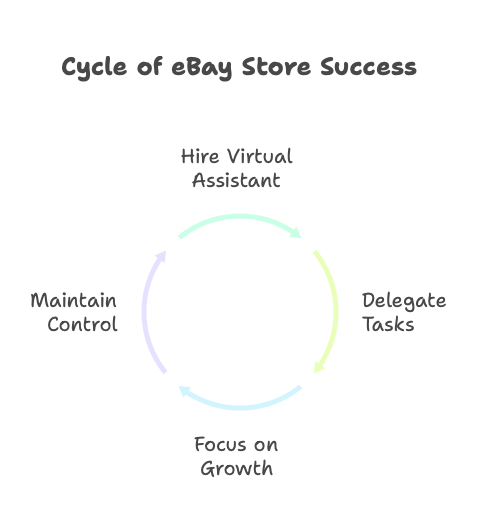
What Sets a Specialist eBay VA Apart From a General Virtual Assistant
A general virtual assistant can answer emails and manage a calendar. An eBay specialist VA understands Cassini, knows how item specifics affect search placement, and builds a listing that converts on Best Match ranking rather than just looking presentable.
The difference matters because eBay’s marketplace operates on mechanics that generalists do not know. Terapeak data informs title construction. ZIK Analytics shapes sourcing decisions. InkFrog manages cross-platform syncing without triggering duplicate listing flags. SKU Grid monitors competitor pricing and fires repricing rules automatically. These are not tools a general VA uses. They are the tools your store needs someone to operate every day.
Aristo Sourcing places VAs with verified experience across the eBay operational stack, not assistants learning on your inventory.
Core eBay VA Competencies: The Full Operational Stack
| Functional Role | Specialist Tools | Key Performance Indicator |
|---|---|---|
| Product Sourcing and Research | Terapeak, ZIK Analytics, Keepa, ZeDrop | Gross profit margin per sourced item |
| Listing Optimization | InkFrog, eBay Bulk Listing Tool, eBay Seller Hub | Impression-to-click conversion rate |
| Inventory and Supplier Sync | AutoDS, SKU Grid, Webgility | Out-of-stock cancellation rate |
| Customer Order Triage | eBay Resolution Center, Zendesk, Freshdesk | First-response time (target: under 2 hours) |
| Pricing and Reprice Management | SKU Grid, AutoDS repricing rules | Competitive price positioning vs. Best Match |
| Feedback and Defect Management | eBay Seller Hub, Resolution Center | Defect rate, late shipment rate, and Top Rated status |
Listing Optimization That Works With Cassini, Not Against It
eBay’s Cassini search algorithm ranks listings based on a combination of title relevance, item specifics completeness, seller performance metrics, and historical conversion data. A VA who understands this builds listings differently than one who does not.
The workflow looks like this. Your VA pulls category-specific keyword data from Terapeak to identify the highest-velocity search terms buyers actually use. They construct the title within eBay’s 80-character limit, placing primary keywords at the front and avoiding keyword repetition that Cassini penalizes. They complete every relevant item specific in the listing form, the fields most sellers ignore, but that Cassini weighs heavily in filtered search results.
For sellers managing large catalogs or cross-posting to Amazon, Etsy, or Shopify, your VA manages listings through InkFrog, which syncs inventory quantities and listing status across platforms without manual updates. When an item sells on eBay, InkFrog updates the other channels automatically, eliminating the oversell risk that generates defects and damages seller metrics.
The result: listings that rank higher, convert better, and do not create the performance violations that erode Top Rated Seller status over time.
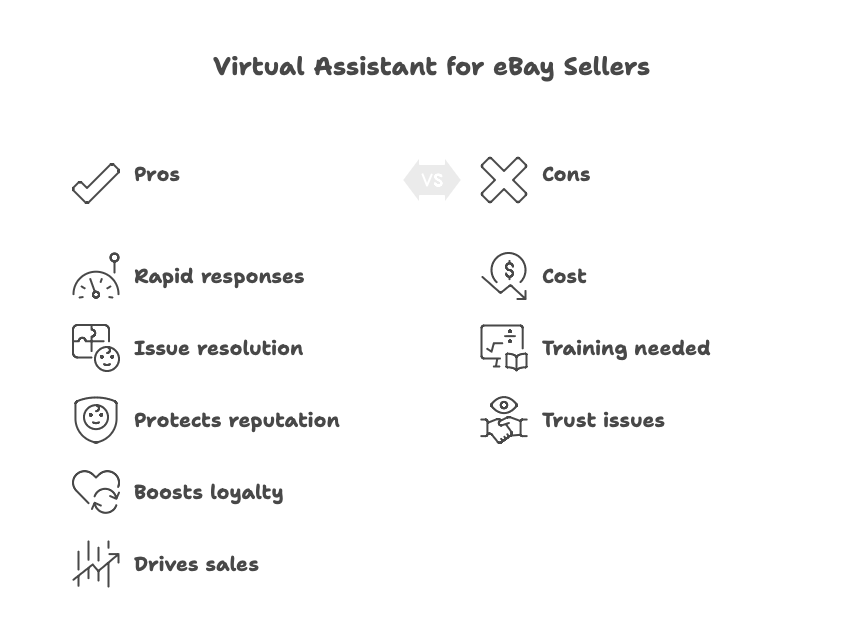
Product Sourcing and Competitive Intelligence
Your VA monitors active sourcing channels daily: AliExpress, Alibaba wholesale suppliers, ZeDrop dropshipping feeds, and direct manufacturer contacts. New products get assessed against margin thresholds before any listing gets built. Products that fail the margin test do not make it onto the store.
Reverse-Sourcing Mastery: How Our VAs Extract Competitor Data
The sourcing workflow a specialist VA runs is more systematic than most store owners realize. Rather than browsing eBay for product ideas, an experienced VA runs a structured reverse-sourcing process that starts with what is already selling at volume.
Using ZIK Analytics, your VA identifies the highest-volume stores in a target category and extracts their top-performing listings over the previous 30 days. The data shows units sold, revenue generated, average sell-through rate, and the number of competing sellers listing the same product. This gives a clear picture of market saturation before any sourcing decision is made.
From there, the VA cross-references the shortlisted products against Terapeak’s historical data to assess price trend stability. A product that has been selling at a consistent margin for 18 months is a safer sourcing decision than one that appeared three months ago and may reflect a short-lived trend. Keepa’s price history charts, originally built for Amazon research, add another dimension for cross-marketplace products, showing whether the item’s retail price is holding stable or declining across both platforms.
Once a product passes market validation, the VA sources it against private label suppliers, wholesale distributors, or AliExpress and Alibaba listings, comparing landed costs against the eBay average selling price to calculate a realistic gross profit margin after fees. Only products clearing a pre-defined margin threshold move to the listing stage.
This entire workflow runs without the store owner’s involvement. The VA delivers a sourcing report, typically weekly, listing validated products with margin calculations, competition analysis, and a recommendation. The store owner approves or rejects. The VA lists.
Inventory Management and Supplier Coordination
Inventory failure costs eBay sellers in two specific ways: out-of-stock cancellations that push defect rates above eBay’s performance thresholds, and overstock that ties up capital in slow-moving product. Both are preventable with the right monitoring structure.
Your VA monitors live stock levels through the SKU Grid, which fires repricing and restocking alerts based on thresholds you set. For dropshipping operations, AutoDS handles supplier syncing, automatically updating prices and availability from AliExpress, Alibaba, or wholesale suppliers when source prices change. For multi-channel sellers, Webgility synchronizes inventory counts across eBay, Amazon, and Shopify in real time, so a sale on any channel updates every other channel immediately.
Your VA also manages supplier relationships directly: purchase order communication, shipment tracking updates in Seller Hub, and escalation to you when a supplier issue requires a commercial decision. You see the outcome. You do not spend your morning chasing tracking numbers.
Master SKU Architecture for Multi-Channel Scaling
Multi-channel selling creates a specific inventory problem: the same physical product carries different listing IDs on eBay, Amazon, and Shopify, and none of those platforms communicate with each other natively. An oversell on one channel generates a cancellation defect on another, and defect rates affect listing visibility across every platform where you sell.
The architecture your VA builds to solve this uses InkFrog as the cross-platform listing layer and Webgility as the inventory synchronization layer. Each product in your warehouse gets assigned a master SKU, a single identifier that maps to every individual platform listing. When a unit sells on any channel, Webgility subtracts it from the master inventory count and updates the quantity available on every other platform within minutes.
Your VA also configures safety stock buffers, minimum inventory thresholds below which listings drop to zero quantity automatically, even if physical stock remains. This protects against the scenario where simultaneous purchases on two channels both process against the same last unit. For high-velocity items during peak periods like Black Friday or the holiday weeks, your VA adjusts buffer settings proactively based on historical sell-through rates.
The result is a multi-channel operation that scales without generating the defects and cancellations that erode seller metrics on each platform.
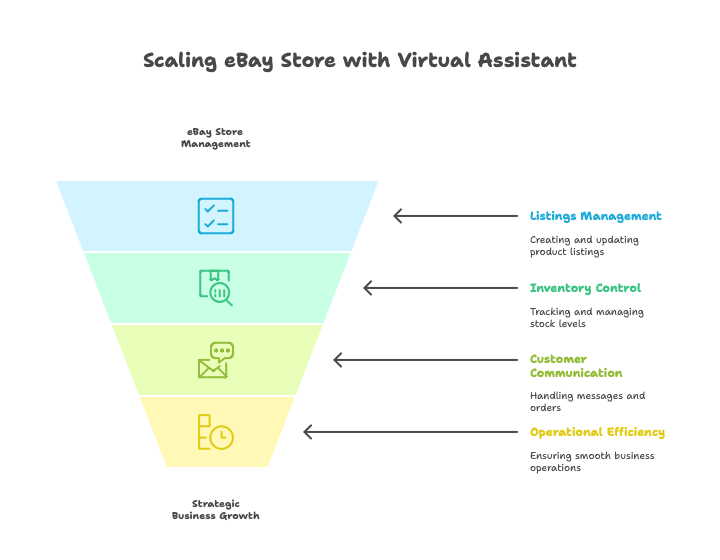
Customer Service That Protects Your Seller Metrics
eBay’s buyer satisfaction standards are specific and unforgiving. A defect rate above 2%, a late shipment rate above 10%, or a cases-closed-without-seller-resolution rate above 0.3% costs you Top Rated Seller status and reduces listing visibility across the board.
Your VA manages the full customer communication cycle with those metrics in mind. Inbound messages receive a first response within two hours, which Salesforce research identifies as the response time 90% of buyers consider important. Returns and claims get processed through the eBay Resolution Center before they escalate to cases. Negative feedback receives a professional response that demonstrates accountability without admitting liability.
For higher-volume operations, your VA uses Zendesk or Freshdesk to triage support queues, categorize ticket types, and maintain a response template library for the 15 to 20 most common buyer queries. Every interaction gets logged. Patterns that suggest a product quality issue, a supplier problem, or a listing accuracy gap get flagged to you before they accumulate into a performance violation.
Defending Your Store Against Fraud and False Claims
High-volume eBay stores attract a specific category of buyer behavior that standard customer service training does not cover: fraudulent Item Not Received claims, return swaps where a buyer sends back a different item than the one purchased, and chargeback attempts that contradict carrier tracking records.
Each scenario requires a specific response protocol that your VA executes without involving you unless the situation reaches a defined escalation threshold.
For Item Not Received claims where carrier tracking confirms delivery, your VA pulls the tracking confirmation from the carrier portal, captures the delivery scan with GPS coordinates where available, and submits this documentation through the Resolution Center within the 3-day response window. Where a buyer continues to dispute a confirmed delivery, your VA files an IC3 internet crime report through the FBI’s Internet Crime Complaint Center and provides eBay’s Trust and Safety team with the case number. eBay takes documented fraud reports significantly more seriously than unsubstantiated seller assertions.
For return swap cases, where a buyer returns a different item than the one originally sold, your VA photographs the returned item immediately, documents the discrepancy against the original listing, and opens an appeal through the Seller Resolution Center with timestamped visual evidence. Successful appeals at this stage consistently include an unboxing photo sequence and a written condition discrepancy report.
For false defects and inaccurate negative feedback, your VA submits a formal feedback revision request with supporting order documentation. Where revision is declined, they draft a professional public response that addresses the claim factually, which protects your store’s reputation for buyers reading feedback without escalating a dispute that has already been resolved.
eBay Compliance and Account Security
This section addresses something most eBay VA agencies skip entirely, and it is the section that high-volume sellers care about most.
eBay’s VeRO (Verified Rights Owner) program removes listings that infringe intellectual property rights without warning and without appeal in most cases. A VA who does not know VeRO will eventually list something that triggers a removal. Aristo Sourcing VAs receive training on VeRO compliance and follow a structured pre-listing check protocol for every category that carries elevated IP risk.
Account access uses eBay’s Multi-User Account Access (MUAA) system, which allows you to grant a VA access to specific Seller Hub functions without sharing the master account password. Your VA operates through its own MUAA credentials. Your primary account password never leaves you. If the working relationship ends, you revoke access through Seller Hub in under five minutes without a password reset and without disrupting any connected platform integrations.
Additional credential management runs through LastPass or 1Password. Your VA accesses only the systems their role requires, through password-sharing protocols that do not expose underlying credentials. This protects not just your eBay account but every connected platform: your payment processing, your supplier accounts, your repricing tools, and your multi-channel listings manager.
The 3-Step Pre-Listing Compliance Protocol for High-Risk Categories
Not all eBay categories carry equal VeRO risk. Consumer electronics, luxury accessories, automotive parts, and branded clothing sit in the highest-risk tier, categories where trademark holders actively monitor eBay and submit removal requests through VeRO regularly. A listing pulled under VeRO does not generate a warning first. It disappears, and repeated violations accumulate toward account restrictions that affect every listing in your store.
Your VA runs a three-step compliance check before publishing any listing in a high-risk category.
- Step 1: VeRO Database Search. The VA searches eBay’s official VeRO participant list for the brand associated with the product. If the brand is a registered VeRO participant, the VA verifies that your store holds an authorized reseller agreement before the listing goes live. Without authorization documentation on file, the listing stays off the platform.
- Step 2: Supplier Authorization Verification. For products where authorization is claimed, the VA verifies the supplier’s reseller certificate or brand authorization letter against the brand’s official authorized reseller list, which is publicly maintained. Grey market goods frequently come with legitimate-looking paperwork that passes visual inspection but fails supplier chain verification.
- Step 3: Image and Description Originality Check. Manufacturer product images carry copyright independently of trademark protections. Your VA runs listing images through a reverse image search to confirm they do not appear on manufacturer websites marked as proprietary. Where manufacturer images are unavoidable, the VA checks eBay’s image use policy for the specific category and, where required, uses original photography or licensed alternatives.
This three-step process adds time to the listing workflow. It also prevents the account violations that cost significantly more time to reverse.
The Time-Zone Advantage for 24/7 Store Coverage
eBay operates globally, in 23 countries. Buyers message at 11 pm. Supplier confirmations arrive at 3 am. A pricing opportunity opens at 6 am before your local competitor opens their laptop.
Aristo Sourcing places VAs primarily in South Africa (GMT+2) and the Philippines (GMT+8). A South African VA maintains strong working hours that overlap with UK and European sellers while covering US evenings as part of a structured handover. A Filipino VA serves US sellers during their night hours, producing a genuine around-the-clock coverage model for high-volume operations.
The practical effect: buyer messages receive responses outside your working hours, positive feedback requests go out at optimal times for response rates, and pricing adjustments in the SKU Grid happen when market conditions shift rather than when you get around to them.
What This Costs Compared to What It Returns
Research from remote staffing platforms Aristo Law, Virtual Staff South Africa, and Time Etc places the cost of a managed VA engagement at up to 78% less than an equivalent local hire when you account for salary, employer taxes, benefits, equipment, and office overhead. The Society for Human Resource Management estimates the loaded cost of a full-time employee at 1.25 to 1.4 times base salary. An eBay VA on a managed placement model eliminates most of that overhead.
The return side of the calculation is specific to your store. A VA who maintains your defect rate below the Top Rated threshold protects a listing placement advantage that translates directly to impressions and sales volume. A VA who processes buyer messages within two hours improves satisfaction scores that influence Best Match ranking. A VA who monitors competitor pricing and fires repricing rules in the SKU Grid keeps you competitive without requiring you to watch the market manually.
These are not soft benefits. They are the mechanics of eBay store performance, and a specialist VA runs them every day. Talk to Aristo Sourcing about what an eBay VA engagement looks like for your store.
Frequently Asked Questions
What does an eBay virtual assistant do day to day?
An eBay VA handles listing creation and optimization using Terapeak keyword data, manages inventory through AutoDS or SKU Grid, responds to buyer messages within defined SLA windows, processes returns through the Resolution Center, monitors seller metrics in Seller Hub, and delivers a daily report on store performance against your agreed KPIs. For sourcing-focused roles, they run weekly ZIK Analytics competitor extractions and deliver a validated product report for your approval.
How does an eBay VA access my account without exposing my password?
eBay’s Multi-User Account Access (MUAA) system lets you grant a VA access to specific Seller Hub functions using their own login credentials. Your master password stays with you at all times. If the working relationship ends, you revoke the VA’s access through Seller Hub without a password reset and without disrupting any connected integrations. Credential management for all other tools runs through LastPass or 1Password.
What happens if my VA lists something that violates VeRO?
Aristo Sourcing VAs follow a three-step pre-listing compliance protocol for high-risk categories: VeRO database verification, supplier authorization document review, and image originality checking. If a listing gets removed despite these checks, your VA follows an escalation procedure that includes documenting the removal, investigating the root cause, and flagging the product category for your review before any re-listing attempt.
Can an eBay VA manage a dropshipping operation?
Yes. VAs with dropshipping experience use AutoDS or ZeDrop to sync supplier pricing and inventory, monitor AliExpress and Alibaba sourcing channels for price changes, manage supplier communication, and handle the fulfillment coordination between buyer orders and supplier dispatch. For multi-channel dropshipping, they configure Webgility’s master SKU architecture and safety buffer thresholds to prevent oversell defects.
How does your VA handle fraudulent buyer claims?
Your VA follows a structured fraud response protocol. For Item Not Received claims with confirmed delivery tracking, they submit carrier evidence through the Resolution Center and, where the dispute continues, file an IC3 fraud report to support an eBay Trust and Safety escalation. For return swap cases, they photograph the returned item, document the discrepancy, and open a Seller Resolution Center appeal with visual evidence. For false defects, they submit a feedback revision request and, where declined, draft a factual public response.
How long does it take to onboard an eBay VA?
Most operations reach a productive working rhythm within 30 days when onboarding includes documented processes and a structured handover. Aristo Sourcing builds the onboarding framework before the VA starts, covering tool access configuration through MUAA, SOP documentation for your store’s specific workflows, communication protocols, and performance benchmarks tied to your seller metrics.
What seller metrics does an eBay VA actively protect?
A specialist VA monitors and protects four core metrics: defect rate (target below 2%), late shipment rate (target below 10%), cases closed without seller resolution (target below 0.3%), and first-response time to buyer messages (target under 2 hours). These are the metrics eBay uses to determine Top Rated Seller status and listing placement in Best Match results.
Can one VA handle multi-channel selling across eBay, Amazon, and Shopify?
For lower-volume multi-channel operations, yes. A VA using InkFrog and Webgility can maintain synchronized listings and master SKU inventory counts across platforms, configure safety stock buffers, and manage repricing rules on each channel independently. For higher-volume operations with distinct platform requirements, a multi-VA structure with channel-specific responsibilities produces better results and cleaner metric separation.
For a broader view of the operational systems a professional VA manages behind the scenes of an e-commerce business, read the full guide: What Virtual Assistants Do Behind the Scenes to Help You Grow
