

Many companies do not stall because of weak sales or poor demand. Growth often slows because communication sits in the wrong place inside the business. In many startups, the entire system depends on one person. That person is the founder.
At the early stage, this setup works. One leader sends updates, answers clients, manages the team, and approves key decisions. As the company grows, that structure breaks. Work slows, teams wait for answers, and strategy disappears behind daily messages.
This pattern creates what many operators now call the Founder Bottleneck. It happens when the company’s communication, knowledge, and decisions flow through one executive.
Companies solve this problem by building a communications layer. This layer creates structure around internal knowledge management, team coordination, and external stakeholder communication. Many founders build this layer with a chief of staff or executive virtual assistant sourced through Aristo Sourcing, whose core model focuses on high-level delegation through skilled virtual assistants.
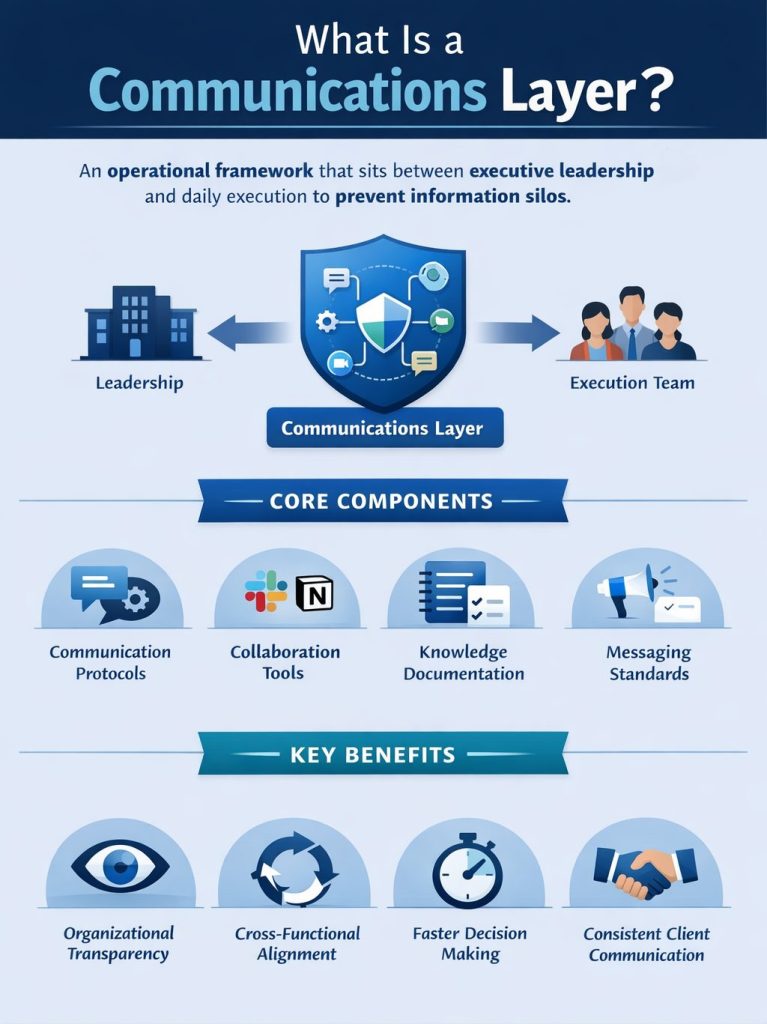
What Is a Communications Layer?
A communications layer is an operational framework that organizes how information moves across a company.
It includes:
- Communication protocols
- Collaboration tools
- Knowledge documentation
- Messaging standards
- A coordinator who manages information flow
This layer sits between leadership and execution.
Without it, the company relies on memory, chat threads, and constant interruptions.
With it, the business gains:
- Organizational transparency
- Cross-functional alignment
- Faster decisions
- Consistent client communication
Research supports this shift. McKinsey reports that companies with strong communication systems improve productivity by 20% to 25%. Harvard Business Review also notes that leaders spend close to 70% of their time communicating in some form.
When one person handles most of that load, growth slows.
The Operator vs. Strategist Transition
Every founder begins as an operator.
Operators build the business directly. They sell, solve problems, answer questions, and keep projects moving.
Growth requires a shift.
The company eventually needs a strategist.
A strategist focuses on:
- Market direction
- Partnerships
- Product evolution
- Hiring leaders
- Long-term growth
Many companies fail during this transition because communication never moves away from leadership.
At the startup phase, a visionary often becomes the main clearinghouse for organizational data. The CEO drafts investor updates, manages internal channels, reviews marketing content, and answers client requests. Each new message adds pressure to the system.
Growth creates a simple equation:
More employees create more communication paths.
When ten people work in a company, communication paths expand quickly. When the founder remains the central node, the company hits a ceiling.
This issue does not reflect poor leadership. It reflects missing infrastructure.
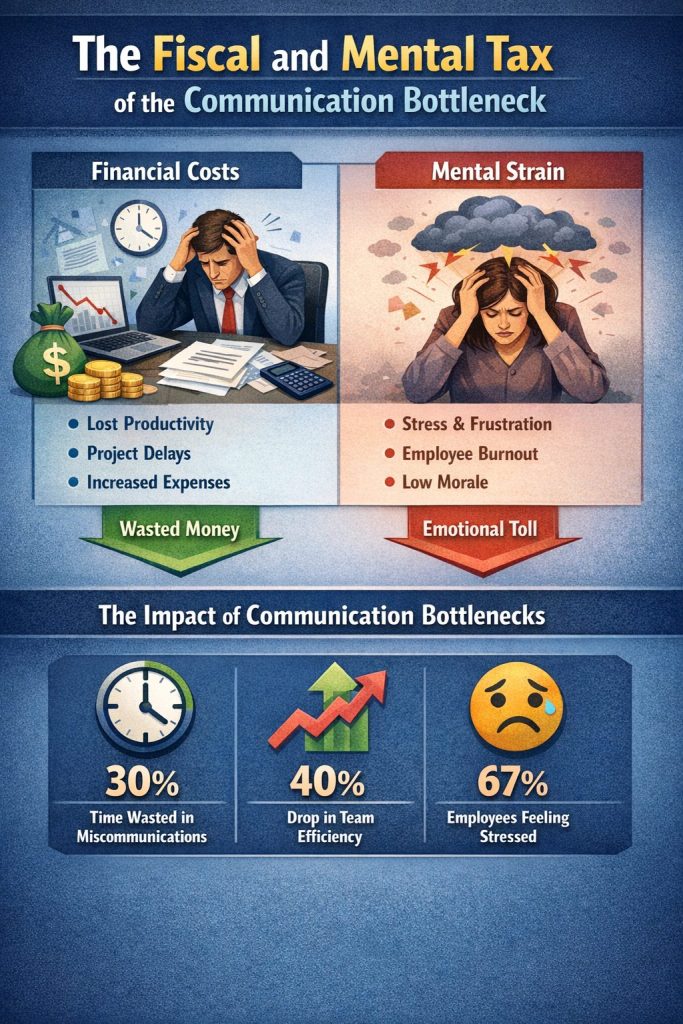
The Fiscal and Mental Tax of the Communication Bottleneck
The cost of poor communication appears in both money and energy.
Leaders lose focus when messages interrupt deep work. Research from the University of California, Irvine shows that workers need about 23 minutes to return to full focus after an interruption. Research from RescueTime reinforces this: knowledge workers check email or messaging apps every six minutes on average. A founder who answers dozens of messages per day rarely reaches deep strategic thinking.
The financial cost also grows.
Salesforce research shows that 86% of employees and executives link workplace failure to poor communication or weak collaboration. Gallup studies also show that disengaged teams cost companies billions in lost productivity each year.
Communication breakdown leads to:
- Project delays
- Client frustration
- Team confusion
- Missed opportunities
- Employee turnover
Many founders treat these symptoms as hiring issues or operational mistakes. In reality, the company lacks a structured communications architecture.
When information remains trapped inside leadership, the organization slows down.
The Hidden Risk: Information Silos
Information silos form when knowledge stays locked in one place or inside one person’s mind.
This problem often grows silently inside startups.
For example:
- A sales team closes deals without sharing key details with delivery teams.
- Marketing promises features that product teams never planned.
- New hires struggle because documentation does not exist.
These gaps reduce trust and efficiency.
Strong companies treat knowledge as infrastructure. They document decisions, standardize updates, and organize information clearly.
This process improves organizational transparency, a major factor in scaling teams.
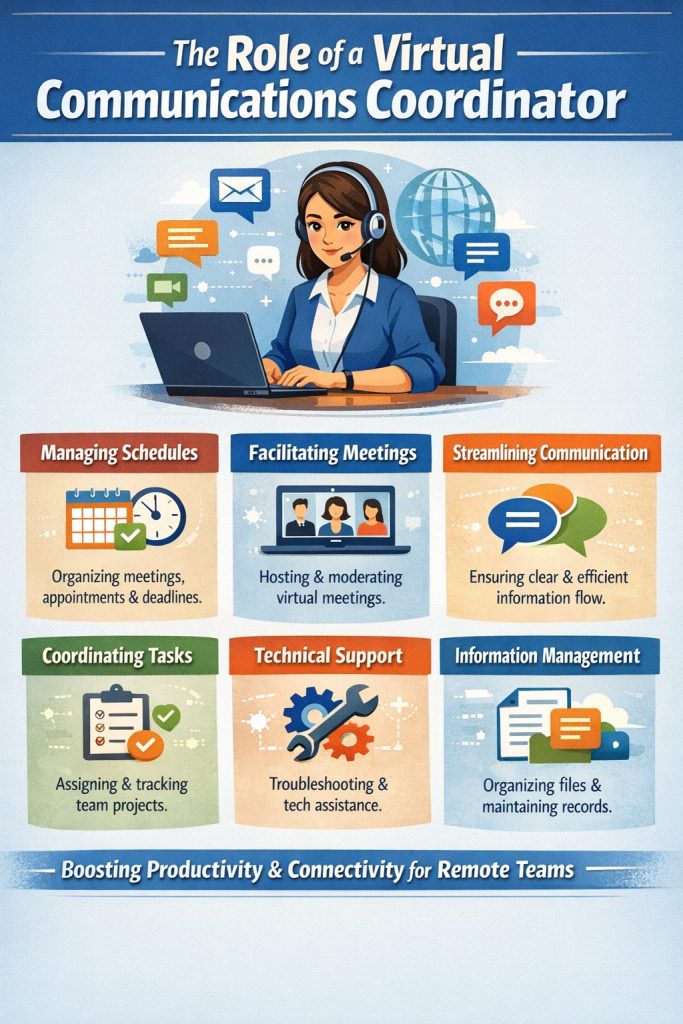
The Role of an Executive Virtual Assistant
An Executive Virtual Assistant acts as the company’s Information Architect.
This role manages the movement of knowledge across the business. Instead of leadership handling daily communication tasks, the VA organizes and distributes information across teams.
This role supports:
- Internal communication systems
- Client lifecycle communication
- Knowledge management
- Cross-team alignment
- Meeting documentation
- Brand voice consistency
The VA does not replace leadership. The role amplifies leadership by ensuring the right message reaches the right people at the right time.
Among founders Aristo Sourcing has supported across 500+ placements, the three most commonly delegated communication tasks in the first 30 days are inbox triage, client update drafting, and meeting documentation. These three tasks alone recover an average of 10 to 15 hours of founder time per week.
Many scaling companies now treat this role as essential.
Different businesses need different variations of this role. The table below clarifies which hire fits which stage:
| Role | Primary Function | Best Fit |
|---|---|---|
| Communications VA | Inbox triage, client comms, internal updates, meeting notes | Founders with 5–15 person teams |
| Executive Virtual Assistant | Scheduling, stakeholder communication, decision documentation, project coordination | Founders scaling from 15–30 people |
| Remote Chief of Staff | Strategic projects, cross-team coordination, leadership leverage | Founders beyond 30 people or multiple business lines |
Asynchronous Communication: The Key to Scaling
Modern companies rely heavily on asynchronous communication. This system allows teams to work without waiting for immediate responses.
Examples include:
- Recorded updates
- Documented decisions
- Task boards
- Structured messaging channels
Asynchronous systems increase productivity across remote teams.
GitLab, one of the world’s largest remote companies, built its operations on this principle. GitLab’s approach is specific: every significant decision gets documented in a merge request or handbook page before it is acted on. Leadership updates go out as recorded Loom videos rather than live meetings. Weekly summaries replace daily standups. The result is a company of thousands operating with near-zero information loss across time zones. The company maintains thousands of pages of documentation to ensure clarity and speed across global teams.
A Communications VA builds and maintains these systems. In practice, that means structuring Slack channels by function rather than topic, writing the weekly founder update from bullet points, and maintaining the internal knowledge base so new hires do not need to ask the same questions twice.
The Tool Stack That Supports Communication at Scale
Scaling companies use a communication and collaboration stack that supports knowledge flow and decision making.
Here are common tools used by growing organizations:
| Function | Tool | What the Communications VA Does Inside It |
|---|---|---|
| Team Communication | Slack | Manages channel structure, enforces message discipline, triages inbound requests, routes decisions to the right people |
| Knowledge Management | Notion | Builds and maintains the internal wiki, documents meeting outcomes, captures SOPs, and keeps the knowledge base current |
| Video Updates | Loom | Records async leadership updates on behalf of the founder, creates onboarding walkthroughs, replaces recurring status meetings |
| Meetings | Zoom | Manages scheduling, prepares agendas, runs note-taking during calls, and distributes action items within 24 hours |
These tools only work when someone manages them correctly. A Communications VA or executive assistant ensures structure, channel clarity, and message discipline.
Without that structure, tools create noise rather than clarity.
Example: A Company Before and After a Communications Layer
Consider a 12-person e-commerce brand scaling its wholesale operation.
The founder leads sales, marketing, and delivery. The team expands from four people to twelve within a year.
At first, growth feels exciting. Soon, problems appear:
- Team members wait hours for simple approvals.
- Clients send direct messages to the founder.
- Internal updates get lost in chat threads.
- Meetings end without clear next steps.
The founder spends most of the day responding to messages instead of guiding growth.
The company hires a Communications VA through Aristo Sourcing.
Within two months, several changes occur:
- The VA builds a structured messaging system.
- Weekly updates keep everyone aligned.
- Clients follow clear communication channels.
- Meetings produce summaries and action items.
- Documentation captures company knowledge.
The founder regains time to focus on partnerships and growth strategy.
The company scales again.
Why Remote Teams Need a Communication Layer Even More
Remote work increases flexibility. It also increases communication complexity.
Distributed teams operate across time zones, tools, and cultures. Without strong coordination, remote companies face confusion quickly.
Clear communication systems solve this challenge.
A well-run communication layer supports:
- Remote collaboration
- Stakeholder management
- Consistent messaging
- Clear ownership
Virtual assistants trained in remote work environments understand these needs well. Many already operate within global teams and structured workflows.
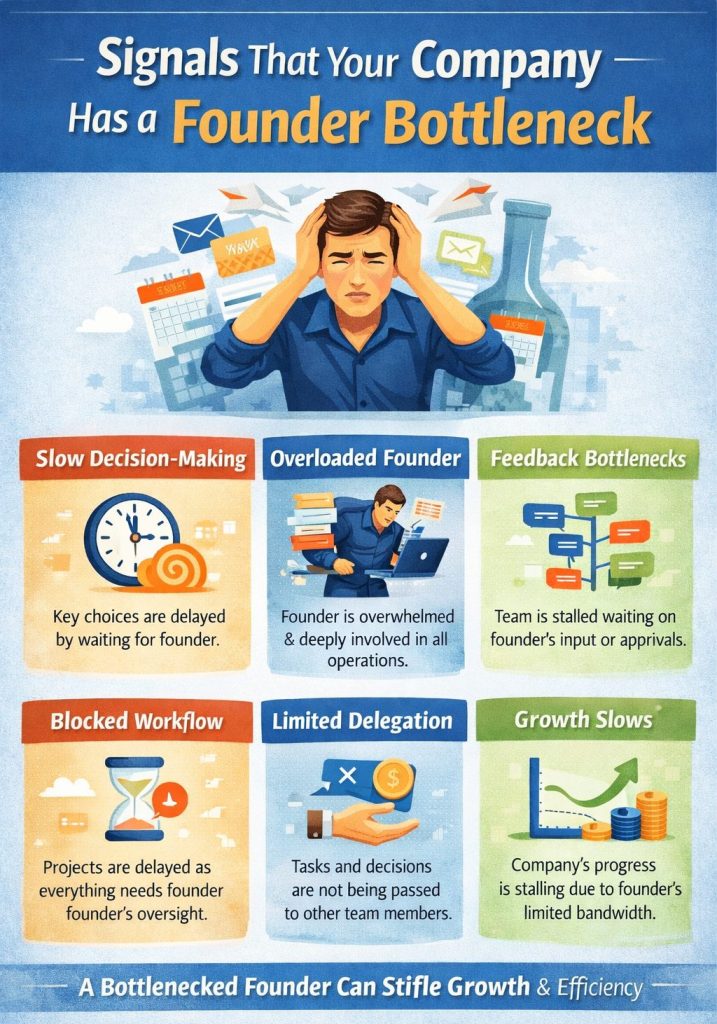
Signals That Your Company Has a Founder Bottleneck
Many leaders do not notice the bottleneck until growth slows.
These signs often appear first:
- Your inbox controls your schedule.
- Your team waits for decisions before moving forward.
- Clients bypass systems and contact you directly.
- Projects slow down because information is missing.
- Your calendar fills with communication tasks rather than strategy.
These signals indicate a structural issue rather than a productivity issue. A reliable threshold: if your response time on internal messages determines whether anyone else on your team can move forward on a given day — and that describes more than three hours of your schedule — you have a bottleneck that a hire will not fix. You have a systems problem that a Communications VA is built to solve.
The business needs a communications layer.
How a Communications Layer Unlocks Growth
When companies organize communication properly, several improvements appear quickly.
Faster Execution
Teams move without waiting for constant approval.
Stronger Alignment
Departments share the same goals and updates.
Better Client Experience
Clients receive clear, consistent communication.
Reduced Founder Burnout
Leaders gain time for strategic work.
Scalable Operations
The company grows without chaos.
Communication infrastructure acts like roads inside a city. When the roads work well, traffic moves smoothly. When they fail, the city slows down.
Why Delegation Is the Real Growth Lever
Many founders believe growth depends on sales or funding. In reality, growth depends on leverage.
When leaders stop managing every message, they unlock time for high-value decisions.
A strong executive assistant or communications VA becomes the bridge between leadership and operations.
This structure allows the company to grow without overwhelming its leadership team.
Companies that scale well treat communication as strategy, not admin work.
What Aristo Sourcing Looks for in a Communications VA
Not every remote assistant has the profile to manage founder-level communication. Aristo Sourcing vets specifically for the following when placing Communications VAs and Executive Virtual Assistants:
- English proficiency at C1 or C2 level — the standard required to draft stakeholder updates, handle client communication, and represent the founder’s voice accurately
- Prior experience managing executive inboxes or acting as a communication point of contact in a client-facing environment
- Demonstrated proficiency in at least two tools from the standard communications stack: Notion, Slack, Loom, Asana, ClickUp, or equivalent
- Comfort with structured SOPs and the ability to follow and improve documented processes without constant supervision
- Cross-cultural communication experience — particularly relevant for South African candidates working with UK and US founders, and Philippine candidates supporting US and Australian businesses
Aristo’s typical placement-to-independence timeline for a Communications VA is four to six weeks: two weeks of onboarding to your systems and voice, then two to four weeks of supervised execution before the founder steps back from day-to-day communication management entirely.
Final Thought
The Founder Bottleneck appears in almost every growing company. It forms when communication remains tied to leadership rather than systems.
Growth requires structure.
A communications layer transforms scattered messages into organized knowledge, improves team alignment, and protects leadership focus.
Communications VAs and Executive Virtual Assistants trained in communication and operations now fill this role effectively, especially through specialized firms like Aristo Sourcing, which focuses on placing skilled remote professionals who support high-level delegation.
When founders move from operator to strategist, the company gains the space it needs to scale.
FAQs
When should a founder stop managing their own inbox?
When your inbox determines what your team can or cannot move forward on in a given day, the inbox has become a bottleneck rather than a tool. Most founders reach this point between eight and twelve team members — when the volume of internal requests, client messages, and stakeholder updates exceeds two to three hours of daily reactive time. That is the threshold at which a Communications VA pays for itself within the first month.
What does a Communications VA do day to day?
A Communications VA triages the founder’s inbox and flags action items, drafts client and stakeholder updates, manages internal Slack or Teams channel structure, documents meeting outcomes and distributes action items, maintains the internal knowledge base, and prepares weekly leadership summaries. In the first 30 days, most Aristo-placed Communications VAs focus on inbox triage, client update drafting, and meeting documentation — the three tasks that recover the most founder time the fastest.
How do I delegate email without losing control of my business?
Start with a read-and-label system: your VA reads everything and categorises each message as Action Required, FYI, or Archive. You review only the Action Required category. Within two weeks, most founders reduce inbox time by 60 to 70 percent without missing anything critical. Full delegation — where the VA drafts replies for your approval — typically follows in week three or four once they have learned your communication style and tone.
What is the difference between an Executive Virtual Assistant and a Chief of Staff?
An Executive Virtual Assistant handles the communication and operational execution layer — inbox management, scheduling, meeting notes, client correspondence, and knowledge base maintenance. A remote Chief of Staff operates at a higher strategic level: running cross-functional projects, preparing board materials, managing leadership priorities, and representing the founder in internal decision-making. Most founders need the VA first and the Chief of Staff later, once the team exceeds 25 to 30 people.
How do you build a knowledge base for a small team?
Start with the five questions your team asks most often and document the answers in a shared Notion or Confluence page. A Communications VA typically takes ownership of this from week two — they identify recurring questions from Slack threads and inbox history, write the answers into structured pages, and maintain the knowledge base as the business changes. The goal is eliminating the same question being asked of leadership twice.
What happens to communication when a startup scales from 5 to 20 people?
Communication paths grow exponentially, not linearly. A five-person team has ten possible communication pairs. A twenty-person team has 190. Without a structured communications layer — defined channels, documented decisions, regular updates — a founder who was the natural communication hub at five people becomes an impossible bottleneck at twenty. The companies that scale smoothly build the communications infrastructure at eight to twelve people, before the breakdown rather than after.
Can a Communications VA manage client communication on my behalf?
Yes — and this is one of the highest-value early delegations. A Communications VA drafts client responses in your voice, manages follow-up sequences, coordinates project update emails, and handles routine client queries. For the first two to four weeks they draft for your approval; after that, most founders move to a spot-check model where they review only high-stakes client messages. The client experience typically improves because response times drop and communication becomes more consistent.
How much does it cost to hire a Communications VA from South Africa or the Philippines?
A dedicated full-time Communications VA or Executive Virtual Assistant placed through Aristo Sourcing typically costs between $1,200 and $2,000 per month depending on seniority, specialisation, and scope. That compares to $4,000 to $7,000 per month for an equivalent onshore executive assistant in the US or UK. South African VAs offer GMT+2 alignment for UK and European founders; Philippine VAs offer overlap with US business hours. Aristo’s placement process includes vetting, matching, and the onboarding support period — the cost covers a dedicated professional, not a shared resource. of mental bandwidth allows the executive to shift from “Firefighting” (Operator) to “Visionary” (Strategist), which is the most effective cure for burnout.