

Only 40.3% of US Google searches resulted in an organic click in March 2025, with zero-click at 27.2%” (Search Engine Land). Most SEO strategies fail before they even start.
Not because the strategy is wrong, but because nothing gets executed consistently.
According to McKinsey & Company, knowledge workers spend up to 60% of their time on repetitive execution tasks. In SEO, that includes publishing, formatting, internal linking, metadata updates, and reporting.
That is where growth stalls.
This guide defines a new standard:
You don’t hire an “SEO expert.”
You build an Operator Layer.
This is the layer that removes:
- Execution Friction → Work that never gets shipped
- Supervision Tax → Cheap hires that require constant oversight
- Founder Bottleneck → When the business cannot move without you

The Core Shift: From SEO Help to Operator Layer
Strategist vs Operator Model
| Function | Strategist | SEO Operator (VA) |
|---|---|---|
| Keyword Direction | Defines clusters & intent | Executes mapping |
| Content Strategy | Designs topical authority | Publishes & formats |
| Internal Linking | Defines structure | Implements system |
| Technical SEO | Diagnoses issues | Logs & escalates |
| Reporting | Defines KPIs | Tracks & reports |
If one person owns both roles at a low cost, quality collapses.
Strategy defines leverage. Execution creates results.
An SEO VA is not support staff.
They are a workflow owner responsible for execution systems.
They operate inside:
- Google Search Console
- Ahrefs
- CMS platforms (WordPress, Webflow)
The SEO Operator Stack (Execution Systems)
Content Operations and LLM Visibility
- Upload and format content in CMS
- Structure headings using entity relationships
- Insert internal links based on clusters
- Add structured data (FAQ, Article via JSON-LD / Schema.org)
- Monitor LLM visibility (Google SGE / AI Overviews)
2026 Standard
A strong SEO VA:
- Checks AI visibility
- Identifies missing entities
- Improves topical completeness
On-Page SEO Execution (Skill Layer)
- Write CTR-focused meta titles/descriptions
- Optimize images (alt text, compression)
- Maintain canonical tags
- Validate indexing
Core Skill Check
Prompt:
“Explain why canonical tags matter.”
A strong answer includes:
- Consolidation of ranking signals
- Prevention of duplicate content
- Clear indexing guidance
Technical Hygiene and Escalation Protocol
The VA does not fix code. They manage detection and escalation.
They monitor:
- Core Web Vitals
- Indexing issues
- Broken links
Escalation Protocol
- Identify issue
- Capture evidence
- Log structured task
- Assign to developer
This is the difference between execution and chaos.
Reporting and Output Tracking
Track execution, not vanity metrics:
- Pages published
- Internal links added
- Pages indexed
- CTR improvements
Entity Coverage and Information Gain
- Expands entity coverage
- Improves content depth
- Aligns with Google’s Information Gain model

SEO VA Job Description Template (Execution-Focused)
Role Summary
We are hiring an SEO Virtual Assistant to operate the execution layer of our SEO system. This role focuses on publishing, optimization, internal linking, and reporting—not strategy.
Core Responsibilities
- Upload and format content in CMS
- Implement internal linking structures
- Optimize metadata for CTR
- Add structured data (JSON-LD)
- Monitor Google Search Console
- Identify issues and follow escalation protocols
- Track SEO outputs weekly
Tools and Systems
- Google Search Console
- Ahrefs
- CMS platforms
- Task management systems
What This Role Is Not
- Not an SEO strategist
- Not a developer
- Not responsible for link buying
Success Metrics
- Consistent publishing
- Low error rate
- Improved CTR
- Clean reporting
Download the checklist below
SEO VA Screening Questions (Verification Layer)
Search Console Scenario
“This page has impressions but no clicks.”
Strong answer includes:
- CTR optimization
- Intent alignment
- Query analysis
Manual Audit Test
Candidate should:
- Review headings
- Identify missing links
- Check metadata
(This verifies execution skills from earlier sections.)
CMS Execution Test
- Upload content
- Format properly
- Insert links
Schema Understanding
“What is FAQ schema?”
Strong answer includes:
- Improves SERP visibility
- Enables rich results
Judgment Test
“Would you use every keyword from Ahrefs?”
Strong answer includes:
- Critical thinking
- Intent awareness
What to Look For in an SEO VA
Execution Without Errors
Can they ship consistently without breaking structure or formatting?
Low Supervision Requirement
Do they reduce your workload?
This is the Supervision Tax test.
System Thinking
Do they:
- Follow SOPs
- Document work
- Maintain consistency
Content Awareness
Can they:
- Match tone
- Understand intent
- Write effective metadata
Escalation Discipline
Do they know when to:
- Stop
- Document
- Escalate
Success Signals: Budget VA vs Operator
| Metric | Budget VA | Aristo-Vetted Operator |
|---|---|---|
| Onboarding Time | 3–6 weeks | 7–10 days |
| Error Rate | High | Low |
| Supervision | Constant | Minimal |
| Reporting | Basic | Structured |
| Consistency | Unreliable | Systemized |
The cheapest hire is often the most expensive.
The First 30 Days (Deployment System)
Week 1 — Access and Shadowing
- Controlled access
- Record workflows
Week 2 — Supervised Execution
- VA performs
- You correct
Week 3 — Partial Ownership
- VA handles execution
- Reports weekly
Week 4 — Full Ownership
- VA owns execution
- You review outputs
Global Hiring Considerations
South Africa
- Strong contextual English
- High-quality metadata writing
- Excellent cost-to-quality ratio
Philippines
- Strong process adherence
- Reliable execution
Eastern Europe
- Higher technical capability
- Higher cost
The real cost is supervision, not salary.
Five Hiring Myths That Stop Businesses From Getting Real SEO Execution
Most businesses that delay hiring an offshore SEO VA are not held back by budget.
They are held back by assumptions, most of which do not survive contact with reality.
These are the five objections that come up most often, and what the data actually says.
Myth 1: “Offshore means cheap, and cheap means low quality”
This is the most common objection and the one most easily disproved.
The belief runs something like this: if the rate is lower, the quality must be lower. It feels logical. It is not accurate.
Quality in SEO execution is not determined by geography. It is determined by three things: clear expectations, defined tools, and a reporting cadence that makes output visible.
A VA in Cape Town working within a structured system with a weekly scorecard will consistently outperform an unmanaged local hire with no SOP and no accountability framework.
Deloitte’s Global Outsourcing Survey found that 80% of executives planned to maintain or increase their outsourcing investment not because they were cutting corners, but because structured offshore hiring delivered capacity and consistency that local hiring could not match at scale.
The cost advantage is real. But it is a secondary benefit.
The primary benefit is that you can hire an execution-focused operator someone whose entire role is to run your SEO system at a rate that makes full-time dedicated support economically viable for businesses that could never justify it locally.
“The real cost of bad SEO is not the salary you paid. It is the six months of lost compounding you will never get back.”
What makes offshore hiring fail is not the hire. It is the absence of a system for them to work inside.
Myth 2: “SEO is too complex and sensitive to delegate offshore”
This objection usually comes from founders or strategists who have conflated SEO strategy with SEO execution — and treated them as the same thing.
They are not.
SEO strategy requires judgment, market understanding, and the ability to make decisions under uncertainty. That is not what an SEO VA does.
SEO execution — the layer that actually moves rankings — is built on repeatable, documentable, verifiable tasks:
- Publishing and formatting content to brief
- Updating metadata and heading structure
- Implementing internal linking across published pages
- Monitoring Core Web Vitals and escalating technical issues
- Running weekly Google Search Console reporting on clicks, impressions, CTR, and average position
Every one of those tasks can be defined in an SOP. Every output can be reviewed. Every result can be measured.
Ahrefs research consistently shows that over 90% of pages receive zero organic traffic not because of strategic failure, but because of execution gaps: missing internal links, thin metadata, no schema, unoptimised headings. These are not strategy problems. They are operational problems that a well-briefed SEO VA can systematically fix.
The complexity argument dissolves the moment you separate what requires judgment from what requires consistency.
Myth 3: “Time zone gaps will kill communication and slow everything down”
This concern is understandable. It is also based on an outdated model of how remote work functions.
The assumption is that real-time proximity equals productivity. The data does not support this.
Research published by the U.S. Bureau of Labor Statistics found that a one percentage-point increase in remote workers correlates with a 0.08 percentage-point increase in total factor productivity growth. The driver of that productivity is not co-location — it is process design.
When SEO execution is built around defined outputs rather than live approvals, time zones stop being a constraint and start being an advantage.
A South African SEO VA operating on SAST (UTC+2) can complete a full day of on-page optimisation, CMS execution, and GSC monitoring before a US-based strategist starts their morning. Work compounds overnight rather than waiting in a queue.
The communication model that works is simple:
- Monday: Weekly brief — pages to update; priorities; blockers
- Wednesday: Midweek check-in — progress update; any flags
- Friday: End-of-week report — URL list; changes made; metrics moved
That is three touchpoints. No standing meetings. No timezone-dependent dependency chains.
When the handoff is clear and the output is measurable, geography becomes irrelevant.
Myth 4: “Hiring offshore is a security and data risk I can’t manage”
This is the one objection that deserves to be taken seriously — and then addressed properly rather than dismissed.
The risk is real. The solution is also well-established.
Verizon’s 2025 Data Breach Investigations Report found that approximately 88% of basic web application breaches involved stolen or compromised credentials. That is not an offshore problem. That is a credential management problem — and it exists in every team, in every location.
The practical controls that eliminate the majority of SEO VA security risk are:
- Role-based Google Search Console access — read-only or restricted permissions rather than full property ownership
- CMS user roles — contributor or editor level, not administrator
- Multi-factor authentication on every tool the VA accesses
- Least privilege by default — access to only the tools and accounts required for the defined scope
- NDA and data handling agreement signed at onboarding
None of these controls are complex. None of them are unique to offshore hiring. They are simply good operational hygiene and any business that has not implemented them with local hires carries the same exposure.
Aristo-placed operators work within a defined access framework from day one. Scope is set before access is granted. The risk profile of a well-onboarded remote SEO VA is lower than an unsupervised local contractor with full CMS admin rights and no audit trail.
Myth 5: “I’ll lose control — there’s no way to hold a remote VA accountable”
This is the myth that reveals the most about the business raising it.
Accountability does not come from proximity. It comes from measurement.
If you cannot measure what your SEO VA is doing, the problem is not that they work remotely. The problem is that you do not have a system that makes output visible — and that problem exists whether the person sits next to you or works from another country.
The accountability framework for an SEO VA is not complicated:
- What pages were published or updated this week? (URL list)
- What metadata was changed and why? (changelog)
- What did GSC show for target pages? (clicks; impressions; CTR; position before and after)
- What was flagged or escalated? (issue log)
These four outputs, delivered weekly, create a complete audit trail. Every action is traceable. Every result is attributable. Every week builds a documented performance record.
John Mueller of Google has repeatedly emphasised that consistent, quality execution over time outperforms tactical bursts of optimisation. Consistency requires accountability. Accountability requires measurement. Measurement requires a system.
Build the system first. The accountability follows automatically.
“If you cannot define what good output looks like, you cannot hire for it — offshore or otherwise.”
The Pattern Across All Five Myths
Look at what each of these objections has in common.
Every one of them is resolved by the same thing: a well-designed system with clear scope, defined tools, measurable outputs, and a weekly reporting cadence.
Offshore hiring does not require more trust than local hiring.
It requires more clarity.
And that clarity, the kind that makes your SEO operator genuinely accountable and your execution genuinely consistent, is exactly what the job description template and deployment system in this guide are built to give you.
Plus, remember, start with a paid test that produces measurable artifacts. Ask for a mini technical audit using Screaming Frog, a GSC opportunity analysis, and one refreshed page with a change log. You want evidence of workflow quality, not claims.
Also, note this:
- Defined scope (content refresh; internal linking; technical QA; metadata; reporting)
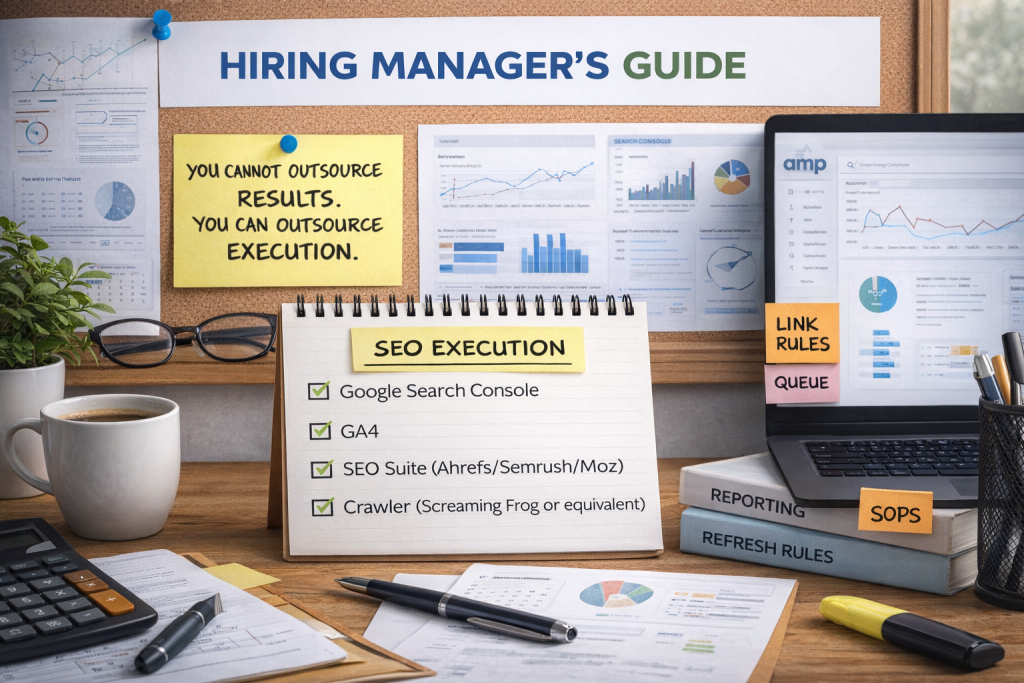
- Defined tools (GSC; GA4; Screaming Frog; Ahrefs; CMS)
- SOPs and quality gates
Backlink Risk Control
Red flags:
- Bulk link buying
- PBNs
- Spam directories
A strong SEO VA:
- Uses outreach
- Documents links
- Focuses on relevance

Aristo Sourcing Positioning
Aristo Sourcing provides the operator layer.
We do not:
- Create SEO strategy
- Promise rankings
We do:
- Provide execution infrastructure
- Match you with vetted operators
- Reduce operational load
Information Gain: Why Most SEO VAs Fail
Based on 500+ candidate evaluations:
- Tool dependency without understanding
- Poor CMS execution
- High supervision needs
Only ~20% pass real-world tests.
Hire an SEO Operator That Actually Ships Work
If your SEO strategy exists but execution is inconsistent, your problem is not SEO.
It is capacity.
Book a free discovery call with Aristo Sourcing to get matched with an SEO VA who:
- Owns execution
- Reduces supervision
- Ships work consistently
Frequently Asked Questions
What is the difference between an SEO Agency and an SEO Virtual Assistant?
An SEO agency typically provides high-level strategy, link-building outreach, and technical roadmaps at a premium price. An SEO Virtual Assistant acts as the internal execution infrastructure, handling the daily CMS uploads, metadata iterations, and reporting. While an agency tells you what to do, an SEO VA is the operator who ensures the work actually ships.
Can an SEO VA help with Google’s SGE and AI Overviews?
Yes. In 2026, a high-level SEO VA monitors LLM visibility by checking how your brand appears in AI-generated summaries. They perform entity coverage audits to ensure your content contains the specific data points and structured schema (JSON-LD) that AI models use to cite sources.
Does an SEO Virtual Assistant need to know how to code?
Generally, no. An SEO VA should be an expert in CMS platforms (WordPress, Webflow, Shopify) and SEO tools (Ahrefs, Semrush, GSC), but they are not developers. Their role is to follow an Escalation Protocol: identifying technical errors like Core Web Vital failures or 404s and documenting them for a developer to fix.
How many hours a week does a standard SEO execution plan require?
For a growing site publishing 2–4 articles per week, a dedicated SEO VA typically requires 10 to 20 hours per week. This covers content formatting, internal link mapping, image optimization, and weekly KPI tracking. Scaling beyond this usually requires a full-time “SEO Operator.”
What are the “Red Flags” when hiring a freelance SEO assistant?
The biggest red flag is a lack of Search Intent awareness. If a candidate suggests high-volume keywords that don’t match your business goals, or if they rely solely on “green lights” in plugins like Yoast without understanding Information Gain, they will likely increase your Supervision Tax.
Which SEO tools should I provide for my Virtual Assistant?
To remove the founder bottleneck, your VA should have access to Google Search Console (for indexing and performance data) and a professional SEO suite like Ahrefs or Semrush. Additionally, they should be proficient in your project management tool (ClickUp, Asana) to log their execution “shipped” logs.
How does an SEO VA improve “Information Gain” for my website?
Following Google’s recent updates, “Information Gain” is a critical ranking factor. An SEO VA supports this by conducting competitor gap analysis and ensuring your articles aren’t just “copy-pasted” ideas but include unique images, updated data, and FAQ schema that provides more value than the current top-ranking pages.
Why is “Contextual English” important for SEO VAs in South Africa or the Philippines?
SEO is no longer about keyword density; it’s about nuance and persuasion. A VA with strong contextual English can write meta descriptions that increase Click-Through Rate (CTR) and format H2/H3 headers that satisfy both the user’s intent and the search engine’s entity requirements.
