

About SEO VA vs SEO freelancer debate: The insights in this article draw directly from Aristo Sourcing’s operational data across 500+ global VA placements since 2014.
Most businesses frame this as a budget decision. They see a freelancer’s $100/hr rate next to a VA’s $15/hr equivalent and assume the math is obvious. It isn’t. The real cost of getting this wrong isn’t the hourly rate differential. It’s six months of stalled rankings, a broken content pipeline, and the slow realization that you hired for the wrong problem entirely.
This article gives you the analytical framework to make the right call, backed by current data, concrete operational context, and an honest look at what each hire actually delivers in the age of AI-augmented SEO.
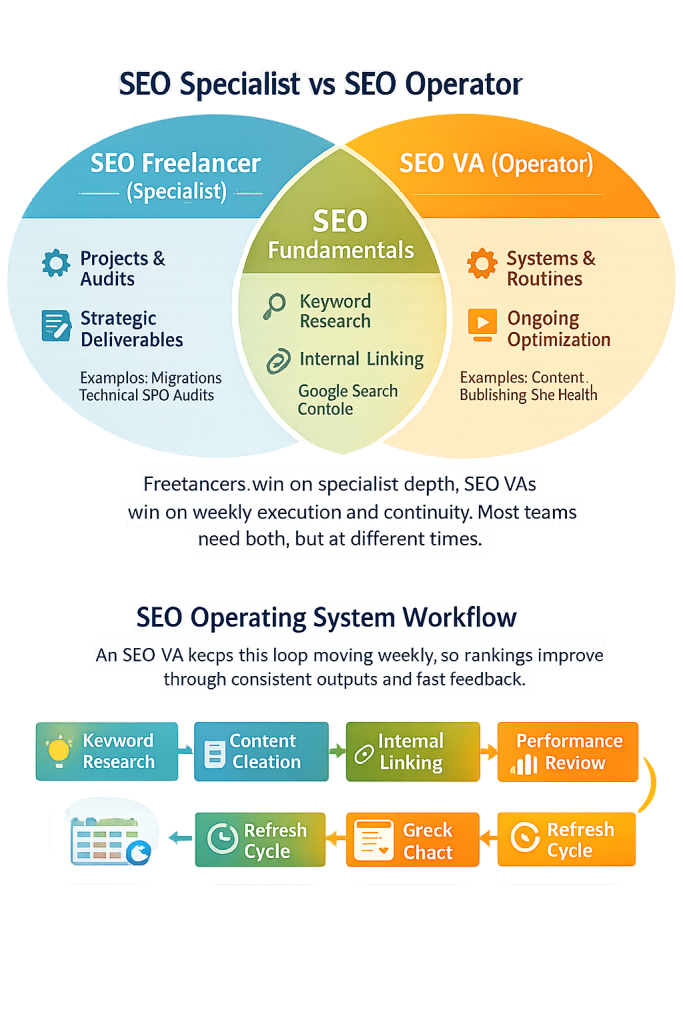
The Two Roles Are Not Interchangeable. They Solve Different Problems.
An SEO freelancer solves problems. An SEO VA scales systems.
That single distinction drives every decision that follows.
When Google pushed its March 2024 core update, the sites that recovered fastest didn’t just have better strategy. They had consistent execution pipelines: weekly crawl audits, content refresh schedules, internal linking protocols, and monitoring systems that caught issues before they compounded. Strategy without execution is a blueprint nobody builds from.
The freelancer’s job is to design the blueprint. The VA’s job is to build from it, every week, without being told.
Neither role is superior. Both fail when deployed against the wrong problem.
What an SEO Freelancer Actually Does
A qualified SEO freelancer operates as a diagnostic specialist. They come in, assess your situation, identify the highest-leverage opportunities, build a strategic roadmap, and leave you better positioned than when they arrived.
Their core deliverables typically include:
- Technical architecture diagnosis. Site migrations, JavaScript rendering analysis, crawl budget optimization, international hreflang structure, and Core Web Vitals root cause investigation. A seasoned freelancer uses log file analysis and regex-filtered Search Console segments to isolate crawl behavior that surface-level audits miss entirely.
- Strategic positioning. Competitive gap analysis in Ahrefs or Semrush, content cluster planning, keyword prioritization frameworks, and link profile audits with disavow recommendations.
- Algorithm forensics. When your rankings drop 30% after a core update, a freelancer runs the diagnostics. They compare your site’s topical coverage, E-E-A-T signals, and link profile against the sites that gained ground during the same period, then hand you a prioritized recovery roadmap.
According to Ahrefs’ freelancer rate research, experienced SEO specialists charge $75 to $150 per hour, with senior technical consultants exceeding $200. A typical project engagement runs $2,500 to $10,000 depending on scope and complexity.
That rate buys speed and breadth. A seasoned freelancer has diagnosed dozens of different site architectures, recovered rankings from multiple algorithm hits, and audited sites across industries. They compress years of pattern recognition into a short engagement window.
What they don’t provide: Freelancers sell project deliverables, not operational continuity. They diagnose the canonicalization issue. They do not then fix 200 pages of canonical tags, monitor Search Console daily, rebuild your internal linking structure, and verify the fix held three weeks later. They move to the next client.
If your SEO problem is “we don’t know what’s broken,” hire a freelancer. If your SEO problem is “we know exactly what needs to happen and nobody’s doing it,” that’s a different hire entirely.
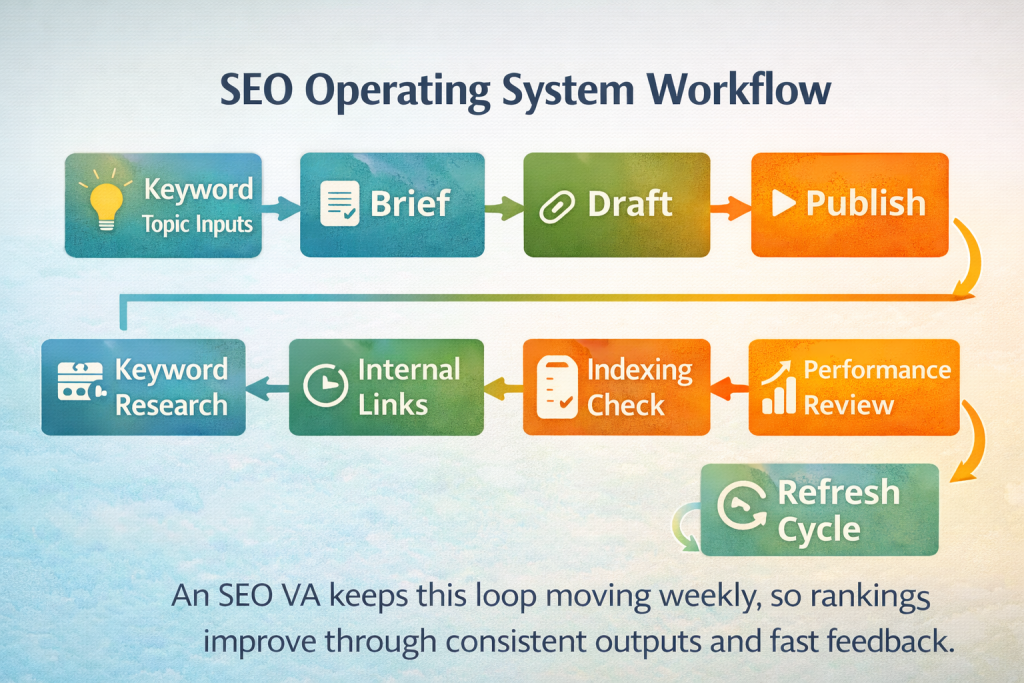
What an Aristo-Sourced SEO VA Does
The 2018 version of an SEO VA published blog posts and tracked keyword rankings in a spreadsheet. That job description no longer exists.
Today’s SEO VA manages human-in-the-loop quality control inside AI content pipelines, runs weekly technical health checks using enterprise crawl tools, and maintains the documented operational systems that keep organic growth compounding month over month.
Here is exactly what that ownership looks like across the four core functions.
Content Operations: The Weekly SOP
Content execution at scale requires a documented workflow, not improvisation. The sequence below details the unvarying six-step framework an Aristo-sourced VA runs weekly to turn content production into a compounding organic asset.
1 / Brief Intake and Calendar Review Monday Morning
The VA pulls the editorial calendar from ClickUp, Asana, or Notion, confirms publication targets for the week, and flags any gaps created by late briefs or delayed approvals. Nothing stalls in silence.
2 / Draft Intake and Initial Quality Pass Content Gate 1
When a draft arrives, whether from a human writer or an AI generation tool, the VA runs a first pass against a strict quality checklist: target word count verification, keyword presence in the title tag and opening 100 words, placeholder removal, and structural alignment with the site’s editorial template.
3 / SEO Optimization and Entity Integration Content Gate 2
The VA opens the draft in Surfer SEO or Rank Math, scales the content optimization score to the defined threshold (typically 70 or above), integrates missing NLP entities from the recommended term list, and verifies that the H2/H3 heading hierarchy delivers deep topical coverage without keyword stuffing.
4 / Internal Link Mapping Structural Context
The VA audits existing site content to identify three to five bidirectional internal link opportunities: which historical pages need to link to this new piece, and which cornerstone content this new piece should reference.
5 / CMS Publishing and Technical Configuration Production Deploy
The VA uploads the asset to WordPress, sets the canonical tag, writes the meta description to precise character limits, injects valid JSON-LD structured data markup, and configures social preview cards before the post goes live.
6 / Post-Publish Indexation and Baseline Monitoring 48 to 72 Hours Post-Deploy
The VA checks Search Console for indexation confirmation, reviews crawl coverage for errors triggered by the new URL, and logs the baseline keyword position in Ahrefs or Semrush to anchor future content refresh decisions.
This SOP runs on every piece of content, every week, without variation. That consistency is what turns content programs from one-time efforts into compounding organic assets.
AI Pipeline Management: The Human-in-the-Loop Workflow
Generative AI changed content production economics permanently. Businesses that deploy AI writing tools at scale now produce first drafts in hours instead of days. But AI-generated content without human quality control fails Google’s helpful content standards, loses the E-E-A-T signals that determine ranking durability, and introduces factual errors that erode brand credibility over time.
The Aristo SEO VA functions as the human checkpoint that every AI content workflow requires.
When a content strategist generates a batch of AI drafts, the VA does not accept them at face value. They open each draft alongside Surfer SEO’s content editor or Clearscope’s topic report and run a comparative analysis: does the draft cover the topical entities the tool recommends? Does it include the natural language variations that distinguish comprehensive coverage from thin, repetitive filler? The VA adds missing entities, restructures sections that lack logical progression, and removes hallucinated statistics by verifying every data point against its cited source before anything touches the CMS.
Beyond optimization scores, the VA adds the E-E-A-T signals that AI tools cannot generate independently. They locate and embed original data points from recent industry studies. They insert expert pull-quotes from verified, named sources. They replace generic stock images with custom graphics, annotated screenshots, or original charts that signal genuine subject-matter investment. On topics that touch health, finance, legal guidance, or other YMYL categories, the VA flags drafts for expert review before publication, preventing the credibility gap that Google’s quality raters actively penalize.
Google’s automated systems distinguish helpful content from AI-generated filler through specific signals: consistent internal voice, accurate factual claims, original formatting choices, and multimedia elements that reflect real editorial investment. A well-trained Aristo VA builds each of these signals into every piece before it publishes, which protects the site from helpful content system penalties while maintaining the throughput that AI production enables.
Technical Monitoring and Analytics
Every week, the VA runs a Screaming Frog crawl filtered for 4xx errors, redirect chains, missing meta descriptions, and duplicate title tags. They monitor Core Web Vitals through PageSpeed Insights and flag any URLs where Largest Contentful Paint or Cumulative Layout Shift exceeds Google’s defined thresholds.
On the analytics side, the VA builds and maintains Looker Studio dashboards connected to GA4 and Search Console. Each week they log organic traffic metrics, track keyword position movement in Ahrefs or Semrush, and surface anomalies for strategist review. Monthly, they compile client-ready reports that translate raw data into decision-ready insight: which content gained ranking ground, which needs a refresh cycle, and where the next 90 days of execution should focus.
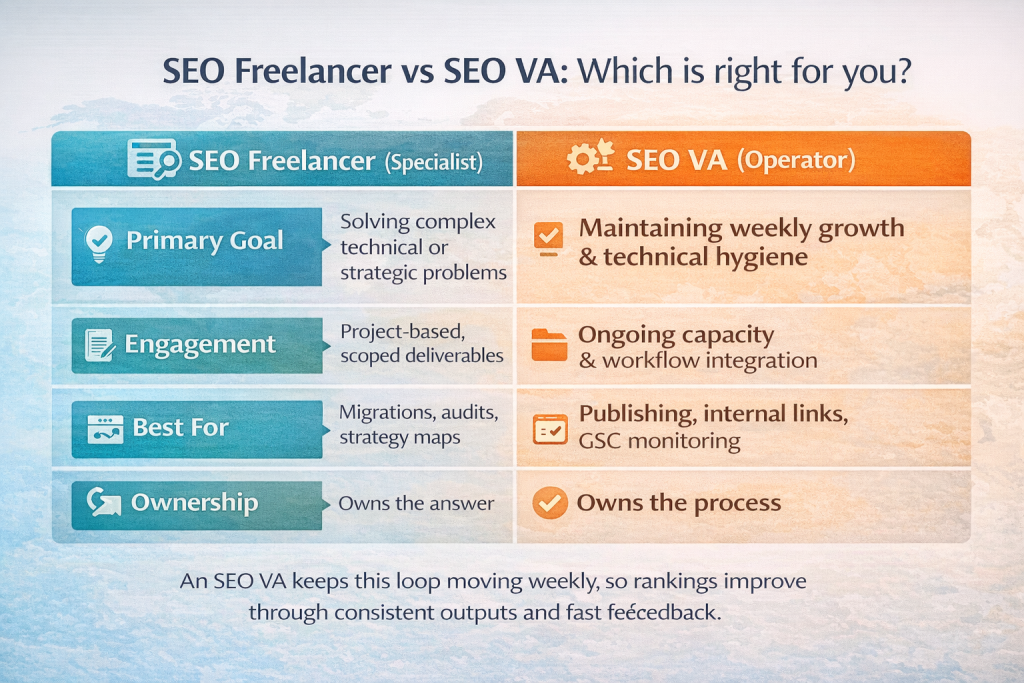
The Financial Reality (The Math Nobody Shows You)
The structural difference between project-based diagnostic spending and predictable payroll investment.
Freelancer Economics
| Engagement Type | Typical Cost | Frequency | Annual Total |
|---|---|---|---|
| Technical SEO Audit | $3,000 to $6,000 | 2x per year | $6,000 to $12,000 |
| Content Strategy Sprint | $2,500 to $5,000 | Quarterly | $10,000 to $20,000 |
| Algorithm Recovery Project | $2,500 to $7,500 | As needed | Variable |
| Annual Floor (Strategy Only) | $16,000 to $32,000+ |
The hidden overhead: This total explicitly excludes implementation, monitoring, content publishing, and weekly execution. You pay strategy costs and separately absorb execution costs through your own executive time or a second operational hire.
SEO VA Economics via Aristo Sourcing
| Model | Setup Cost | Monthly Cost | Annual Total |
|---|---|---|---|
| Direct hire (you pay VA salary) | $1,999 recruitment fee | $1,200 to $2,000 salary | $16,400 to $25,999 |
| Managed model | Lower upfront | $400/month to Aristo + VA salary | Scales with role |
A full-time Aristo SEO VA delivers roughly 160 hours of execution per month. At a freelancer’s floor rate of $75/hr, that equivalent output costs $12,000 per month. The VA model delivers the same execution hours at 10 to 15% of that cost.
The tipping point formula: If your monthly SEO workload exceeds 20 hours of execution tasks (publishing, monitoring, reporting, fixing), a dedicated VA costs less than a freelancer for equivalent output within the first 90 days. Most growing businesses cross that threshold earlier than they expect.
The Operational Maturity Matrix
Identify exactly where your infrastructure currently stands to determine the correct hiring sequence.
| Stage | SEO Maturity | Primary Bottleneck | Target Hire |
|---|---|---|---|
| Stage 1 | No SEO System | “We don’t know where to start or what to prioritize.” | Freelancer: Audit and Roadmap |
| Stage 2 | Strategy, No Execution | “We have an expensive roadmap collecting dust.” | Full-Time SEO VA: Execution |
| Stage 3 | Execution, No Strategy | “We ship content consistently but traffic is flat.” | Freelancer Sprint: Recalibration |
| Stage 4 | Scaling Assets | “We need more operational velocity on what’s working.” | Scale VA Hours: System Growth |
Most businesses land in Stage 2 or Stage 3. Stage 2 is the most common trap: they invested in strategy, received a solid roadmap, and then watched it collect dust for six months because nobody executed it.
Three Scenarios That Clarify the Decision
Scenario 1: E-commerce site preparing for a platform migration.
Hire a freelancer. Migration SEO requires expertise in crawl configuration, redirect mapping, canonical architecture, and pre/post-migration traffic monitoring. A VA does not carry the diagnostic depth to manage this safely. Pay the project rate and get it right. After the migration stabilizes, deploy an Aristo SEO VA to monitor crawl health weekly, maintain redirect logs, and publish new content to the migrated structure.
Scenario 2: SaaS company running a content program producing 12 articles per month.
Hire a full-time VA. Your problem is operational throughput, not strategic clarity. You have a keyword target list, a documented brief process, and an editorial calendar. What you lack is someone who executes the production pipeline consistently without requiring management oversight on every task.
Here is the exact five-step handoff between a SaaS content strategist and an Aristo SEO VA:
- Strategist delivers the brief. The brief drops into the shared project workspace with target keyword, content type, word count, internal linking targets, competing URLs to outperform, and brand voice notes. The VA confirms receipt and slots it into the weekly production queue.
- VA initiates AI-assisted draft production. The VA generates a first draft using the approved AI writing tool. The VA owns the output quality. If the draft fails the quality checklist on first pass, they iterate before moving forward.
- VA runs the optimization and E-E-A-T pass. Working in Surfer SEO or Clearscope, the VA brings the content score to threshold, inserts missing topical entities, verifies all factual claims against primary sources, and formats the piece against the site’s editorial template.
- VA publishes and configures SEO settings. The VA publishes in the CMS, sets the canonical tag, writes the meta description, adds structured data markup, and confirms social preview specifications.
- VA logs the baseline and monitors. The VA enters the URL into the rank tracker, logs the publication date and target keyword, and sets a 90-day prompt for the first content refresh review. Search Console monitoring begins immediately.
The strategist spends zero time on production logistics and full time on the decisions only they can make.
Scenario 3: Local service business whose rankings dropped after a core update.
Hire a freelancer first. Before you produce more content or adjust meta tags, a qualified SEO specialist needs to identify what specifically changed in your topical authority profile and why. Once you have a clear recovery roadmap, an Aristo VA executes the fix sequence with consistency and documentation.
The pattern across all three scenarios is identical: freelancers make the strategic call, VAs execute it with documented precision.cialist to solve a high-stakes problem, or do you need an operator who keeps your SEO moving every single week? Answer that honestly, and the right choice becomes obvious.
Why “Unvetted Freelancer vs. Aristo VA” Is the More Honest Comparison
The standard VA vs. freelancer framing assumes both hires arrive with equal reliability. They don’t.
An unvetted marketplace hire carries real operational risk: inconsistent output quality, undisclosed client conflicts, limited accountability, and no replacement process when the relationship breaks down.
An Aristo Sourcing placement carries the inverse. Their seven-step recruitment process (task definition, market sourcing, structured interviews, skills testing, candidate presentation, client interviews, and managed onboarding) filters for the specific combination of technical capability, communication discipline, and operational fit that determines long-term retention. Their 93% retention rate across 500+ placements since 2014 is the measurable output of a vetting system built to find candidates who stay, perform, and build institutional knowledge inside your business over years.
High retention matters more than most hiring managers initially calculate. Every departing SEO hire takes with them your URL structure history, redirect decisions, content calendar context, and the undocumented operational knowledge that accumulates through months of consistent work. Rebuilding that knowledge costs time that compounds against your ranking trajectory.
The real comparison is not VA versus freelancer. It is managed, vetted, accountable execution versus the open-marketplace hiring lottery.
How to Make the Decision in Five Minutes
Answer these four questions:
1. Do you have a documented SEO strategy with clear priorities? If no, hire a freelancer first to build the foundation before you hire anyone to execute it.
2. Do you have more than 20 hours of SEO execution work per month sitting undone? If yes, a full-time VA covers it faster and cheaper than any freelancer model.
3. Have your rankings dropped or plateaued despite consistent execution? If yes, bring in a freelancer for a diagnostic sprint before adding more execution hours to the same broken approach.
4. Do you need someone who stays inside your workflow, learns your systems, and builds institutional knowledge over months and years? Only a full-time, properly placed VA delivers that.
If you answered yes to questions 2 and 4, an Aristo Sourcing SEO VA is the right next move. Their placement process runs two to four weeks and delivers three to five vetted candidates for you to interview directly. One flat recruitment fee. No ongoing agency markup. You pay your VA’s salary directly and own the relationship.
If you answered yes to questions 1 and 3, engage a specialist freelancer for a defined project scope with clear deliverables and a structured handoff plan.
Most growing businesses eventually need both. The sequencing determines whether you build momentum or keep restarting from zero.
The Bottom Line
This decision is not about budget. It is about matching the hire to the problem your business has right now.
Freelancers fix broken systems and design new ones. They perform best as periodic specialists brought in for defined, high-stakes projects where diagnostic depth matters more than operational continuity.
SEO VAs placed through Aristo Sourcing scale proven systems with consistent, documented execution. They perform best as permanent operational team members who own the week-to-week work that drives compounding organic growth: the content SOP, the technical health checks, the AI pipeline quality gates, and the reporting infrastructure that tells you what’s working before the gains disappear.
The most expensive outcome is misaligning the two: paying a $100/hr freelancer to do work a VA handles at 15% of that cost, or asking a VA to perform diagnostic work that requires a specialist’s depth and cross-industry pattern recognition.
Get the sequencing right, and SEO compounds. Get it wrong, and you spend budget generating activity with no results to show for it.
Aristo Sourcing has placed 500+ virtual assistants across 200+ companies since 2014. Their SEO VA placements draw on a seven-step vetting process and a 93% retention rate built on matching execution capability to operational need, not filling seats.