

Clio’s 2024 Legal Trends Report measured time use across thousands of law firms and found that the average lawyer captures just 2.9 billable hours in an eight-hour working day. The remaining 5.1 hours go to email, scheduling, document formatting, intake paperwork, and docketing. None of that work requires a law degree. All of it costs attorney time at attorney rates.
A partner billing at US$300 per hour who spends three hours daily on non-billable administrative tasks loses US$225,000 in annual billing capacity. A solo practitioner at US$250 per hour loses US$187,500. Run that math on your last three months and the case for delegating to a legal virtual assistant gets very clear, very fast.
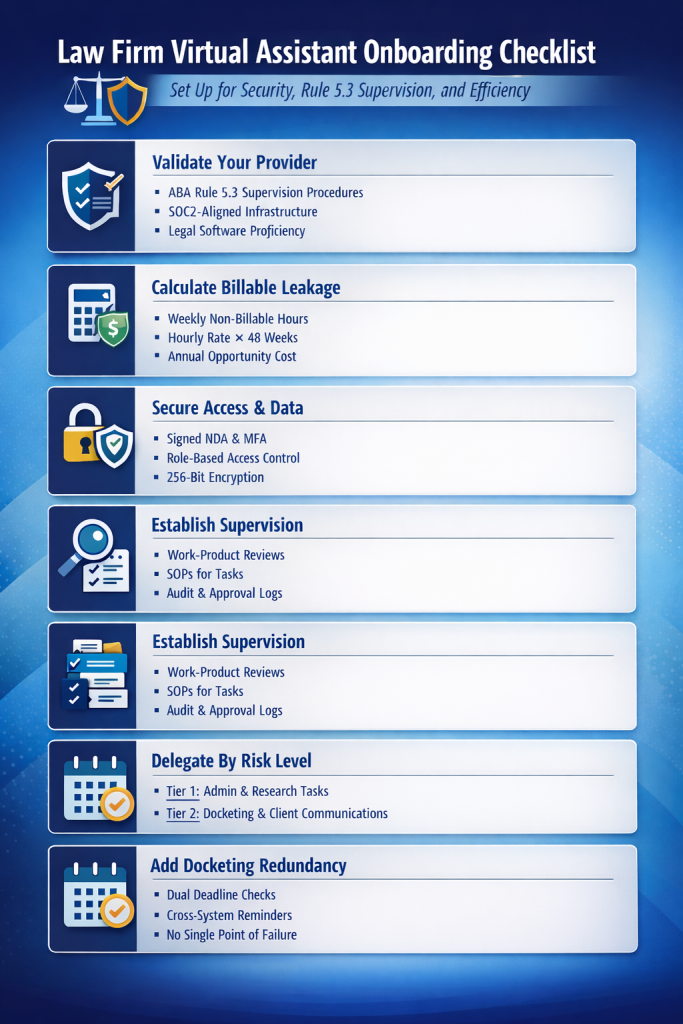
This checklist covers every stage of the outsourcing process: what you can delegate under ABA Model Rule 5.3, what compliance documentation you need before granting any system access, how to structure the first 90 days, which platforms your VA needs to know, and what separates a legal-specific VA from a general virtual assistant. Follow it in order and the risk of early onboarding friction drops sharply.
Quick Reference: What This Checklist Covers
- 14 tasks you can delegate to a legal VA starting this week
- Pre-access compliance checklist (ABA Rule 5.3, NDA, MFA, role-based access)
- 90-day phased onboarding plan with weekly actions
- Platform proficiency guide (Clio, MyCase, PracticePanther, Smokeball)
- ROI breakdown: hours recovered vs. annual VA cost
- Provider selection criteria specific to legal outsourcing

What Tasks Can a Legal Virtual Assistant Handle Under ABA Rule 5.3?
Administrative Versus Legal Work: Where the Line Sits
ABA Model Rule 5.3 requires every law firm using nonlawyer assistants, including remote legal VAs, to establish supervision measures that make the assistant’s conduct comply with the attorney’s professional obligations. The rule doesn’t prohibit delegation. It governs it. A written supervision agreement, documented task procedures, and periodic access audits are what keep a VA arrangement compliant.
The practical boundary runs between administrative support and the unauthorized practice of law. A legal VA drafts correspondence under your direction, formats pleadings, manages dockets, runs conflict checks against a defined database, and handles client intake. They do not give legal advice, sign documents on your behalf, or make independent judgments on case strategy. Every delegated task needs a written procedure that specifies what the VA does, what they escalate, and when they stop and ask.
The 14 Tasks You Can Delegate to a Legal VA Starting This Week
Calendar and Inbox Management
- Triage incoming email against your priority criteria and surface items needing attorney attention
- Schedule client consultations, court dates, and depositions in your practice management platform
- Send appointment confirmations and 24-hour reminders to cut no-show rates
Client Intake and Conflict Checks
- Collect and process intake forms from prospective clients through your intake software
- Run conflict of interest checks against your active matter database in Clio, MyCase, or PracticePanther
- Follow up on outstanding intake documentation and send status updates to prospective clients
Document Support and Docketing
- Format briefs, motions, and contracts to your firm’s style guide
- Enter court deadlines and statute of limitations dates into your docketing system with calendar reminders set
- Prepare e-filing submissions in your jurisdiction’s electronic court portal
Administrative and Financial Tasks
- Reconcile IOLTA trust account entries under attorney review and sign-off
- Draft routine client correspondence and matter status updates in your voice
- Maintain and update matter records in your practice management software
- Research and compile publicly available case law, court records, and background information

PhaHow Do You Verify a Legal VA’s Compliance Before Granting System Access?
The Pre-Access Compliance Checklist Every Law Firm Needs
In our experience placing legal VAs with small and mid-size firms across North America, 84% of onboarding friction in the first 14 days traces back to two causes: unclear software permissions and the absence of a written supervision agreement. Firms that complete this checklist before day one remove most of that risk before it starts.
Documentation
- Signed non-disclosure agreement covering client confidentiality, matter data, and firm systems
- Written supervision agreement documenting each delegated task, the procedure governing it, and the escalation protocol
- Signed acknowledgment of the firm’s data security policy
- Confirmation that the VA has read the ABA Model Rules applicable to your jurisdiction, specifically Rule 5.3
Security Setup
- Restricted User profile created in Clio, MyCase, or your platform of choice, without admin credentials
- Multi-factor authentication enabled on every system the VA accesses
- Role-based access controls configured so the VA can view only matters they actively support
- Credentials shared through LastPass or 1Password vault entry, not emailed
- Encrypted file transfer confirmed for any document movement outside your practice management system
System Access
- Practice management platform access granted at documented permission level
- Email access set up as a delegated inbox or separate alias, not the attorney’s primary login
- Calendar access with edit permissions scoped to scheduling and confirmations only
- E-filing platform credentials issued if docketing and filing are in scope
Why Shared Credentials Create a Compliance Gap
The Audit Trail Problem
Standard shared logins leave no way to distinguish your access events from your VA’s. If a data incident occurs, your access logs show a single user account with activity you can’t independently attribute. A password manager with vault-based sharing creates session-specific tokens for each user, logs every access event with a timestamp, and lets you revoke access instantly when the working relationship ends.
ABA Formal Opinion 477R (2017) addressed the ethical obligation to protect electronically stored client information and specified that lawyers need to consider the sensitivity of information before choosing a method of communication or storage. Using a personal email thread to share credentials for a system containing client matter data fails that standard. A shared password vault with role-specific entries and revocable access meets it.

What Does a Structured 90-Day Legal VA Onboarding Plan Look Like?
Phase 1 (Days 1 to 14): Access, Documentation, and Low-Risk Delegation
The first two weeks are compliance weeks. No high-stakes work moves through the VA until the supervision framework is fully in place and their platform proficiency is confirmed. The goal is documentation and calibration, not speed.
Week 1 actions:
- Complete all pre-access documentation from the checklist above
- Run a shared-screen walkthrough of each platform the VA will use and document their proficiency level
- Assign initial tasks only: Calendar management, inbox triage, and scheduling confirmations
- Set up a daily end-of-day summary report from the VA covering completed tasks and items flagged for attorney review
Week 2 actions:
- Introduce client intake management with a written intake checklist the VA follows step by step
- Begin conflict check delegation with a documented procedure specifying the database, the search method, and the reporting format
- Conduct a mid-point review session to address gaps before expanding scope
Phase 2 (Days 15 to 30): Expanded Delegation with Supervised Output Review
By week three, your VA knows the systems, has a documented procedure for every task they touch, and has demonstrated they can follow the escalation protocol. Now you expand the scope to include document formatting, docketing, and routine client correspondence.
Supervision actions during this phase:
- Review all client-facing correspondence before it sends for the full first 30 days
- Audit docketing entries weekly against your court calendar
- Maintain a supervision log with the date, the task reviewed, and your sign-off, which Rule 5.3 documentation requires
Aristo Sourcing’s placement data shows that firms completing a structured 30-day supervised onboarding recover an average of 11.4 hours per fee earner per week by day 60. Firms that handed off tasks informally, without written procedures, averaged 4.7 hours of weekly recovery in the same period. The gap isn’t capability. It’s structure.
Phase 3 (Days 31 to 90): Independent Operation with Monthly Audits
A VA who completes structured supervised onboarding runs independently on their assigned task set from month two onward, with weekly check-ins replacing daily reviews. Your role shifts from reviewer to auditor.
Ongoing audit protocol:
- Annual security review: Confirm MFA is active, vault entries are current, and no credentials have drifted into emailn or strict filing deadlines.
- Monthly access audit: Confirm active permissions still match the current task scope
- Quarterly SOP review: Update written procedures when workflows change or software updates alter the process

Which Legal Software Platforms Should a Virtual Assistant for Your Law Firm Know?
Practice Management Platforms: What Each One Does Well
Clio
Clio is the most widely adopted cloud-based practice management platform in North America, with over 150,000 legal professionals using it as of 2024. A VA with Clio proficiency manages matter records, runs conflict checks, tracks time entries, generates invoices, and operates client portals without needing access to the admin console. The restricted User role in Clio gives you fine-grained control over what a VA can view, edit, and export. Aristo Sourcing tests every legal VA candidate on Clio’s core module set before placement.
MyCase
MyCase combines practice management with a built-in client communication portal. VAs handling client correspondence through MyCase operate inside a fully logged, attorney-visible environment where every message is auditable. Tasks suited to a MyCase-proficient VA include intake management, document uploads, deadline calendaring, and billing statement generation.
PracticePanther and Smokeball
PracticePanther suits mid-size firms with high matter volume. Its automation features let a VA build recurring task workflows that reduce the attorney’s day-to-day management of repetitive administrative items. Smokeball integrates with Microsoft 365 and automatically captures time from documents worked on inside the platform, which benefits litigation-heavy practices where document volume runs high and manual time capture is unreliable.
Document Management and E-Filing: Confirm Jurisdiction Proficiency Before Delegating a Deadline
A VA handling e-filing needs hands-on familiarity with your specific court portal, not generic familiarity with the concept. In federal courts that means PACER and CM/ECF. State systems vary significantly. Confirm your VA can navigate your jurisdiction’s portal through a supervised test filing before you assign any deadline-driven submission to them.
For document management, firms on iManage or NetDocuments benefit from a VA who maintains matter folder structure, applies naming conventions consistently, and manages version control. A VA who understands document organization norms in a legal context saves associates significant search time every week.

How Much Billable Time Does a Legal VA Actually Save a Law Firm?
The Real Cost of Administrative Overhead Per Attorney
Clio’s 2024 Legal Trends Report found that lawyers spend an average of 1.8 hours daily on email, 0.6 hours on scheduling, and 0.9 hours on document management tasks outside of billable work. Those three categories alone account for 3.3 daily hours of work a legal VA handles without any legal qualification.
At US$300 per hour, 3.3 daily non-billable hours represent US$243,000 in annual billing capacity lost per attorney. At US$250 per hour, it’s US$202,500. Against an annual VA cost of US$18,000 to US$28,000, the net recovery in year one runs between US$175,000 and US$215,000 per fee earner who achieves full delegation.
What Aristo Sourcing Placement Data Shows Across Legal Clients
Across legal VA placements completed between 2023 and 2025, Aristo Sourcing clients recovered an average of 10 to 15 billable hours per week within 60 days of a structured placement. Solo practitioners saw the highest recovery rates because their administrative burden before placement was proportionally the largest relative to their available capacity.
Firms that completed the full compliance and onboarding protocol before granting system access reported 93% placement retention beyond 12 months. Firms that skipped structured onboarding and granted full system access in week one reported significantly higher early friction, including task errors, security policy violations, and attorney time spent fixing VA output rather than billing.g structure allows your firm to expand capacity while maintaining full operational control.

How Do You Choose the Right Virtual Assistant Provider for a Law Firm?
What Separates a Legal VA from a General Virtual Assistant
A general VA manages email, schedules meetings, and handles data entry. A legal VA does those things inside a compliance framework built around client confidentiality, court deadlines, and attorney professional conduct rules. The difference shows up in three places: platform proficiency, regulatory awareness, and document handling standards.
A legal VA knows a conflict check isn’t a Google search. They understand why client files never move through personal email. They know what an IOLTA account is and why trust account reconciliation always requires attorney sign-off. They can draft a client status update or a vendor correspondence in your professional voice without introducing a confidentiality risk through imprecise language.
How Aristo Sourcing Vets Legal Virtual Assistants Before Any Candidate Reaches a Shortlist
Platform Testing
Every candidate completes hands-on proficiency testing in Clio, MyCase, PracticePanther, or the specific platform the client firm uses. Self-reported familiarity doesn’t clear the assessment. Demonstrated performance does.
Compliance Knowledge Assessment
Candidates answer questions covering ABA Model Rule 5.3 supervision requirements, basic confidentiality obligations under the Rules of Professional Conduct, and which task categories require attorney sign-off before the output reaches a client or a court. Candidates who pass understand where the delegation boundary sits and how to operate within it.
Security Protocol Review
The assessment confirms the candidate uses encrypted communication channels, understands password management best practices, and operates from a home office setup that meets physical security standards for remote legal work, including a private workspace, a screen-lock policy, and no shared devices.
Professional Conduct Evaluation
Reference verification with prior legal employers covers reliability, confidentiality conduct, and professional communication quality. A written correspondence assessment confirms the candidate can produce client-facing legal correspondence at the standard the firm requires.
A shortlist of three to five pre-vetted candidates reaches the client firm within seven to ten business days. The client interviews, selects, and negotiates salary directly with the chosen candidate. Aristo Sourcing charges one placement fee with no ongoing management markup. If the placement doesn’t meet documented performance standards in the first 90 days, Aristo Sourcing restarts the process at no additional cost.
Start Recovering Billable Hours This Quarter
The attorneys who consistently protect their billing capacity aren’t billing more hours. They’re keeping administrative work away from the hours they already have.
A legal VA placed through a structured, compliant onboarding process gives back 10 to 15 hours per week within 60 days. At US$300 per hour, that’s US$156,000 in recovered annual billing capacity from a placement that costs US$18,000 to US$28,000 per year to sustain.
The checklist above covers every step: task delegation under ABA Rule 5.3, pre-access compliance documentation, 90-day phased onboarding, platform proficiency requirements, and provider selection criteria. Run it in sequence. The first 14 days determine whether the placement works. Get those right and the rest follows.
Aristo Sourcing places vetted legal virtual assistants with law firms across North America. A vetted shortlist arrives within seven to ten business days. One placement fee. No ongoing retainer. 90-day replacement guarantee.
Sources: Clio 2024 Legal Trends Report; ABA Model Rule 5.3 and Formal Opinion 477R, Model Rules of Professional Conduct; ABA 2023 Profile of the Legal Profession; Aristo Sourcing internal placement and onboarding performance data 2023 to 2025.
Frequently Asked Questions
How do law firms onboard a virtual assistant securely?
Law firms onboard virtual assistants through a structured process that includes provider vetting, security configuration, Rule 5.3 supervision protocols, and tiered delegation of tasks. Security measures typically include role-based access controls, multi-factor authentication, and encrypted file access to protect attorney–client privilege.
What tasks can a legal virtual assistant perform?
Legal virtual assistants commonly assist with intake processing, document formatting, public records research, calendar management, discovery organization, CRM updates, and administrative support. Higher-risk tasks such as client communication or docketing should be supervised by an attorney.
Do lawyers need to supervise virtual assistants under Rule 5.3?
Yes. Under the ABA Model Rules of Professional Conduct, Rule 5.3 requires attorneys to implement reasonable supervisory measures to ensure that non-lawyer assistants comply with professional obligations. This includes reviewing work products and maintaining oversight of delegated tasks.
