
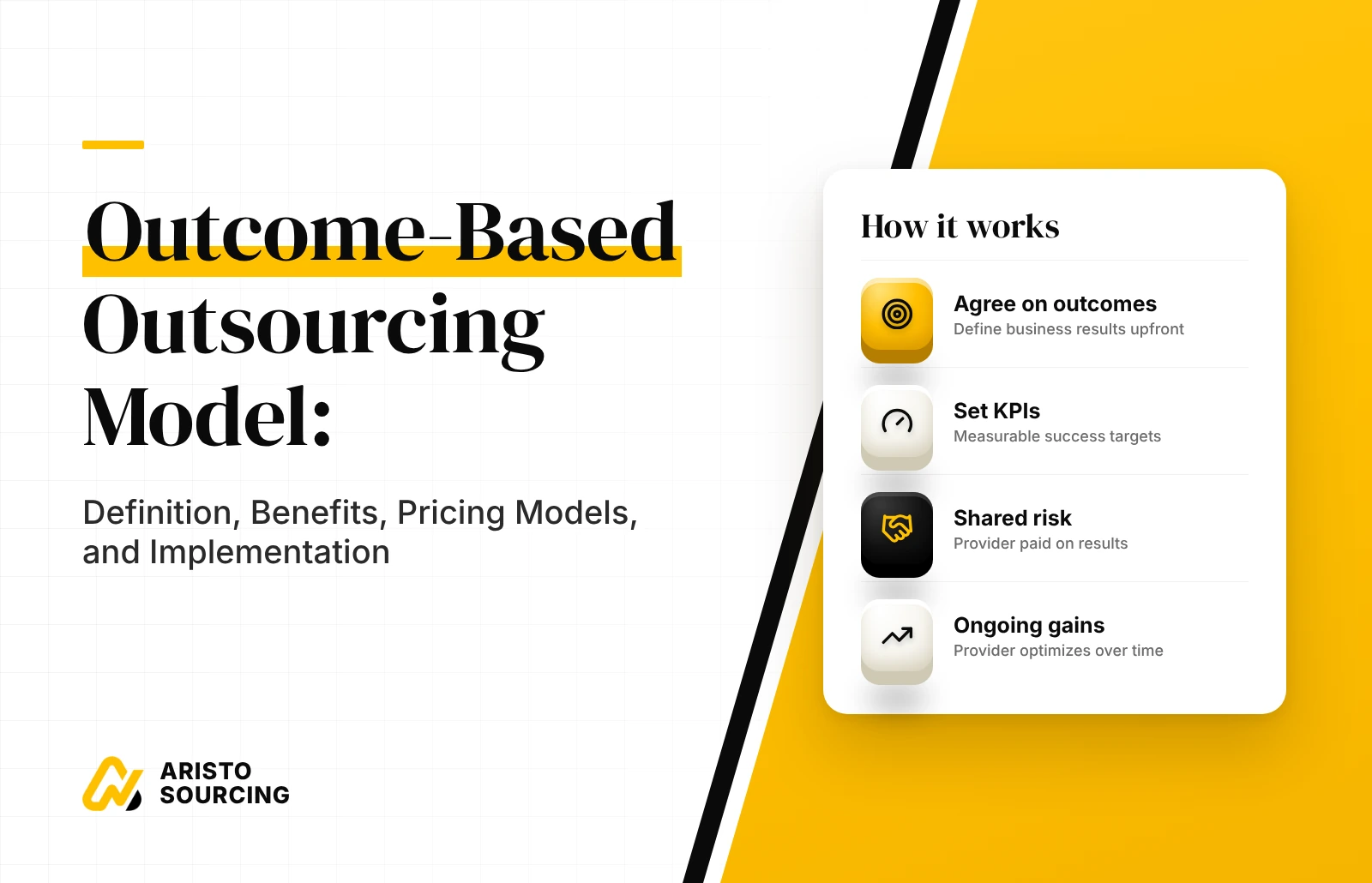
An outcome-based outsourcing model basically refers to paying an outsourcing provider for measurable business results instead of hours. The client defines the result it needs, and the provider takes responsibility for delivering that result under shared risk and shared reward. The main benefits of the model are aligned incentives, stronger accountability, more innovation, better operational efficiency, and clearer business value. Common pricing models include fixed plus variable pricing, incentives, gainsharing, and risk premiums. The model also carries risks, such as measurement risk, attribution problems, poor data quality, and low governance maturity.
A good outcome-based contract includes defined outcomes, KPIs, targets, a pricing model, clear responsibilities, governance, and a dispute resolution process. Outcome-based outsourcing does not fit every function, so this guide also explains when a business should use the model and how to implement it step by step. Choosing the right outsourcing partner matters as much as the contract itself, because the partner’s skills, data practices, and reporting discipline decide whether the agreed outcomes are reached.
What Is an Outcome-Based Outsourcing Model?
An outcome-based outsourcing model is an arrangement in which a business pays an outsourcing provider according to the measurable business outcomes delivered, rather than the time or staff used. Payment is tied to measurable business results, such as lower costs, faster resolution times, or higher customer retention, rather than hours billed, headcount assigned, or effort spent. This payment method is called outcome-based pricing. Under outcome-based pricing, the client buys a result, not a resource.
The relationship between the client and the outsourcing provider works like a partnership. The client defines the business outcomes and supplies the access, data, and decisions the provider needs. The outsourcing provider chooses the methods, tools, and staffing required to reach those outcomes. Because part of the provider’s fee depends on performance, both parties carry shared risk, and both gain when results improve.
How Does Outcome-Based Outsourcing Work?
Outcome-based outsourcing works by linking a provider’s compensation to an agreed business outcome, which is tracked through KPIs, compared against a baseline, and judged against a target. The process starts when the client and the provider agree on one business outcome, such as reducing customer churn or cutting invoice processing costs. Both parties then record current performance as a baseline, select the KPIs that will track progress, and set a target for each KPI. During the engagement, the provider reports performance metrics at agreed intervals, and both parties review the results against the targets.
KPIs translate the outcome into numbers, and targets define the level of performance that counts as success. Provider pay follows those numbers through performance-based compensation. Under performance-based compensation, the provider earns more when targets are met or exceeded and earns less when performance falls short. This link between pay and results is what makes outcome-based outsourcing different from traditional outsourcing, where the fee stays the same regardless of results.
What Is the Difference Between Outcome-Based Outsourcing and Traditional Outsourcing?
Outcome-based outsourcing differs from traditional outsourcing mainly in what a business pays for, because traditional outsourcing pays for resources and effort, while outcome-based outsourcing pays for measurable results. Traditional outsourcing usually relies on FTE-based pricing, where the client pays a fixed rate per full-time employee or per hour, whereas outcome-based pricing ties part or all of the fee to agreed KPIs.
Vendor accountability also changes, because a traditional vendor is accountable for supplying staff and completing tasks, while an outcome-based provider is accountable for the result itself. Risk and incentives shift as well, since the client carries most of the performance risk in a traditional deal, while an outcome-based deal shares that risk and rewards the provider for better results instead of more hours. Each model has its own benefits, so traditional outsourcing still suits work that is hard to measure, and outcome-based outsourcing suits work with clear, measurable results.
What Are the Benefits of Outcome-Based Outsourcing?
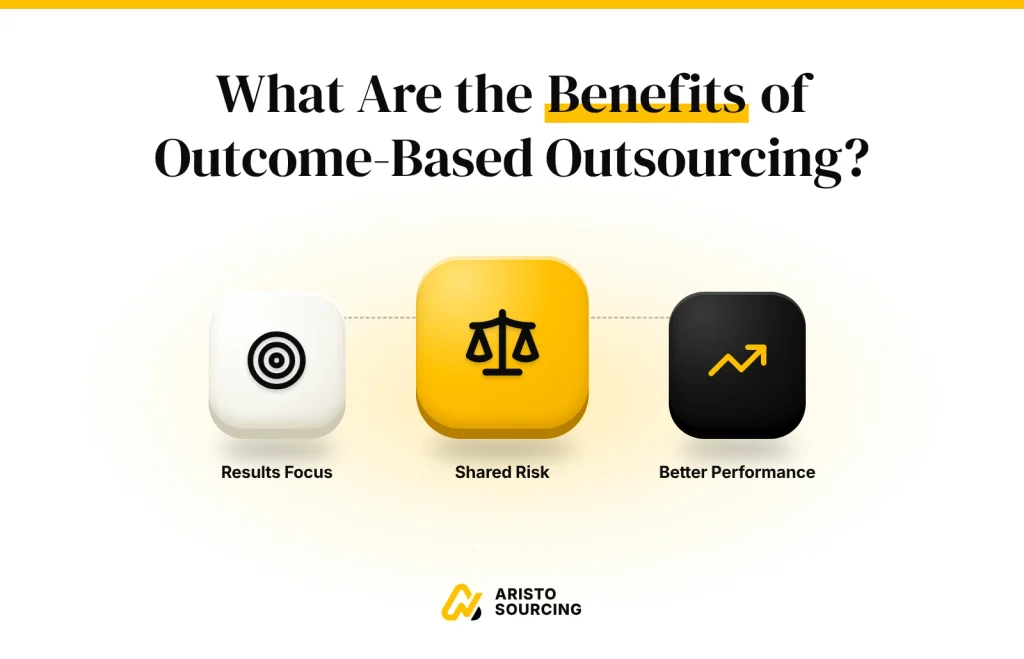
The benefits of outcome-based outsourcing include aligned incentives, stronger accountability, more innovation, improved operational efficiency, and greater business value.
The benefits of outcome-based outsourcing are listed below.
- Aligns Incentives: Aligning incentives refers to structuring an outsourcing agreement so that the client and the provider gain from the same measurable result, instead of pursuing separate or competing goals. In a traditional deal, the provider earns more when work takes longer, while the client wants the work done faster. Outcome-based outsourcing creates aligned incentives, because the provider earns more only when the client’s result improves.
- Strengthens Accountability: Strengthening accountability refers to making the outsourcing provider directly responsible for delivering an agreed result, with clear consequences for success or failure written into the contract. When payment depends on results, the provider owns the outcome instead of only the task list. This ownership pushes the provider to find and fix problems early, because missed targets reduce its fee.
- Drives Innovation: Driving innovation refers to encouraging the provider to develop new methods, tools, or processes that reach the agreed outcome faster, cheaper, or more reliably than current practices. The client defines the target, not the method, so the provider is free to change how the work gets done. Automation, better workflows, and smarter staffing all become ways for the provider to hit a target and earn more.
- Improves Operational Efficiency: Improving operational efficiency refers to producing the same or better business results with less time, cost, and waste, so every resource in the engagement contributes to the outcome. The model discourages paying for idle time, because the client pays for results rather than hours on a timesheet. Low-value work also drops, since the provider gains nothing from tasks that do not move the KPI.
- Delivers Business Value: Business value, in this context, refers to the measurable financial or strategic gain a business receives from an outsourcing engagement, such as higher revenue, lower costs, or happier customers. Outcome-based outsourcing keeps the engagement focused on results that matter to the business, not on activity reports.
These benefits depend on how the provider is paid, which makes the pricing model one of the most important choices in any outcome-based engagement.
What Are Outcome-Based Outsourcing Pricing Models?
The outcome-based outsourcing pricing models include fixed plus variable pricing, incentives, gainsharing, and risk premiums.
The common outcome-based outsourcing pricing models are listed below.
- Fixed Plus Variable Pricing
- Incentives
- Gainsharing
- Risk Premium
Fixed Plus Variable Pricing
Fixed plus variable pricing refers to a pricing structure in which the provider receives a guaranteed base fee plus an additional payment that rises or falls with measured performance. The base fee covers the provider’s core operating costs, such as staff and tools, so service delivery stays stable. The variable component is the outcome-based pricing element, and the provider receives it only when agreed KPIs are met. For example, a contract might pay 80% of the fee as a fixed amount and hold back 20% as a results-linked payment. This blend of guaranteed and performance-based pricing is a common starting point, because it limits risk for both sides.
Incentives
Incentives refer to extra payments a provider earns when its performance exceeds the targets agreed in the contract, rewarding results above the minimum required standard of service. The contract sets targets for each KPI and attaches a bonus to performance above those targets. For example, a customer support provider might earn a bonus for every percentage point of first-contact resolution above an agreed 80% target. Incentives can also be tiered, with larger payments for larger improvements. Some contracts pair incentives with penalties, so the provider earns less when it misses a target.
Gainsharing
Gainsharing refers to a pricing arrangement in which the client and the provider divide the measurable financial value created above an agreed baseline, according to a split set in advance. The baseline records the cost, revenue, or performance level before the engagement starts. When the provider’s work produces savings or gains above that baseline, both parties share the value, for example, at a 50/50 or 60/40 split. Gainsharing works best when the financial impact is easy to calculate, such as lower processing costs or higher collected revenue. The model gives the provider a direct stake in the client’s success, because the provider’s share grows as the value grows.
Risk Premium
A risk premium refers to the additional amount a provider charges when it accepts more responsibility for outcomes that it cannot fully control or predict in advance. Shared risk has a price, because a provider that may lose part of its fee needs compensation for that uncertainty. The premium grows when results depend on factors outside the provider’s control, such as market demand, client decisions, or poor data. A risk premium also rises when measuring the outcome is difficult, because unclear measurement increases the chance of disputes and unpaid work. Clear KPIs, reliable data, and a well-defined baseline usually lower the premium, which makes measurement the foundation of every outcome-based deal.
How to Measure Outsourcing Outcomes?
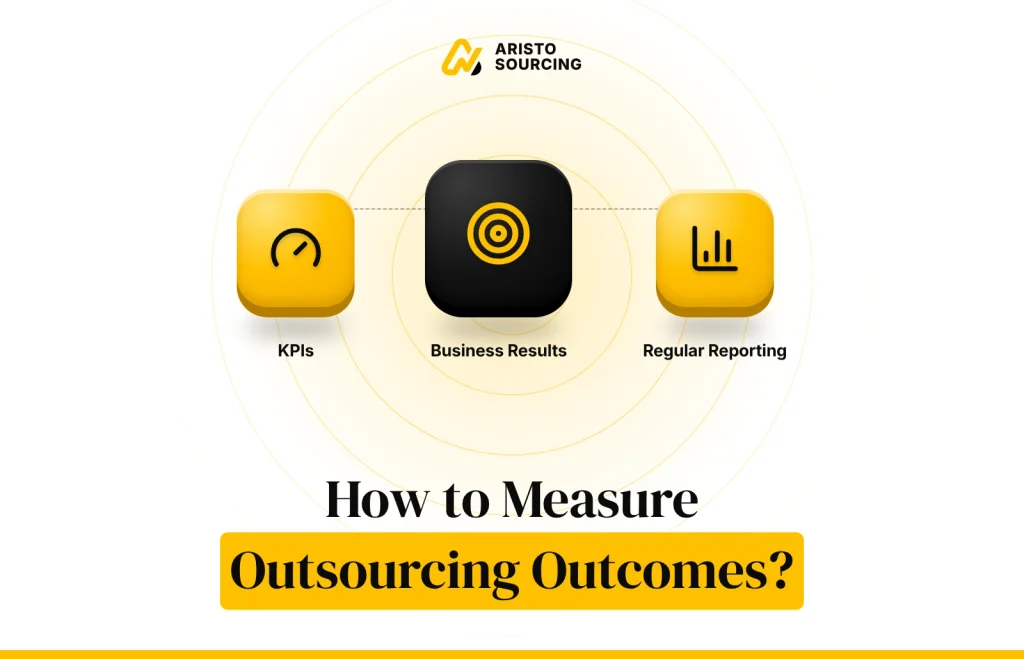
Measuring outsourcing outcomes includes defining the business outcomes, selecting KPIs, recording a baseline, setting targets, and tracking actual results against those targets throughout the engagement. Outcomes must be specific and measurable, because a vague goal such as “better service” cannot support payment decisions or performance reviews. The baseline shows where performance starts, and the target shows where performance must reach, so measurement without both numbers cannot prove improvement.
Business outcomes also differ from activity or output metrics, because tickets closed or hours logged show effort, while cost reduction, customer satisfaction, system uptime, customer retention, and revenue show results. Agreeing on data sources, calculation methods, and reporting frequency before the engagement starts helps both parties avoid risks such as disputed numbers and unfair payments. Even with careful measurement, the model carries several risks that a business should plan for.
What Are the Risks and Challenges of Outcome-Based Outsourcing?
The risks and challenges of outcome-based outsourcing are listed below.
- Measurement Risk: Measurement risk occurs when the chosen KPIs do not accurately reflect the business outcome, which leads to payments for the wrong results. Businesses can avoid this risk by testing each KPI against historical data and writing the calculation method into the contract before the engagement starts.
- Attribution Problems: Attribution problems arise when outside factors, such as market changes, seasonal demand, or client-side decisions, affect the outcome and hide the provider’s real contribution. Businesses can avoid this challenge by choosing outcomes the provider directly influences and by adding adjustment rules for external factors to the contract.
- Data Quality: Poor data quality, such as incomplete records, inconsistent definitions, or manual reporting errors, makes performance results unreliable and payment calculations easy to dispute. Businesses can avoid this risk by auditing data sources, assigning clear data ownership, and agreeing on a single source of truth before measurement begins.
- Governance Maturity: Low governance maturity means the client lacks the processes, people, or reporting habits needed to manage a results-based relationship, so reviews become irregular, and issues go unresolved. Businesses can avoid this challenge by setting a review schedule, naming owners on both sides, and starting with a smaller pilot before expanding the contract.
What Should an Outcome-Based Outsourcing Contract Include?
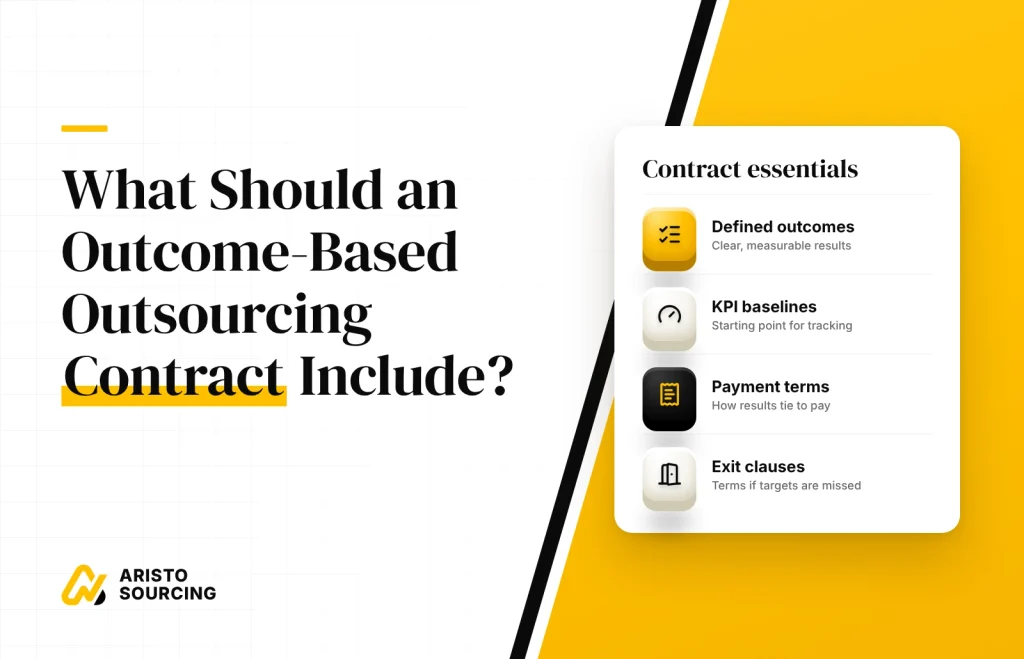
An outcome-based outsourcing contract should include defined outcomes, KPIs, targets, a pricing model, clear responsibilities, a governance structure, and a dispute resolution process.
The elements of an outcome-based outsourcing contract are listed below.
- Defined Outcomes: Defined outcomes, in a contract, refer to the specific, measurable business results the provider is expected to deliver, stated clearly enough that both parties can verify success. An outcome-based contract must name the exact result, such as “reduce average handling time by 15%,” because every payment and review depends on that result. Vague outcomes lead to disagreements over whether the provider succeeded.
- KPIs: KPIs refer to key performance indicators, which are the specific, quantifiable metrics that both parties use to track progress toward each defined outcome during the outsourcing engagement. KPIs translate a broad outcome into something trackable, such as turning “better customer experience” into a customer satisfaction score or a first-contact resolution rate. The contract should define each KPI’s formula, data source, and reporting frequency.
- Targets: Targets refer to the specific performance levels each KPI must reach within a set period for the provider’s work to count as successful under the contract. Targets set the threshold for success against each KPI, such as 99.9% system uptime or a 90% customer satisfaction score. Contracts often define both minimum and stretch targets, which connect directly to penalties and incentives.
- Pricing Model: Pricing model refers to the payment structure that defines how the provider is paid, including fixed fees, variable payments, incentives, gainsharing, or penalties linked to results. The contract should spell out the pricing model being used, the formula for each payment, and the timing of every payout. Clear pricing terms prevent surprises when results are reviewed.
- Responsibilities: Responsibilities, in this context, refer to the specific tasks, decisions, and resources that each party must provide so the agreed outcomes can be delivered and measured fairly. The client usually owns strategic decisions, system access, data, and timely approvals. The provider owns daily execution, staffing, process improvements, and performance reporting.
- Governance: Governance refers to the structure of meetings, reports, roles, and decision rights that both parties use to oversee performance and manage the relationship throughout the engagement. A typical governance model includes monthly performance reports, quarterly business reviews, and named contacts on each side. Regular reviews let both parties spot problems early and adjust targets when business conditions change.
- Dispute Resolution: Dispute resolution refers to the agreed process both parties follow when they disagree about performance results, measurement methods, data accuracy, or payments owed under the contract. A good example is a three-step process: the account managers try to resolve the issue first, senior leaders review it next, and an independent expert decides if the disagreement continues. Both parties should also agree in advance on which data source is final, because many disputes start with conflicting numbers.
What Are the Examples of Outcome-Based Outsourcing?
The examples of outcome-based outsourcing are listed below.
- IT Outsourcing: In IT outsourcing, a provider is paid according to results such as system uptime, incident resolution time, or prevented outages, rather than the number of engineers assigned. For example, a managed IT provider can earn a bonus for keeping system uptime above 99.9% and pay a penalty for each hour of unplanned downtime.
- BPO: In business process outsourcing (BPO), payment is tied to transactions processed accurately, such as invoices, claims, or orders, rather than the hours staff spends on them. A finance BPO provider, for instance, may be paid per invoice processed without errors, which rewards both speed and accuracy.
- Customer Service: In customer service outsourcing, the provider is paid for resolved customer issues, first-contact resolution rates, or customer satisfaction scores rather than for agent hours. This structure encourages the provider to solve problems in fewer contacts instead of keeping customers on the phone longer.
- Revenue Growth: In revenue growth engagements, such as outsourced sales or lead generation, the provider earns a share of the new revenue, qualified leads, or closed deals it generates. This approach turns the provider into a growth partner, because the provider’s income rises only when the client’s sales rise.
- Customer Satisfaction: In customer satisfaction engagements, the provider’s fee is linked to improvements in Net Promoter Score (NPS), customer satisfaction (CSAT) scores, or customer retention rates. These engagements suit businesses where loyalty and repeat purchases drive long-term profit.
Understanding the proper time to use outcome-based outsourcing is very important.

When Should a Business Use Outcome-Based Outsourcing?
A business should consider outcome-based outsourcing when the desired result can be measured clearly, the provider can directly influence that result, and reliable data exists to track progress. The model suits repeatable, high-volume work with stable processes, such as ticket resolution, transaction processing, or system maintenance. Measurable outcomes are essential, because a result that cannot be counted cannot be priced, reviewed, or rewarded.
The provider must also have real influence over the outcome. Tying payment to company-wide sales when the provider only answers support emails creates unfair risk and attribution disputes. Suitable functions include IT, BPO, customer service, and HR, where results such as uptime, accuracy, resolution rates, and time-to-hire are easy to track. Businesses implementing outcome-based outsourcing models also need enough governance capacity to review results regularly, or they can start with a pilot to build that capacity. The model is less suitable for creative, exploratory, or fast-changing work, where results are hard to define in advance.
How to Implement an Outcome-Based Outsourcing Model?
Implementing an outcome-based outsourcing model generally follows a few steps, starting with defining the business outcome and ending with ongoing monitoring and optimization of the provider’s performance.
The steps to implement an outcome-based outsourcing model are listed below.
- Define the Business Outcome: Defining the business outcome means agreeing with the provider on the specific, measurable result the engagement must achieve and linking that result to a clear business objective. For example, the business objective of improving customer loyalty might become an outcome to increase customer retention from 82% to 88% within 12 months.
- Establish the Baseline: Establishing the baseline means recording current performance levels for each chosen metric before the engagement starts, so both parties have a fixed starting point for measuring improvement. A baseline built from several months of historical data smooths out seasonal swings and makes later comparisons fair.
- Select KPIs and Targets: Selecting KPIs and targets means choosing the measurable indicators that track the outcome and setting the specific thresholds that count as success, minimum performance, and exceptional performance. Each KPI should sit within the provider’s control and be simple to calculate from available data. A short list of three to five KPIs per outcome usually keeps the focus sharp.
- Agree on Pricing and Incentives: Agreeing on pricing and incentives means settling how the provider gets paid for meeting targets, how much extra it earns for exceeding them, and what happens when performance falls short. The pricing model, whether fixed plus variable, gainsharing, or incentive-based, should match the level of risk each party is willing to carry.
- Establish Measurement and Governance: Establishing measurement and governance means setting up the reporting tools, data sources, review meetings, and decision rights that both parties will use to track and manage performance. Clear governance prevents disputes, because everyone knows who reports what, when, and to whom. An experienced partner, such as Aristo Sourcing, can help set up this structure from the start of the engagement.
- Monitor and Optimize Performance: Monitoring and optimizing performance means reviewing results against targets at regular intervals and adjusting processes, staffing, or targets whenever the data shows a need for change. Outsourcing providers that review performance every month can catch problems before they affect payments or customers. Targets may also need updating as the business grows or market conditions shift.
How Do Outsourcing Providers Help With Outcome-Based Outsourcing?
Outsourcing providers help with outcome-based outsourcing by aligning their people, processes, and tools with measurable outcomes, such as customer satisfaction, cost reduction, operational efficiency, system uptime, or other agreed performance targets. Contracts and service level agreements (SLAs) define the expected outcomes, the KPIs used to track them, the measurement methods, and the provider’s responsibilities, so both parties know exactly what success looks like.
This model differs from traditional FTE-based outsourcing, where the buyer pays for hours worked, headcount, or specific inputs, because the buyer pays for results and business impact instead. In this setup, providers like Aristo Sourcing focus on the talent and execution behind the results, so clients can judge the partnership by its business impact.
What Is Aristo Sourcing’s Role in Outcome-Focused Outsourcing?
Aristo Sourcing plays an execution-focused role in outcome-focused outsourcing by providing staffing and recruitment support, so businesses can focus on achieving broader business outcomes instead of managing hiring tasks. Aristo Sourcing manages the hiring side of outsourcing, including candidate sourcing, screening, and placement of skilled remote professionals. This support removes the time-consuming recruitment work that slows down growing teams.
Aristo Sourcing focuses on SMBs, startups, and specialized agencies rather than large enterprises with multi-million-dollar outsourcing contracts. These businesses often want the benefits of outcome-based outsourcing, such as clear accountability and better results, without the complexity of an enterprise-scale pricing model. Reducing the tactical burden and risk of hiring allows founders and teams to spend more time on strategic growth and core business priorities. For businesses implementing outcome-focused outsourcing models, this support creates a practical starting point: the right people are in place, so the focus stays on results.