
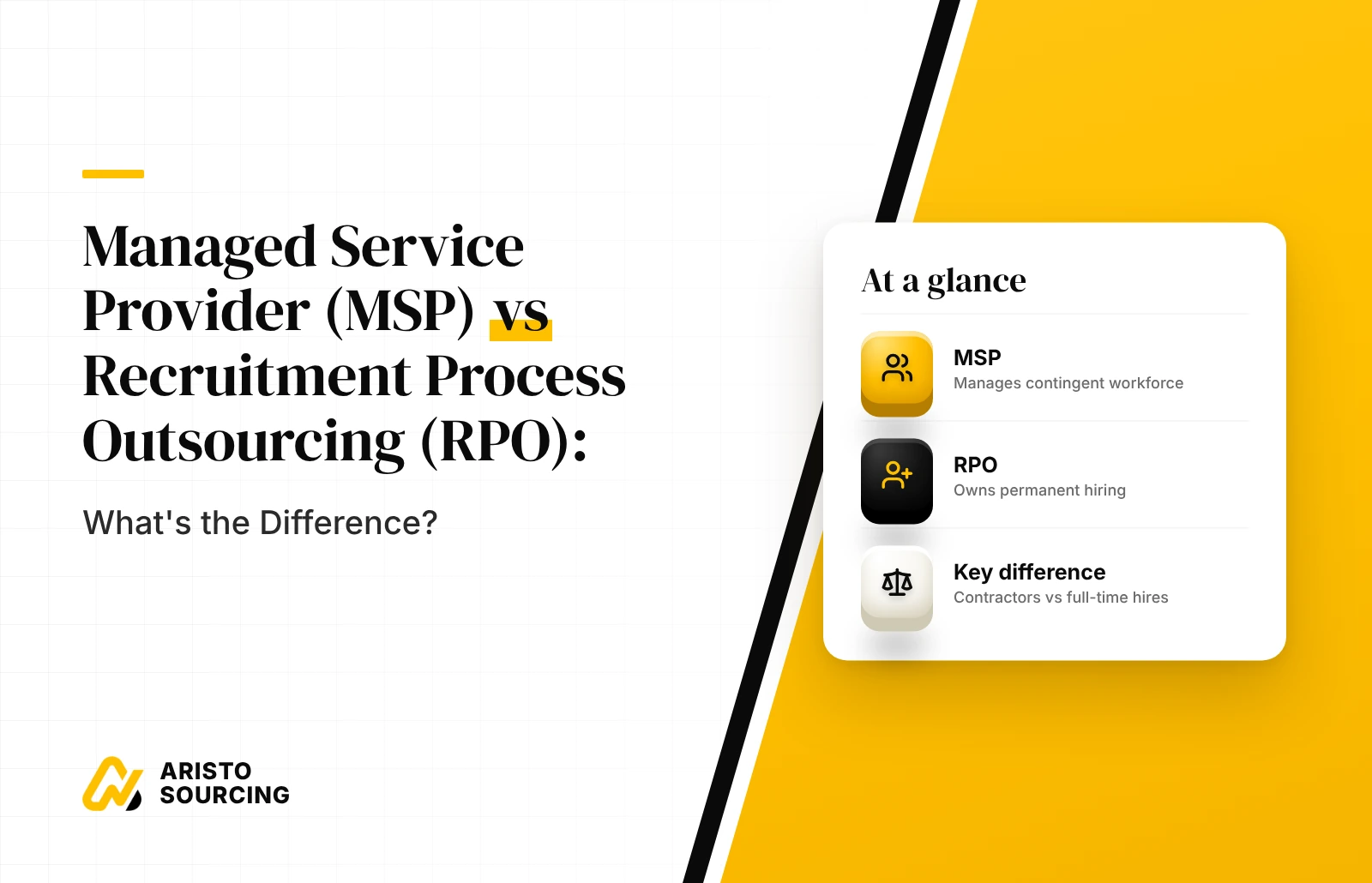
Managed Service Provider (MSP) and Recruitment Process Outsourcing (RPO) mainly differ in the workforce each model manages, the hiring problems it solves, and the outcomes it delivers. An MSP manages the contingent workforce of contractors, freelancers, and temporary workers, while an RPO provider manages permanent hiring for full-time roles. Both MSP and RPO are workforce outsourcing models, but each model serves a different workforce need. Choosing the right model aligns outsourcing with the actual workforce gap, which leads to stronger hiring quality, better cost control, and more reliable workforce outcomes. An experienced outsourcing partner can help a business implement the right model, whether that model is MSP, RPO, or a combination of both.
What Is the Difference Between MSP and RPO?
The difference between MSP and RPO lies in the type of workforce each model manages, as MSP oversees the contingent workforce through a network of staffing suppliers while RPO manages talent acquisition for the permanent workforce.
MSP programs are built for supplier control, compliance, and spend management, while RPO programs are built for sourcing, screening, and hiring permanent employees.
The difference between MSP and RPO is presented in the table below.
| Factor | Managed Service Provider (MSP) | Recruitment Process Outsourcing (RPO) |
| Workforce type | Contingent workforce, including contractors, freelancers, consultants, and temporary workers | Permanent workforce, including full-time and long-term employees |
| Purpose | Control the quality, cost, and compliance of contingent labor across multiple staffing suppliers | Run or support talent acquisition so the organization hires permanent employees at the required speed and quality |
| Responsibilities | Staffing supplier selection, supplier performance tracking, contractor onboarding and offboarding, rate management, invoicing, and compliance | Candidate sourcing, screening, interview coordination, offer management, employer branding, and talent pipeline building |
| Primary outcomes | Controlled contingent labor costs, lower compliance risk, and clear workforce visibility | Shorter time to fill, higher quality of hire, and a scalable recruitment process |
What Is a Managed Service Provider (MSP)?
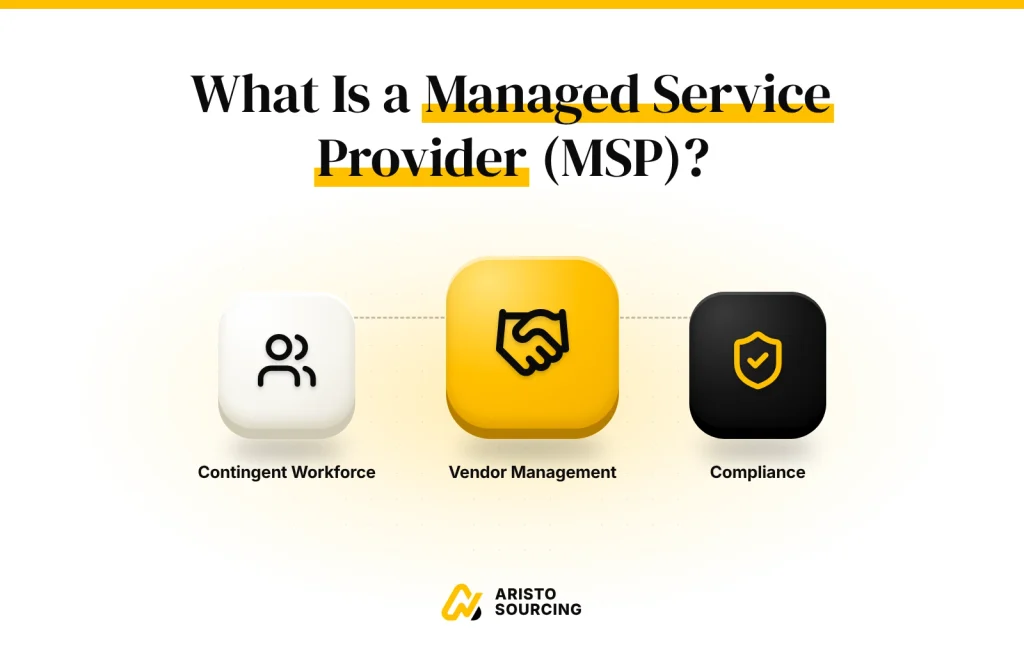
A Managed Service Provider (MSP) is an outsourced partner that manages an organization’s contingent workforce program, including contractors, temporary workers, staffing suppliers, compliance, and contingent labor spend. The MSP selects, coordinates, and evaluates the staffing suppliers that provide contractors, which turns scattered agency relationships into one structured supplier management program.
The MSP also handles workforce management tasks such as onboarding, rate control, invoicing, and compliance checks, which gives the organization clear workforce visibility and tighter control over labor costs. An MSP is different from RPO because an MSP focuses on contingent labor sourced through staffing suppliers rather than on recruiting permanent employees.
What Is Recruitment Process Outsourcing (RPO)?
Recruitment Process Outsourcing (RPO) is a talent acquisition model in which an external provider manages some or all of an organization’s permanent recruitment process, from candidate sourcing to hiring. An RPO provider can run the full recruitment cycle or take over specific stages, such as candidate sourcing, screening, interview scheduling, and offer management for permanent employees.
RPO supports the internal talent acquisition team by adding recruiters, sourcing capacity, and hiring expertise without adding fixed headcount. The RPO provider also builds a talent pipeline of qualified candidates, so permanent hiring stays consistent when hiring demand rises. RPO follows different costing than MSP because RPO fees are usually tied to hires, recruiter capacity, or program scope rather than to contingent labor spend.
What Are the Cost and Pricing Differences Between MSP and RPO?
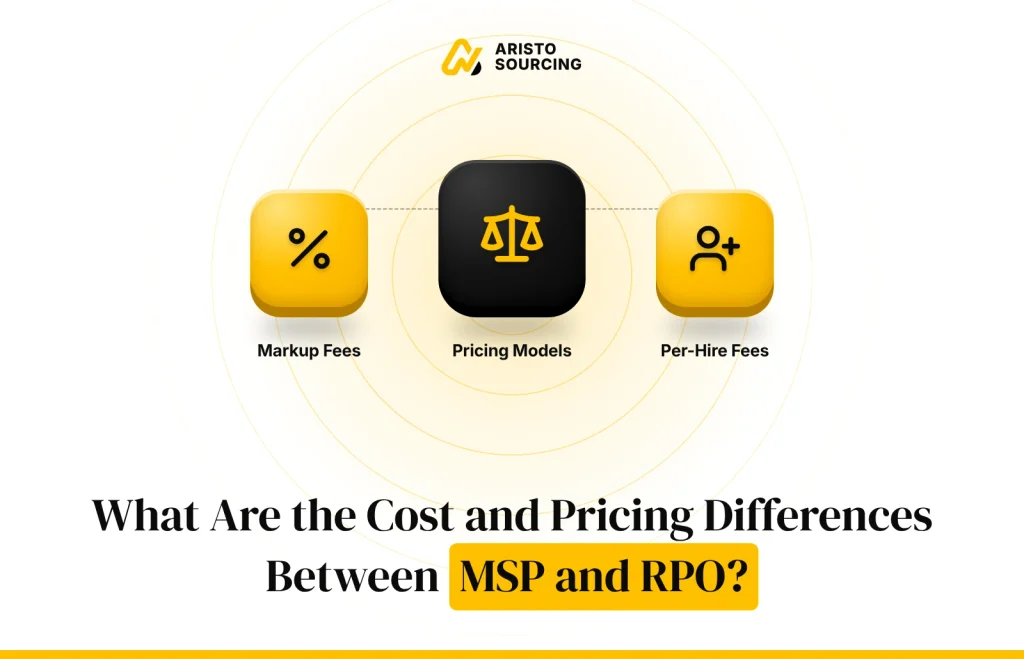
The cost and pricing differences between MSP and RPO are rooted in what each model manages: MSP cost is usually linked to contingent workforce spend, while RPO cost is usually linked to recruitment activity and permanent hires. Pricing for both models depends on 3 main factors: workforce or hiring volume, program complexity, and the services included in the contract.
MSP cost is typically calculated as a percentage of total contingent labor spend, and the fee can be paid by the client, funded by staffing suppliers, or split between both. An MSP program also influences overall labor costs because the MSP standardizes bill rates, consolidates suppliers, and reduces off-contract spending.
RPO cost is typically structured as a cost per hire, a monthly management fee, or a hybrid model that combines fixed and per-hire fees. Cost per hire is the most useful comparison point for RPO because it shows how the RPO cost compares with internal recruiter salaries, job board spend, and agency fees.
Neither model is always cheaper, since the final value depends on the organization’s workforce mix, hiring volume, and existing inefficiencies. A fair comparison measures MSP and RPO against the same KPI baseline, such as total labor costs, cost per hire, and time to fill, before the organization commits to either model.
What KPIs and Performance Metrics Differentiate MSP from RPO?
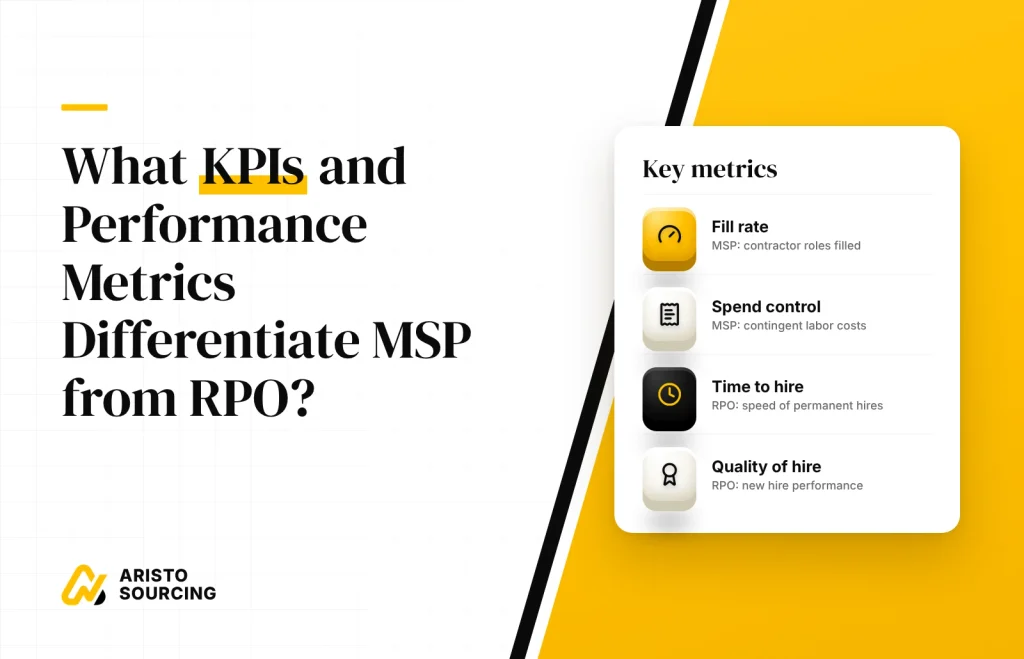
The KPIs and performance metrics that differentiate MSPs from RPOs include supplier and spend metrics for MSP programs and hiring outcome metrics for RPO programs. MSP metrics focus on vendor compliance, supplier performance, cost control, and contingent workforce spend. MSP programs also track fill rate and the speed of hiring or processing contingent workers, usually through data collected in a vendor management system (VMS).
RPO metrics focus on quality of hire, time to fill, cost per hire, hiring manager satisfaction, recruitment efficiency, and employee retention. The key difference is that MSP performance is mainly measured by vendor and workforce management, while RPO performance is measured by talent acquisition and hiring outcomes.
Why Do MSPs Rely on VMS While RPOs Adopt ATS?
MSPs rely on VMS platforms because MSPs need to manage third-party staffing suppliers and contingent workers, while RPOs typically adopt ATS platforms because RPOs need to manage individual candidates moving toward permanent employment. A VMS supports workforce management by centralizing vendor relationships, contracts, rate cards, timesheets, invoices, and contingent worker logistics in one platform.
An applicant tracking system (ATS) is recruitment technology that helps RPO recruiters source, track, engage, and nurture individual candidates from first contact to a permanent job offer. The key distinction is that VMS manages the staffing supply chain and vendors while ATS manages the candidate and recruitment process, which makes technology fit a practical factor when choosing MSP or RPO support.
When Is an MSP the Right Choice?
An MSP is the right choice when an organization relies heavily on contingent labor and needs one structured program to manage its contractors and staffing suppliers. Companies that work with many contractors across several staffing suppliers often face inconsistent bill rates, duplicate agency relationships, and scattered worker data. An MSP consolidates those suppliers under one program, which improves workforce visibility across departments and locations.
An MSP also lowers compliance risk by managing worker classification checks, contract terms, onboarding requirements, and audit documentation for the contingent workforce. Organizations that need to control contingent labor costs, standardize rates, and track spend accurately should select an MSP rather than choosing RPO, because RPO is built for permanent recruitment instead of contingent workforce management.
When Is an RPO the Right Choice?
An RPO is the right choice when an organization faces high-volume or difficult permanent hiring that the internal talent acquisition team cannot handle efficiently. High-volume hiring for roles in customer service, sales, or operations requires a recruitment process that scales up and down without adding internal recruiters.
Difficult permanent hiring for specialized or senior roles requires deeper candidate sourcing, stronger screening, and access to passive candidates. An RPO provider delivers recruitment scalability through flexible recruiter capacity and builds a talent pipeline that shortens future hiring cycles. When choosing between MSP and RPO, an organization should select RPO if the main gap is the quality, speed, or volume of permanent hires rather than the management of contractors.

How to Choose Between MSP and RPO?
Choosing between MSP and RPO depends on the organization’s workforce needs, with MSP suited to managing contingent labor costs and suppliers, while RPO focuses on improving permanent hiring and recruitment efficiency.
If the organization needs both contingent workforce control and permanent hiring support, an MSP plus RPO model or a total talent management approach is worth considering. A practical first step is to map the current workforce mix, hiring volume, and spend by worker type, because that data shows where outsourcing delivers the most value.
Is It Possible to Use MSP and RPO Together?
Yes, MSP and RPO can be used together, and organizations with both contingent and permanent hiring needs often run the two models side by side. The MSP manages contingent workers and staffing suppliers, while the RPO provider manages permanent recruitment at the same time. Total talent management is the broader strategy that unifies both models by placing the contingent workforce and the permanent workforce under one plan for talent, cost, and capacity.
Total talent management helps hiring managers decide whether a role should be filled by a contractor or a permanent employee based on business need, not on which hiring channel is easier to access. Experienced outsourcing partners help businesses run combined MSP and RPO programs without added complexity by aligning processes, reporting, and technology across both models.
When Should Companies Consider Outsourcing Providers for MSP and RPO Needs?
Companies should consider outsourcing MSP or RPO needs when internal workforce management or recruitment operations become difficult to scale, control, or manage efficiently. Operational maturity, budget visibility, workforce complexity, and risk levels are the main decision factors that indicate whether outsourcing is appropriate.
Outsourcing to providers like Aristo Sourcing can shift some fixed talent acquisition or workforce management costs into more scalable, variable costs that follow actual hiring demand. The reasons for adopting an MSP usually relate to contingent workforce management and supplier coordination, while RPO becomes more relevant when recruitment volume, hiring complexity, or internal recruiting capacity becomes difficult to manage.
Why Should Businesses Consider Aristo Sourcing for MSP and RPO Solutions?
Businesses should consider Aristo Sourcing for MSP and RPO solutions because Aristo Sourcing gives them a flexible, managed way to access skilled talent without carrying the full cost and workload of traditional hiring. Aristo Sourcing operates as a managed global remote staffing extension that bridges traditional hiring and fully managed workforce solutions.
Aristo Sourcing focuses on SMBs and expanding enterprises that need to scale their talent capabilities without building large internal recruitment teams. The key business benefits of working with Aristo Sourcing include reduced overhead and access to global talent across a wide range of business functions. Knowing the difference between MSP and RPO simplifies the Managed Service Provider vs Recruitment Process Outsourcing decision. Aristo Sourcing supports businesses in choosing the right one between MSP and RPO, whether the priority is contingent workforce support or RPO for permanent hiring.