
The benefits of outsourcing are lower costs, access to specialized talent, more focus on core business, faster scalability, round-the-clock operations, and more.
The size of each benefit depends on the outsourcing model, the business function, and the provider. Cost savings come first for most companies, but the advantages of outsourcing also include speed, flexibility, and access to skills that are hard to hire locally.
Outsourcing remains a core business strategy. According to the Deloitte Global Outsourcing Survey 2024, which drew on more than 500 executives, 80% of executives plan to maintain or increase investment in third-party outsourcing, and 83% already use AI as part of their outsourced services.
What Is Outsourcing?
Outsourcing is the practice of contracting an external service provider to perform business functions or processes that a company would otherwise handle with its own employees. It works through a contract that defines the scope of work, service levels, and fees.
The types of outsourcing are business process outsourcing (BPO), information technology outsourcing (ITO), and knowledge process outsourcing (KPO). Outsourcing also follows 3 location models: onshore, nearshore, and offshore.
What Are the Benefits of Outsourcing?
The benefits of outsourcing are lower costs, specialized talent, core business focus, scalability, 24/7 operations, technology access, speed to market, shared risk, and measurable performance. The 10 benefits of outsourcing are listed below.
- Lower Labor Costs
- Variable Cost Structure
- Access to Specialized Talent
- Focus on Core Business
- Faster Scalability
- 24/7 Operations
- Access to the Latest Technology
- Faster Time to Market
- Shared Risk
- Measurable Performance Through SLAs
1. Lower Labor Costs
Lower labor costs are the outsourcing benefit of paying a provider’s fee instead of the full cost of in-house employees. Outsourcing removes the employer’s spending on salaries, benefits, training, and office space for the outsourced role. According to the US Bureau of Labor Statistics, benefits accounted for 30.0% of private industry employer compensation costs in June 2026, so an in-house hire costs much more than the base salary alone.
2. Variable Cost Structure
A variable cost structure is the outsourcing benefit of turning fixed costs into fees that rise and fall with usage. Outsourcing replaces fixed spending on staff and infrastructure with fees paid per hour, per transaction, or per outcome. A variable cost structure frees capital for growth and lowers financial risk when demand drops.
3. Access to Specialized Talent
Access to specialized talent is the outsourcing benefit of using skilled and certified professionals without hiring them directly. Outsourcing providers already employ specialists in fields such as accounting, cybersecurity, and software development. Companies gain these skills without recruitment costs or onboarding delays.
4. Focus on Core Business
Focus on core business is the outsourcing benefit of moving internal teams from routine tasks to strategic work. Outsourcing transfers administrative and repetitive processes to a provider. Internal leaders and staff then spend more time on revenue, product, and strategy.
5. Faster Scalability
Faster scalability is the outsourcing benefit of adding or reducing capacity quickly as demand changes. Outsourcing providers adjust team size for seasonal peaks, product launches, or slow periods. Companies scale operations without the cost and delay of hiring or the legal exposure of layoffs.
6. 24/7 Operations
Round-the-clock operations, or 24/7 operations, are the outsourcing benefit of running work across time zones without a break. Offshore and multi-site providers staff customer support, monitoring, and data processing during the client’s nights and weekends. Work that starts at the end of one business day can be finished by the start of the next.
7. Access to the Latest Technology
Access to the latest technology is the outsourcing benefit of using a provider’s tools and systems without buying them. Outsourcing providers invest in software, infrastructure, and security systems that serve many clients. Companies gain current technology without capital spending or upgrade costs.
8. Faster Time to Market
Faster time to market is the outsourcing benefit of shortening project and launch timelines with dedicated external teams. Outsourcing providers start work with trained teams and proven processes. Companies launch products, campaigns, and services sooner than an internal hiring cycle allows.
9. Shared Risk
Shared risk is the outsourcing benefit of transferring part of the operational, compliance, and technology risk to the provider under contract. Outsourcing providers maintain industry standards, security controls, and backup staff. The contract assigns responsibility for service failures, which reduces the risk a company carries alone.
10. Measurable Performance Through SLAs
Measurable performance through SLAs is the outsourcing benefit of tracking a provider against agreed service targets. A service level agreement (SLA) sets targets, reporting schedules, and penalties for missed service levels. SLAs give companies clear data on quality, speed, and accuracy, which is often harder to measure for internal teams.
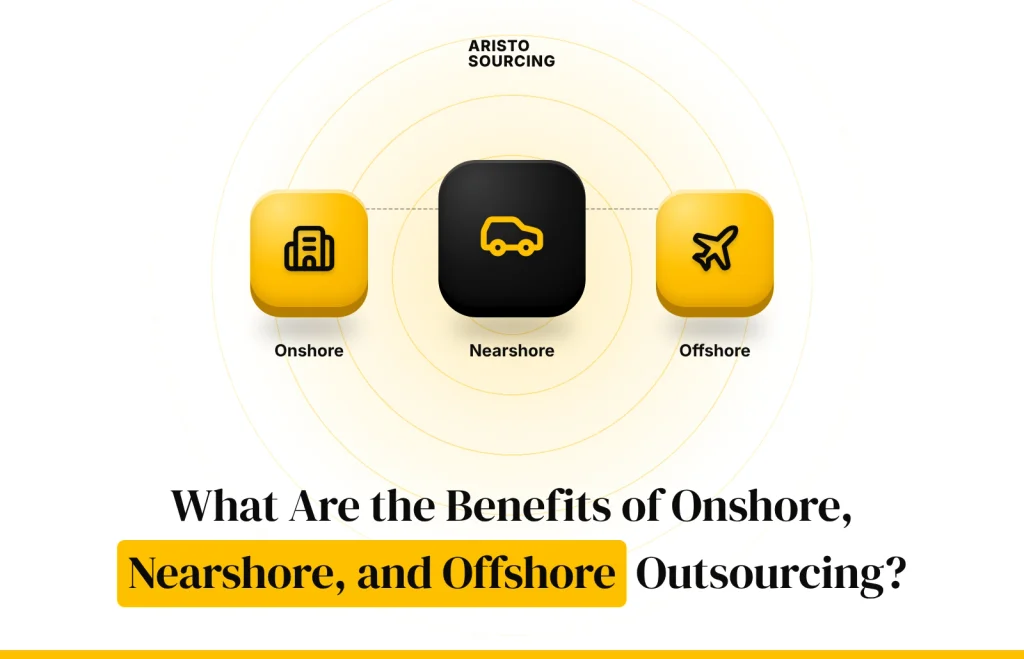
What Are the Benefits of Onshore, Nearshore, and Offshore Outsourcing?
The benefits of onshore, nearshore, and offshore outsourcing differ by language fit, time-zone alignment, and cost savings. Onshore offers the closest fit, nearshore balances savings and time zones, and offshore offers the largest savings.
The benefits of each outsourcing model are presented in the table below.
| Model | Location | Main Benefit | Trade-Off |
| Onshore | Same country | Same language, culture, and time zone | Highest cost |
| Nearshore | Neighboring country | Similar time zones and moderate savings | Smaller savings than offshore |
| Offshore | Distant country | Largest cost savings and 24/7 coverage | Time-zone gaps |
The cost gap between models is large. Crescendo, an AI customer service company, estimates 2026 contact center rates at $29.40 to $42 per agent hour in the United States, $12 to $19 in Latin America, and $7 to $16 in India, the Philippines, and Pakistan. A detailed breakdown of offshore outsourcing benefits shows how these savings apply by country and role.
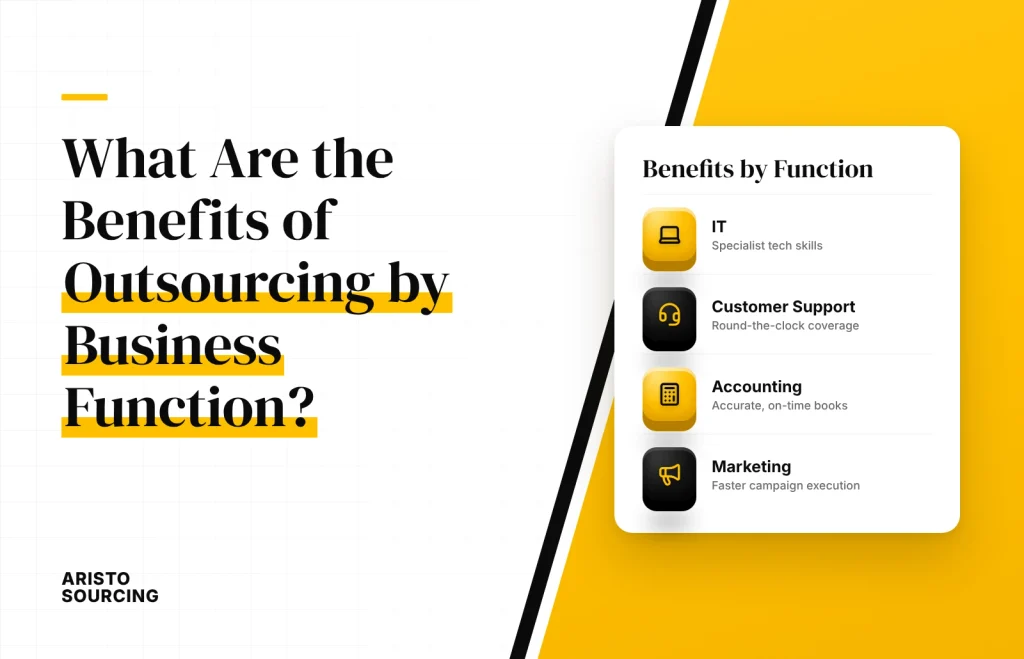
What Are the Benefits of Outsourcing by Business Function?
The benefits of outsourcing by business function are specialist skills, lower costs, and faster delivery in IT, customer service, HR, finance and accounting, digital marketing, and ecommerce. Each function gains a different main benefit.
The benefits of outsourcing by business function are listed below.
- IT: IT outsourcing gives access to developers, cloud engineers, and cybersecurity specialists without full-time hires.
- Customer Service: Customer service outsourcing provides 24/7 multilingual support that scales with call and ticket volume.
- HR: HR outsourcing handles recruitment, payroll, and compliance with employment rules.
- Finance and Accounting: Finance and accounting outsourcing improves bookkeeping accuracy and speeds up the month-end close.
- Digital Marketing: Digital marketing outsourcing adds SEO, content, social media, and paid advertising skills on demand.
- Ecommerce: Ecommerce outsourcing covers order processing, product listings, and customer support during seasonal peaks.
Matching each business function to the right provider and location model is how a company turns the benefits of outsourcing into measurable cost savings and growth.

What Are the Disadvantages of Outsourcing?
The disadvantages of outsourcing are less control, quality gaps, data security risks, hidden costs, and vendor lock-in. Clear SLAs and careful vendor checks reduce most of these risks before the contract starts. The questions below cover small businesses, offshoring, and AI.
Is Outsourcing Good for Small Businesses?
Yes, outsourcing is good for small businesses when the work is repetitive and non-core. Outsourcing lowers overhead for a small business because the business pays only for the hours or tasks it needs. Outsourcing also gives a small team access to skills it lacks, such as bookkeeping, IT support, or digital marketing.
What’s the Difference Between Outsourcing and Offshoring?
The difference between outsourcing and offshoring is that outsourcing changes who does the work, while offshoring changes where the work is done. A US company hiring a domestic payroll firm is outsourcing; a US company moving its own support team to the Philippines is offshoring. A full comparison of offshoring vs outsourcing covers how the two models combine.
How Is AI Changing the Benefits of Outsourcing?
AI is changing the benefits of outsourcing by automating routine tasks and shifting providers toward higher-value work. AI tools speed up data entry, ticket routing, and document processing, while human teams handle exceptions and complex cases. Most providers now run hybrid AI and human teams, which reflects the wider AI in outsourcing trend.