
Call center outsourcing is hiring a third-party provider to handle a company’s customer calls and related support channels. The main types of call center outsourcing are inbound, outbound, and omnichannel, and costs depend mostly on agent location and pricing model. The main benefits are lower fixed costs, 24/7 coverage, multilingual support, and scalability.
Call center outsourcing sits inside a large and growing market. According to Grand View Research, the global customer experience (CX) business process outsourcing market was valued at $113.0 billion in 2025 and is projected to reach $296.3 billion by 2033, growing at a CAGR of 13.0% from 2026 to 2033.
What Is Call Center Outsourcing?
Call center outsourcing is the practice of contracting an external provider to handle a company’s inbound and outbound customer calls, plus email and chat support, under agreed service levels. An outsourced call center is the external team of agents, supervisors, and systems that handles those customer interactions on the company’s behalf.
How Does Call Center Outsourcing Work?
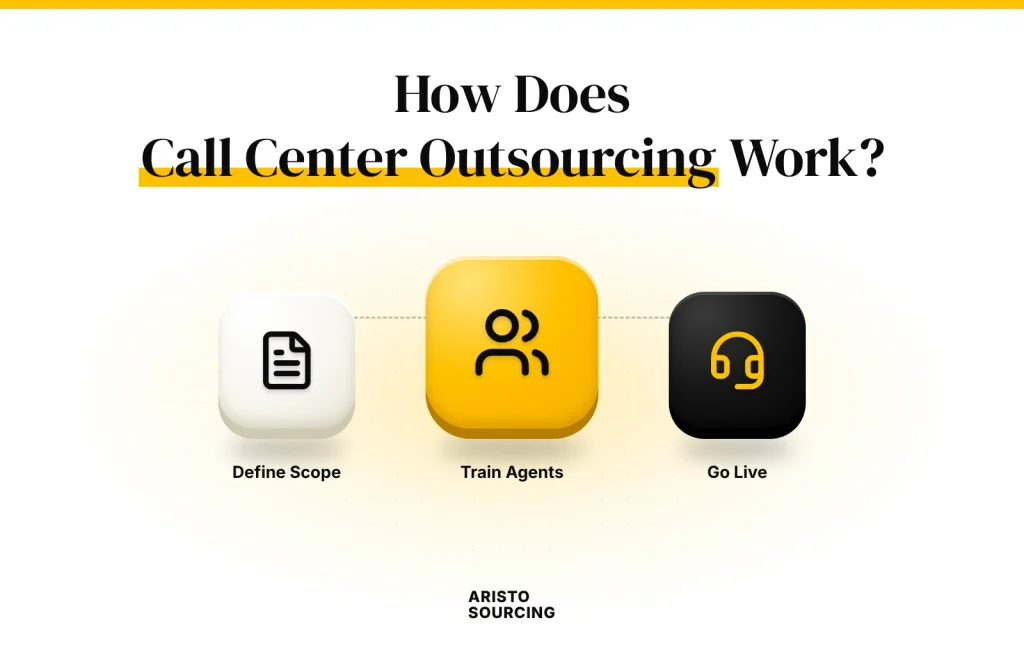
Call center outsourcing works by agreeing on scope and service levels, transferring call handling to a trained external team, and reviewing performance against agreed KPIs. The steps of call center outsourcing are listed below.
- The company defines the scope of work and the service level agreement (SLA), including call types, hours, and targets.
- The provider hires and trains agents on the company’s products, policies, and brand voice.
- The agents handle customer calls using the company’s systems or the provider’s platform.
- The provider reports KPIs such as service level, resolution rate, and customer satisfaction.
- The company and the provider hold regular reviews to adjust scripts, staffing, and targets.
What Are the Types of Call Center Outsourcing?
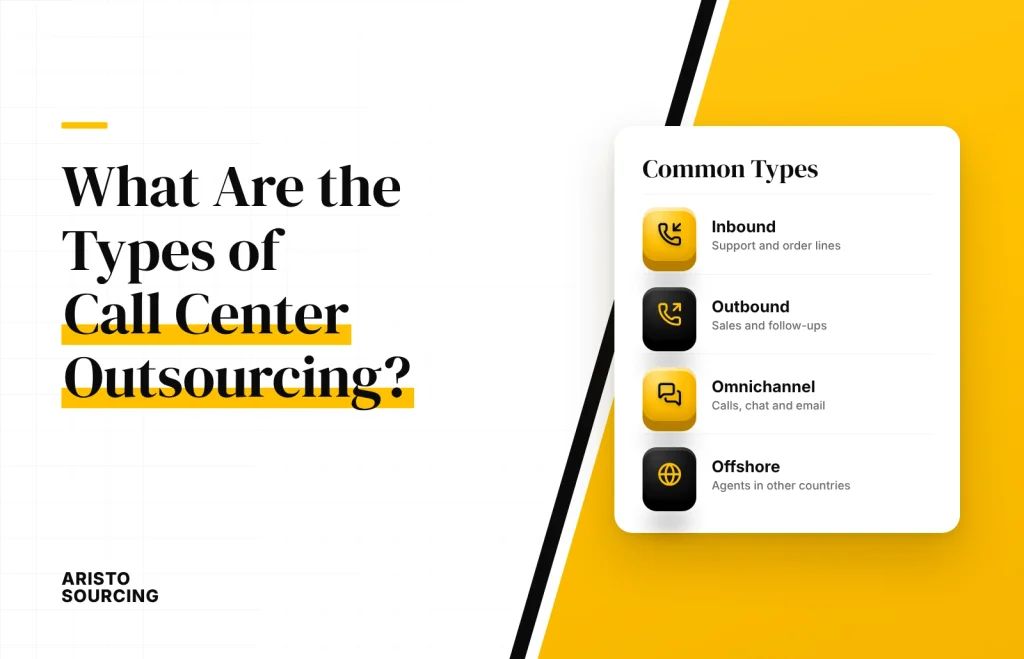
The types of call center outsourcing are inbound, outbound, and omnichannel outsourcing. Each type covers a different direction or range of customer contact.
The 3 types of call center outsourcing are listed below.
- Inbound Call Center Outsourcing: Inbound outsourcing covers calls that customers start, such as support requests, billing questions, help desk issues, and order processing.
- Outbound Call Center Outsourcing: Outbound outsourcing covers calls that agents start, such as sales calls, lead generation, appointment setting, and customer surveys.
- Omnichannel Contact Center Outsourcing: Omnichannel outsourcing combines voice, email, live chat, SMS, and social media support in one agent workflow.
What Are the Call Center Outsourcing Models?
The call center outsourcing models are onshore, nearshore, and offshore by agent location, and dedicated or shared by agent assignment. Location models trade cost against language fit and time-zone alignment.
The 5 call center outsourcing models are listed below.
- Onshore: Onshore outsourcing uses agents in the company’s own country, which gives the best language and culture fit at the highest cost.
- Nearshore: Nearshore outsourcing uses agents in a nearby country, which balances moderate savings with close time-zone alignment.
- Offshore: Offshore outsourcing uses agents in a distant country, which gives the largest labor savings but needs closer management across time zones.
- Dedicated Agents: Dedicated agents work only on one company’s account, which suits steady, high call volumes.
- Shared Agents: Shared agents split their time across several client accounts, which suits lower or unpredictable call volumes.
How Much Does It Cost to Outsource a Call Center?
Outsourcing a call center costs about $7 to $42 per agent hour, depending mostly on where the agents are located. Crescendo, an AI customer service company, estimates 2026 rates at $29.40 to $42 per agent hour in the United States, $12 to $19 in Latin America, and $7 to $16 in India, the Philippines, and Pakistan. Retell AI, a voice AI company, estimates inbound outsourcing at $0.50 to $1.75 per minute in 2026.
The 5 call center outsourcing pricing models are listed below.
- Per Hour: The provider bills for every hour an agent is staffed on the account.
- Per Minute: The provider bills only for the minutes agents spend on calls.
- Per Call: The provider bills a flat fee for each call handled.
- Per Seat: The provider bills a fixed monthly fee for each dedicated agent.
- Per Outcome: The provider bills for results, such as a booked appointment or a sale.
The main cost drivers are agent location, call volume, the number of channels, SLA targets, language requirements, and 24/7 coverage. Businesses comparing quotes can use outsourced call center pricing benchmarks to check whether a rate fits the service level offered.
What Are the Benefits and Risks of Call Center Outsourcing?
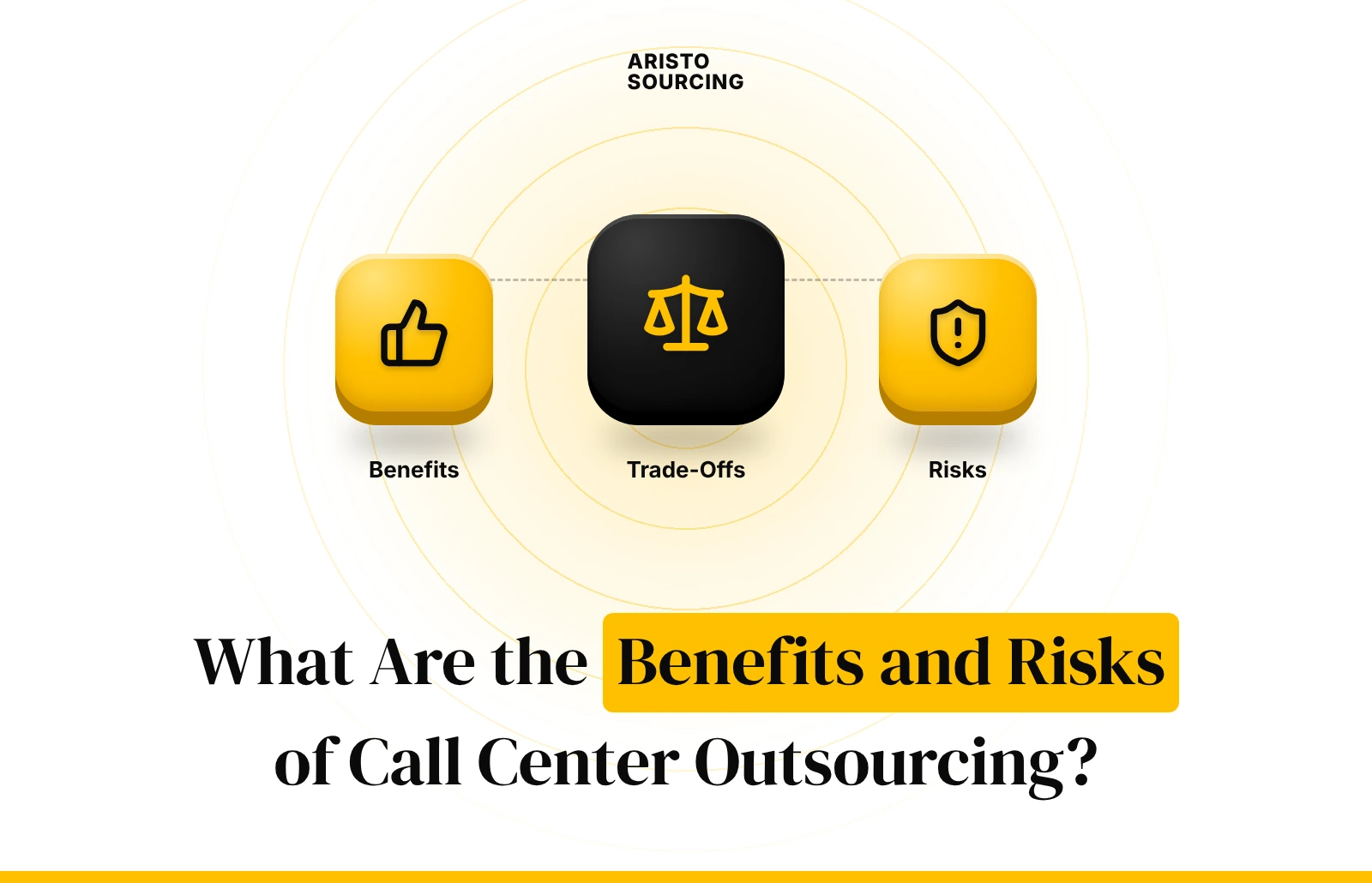
The benefits of call center outsourcing are lower costs, 24/7 coverage, multilingual support, and scalability, while the main risks are less control and data security. Clear SLAs and regular quality reviews reduce most of these risks.
The benefits of call center outsourcing are listed below.
- Lowers Fixed Costs: Call center outsourcing replaces salaries, office space, and phone systems with a variable service fee.
- Provides 24/7 Coverage: Call center outsourcing gives round-the-clock support without staffing night and weekend shifts internally.
- Adds Multilingual Support: Call center outsourcing gives access to agents who speak the languages a company’s customers use.
- Scales With Demand: Call center outsourcing adds or removes agents as call volumes rise and fall.
- Protects Internal Focus: Call center outsourcing frees internal teams to handle complex cases and core business work.
The risks of call center outsourcing are listed below.
- Less Control: Call center outsourcing gives the company less direct control over hiring, coaching, and daily operations.
- Brand Voice Gaps: Call center outsourcing can produce responses that do not match the company’s tone without strong training.
- Data Security: Call center outsourcing gives a third party access to customer data, which raises privacy and compliance risk.
- Quality Consistency: Call center outsourcing needs active monitoring to keep service quality stable across agents and shifts.
How to Choose a Call Center Outsourcing Provider
To choose a call center outsourcing provider, businesses should compare industry experience, data security, SLA terms, KPI reporting, scalability, and location fit. The steps to choose a call center outsourcing provider are listed below.
- Check the provider’s experience in the company’s industry.
- Confirm data security certifications such as PCI DSS for payments and SOC 2 for data controls.
- Review SLA terms, including targets, penalties, and exit clauses.
- Ask for sample KPI reports and the reporting schedule.
- Test whether the provider can scale agents up and down with demand.
- Match the provider’s location to the company’s budget, languages, and time zones.
The key KPIs to set with a call center outsourcing provider are service level, first call resolution, average handle time, and customer satisfaction (CSAT). Smaller businesses with low call volumes often hire a customer service virtual assistant instead of a full outsourced call center. Comparing providers on these criteria shows how call center outsourcing types, costs, and benefits fit a specific business.

Can AI Replace an Outsourced Call Center?
No, AI cannot fully replace an outsourced call center, because AI handles routine contacts well while complex and sensitive calls still need human agents. Gartner predicted in March 2025 that agentic AI will autonomously resolve 80% of common customer service issues without human intervention by 2029. Many companies now use a hybrid model, where AI handles routine requests and human agents take over complex cases, which reflects the wider shift toward AI in BPO operations. The questions below cover contact centers, industries, and providers.
What Is the Difference Between Call Center and Contact Center Outsourcing?
The difference between call center and contact center outsourcing is the range of channels covered. Call center outsourcing focuses on voice calls, while contact center outsourcing covers voice plus email, live chat, SMS, and social media. Companies with phone-heavy support choose call center outsourcing, while companies with digital-first customers choose contact center outsourcing.
Which Industries Benefit Most From Call Center Outsourcing?
The industries that benefit most from call center outsourcing are healthcare, ecommerce and retail, telecommunications, and financial services, because these industries handle high call volumes and seasonal peaks. The 4 industries that benefit most from call center outsourcing are listed below.
- Healthcare: Healthcare providers outsource appointment scheduling, patient support, and billing questions.
- Ecommerce and Retail: Ecommerce and retail companies outsource order support, returns, and holiday-season peaks.
- Telecommunications: Telecommunications companies outsource technical support, billing questions, and plan changes.
- Financial Services: Financial services firms outsource account support, card services, and collections.
Healthcare is a common starting point, and healthcare call center outsourcing needs providers that meet HIPAA requirements for patient data in the United States.
What’s the Best Call Center Outsourcing Company?
There is no single best call center outsourcing company, because the right provider depends on industry fit, location, and scale. Large global providers include Teleperformance, Concentrix, and TTEC, while smaller providers often suit businesses that need dedicated attention or niche industry experience.