
Onshore, nearshore, and offshore outsourcing mainly differ in provider location, labor cost, and time-zone overlap. Onshore outsourcing uses a provider in the same country, nearshore outsourcing uses a provider in a nearby country, and offshore outsourcing uses a provider in a distant country. Each model trades cost against collaboration and control, since lower labor rates usually come with greater distance, wider time gaps, and less direct oversight.
Choosing the right outsourcing model helps a business protect its margins, keep projects on schedule, and give each function the level of oversight it needs. An experienced outsourcing partner can help a business weigh these trade-offs and implement the model that fits its budget and workflows.
What’s the Difference Between Onshore, Nearshore, and Offshore Outsourcing?
The difference between onshore, nearshore, and offshore outsourcing involves where the provider is located, how much its labor costs, how far its time zone sits from the client’s, and how easily the two teams communicate.
The difference between onshore, nearshore, and offshore outsourcing is presented in the table below.
| Factor | Onshore Outsourcing | Nearshore Outsourcing | Offshore Outsourcing |
| Location | Same country as the client | Nearby country in the same region | Distant country, often on another continent |
| Cost | Highest: around $110 to $180 per hour for US software development | Moderate: usually between onshore and offshore rates | Lowest: around $25 to $50 per hour for software development |
| Time-zone difference | Minimal: same national time zones | Small: usually 0 to 3 hours | Large: often 5 hours or more |
| Communication | Easiest: shared language, culture, and working hours | Easy: overlapping working hours and similar business culture | Mostly asynchronous: relies on documentation and scheduled overlap |
| Use cases | Regulated, compliance-sensitive, and on-site work | Agile software development, IT support, and real-time customer support | High-volume back-office operations, 24/7 customer support, and cost-driven development |
What Is Onshore Outsourcing?
Onshore outsourcing is delegating business functions to a third-party provider in the same country as the client, such as a Chicago company hiring a Dallas agency. Onshore outsourcing is also called domestic outsourcing, and the provider may work in the same city, a different state, or a rural region with lower operating costs.
Same-country collaboration gives onshore outsourcing three advantages, including cultural alignment, regulatory familiarity, and easier communication. The provider shares the client’s language, business norms, holidays, and legal system, which simplifies regulatory compliance and data security for sensitive information. Onshore outsourcing is different from nearshore outsourcing because the work never crosses a national border, so no cross-border data transfer rules or foreign contract laws apply.
The main drawback of onshore outsourcing is higher cost because domestic providers pay local wages, benefits, and overhead in expensive labor markets. Onshore outsourcing suits regulated industries such as healthcare, banking, and government contracting, along with projects that need on-site support, frequent in-person meetings, or deep knowledge of local markets.
What Is Nearshore Outsourcing?
Nearshore outsourcing is delegating business functions to a third-party provider in a nearby country, usually one that shares a similar or overlapping time zone with the client. Nearshore providers are close enough for short business trips, and their working days largely overlap with the client’s schedule.
Nearshore outsourcing balances cost savings with easy collaboration. Nearshore labor rates are usually lower than domestic rates, while time-zone alignment allows both teams to hold daily stand-ups, review work together, and resolve issues through real-time collaboration.
Common examples include US companies working with providers in Latin America, such as Mexico, Colombia, Costa Rica, and Brazil, and Western European companies working with providers in Eastern Europe, such as Poland, Romania, and Bulgaria. These regions offer deep regional talent in software engineering, IT support, and multilingual customer service. Nearshore outsourcing is different from offshore outsourcing because the provider stays within the client’s broader region, which keeps working hours, business culture, and travel times close to the client’s own.
What Is Offshore Outsourcing?
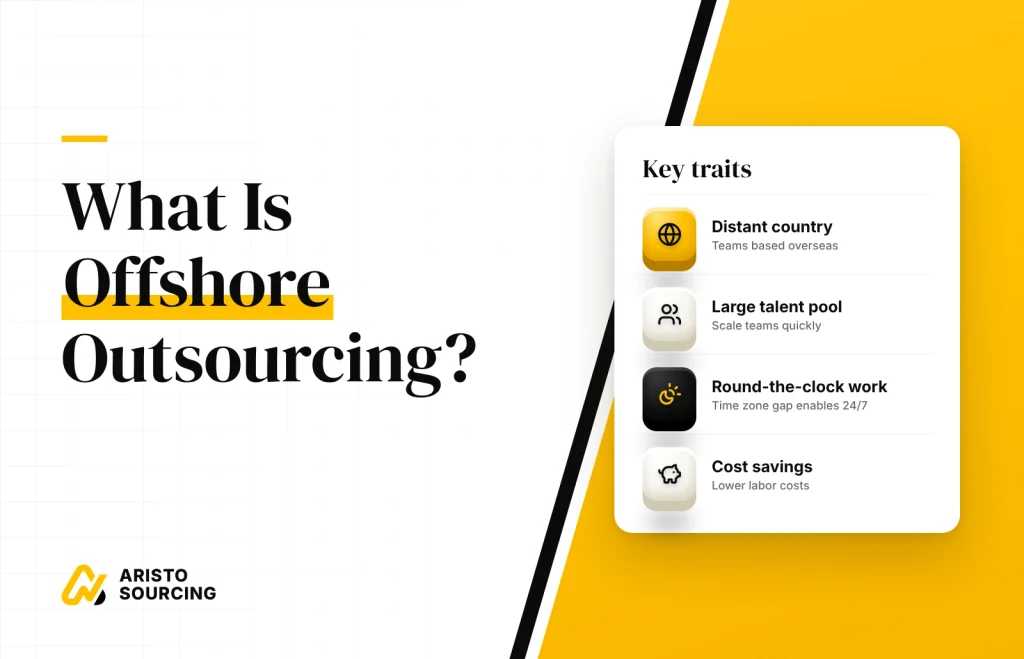
Offshore outsourcing is the practice of delegating business functions to a third-party provider in a distant country, usually one with lower labor costs and a large time-zone difference. Popular offshore destinations include the Philippines, India, Bangladesh, South Africa, and Vietnam, where established outsourcing industries deliver skilled work at a lower cost than providers in the United States or Western Europe.
Offshore outsourcing gives businesses access to global talent, including developers, accountants, and customer support agents who are scarce or expensive in the client’s home market. The time-zone difference also enables 24/7 support, because an offshore team can keep operations running while the client’s domestic team is offline. The same time-zone difference creates communication challenges, since limited overlap in working hours can delay answers and approvals when clear handoff processes are missing.
Accurate costing for an offshore engagement includes management time, onboarding, communication tools, and quality assurance, not just the hourly rate.
How Much Does Onshore, Nearshore, and Offshore Outsourcing Cost?
The cost of onshore, nearshore, and offshore outsourcing varies by location, talent rates, and time-zone alignment, with onshore providers usually charging the most and offshore providers charging the least. Onshore software development may cost around $110 to $180 per hour in the United States, while offshore software development teams may cost around $25 to $50 per hour.
Offshore outsourcing can provide around 40% to 60% lower labor costs than US-based onshore talent. The gap in hourly labor rates is wider than the gap in total cost, because offshore engagements add expenses for management, communication, and quality assurance.
Nearshore outsourcing often provides a middle ground between cost savings and easier collaboration, because nearshore rates usually sit between onshore and offshore rates and the closer time zone reduces delays. The most reliable way to compare outsourcing cost is ROI rather than the hourly rate, since a cheaper team that needs heavy rework or misses deadlines can produce a higher total cost than a more expensive team that delivers the first time correctly.
How Do Time Zones Affect Outsourcing?
Time zones affect outsourcing by determining how many working hours the client and the provider share, which controls the speed of communication, feedback, and problem-solving. A small time-zone difference lets both teams meet, message, and review work during the same working hours. A large time-zone difference shrinks that shared window to a few hours or removes it, so questions and approvals often move at the pace of one exchange per day.
Onshore and nearshore setups support real-time collaboration, which suits agile sprints, live troubleshooting, and projects with frequent client feedback. Offshore setups rely more on asynchronous work, where teams communicate through documented tasks, recorded updates, and written end-of-day handoffs.
Offshore teams turn the time-zone difference into an advantage by providing 24/7 coverage. A company in New York, for example, can hand customer support queues, system monitoring, or data processing to a team in Manila at the end of its day and receive completed work by the next morning, a model known as follow-the-sun support. Time zones are only one location factor, because communication, culture, security, and regulation also change as the distance between client and provider grows.
How Do Communication and Cultural Differences Affect Outsourcing?
Communication and cultural differences affect outsourcing by shaping how accurately teams understand requirements, how quickly they raise problems, and how smoothly their collaboration runs. Ease of communication usually declines as geographic distance grows, because distance tends to add differences in language, business etiquette, public holidays, and expectations about hierarchy and feedback.
Onshore outsourcing offers the strongest cultural alignment, since both teams share a native language and the same business norms. Nearshore outsourcing usually offers high alignment, because many nearshore markets have strong English skills and close familiarity with US or European business practices. Offshore outsourcing varies by destination: the Philippines and South Africa, for example, combine high English proficiency with strong familiarity with Western clients, while other markets may need more structured language support.
Communication quality matters most for collaborative work such as agile development, where requirements change every sprint and a single misunderstanding can turn into days of rework. Clear communication also strengthens security, because teams that fully understand data-handling policies and escalation paths follow them more consistently.
How Do Security and Regulatory Requirements Affect Outsourcing?
Security and regulatory requirements affect outsourcing by limiting where certain data can be stored, processed, or accessed, and by setting the controls a provider must follow. Location matters for sensitive or regulated work because data protection laws differ by country, and some rules restrict cross-border data transfers or require data to remain within national borders. For example, US healthcare organizations must protect patient information under HIPAA, and companies that handle the personal data of people in the EU generally must follow GDPR rules for international transfers.
Three considerations shape the decision. Data security covers technical safeguards such as encryption, access controls, and secure networks. Data privacy covers how personal information is collected, used, and shared. Regulatory compliance covers the legal obligations of both the client’s industry and the provider’s country.
Offshore outsourcing is not inherently insecure. Offshore providers that hold certifications or audits such as ISO/IEC 27001 and SOC 2, sign data processing and non-disclosure agreements, and restrict access to sensitive data can meet the same standards as domestic providers. The deciding factor is the use case, as work governed by export controls or strict data residency laws may require onshore delivery, while most customer support, finance, and back-office tasks can run securely offshore with the right safeguards and contracts in place.
What Are the Best Use Cases for Onshore, Nearshore, and Offshore Outsourcing?
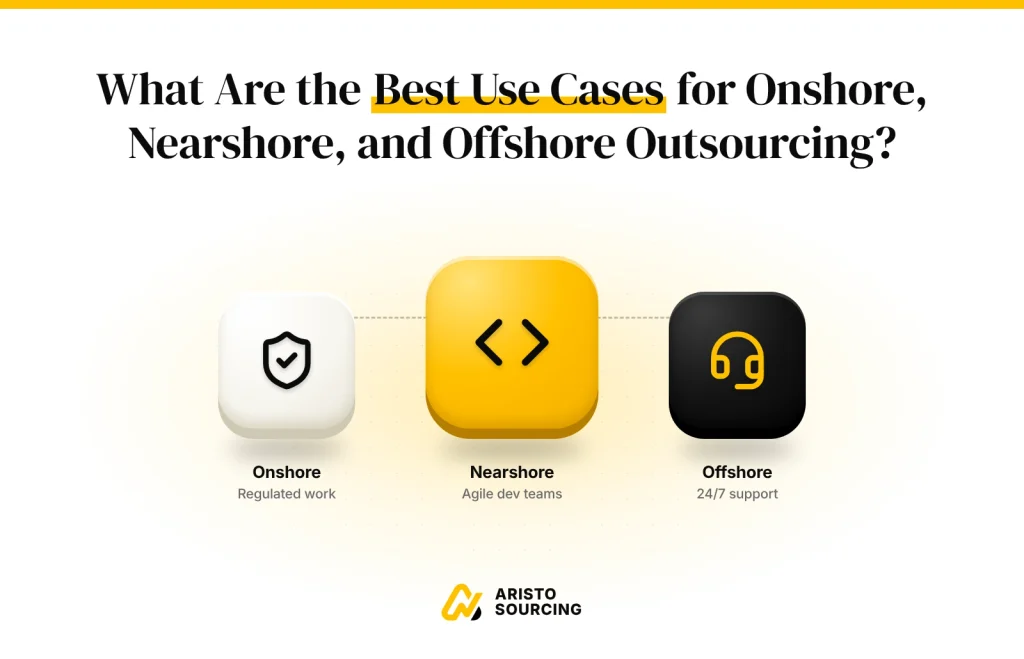
The best use cases for onshore, nearshore, and offshore outsourcing include regulated and on-site work for onshore teams, collaborative product work for nearshore teams, and high-volume, cost-driven operations for offshore teams.
Onshore outsourcing fits regulated industries such as healthcare, banking, and government contracting, along with IT support that requires on-site visits and legal or financial work that depends on local expertise. Nearshore outsourcing fits agile software development, product design, and IT support that must respond during the client’s business hours. Offshore outsourcing fits customer support with 24/7 coverage, back-office operations such as data entry, bookkeeping, and claims processing, and well-documented software development tasks such as testing and maintenance.
Projects that change often, carry legal risk, or depend on daily discussion favor proximity and control. Projects that are repeatable, well documented, and measured by volume favor cost and scale. Choosing the right outsourcing model therefore starts with the nature of the work rather than the hourly rate.

How to Choose Between Onshore, Nearshore, and Offshore Outsourcing?
Choosing between onshore, nearshore, and offshore outsourcing depends on four factors, namely budget, collaboration needs, security requirements, and scalability. If budget and cost savings are the top priorities, offshore outsourcing is often the better fit, because it offers the lowest labor rates and the largest talent pools. If real-time collaboration, control, and compliance matter most, onshore or nearshore outsourcing is the better fit, because shared working hours and similar legal frameworks reduce delays and risk. If the organization needs a mix of all three, a hybrid model is worth considering.
A strong outsourcing strategy maps business requirements, such as response time, data sensitivity, and expected volume, to the model that serves each one best. The strategy should be reviewed as the company grows, because a function that starts onshore may later move nearshore or offshore once its processes are documented and stable.
Can Onshore, Nearshore, and Offshore Outsourcing Be Combined?
Yes, onshore, nearshore, and offshore outsourcing can be combined into a hybrid outsourcing model that assigns each business function to the location that suits it best. In a typical hybrid outsourcing setup, an onshore team manages client relationships, strategy, and compliance-sensitive tasks; a nearshore team handles agile development and real-time IT support; and an offshore team covers testing, back-office processing, and after-hours customer support.
A hybrid structure balances cost, control, collaboration, and coverage, with the onshore team keeping control of high-risk decisions, the nearshore team keeping collaboration fast, and the offshore team lowering costs and extending coverage across time zones. A global delivery model adds coordination work, so experienced outsourcing partners help businesses standardize processes, tools, and reporting across locations without added complexity.
When Should Companies Consider Outsourcing Partners for Onshore, Nearshore, or Offshore Needs?
Companies should consider outsourcing partners when internal operations become difficult to scale, control, or manage efficiently. Budget visibility, collaboration needs, security requirements, and talent gaps indicate whether outsourcing is appropriate, especially when local hiring cannot supply the global talent a role requires.
Outsourcing improves scalability by turning fixed labor and operational costs into more flexible, variable costs that rise or fall with demand. Onshore outsourcing suits compliance-sensitive work, nearshore outsourcing suits collaborative work on a moderate budget, and offshore outsourcing suits cost-driven, high-volume work. Providers like Aristo Sourcing formalize these choices in a clear outsourcing agreement that defines the scope, costs, security obligations, and performance standards of each outsourcing partner relationship.
Why Should Businesses Consider Aristo Sourcing for Onshore, Nearshore, and Offshore Outsourcing?
Businesses should consider Aristo Sourcing for onshore, nearshore, and offshore outsourcing because Aristo Sourcing provides dedicated, managed remote staff who fit the outsourcing model each business function needs. Aristo Sourcing is a managed global remote staffing extension that connects businesses with dedicated virtual assistants from South Africa and the Philippines.
Aristo Sourcing focuses on SMBs and expanding enterprises that need to scale their teams without the overhead of local hiring. South African staff share most working hours with the UK and Europe, which gives those businesses the time-zone alignment of nearshore outsourcing, while Philippine staff give US businesses offshore cost savings and overnight coverage. Aristo Sourcing staff also work alongside a company’s onshore team in a hybrid model, so local employees keep compliance-sensitive work while remote staff handle scalable daily tasks.
The key business benefits include reduced overhead, a retention rate above 93%, and access to global talent, which together create a sustainable cost saving compared with local hiring. Understanding the difference between onshore, nearshore, and offshore outsourcing is the first step, and Aristo Sourcing helps businesses take the next one by choosing the right outsourcing model for each role and matching dedicated staff with the best use cases, from customer support to back-office operations.