

Nearshore outsourcing means hiring a third-party provider in a nearby or neighboring country, close enough in time zone and often similar enough in culture to make real-time collaboration easy. This guide covers what the term means, the regions and services driving its growth, the benefits it offers, how it compares on cost, and how to decide if it’s the right fit.
The Inter-American Development Bank estimates that nearshoring could boost Latin America and the Caribbean’s exports by $78 billion annually, including $14 billion from services alone, a sign of how much this middle-ground model has grown. Nearshore sits between the two extremes: cheaper than onshore, but closer and easier to coordinate with than offshore. This guide is for business owners weighing a nearshore provider against those other options. Start with the definition below.
What Is Nearshore Outsourcing?
Nearshore outsourcing means contracting a third-party provider in a geographically close country, typically a neighboring nation or one within the same region, chosen specifically for time-zone and cultural alignment. Proximity is the defining trait: shorter or overlapping working hours, closer cultural fit, and easier travel if an in-person visit is ever needed.
The most common driver is real-time collaboration at a lower cost than onshore hiring, without the coordination gaps that come with a distant offshore provider. For how nearshore fits alongside onshore and offshore options more broadly, see our guide to outsourcing by location. Below, we cover how nearshore outsourcing works in practice, how it compares to onshore and offshore models, and how the terms nearshoring, outsourcing, and offshoring relate to each other.
How Does Nearshore Outsourcing Work?
Nearshore outsourcing works by first identifying which process to hand off, then selecting a provider based in a nearby country suited to that work. From there, the business chooses a delivery model: a managed team has the provider run operations independently, a dedicated team works exclusively for the client under the provider’s oversight, and staff augmentation places individual nearshore hires directly under the client’s own daily management.
Once the model is chosen, the business sets the scope, service-level agreements, and overlap hours, though nearshore engagements usually start with most working hours already aligned. Onboarding, system integration, and ongoing performance review follow before the arrangement reaches full productivity. That close time-zone alignment is exactly what separates nearshore from the other two location-based models.
Nearshore vs Offshore vs Onshore Outsourcing
The difference between nearshore, offshore, and onshore outsourcing comes down to distance, and distance drives everything else: cost, time-zone overlap, and cultural fit. Onshore keeps the provider in the same country, costing the most of the three but offering the tightest alignment and easiest oversight. Offshore sends work to a distant country, delivering the lowest cost but the widest time-zone and cultural gap to manage.
Nearshore sits deliberately in between, using a neighboring or same-region country to capture meaningful cost savings while keeping working hours close enough for real-time collaboration. That middle position is the entire reason nearshore exists as its own category: it’s the trade-off point between what onshore protects and what offshore saves.
Nearshoring vs Outsourcing vs Offshoring
The difference between nearshoring, outsourcing, and offshoring comes down to two separate questions: who does the work, and where. Outsourcing means hiring a third party for the work, regardless of location. Offshoring means moving work to a distant country, which can happen with a third party or entirely in-house.
Nearshoring means moving work to a nearby country specifically, and like offshoring, it can happen through a third-party provider or through a company’s own branch abroad. The terms overlap when nearshoring is done through outsourcing, producing nearshore outsourcing, but they split the moment nearshoring happens in-house instead, since that’s nearshoring without any outsourcing involved at all.
What Services Are Commonly Nearshored?
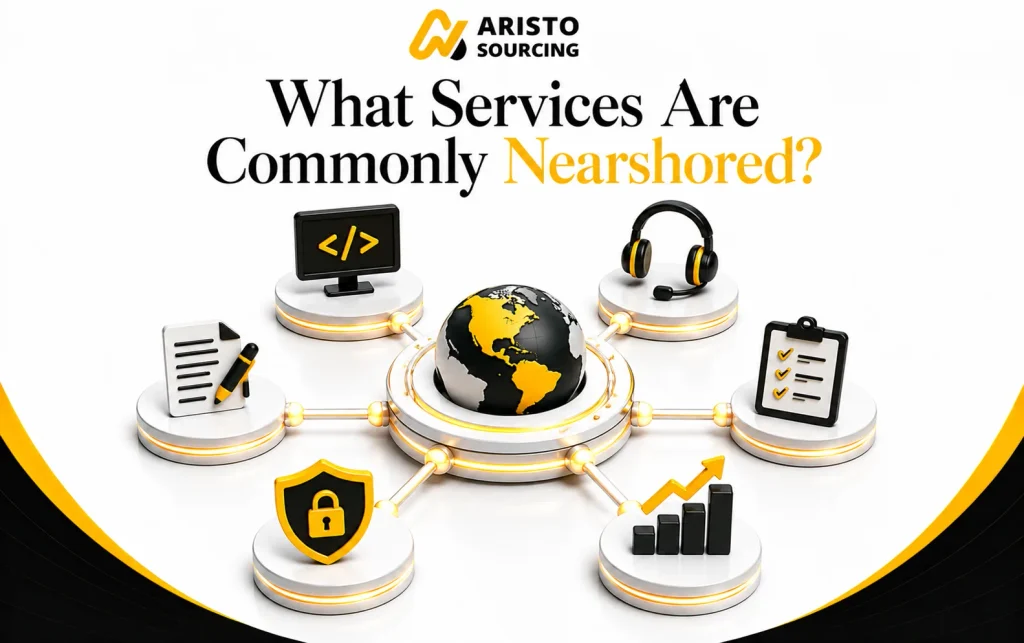
The most commonly nearshored services are software development, IT and technical support, customer service and call center work, and back-office or accounting functions. Software development and IT support suit nearshore delivery because complex technical collaboration benefits heavily from overlapping working hours, letting teams troubleshoot and iterate together in real time. Customer service and call center work gain from the same time-zone fit, since real-time voice support depends on agents being available exactly when customers are calling.
Back office, accounting, and broader BPO functions suit nearshore delivery because they often require close coordination with finance or operations teams during standard business hours, something a distant offshore provider can’t match as easily. Each service has its own dedicated breakdown of nearshore benefits and providers linked below.
What Are the Most Common Nearshore Outsourcing Destinations?
The most common nearshore outsourcing destinations depend on where the client is based. For US companies, Mexico and Latin America broadly, including Brazil, Colombia, Argentina, and Bolivia, dominate, offering close time-zone alignment and a rapidly growing tech talent base. For Western European companies, Eastern Europe, particularly Poland, Ukraine, and Romania, serves the same role, providing strong technical talent within easily overlapping working hours.
Mexico stands out for its proximity and large-scale IT and manufacturing-support talent, while Brazil and Colombia offer deep software development pools at competitive rates. Poland brings mature IT outsourcing infrastructure and strong English proficiency, while Ukraine and Romania are known for specialized engineering talent despite regional volatility factoring into some sourcing decisions. Each destination has its own dedicated breakdown of talent, pricing, and best-fit use cases linked below.
What Are the Benefits of Nearshore Outsourcing?
Nearshore outsourcing delivers seven distinct advantages, led by the one thing it beats offshore on outright: time-zone alignment. Here’s how each benefit plays out, backed by real data where it exists.
1. Time-Zone Alignment and Real-Time Collaboration
Time-zone alignment and real-time collaboration mean nearshore teams work the same or nearly the same hours as the client, allowing live meetings, quick back-and-forth, and same-day problem-solving instead of waiting on delayed replies. This overlap is nearshore’s defining edge over offshore models.
Businesses running fast-moving projects like software development or urgent support gain the most from this alignment. Working the same hours solves a coordination problem, but it doesn’t guarantee both teams interpret feedback and context the same way, which is where cultural and language proximity comes in.
2. Cultural and Language Proximity
Cultural and language proximity means nearshore providers, often located in a neighboring or same-region country, tend to share more business norms, communication styles, and sometimes language overlap with the client than a distant offshore provider would. Fewer cultural misreads mean fewer costly misunderstandings in day-to-day work.
Auxis and SSON Research’s State of the GBS & Outsourcing Industry report found that 87% of companies using Latin American nearshore services report high or very high satisfaction, compared to 53% for Asian offshore providers and 64% for European providers. Businesses running client-facing or judgment-heavy work gain the most from this fit. Strong cultural alignment builds trust, but it doesn’t by itself make nearshore cheaper than keeping the work onshore, which is the next trade-off worth weighing.
3. Lower Costs Than Onshore
Lower costs than onshore means nearshore providers typically charge less than domestic hires, since wages and overhead in neighboring countries usually run below onshore rates even if they sit above the lowest offshore options. The business gives up some of offshore’s maximum savings in exchange for the collaboration benefits above.
Companies wanting meaningful cost relief without the full communication gap of offshore outsourcing gain the most from this middle-ground pricing. Saving money matters, but none of it counts for much if getting a team member on-site is difficult when the work genuinely calls for it, which is where travel comes in.
4. Easier Travel and In-Person Visits
Easier travel and in-person visits mean nearshore’s geographic proximity makes on-site meetings, training, or team visits realistic in a way a distant offshore location rarely allows. A short flight instead of a full day of travel keeps in-person collaboration on the table when it matters.
Businesses that value occasional face-to-face contact, such as leadership check-ins or hands-on onboarding, gain the most from this proximity. Being able to visit easily matters for relationship-building, but the real reason most businesses nearshore in the first place is the talent waiting on the other end of that visit.
5. Access to Skilled Regional Talent
Access to skilled regional talent means nearshore destinations, particularly across Latin America and Eastern Europe, have built genuinely deep technical and professional talent pools rather than serving only as a lower-cost alternative to onshore hiring. Businesses aren’t trading quality for proximity; strong nearshore markets increasingly compete directly with offshore and even onshore talent on skill.
Companies needing specialized technical work, like software development, gain the most from these established regional hubs. Deep talent solves a skills gap, but it means little if the business can’t flex that team size when demand changes, which is where scalability comes in.
6. Scalability and Flexibility
Scalability and flexibility mean a business can grow or shrink its nearshore team relatively quickly, without the long hiring cycles or severance costs tied to domestic staffing changes. Nearshore providers typically keep a workable bench of talent ready to deploy faster than most internal HR departments can match.
Companies facing seasonal demand or fast growth gain the most from this flexibility. Adjusting team size is one kind of ease, and avoiding legal friction while doing it is a separate one entirely, which is exactly what reduced compliance friction addresses.
7. Reduced Legal and Compliance Friction
Reduced legal and compliance friction means nearshore countries often share regional trade agreements, similar regulatory standards, or established legal frameworks with the client’s home country, simplifying contracts and data handling compared to a more distant, less aligned jurisdiction. The USMCA, for example, gives US companies working with Mexican nearshore providers a shared trade and legal framework that offshore arrangements in unrelated regions don’t offer.
Businesses in regulated industries or handling cross-border data gain the most from this alignment. Together, these seven benefits explain why nearshore outsourcing has become the preferred middle ground for businesses that need offshore’s cost relief without giving up onshore’s ease of collaboration.

What Are the Disadvantages of Nearshore Outsourcing?
The main disadvantages of nearshore outsourcing are higher cost than offshore, a smaller available talent pool, fewer providers in some regions, and cultural variation that still exists despite regional proximity. Cost is nearshore’s signature trade-off: businesses give up a meaningful portion of offshore’s savings in exchange for closer time-zone alignment and easier collaboration.
Talent pools in nearshore regions, while genuinely skilled, tend to be smaller than the scale offered by major offshore hubs like India or the Philippines, which can mean longer searches for very specific or highly specialized roles. Some nearshore regions also have fewer established providers to choose from compared to mature offshore markets, narrowing the field of vetted options. Proximity doesn’t eliminate cultural differences either; business norms, communication styles, and work culture can still vary meaningfully even between neighboring countries.
Mitigating these trade-offs starts with vetting providers early and confirming they’ve actually staffed the specific skill set needed before committing. Working with providers who have a track record in the client’s industry helps offset the smaller talent pool, and clear onboarding around communication expectations narrows whatever cultural gap remains. Together with the benefits already covered, these trade-offs make up the full picture of nearshore outsourcing’s pros and cons.
Nearshore vs Offshore: Which Should You Choose?
The choice between nearshore and offshore outsourcing depends on what a business values more: cost or collaboration. Nearshore wins on real-time collaboration, cultural fit, less rework from miscommunication, and the ability to visit a provider in person without a long-haul flight. Offshore wins on the lowest possible cost, true 24/7 follow-the-sun coverage, and access to the largest talent pools in the world.
The decision ultimately comes down to two axes: how tight the budget is versus how much real-time collaboration the work demands, and whether the work is synchronous, needing live back-and-forth, or asynchronous, where handoffs across time zones work just fine. Below, we cover exactly when nearshore comes out ahead.
When Is Nearshore Outsourcing the Better Choice?
Nearshore outsourcing is the better choice when the work needs real-time collaboration or frequent, ongoing sync between teams, since waiting on offshore’s delayed replies can slow down fast-moving projects. It also wins when cultural or language alignment genuinely matters to the outcome, such as voice-based customer service or sales roles where tone and rapport carry real weight.
Agile teams that rely on daily stand-ups or constant iteration benefit from nearshore’s overlapping hours in a way offshore arrangements struggle to match. Nearshore also makes more sense whenever occasional in-person visits, whether for training, leadership check-ins, or hands-on onboarding, are likely to come up over the course of the relationship.

What Does Nearshore Outsourcing Cost?
Nearshore outsourcing costs depend on region, skill level, seniority, and delivery model, but the pricing consistently lands above offshore rates and below onshore hiring costs. That positioning is intentional: nearshore trades away some of offshore’s maximum savings in exchange for real-time collaboration and closer cultural fit.
Region plays the biggest role in where rates land within that middle band, with more established tech hubs commanding higher rates than emerging ones. Skill level and seniority move the number further, since senior specialists cost meaningfully more than junior talent regardless of location. The delivery model matters too, a fully managed team typically costs more than staff augmentation, since the provider absorbs more of the operational overhead.
The ROI case for nearshore isn’t about being the cheapest option, it’s about what that premium over offshore buys back. Real-time collaboration cuts down on the rework, delays, and miscommunication that often erode offshore’s apparent savings once a project is actually underway. For many businesses, especially on collaboration-heavy work like software development, the extra cost over offshore pays for itself in fewer stalled sprints and faster iteration cycles.
How Do You Choose a Nearshore Outsourcing Partner?
Choosing the right nearshore partner starts with defining the scope of work and the specific goals it needs to meet, then picking a region based on both time-zone fit and the skill set required, whether that’s Latin America for US-based work or Eastern Europe for Western European clients. From there, vet potential providers on relevant experience, client references, and security or compliance certifications appropriate to the work involved.
Confirm exactly how many overlap hours the provider offers, how communication will run day-to-day, and which delivery model fits best, a managed team, a dedicated team, or staff augmentation. Set clear service-level agreements and KPIs before work begins, so expectations are defined rather than assumed once the relationship is underway.
Worth noting: South Africa, while not geographically nearshore to Europe, offers time-zone overlap with the EU that functions in a nearshore-like way for European clients, which is part of why Aristo Sourcing places offshore virtual assistants from South Africa alongside its Philippines talent. For a full walkthrough of vetting criteria that apply across nearshore, offshore, and onshore providers alike, see our guide to how to choose a provider.
Common Nearshore Outsourcing Mistakes to Avoid
The most common nearshore outsourcing mistakes are choosing a provider based on proximity alone without vetting actual skill, assuming cultural fit means the relationship needs less active management, skipping clear SLAs or overlap-hour agreements, and ignoring the cost trade-off against offshore before committing. Picking a provider just because it’s nearby overlooks the fact that geography says nothing about whether the team can actually do the work well, so skill and track record still need the same scrutiny as any other hiring decision.
Cultural and language similarity can create a false sense of ease, leading businesses to skip the onboarding structure and oversight any new provider relationship needs regardless of how familiar it feels. Failing to define overlap hours, response times, and service-level expectations upfront leaves both sides guessing once real work begins, which causes friction that proximity alone won’t solve. And treating nearshore as simply “cheaper than onshore” without weighing it against offshore’s deeper savings can lead to overpaying for collaboration benefits the business didn’t actually need for that specific task.