

The salary of a VA is typically between $19 per hour and over $26 per hour in the United States, or roughly $38,000 to over $53,000 a year. Before comparing numbers, it helps to separate what “salary” actually means in this market. A contractor’s hourly rate, an employed VA’s wage, and an agency’s flat monthly fee are three different figures, and mixing them up is the main reason salary numbers online look inconsistent. This article breaks the pay down by hour, month, and year, and explains why the figures move depending on the source, the country, and the specialization.
How Much Does a Virtual Assistant Make?
A virtual assistant makes an average of $19 to over $26 per hour, or annually around $38,000 to over $53,000, depending on experience, task complexity, and whether the figure comes from a job-posting site, a self-reported survey, or a freelance marketplace. Sources vary in how they calculate this number. Some sources track advertised job listings, some rely on workers voluntarily reporting their own pay, and some pull bid data from freelance platforms. Each method samples a different slice of the VA workforce, so no single number is “the” market rate; the range above is the realistic band a US employer or freelance VA should expect to see.
What Is the Average Virtual Assistant Salary Per Hour?
The average virtual assistant salary per hour according to Indeed is around $25.75/hour, according to ZipRecruiter is around $24.40/hour, according to Payscale is around $19.45–$19.70/hour, and according to Upwork is around $13/hour. But Upwork’s number reflects bid data, not salary data, since it’s drawn from what freelancers list as their asking rate on open jobs rather than what employers actually pay.
The other three sources calculate differently as well. Indeed and ZipRecruiter pull from advertised job postings, which tend to skew toward higher-paying, more established roles, while Payscale relies on self-reported pay from individual VAs, which pulls the average down toward entry-level and part-time work. Because these platforms refresh their samples on a rolling basis, the exact figure changes every month, so treat any single number as a snapshot rather than a fixed rate.
What Is the Average Virtual Assistant Salary Per Month?
The average part-time VA salary per month is between $500 and $3,200, while the average full-time VA salary per month is between $2,500 and $8,000+, depending on hours worked, specialization, and whether the VA is US-based or offshore.
These monthly figures assume a US-based or Western-market VA billing by the hour and multiply that rate by part-time or full-time hours annually. Offshore VAs, in the Philippines, South Africa, Latin America, or elsewhere, sit far below these US-based bands, often earning a full-time monthly wage that a US VA would earn in a single week. This is the main reason offshore staffing has become such a common cost-reduction strategy for small businesses and agencies.

What Is the Average Virtual Assistant Salary Per Year?
The average virtual assistant salary per year is $38,007 according to Salary.com, between $40,842 and $52,848 according to Indeed, around $50,749 according to ZipRecruiter, and about $52,848 according to Glassdoor. The gap between the low end ($38,000) and the high end ($53,000) comes down to the same methodology differences covered above.
Salary.com’s model leans conservative and broad, while Indeed, ZipRecruiter, and Glassdoor weight more heavily toward postings for specialized or full-time roles. These figures change regularly as each platform refreshes its underlying data, so a VA researching pay or a client budgeting for one should treat any annual figure as a range rather than a fixed number.
Why Do Virtual Assistant Salary Figures Differ Across Sources?
VA salary figures differ across sources because each platform measures a different part of the market using a different collection method, not because any one source is wrong. Job ads skew toward experienced VAs, while marketplace bids include many entry-level freelancers, pulling averages apart. Job-posting data from sites like Indeed and ZipRecruiter reflects advertised salary ranges that employers post to attract applicants; these numbers tend to skew high because employers post competitive ranges to compete for talent, and because job ads disproportionately represent higher-skill, higher-responsibility roles.
Self-reported salary data from sites like Glassdoor and Payscale comes from individuals voluntarily submitting what they actually earn; these samples are smaller, skew toward people willing to disclose pay, and can undercount high earners who don’t bother filling out a salary survey.
Marketplace bid data, from platforms like Upwork, reflects what freelancers list as their asking rate across a global freelancer supply; this skews low because it includes VAs based in low-cost-of-living countries bidding against each other for the same jobs. On top of the collection method, sample size and refresh date change the same source’s own number from month to month, which is why a figure pulled today can differ from the same source’s figure pulled a quarter ago. In reality, the figure to use depends on the purpose; for example, job-posting data works best for budgeting a US-based hire, and marketplace data works best for a freelancer setting a competitive rate.
How Does Experience Change a Virtual Assistant’s Salary?
Experience changes a virtual assistant’s salary by moving the hourly rate across 3 broad bands. Entry-level VAs, with 0–2 years of experience, typically earn $12–$25 per hour and handle straightforward, well-defined tasks like calendar management, data entry, and email triage.
Mid-level VAs, with 3–5 years of experience, typically earn $25–$40 per hour and take on more judgment-based work, such as light project coordination or client-facing communication. Expert VAs, with 5 or more years of experience, typically earn $40–$75 or more per hour and often function closer to an operations manager than a task-taker.
The factors that move a VA from one pay band to the next aren’t years alone; they include how much supervision the VA needs, how fluent they are across the client’s tools and software stack, and whether they own an entire function (like inbox management or lead qualification) rather than just a list of individual tasks. A VA who has become specialized in a high-value skill set can jump bands faster than one doing general admin work, regardless of tenure.
How Does Specialization Change a Virtual Assistant’s Hourly Rate?
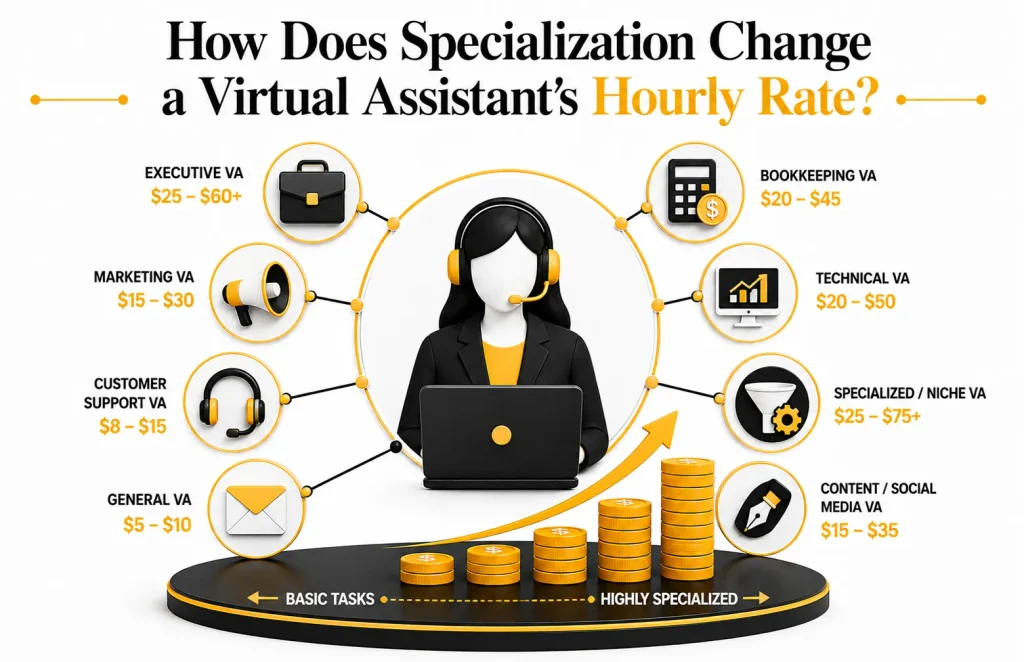
Specialization changes a VA’s hourly rate by a wide margin, often more than experience alone.
Differences in virtual assistant salary ranges by specialization are shown in the table below.
| Specialization | Hourly Rate | Why |
|---|---|---|
| General admin | $15–$25 | Lower-skill, high-supply tasks (scheduling, inbox, data entry) that any trained VA can perform |
| Social media | $25–$45 | Requires content judgment, platform fluency, and brand-voice consistency |
| Marketing and lead generation | $30–$60 | Tied directly to revenue outcomes, so clients pay for results, not just hours |
| CRM and automation | $35–$75 | Technical setup and workflow logic that most general VAs can’t replicate |
| Executive and technical support | $40–$80 | Combines discretion, decision-making authority, and often a technical or industry-specific skill set |
The pattern across every row is the same, meaning that rates rise with how much revenue impact, technical complexity, or decision-making authority the role carries. A general admin VA is interchangeable with thousands of others; a CRM-and-automation VA who can build a working sales funnel is not, and clients pay accordingly. Specialization also interacts with location; a specialized VA in a different country can still charge a premium over a general VA in the same country, even though both cost less than their US counterparts.
How Much Do Virtual Assistants Earn by Country?
By country, VA hourly rates range from about $7/hr to $75/hr, depending on local cost of living, currency strength, and maturity of the outsourcing market in that country.
Virtual assistant salary ranges for different countries are listed below.
- United States: With native-language fluency, US time-zone overlap, and full legal protections, United States virtual assistants command $25–$75/hr, the highest global rates.
- Latin America: Strong US time-zone overlap and rising English proficiency make Latin America a popular nearshore option for US clients at $8–$25/hr.
- Middle East: A smaller but growing VA market, the Middle East often serves both regional businesses and Western clients, typically around $10–$20/hr.
- Asia: Anchored by the Philippines, Asia offers the largest offshore VA supply at $7–$15/hr, reflecting local living costs, not lower skill.
These regional bands reflect cost-of-living-adjusted pay rather than a difference in output quality. A $10/hr VA in Asia and a $40/hr VA in the US can deliver comparable work on the same task; the gap comes from what a comparable standard of living costs in each country, not from a gap in capability.
Virtual Assistant Salary in the Philippines
The average monthly salary for a VA in the Philippines is between ₱25,000 and ₱45,000 (roughly $430–$780 USD) for general tasks, but specialized or senior roles can earn between ₱50,000 and over ₱90,000 (roughly $860–$1,550+ USD).
Pay breaks down by role level; general virtual assistants handling admin, scheduling, and email sit at the lower end of the range. Specialized VAs in social media, CRM, or bookkeeping sit in the middle, and senior or experienced professionals with several years of managing a function independently sit at the top.
The main factors affecting pay are experience, technical skill set, the scope of responsibilities, and whether the VA works directly for a client or through an agency, with agency placements typically paying the VA less per hour than a direct freelance arrangement because the agency’s fee covers recruitment and management on top of the assistant’s wage.
Philippine rates sit below US rates without a quality gap; the difference reflects the country’s cost of living and currency, not a difference in training, English proficiency, or output. For businesses choosing between South African and Filipino talent, the Philippines generally offers a larger talent pool and lower base rates, while South Africa offers stronger time-zone alignment with European and UK clients.
Virtual Assistant Salary in South Africa
The average monthly salary for a VA in South Africa is between R9,000 and R17,000 (roughly $561–$1,061 USD), depending on experience, specialization, and client base. South Africa has become a sourcing market for remote assistants largely because of its time-zone overlap with the UK and EU, a South African VA can work a normal local schedule while still covering a European client’s business hours in real time, which removes the awkward overnight-shift problem that comes with hiring VAs from Asia for European clients. That overlap functions as a pay premium, South African VAs serving UK or EU clients often command higher rates than the general regional average because the scheduling convenience is worth paying for.
How Are Virtual Assistants Paid?
Virtual assistants are paid in one of 4 main structures including, hourly, monthly retainer, per project, and agency flat monthly free.
The 4 ways virtual assistants are paid are listed below.
- Hourly: Pay scales with actual time worked, which suits variable or unpredictable workloads where the client doesn’t want to pay for idle time.
- Monthly retainer: The client reserves a fixed block of hours each month for a set fee, which gives both sides a predictable budget and guarantees the VA a baseline income.
- Per project: The VA and client agree on a fixed scope and a fixed fee upfront, which works well for one-off deliverables like building a CRM workflow or launching a content calendar.
- Agency flat monthly fee: The client pays one all-inclusive fee that covers recruitment, ongoing management, and the assistant’s own pay, removing the client from the hiring process entirely.
The best staffing arrangement depends on how consistent the workload is and how much the client wants to manage the hiring process directly. A short-term or fluctuating need points toward hourly or per-project staffing arrangements, while an ongoing, predictable need points toward a retainer or an agency arrangement.

How Much Does It Cost to Hire a Virtual Assistant?
It costs between $400 and $750 per month to hire a virtual assistant through a managed provider like Aristo Sourcing, depending on the assistant’s experience level, specialization, and hours committed. The client price exceeds the assistant’s own pay because a managed placement fee covers more than just the hours worked, it typically includes candidate sourcing and vetting, ongoing performance management, HR administration, backup coverage if the assistant is unavailable, and payroll handling in the assistant’s local currency. For a client, that markup buys a dedicated remote assistant without the client having to run its own hiring process, handle foreign payroll compliance, or absorb the risk of a bad hire directly, the provider absorbs that overhead in exchange for the fee.
What Does an In-House Assistant Cost a US Employer?
An in‑house assistant, such as executive secretaries and executive administrative assistants, costs a U.S. employer an average annual wage of $73,680 and a median of $70,310, according to BLS OES data from May 2023. Secretaries and administrative assistants overall have a median annual wage of around $47,460, according to BLS Occupational Outlook Handbook data from May 2024. Neither figure is the employer’s full cost, the fully loaded labor cost of an in-house hire adds payroll taxes, benefits, office space, equipment, and paid time off on top of the base salary, typically pushing the true cost 25–40% above the salary number alone. That fully loaded cost is different than VA pricing, since a VA arrangement, whether direct-hire remote or agency-placed, usually bundles most of those overhead costs into a single flat fee or hourly rate. Comparing a local hire against a remote assistant on base salary alone understates how much a business actually saves by going remote.
How Do Virtual Assistant Salaries Compare by Role?
VA salaries compared by role vary based on how specialized the required knowledge is and how much liability or compliance risk the role carries. An executive assistant supporting a C-suite leader typically earns near the top of the general VA range, since the role demands discretion, judgment, and often gatekeeping authority. A medical and healthcare assistant, handling scheduling, patient intake, or insurance verification, typically earns a premium over general admin work because of the compliance knowledge required around patient data and healthcare regulations; businesses hiring a virtual medical assistant should expect to pay above general VA rates for that reason.
A real estate assistant, managing listings, transakaction coordination, and client communication, sits in the middle of the range, reflecting moderate specialization without formal compliance risk. A general administrative assistant, handling scheduling, email, and data entry without a specialized vertical, earns the least of the four, since the skill set is the most widely available. In every case, the qualifications the role demands, technical, regulatory, or interpersonal, track directly with where the role lands in the pay range.
What Qualifications Do You Need to Become a Virtual Assistant?
No formal qualification is required to become a virtual assistant as there’s no license, degree, or certification gatekeeping entry into the field. What determines the rate a VA can charge is the specific skills and tools they bring, not credentials.
Most VAs start without prior professional experience in the field, often transitioning from an unrelated job and building a portfolio through smaller clients or freelance platforms before raising rates. The skills that raise rates fastest are CRM and automation tools, marketing and lead-generation execution, and industry-specific knowledge like healthcare or real estate compliance.
Understanding how VA salary actually works (hourly, monthly pay, and annual salary) and how each figure is calculated matters just as much for a new VA setting rates as it does for a client budgeting a hire, since both sides are negotiating against the same fragmented, source-dependent market described throughout this article.