
Offshore outsourcing does more than trim payroll. It opens access to global talent, extends coverage across every time zone, and lets a business scale capacity without the wait of domestic hiring. This guide breaks down 20 real benefits, plus the trade-offs worth understanding before choosing a provider abroad.
McKinsey’s research on business process outsourcing has documented cost reductions of up to 60% in strategic offshore relationships, one sign of why the model keeps expanding despite the added distance. Customer service, IT, and back-office functions tend to gain the most from offshore arrangements. By the end, you’ll know exactly which benefits apply to your business and where the risks start to outweigh them.
Why Do Businesses Choose Offshore Outsourcing?
Businesses choose offshore outsourcing to relieve cost pressure, close talent gaps that don’t exist locally, and secure coverage across time zones a single domestic office can’t provide. For the full breakdown of what offshore outsourcing means and how it fits within outsourcing more broadly, see our guide to offshore outsourcing.
Deloitte’s 2024 Global Outsourcing Survey found that just 34% of companies now cite cost reduction as their top outsourcing driver, down sharply from 70% in 2020, while 42% now point to access to specialized talent as the leading reason. That shift shows why offshore decisions increasingly hinge on where the right skills are, not just where labor is cheapest. The specific benefits driving this shift, starting with cost, are covered next.
What Are the Benefits of Offshore Outsourcing?
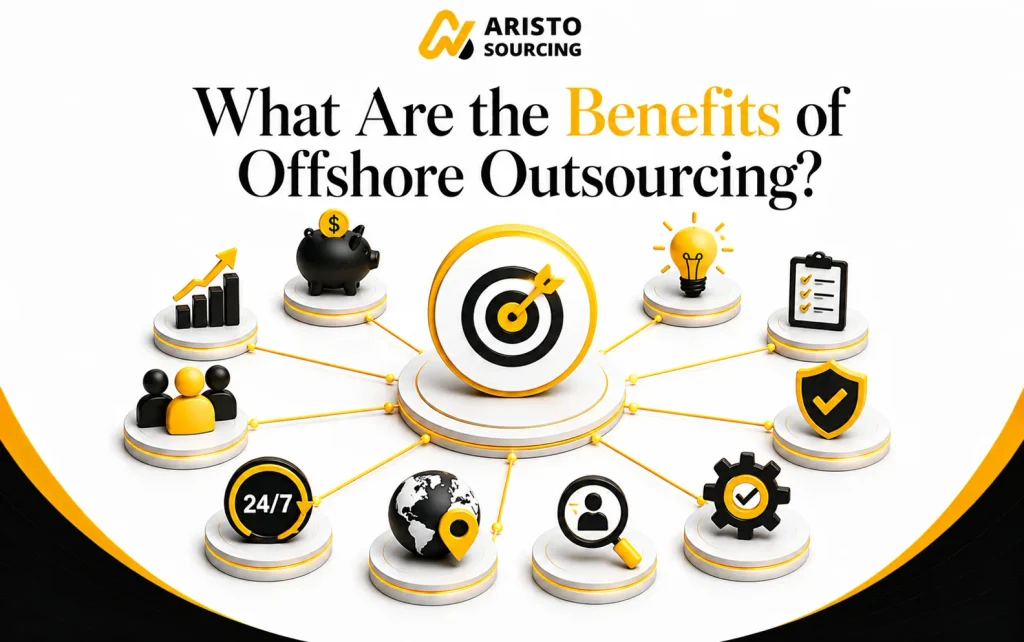
Offshore outsourcing delivers 20 distinct advantages spanning four areas: cost, talent, operations, and long-term strategy. Cost savings top the list, but talent access and growth advantages matter just as much for most businesses today.
1. Lower Labor and Operating Costs
Offshore outsourcing cuts labor and operating costs by shifting work to countries where wages, benefits, and office overhead run far below domestic rates, without requiring any drop in output quality. The savings come from genuine wage differentials rather than shortcuts on the work itself.
Businesses replace a fixed local salary structure with a variable fee tied to actual output, removing the cost of idle capacity during slower periods. Businesses with thin margins or high domestic labor costs gain the most. Cost is the easiest benefit to calculate on a spreadsheet, but it says nothing about whether the right people exist to do the work at all, which brings up access to a global talent pool.
2. Access to a Global Talent Pool
A global talent pool means a business can recruit from labor markets worldwide instead of being capped by whoever lives within commuting distance of its office. That breadth matters most in functions where local supply simply can’t keep up with demand.
NASSCOM data cited by the India Brand Equity Foundation shows India alone has the world’s largest developer workforce, with over 5.4 million software engineers, a single country’s supply that dwarfs what most domestic markets can offer for technical roles. Companies in talent-scarce local markets gain the most. Breadth of supply is one advantage, and having workers active while the home office sleeps is a separate one entirely, covered next under 24/7 productivity across time zones.
3. 24/7 Productivity Across Time Zones
24/7 productivity across time zones means offshore teams keep work moving around the clock, handing tasks off across regions so progress continues after the home office closes for the day. Nothing sits idle overnight the way it would with a single-location team.
A support ticket filed at midnight in one region can be picked up immediately by a team just starting its workday elsewhere, instead of waiting until the next local morning. Companies with international customers or urgent turnaround needs gain the most. Constant coverage keeps work moving, but it doesn’t guarantee the people doing that work have the seniority a harder problem requires.
4. Access to Deep and Senior Talent
Access to deep and senior talent means reaching experienced specialists, not just entry-level staff, in fields where that expertise is scarce or expensive close to home. Offshore hiring opens doors to seasoned professionals a local search would rarely surface.
Markets like India and Eastern Europe have built decades of specialization in software engineering and technical support, producing senior professionals at a scale few domestic cities can match. Businesses tackling complex, judgment-heavy work gain the most from this depth. Depth of expertise solves one kind of problem, and having enough people on hand to grow or shrink that team quickly solves a different one, which is exactly what scalability addresses.
5. Easier Scalability
Easier scalability means a business can expand or reduce its offshore team quickly, without the months-long hiring cycles or severance costs tied to domestic staffing changes. Offshore providers typically keep a larger bench of ready talent available on shorter notice than most in-house HR departments can match.
A company preparing for a product launch or a seasonal demand spike can bring on offshore staff in weeks instead of months. Fast-growing companies and those with unpredictable demand gain the most from this flexibility. Scaling a team up or down handles workload, but it says nothing about what happens to the internal team’s own priorities once that offshore capacity is in place, which leads to a focus on core business.
6. Focus on Core Business
Focus on core business means moving routine, non-strategic work offshore so internal teams and leadership can concentrate on what actually differentiates the company. Every hour spent managing a task an offshore provider could run independently is an hour not spent on strategy or product.
Growth-stage companies benefit most, since leadership bandwidth is scarcest at that stage and every reclaimed hour compounds over time. Freeing up internal time only helps if the business can also count on what it’s paying for staying predictable, which brings up pricing next.
7. Competitive and Predictable Pricing
Competitive and predictable pricing means offshore providers typically offer clear, standardized rate structures, whether hourly, monthly, or project-based, that make budgeting far easier than managing the variable cost of an in-house hire. A fixed offshore rate doesn’t fluctuate with benefits renewals, raises, or overtime the way domestic payroll does.
This predictability matters most for businesses on tight budgets or those managing costs across multiple ongoing projects. Predictable pricing controls the recurring bill, but it says nothing about the upfront capital a business avoids by not building its own offshore infrastructure, which is where reduced infrastructure costs come in.
8. Access to Modern Technology
Access to modern technology means using a provider’s existing software, tools, and infrastructure instead of purchasing and maintaining them independently. Offshore providers often serve many clients at once, letting them justify investment in advanced systems no single client would fund alone.
Smaller businesses gain access to enterprise-grade tools without the capital outlay larger competitors can absorb more easily. Better tools improve how work gets done, but the biggest financial relief often isn’t the tools themselves; it’s the physical setup a business never has to build in the first place.
9. Reduced Infrastructure and Capital Costs
Reduced infrastructure and capital costs mean a business avoids the expense of leasing office space, buying equipment, and building IT systems abroad, since the offshore provider already owns and maintains all of it. There’s no capital outlay before the work even begins.
This matters most for companies without the appetite for large upfront investment in a foreign market. Skipping the cost of building infrastructure is one advantage, but skipping the time it would take to build that operation from scratch is a separate one, which is exactly what faster delivery addresses next.
10. Faster Delivery and Time to Market
Faster delivery and time to market happen because an offshore provider’s existing staff and infrastructure let work start immediately, without the setup delay of hiring, training, or building a team domestically first. Providers already running similar operations for other clients can apply that experience straight away.
Product launches and time-sensitive projects benefit most from this head start. Speed getting started is valuable, but it means little if the same offshore team turns over constantly and the business has to keep restarting with someone new.
11. Higher Team Retention and Continuity
Higher team retention and continuity means offshore roles at established providers often see lower turnover than equivalent domestic positions, since the job itself, career growth path, and provider stability keep staff in place longer. A consistent team stays familiar with the business’s systems and preferences instead of restarting that learning curve repeatedly.
Providers in mature offshore hubs with structured career tracks tend to retain staff the longest. Businesses running long-term, relationship-dependent work gain the most from this stability. A stable team solves one problem, but it doesn’t expand who else is available if that team ever needs to grow, which is where a larger talent network comes in.
12. Access to a Larger Talent Network
Access to a larger talent network means an offshore provider can draw from its own broader bench of vetted candidates and past hires, not just the individuals currently placed with a client. That existing network shortens the search whenever a business needs to add a new role or replace someone.
Providers with years of placements built up in a given region carry the deepest networks. Companies planning to grow their offshore presence over time gain the most. A wide network makes hiring faster, but it doesn’t automatically make the work itself more efficient once people are in place.
13. Increased Productivity and Efficiency
Increased productivity and efficiency come from providers who specialize in a single function and refine how they run it, rather than splitting attention across unrelated internal priorities the way many domestic teams do. A dedicated offshore team repeating the same workflow daily tends to improve it faster than a generalist team juggling other responsibilities.
Businesses with high-volume, repeatable workloads gain the most from this focus. Efficient execution keeps day-to-day output high, but it has nothing to do with what a business owes in taxes once that work is running, which brings up financial advantages next.
14. Tax and Financial Advantages
Tax and financial advantages refer to the incentives some offshore destinations offer to attract foreign business, including reduced corporate tax rates, income tax holidays, or export-processing zone benefits. These incentives can lower a company’s effective cost of doing business beyond the wage savings alone.
The Philippines, for example, offers PEZA-registered BPO companies income tax holidays and reduced corporate tax rates as part of its economic zone program. Companies operating at meaningful scale in a qualifying zone gain the most from these incentives. Favorable tax treatment helps the bottom line, but it means little if the surrounding regulatory environment makes doing business there difficult in the first place.
15. Business-Friendly Regulatory Environments
Business-friendly regulatory environments mean some offshore destinations actively structure their laws, permitting processes, and business registration systems to make it easier for foreign companies to set up and operate. Fewer bureaucratic hurdles translate directly into faster time-to-operation.
Governments competing for outsourcing investment often streamline these processes deliberately, recognizing the jobs and revenue the industry brings. Companies entering a new offshore market for the first time gain the most from this ease. A smooth regulatory environment reduces friction in getting started, but it doesn’t protect a business from disruption once operations are already running, which is where risk distribution comes in.
16. Risk Distribution and Business Continuity
Risk distribution and business continuity mean spreading operations across a provider’s broader infrastructure and staff instead of depending on a single internal team as one point of failure. If a key employee leaves or a local disruption hits the provider’s site, a larger bench and established backup systems can absorb the gap.
This matters most for companies in disaster-prone regions or running lean with little internal redundancy of their own. Businesses that can’t afford a full operational stop gain the most from this protection. Staying operational protects a business from disruption, but it doesn’t by itself help that business grow faster than its competitors.
17. Faster Business Growth
Faster business growth happens when the combined savings, freed-up leadership time, and added capacity from offshore outsourcing get reinvested directly into product development, marketing, or expansion instead of absorbed by fixed overhead. Growth that would otherwise wait on hiring or budget cycles can move immediately instead.
Startups and scale-ups reinvesting aggressively gain the most from this compounding effect. Growing faster is one outcome of offshore outsourcing, but growth alone doesn’t guarantee the customer actually feels the difference, which is where customer experience comes in.
18. Improved Customer Experience Coverage
Improved customer experience coverage means offshore teams extend support hours, language coverage, and response capacity beyond what a single domestic team could sustain alone. Customers get faster replies and more consistent service regardless of when or where they reach out.
Businesses serving customers across multiple countries or time zones gain the most from this expanded coverage. Better customer experience keeps the people already buying happy, but it says nothing about how quickly a business can react when demand itself suddenly shifts, which is where staffing agility comes in.
19. Flexibility and Staffing Agility
Flexibility and staffing agility mean a business can adjust its offshore workforce in near real time as priorities, projects, or demand change, without the delays of a formal domestic hiring or layoff process. A provider can reassign, add, or reduce staff far faster than an internal HR department typically can.
Companies operating in fast-changing markets or running multiple shifting projects at once gain the most from this agility. Everything covered so far- cost, talent, speed, and flexibility- ultimately rolls up into one outcome: whether a business ends up ahead of the competitors that haven’t made the same move.
20. Stronger Competitive Advantage
Stronger competitive advantage means combining every benefit above- cost, talent, speed, and flexibility, into a business that can price more aggressively, launch faster, and serve customers better than competitors still operating without offshore support. No single advantage on its own creates this edge; it’s the compounding effect of all nineteen working together.
Lean, fast-scaling companies capture this advantage most fully, since they’re positioned to reinvest every gain straight back into growth. That covers all twenty benefits of offshore outsourcing, from the cost savings that start the conversation to the competitive edge that ultimately justifies it.
What Are the Disadvantages of Offshore Outsourcing?
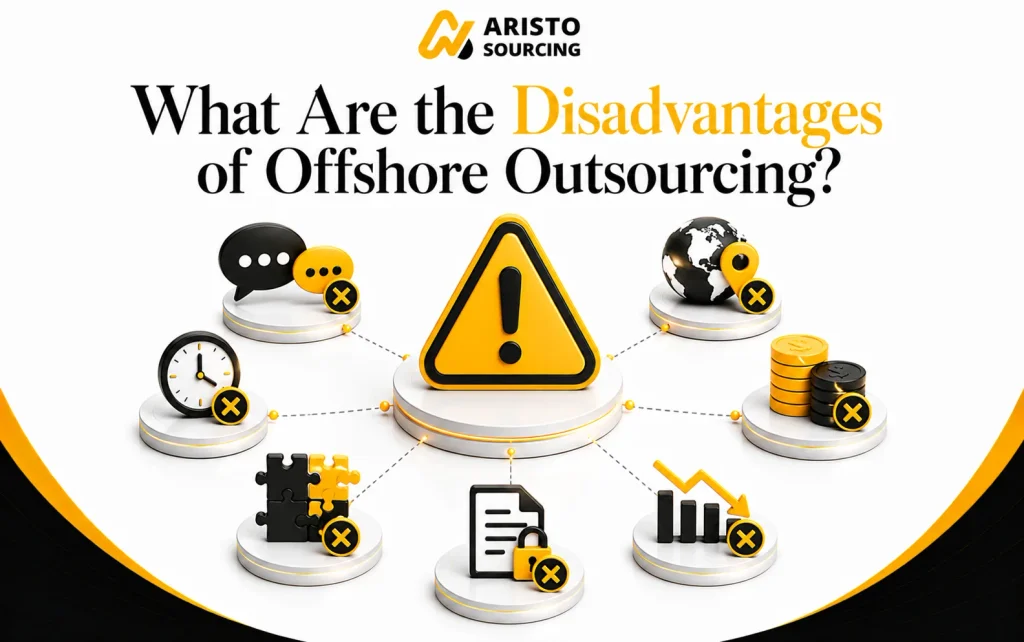
Every benefit covered above comes with a corresponding trade-off, and together they make up the real pros and cons of offshore outsourcing. The seven risks below aren’t reasons to avoid offshore outsourcing outright, but they are reasons to plan for them before signing a contract.
1. Communication and Language Barriers
Offshore outsourcing risks communication and language barriers because teams working across countries often don’t share a first language, communication style, or default assumptions about how explicit instructions need to be. A brief that reads as complete to one team can leave gaps another team fills incorrectly.
Vague scopes, minimal documentation, and providers with limited English proficiency in client-facing roles all make this worse. Written documentation standards, structured handoff templates, and vetting for language proficiency during hiring cut this risk significantly. Clear communication still depends on both teams actually being online at the same time often enough to resolve things quickly, which is where time-zone gaps come in.
2. Time-Zone and Collaboration Gaps
Time-zone and collaboration gaps create risk because a message sent at the end of one team’s workday might not get answered until the next day begins on the other side, slowing decisions that would take minutes with full overlap. Real-time collaboration becomes the exception rather than the norm.
Offshore arrangements with little or no overlapping work hours feel this hardest, especially during urgent issues or incident response. Scheduling deliberate overlap hours, using asynchronous project tools, and setting clear response-time expectations closes most of the gap. Even well-timed communication can still go sideways if the two teams read the same message completely differently, which is where cultural differences come in.
3. Cultural Differences
Cultural differences create risk because business norms around feedback, hierarchy, urgency, and decision-making vary significantly across countries, and a provider team can misread a client’s expectations without realizing it. What one culture considers direct feedback, another might read as unusually harsh, or the reverse.
This friction shows up most in client-facing roles and in leadership styles that clash with a provider’s internal management culture. Cultural orientation training, hiring managers experienced with cross-cultural teams, and setting explicit rather than implied expectations narrow this gap. Getting the human side of the relationship right still does nothing to protect the data flowing between the two teams.
4. Data Security and Privacy Risks
Offshore outsourcing exposes a business to data security and privacy risks because sensitive information now passes through a foreign provider’s systems, staff, and often a different regulatory environment than the client operates under. Every additional country involved adds its own compliance requirements and potential points of failure.
Providers handling regulated data, such as healthcare or financial records, without recognized security certifications carry the highest exposure. Vetting for credentials like SOC 2 or ISO 27001, limiting data access to what’s strictly necessary, and confirming compliance with regulations like GDPR reduce this exposure substantially. Secure systems protect information, but they say nothing about whether the finished work meets the standard the business actually needs.
5. Quality Control Challenges
Quality control challenges arise when offshore output drifts from what the client expects, often due to unclear standards, insufficient training, or a provider juggling too many clients at once. Inconsistent quality can quietly erase the cost savings offshore outsourcing was meant to deliver.
High-turnover providers, rushed onboarding, and vague acceptance criteria all make this risk worse. Defining measurable quality benchmarks upfront, running a paid trial period, and requiring regular QA audits keep standards from slipping over time. Quality problems tend to be visible fairly quickly, but the costs hiding in the contract itself often aren’t.
6. Hidden Costs
Hidden costs describe the fees and clauses that surface after signing, beyond the headline rate a business originally budgeted for. Setup charges, management fees, and scope changes can all add unplanned expense over the life of a contract.
Vague contracts with undefined deliverables make this worse. Buyer guides citing Clutch’s 2026 Pricing Guide document setup fees ranging from a few hundred dollars for small engagements to $200,000 at enterprise-level offshore providers, depending on complexity. Requesting an itemized cost breakdown upfront and capping change-order fees keeps the total predictable. Cost control matters, but none of it holds up if the legal ground the contract sits on shifts unexpectedly.
7. Legislative and Compliance Inconsistency
Legislative and compliance inconsistency means laws around labor, data protection, and business operations can differ significantly between the client’s country and the provider’s, and those laws can also change with little warning. A contract built around today’s regulatory environment can become outdated if either country updates its rules.
This risk is highest in offshore markets with less mature regulatory frameworks or frequent policy shifts. Working with legal counsel familiar with both jurisdictions, building contract flexibility for regulatory change, and choosing destinations with stable, well-established compliance systems all reduce this exposure. Together, these seven risks are why offshore outsourcing rewards careful vetting rather than a rushed decision based on cost savings alone.
Which Businesses Benefit Most from Offshore Outsourcing?
The businesses that benefit most from offshore outsourcing are small and mid-sized companies, startups, scaling brands, and any business with roles facing a local talent gap. SMEs gain by reinvesting the cost and time saved directly into growth, since freeing up budget matters more when margins are thin. Startups gain by accessing skilled talent without the overhead of a full domestic hiring process, a route Clutch found 37% of small businesses now use for at least one business function.
Scaling brands benefit most when demand is seasonal or requires round-the-clock coverage, since offshore teams can flex capacity and cover hours a single domestic office can’t sustain alone. Businesses with roles facing a genuine local talent gap, whether a scarce technical skill or a function too expensive to staff domestically, also see outsized gains, since offshore hiring opens access to talent that simply isn’t available or affordable close to home.
Is Offshore Outsourcing Right for Your Business?
Offshore outsourcing makes sense once several conditions line up: cost pressure is squeezing margins, the skills a task needs don’t exist locally, coverage is needed around the clock, or growth is outpacing what domestic hiring can support. Weigh that against the disadvantages covered earlier, since communication, quality control, and data security all shift once work moves offshore.
The decision comes down to four questions: which specific functions are worth moving offshore, what budget makes sense once setup and management costs are factored in, how much day-to-day control the business is willing to hand over, and how sensitive the data involved actually is. A task that’s routine, cost-driven, and low on sensitive data usually clears the bar easily. One that’s strategic, tightly regulated, or dependent on constant in-person collaboration usually doesn’t.
If offshore outsourcing looks like the right fit, the next step is working through how to choose provider carefully rather than rushing the decision on cost alone. Aristo Sourcing places offshore virtual assistants from the Philippines and South Africa under a staff-augmentation model, giving businesses direct day-to-day management with a 93%+ retention rate behind the placements.