
Business process outsourcing (BPO) refers to the practice of contracting specific business functions to external third-party providers. The BPO challenges are the operational, financial, and strategic risks that arise when companies delegate processes externally.
The primary BPO challenges encompass data security risks, communication barriers, quality inconsistencies, vendor dependency, hidden costs, and compliance risks, all of which are thoroughly addressed in this article.
Overcoming these business process outsourcing challenges and selecting the right BPO provider requires evaluating governance structures, SLA rigor, and cultural alignment. Both enterprises and small businesses can benefit from BPO when provider selection is deliberate and outcome-focused.

What Is Business Process Outsourcing?
Business process outsourcing, also known as BPO, is the practice of contracting specific operational functions, such as customer service, HR, or accounting, to external vendors who deliver those functions on the buyer’s behalf. BPO operates across two primary categories; front-office functions (customer-facing services like sales and support) and back-office functions (internal operations like payroll, data entry, and compliance).
The buyer-vendor relationship in BPO is governed by service agreements in which the buyer defines the scope and the vendor delivers against agreed performance metrics. Companies adopt BPO primarily to reduce costs, access specialized talent, and redirect internal resources toward core business priorities. The term “BPO challenge” refers to any risk, friction, or failure point that emerges from this relationship.
What Are the Challenges of Business Process Outsourcing?
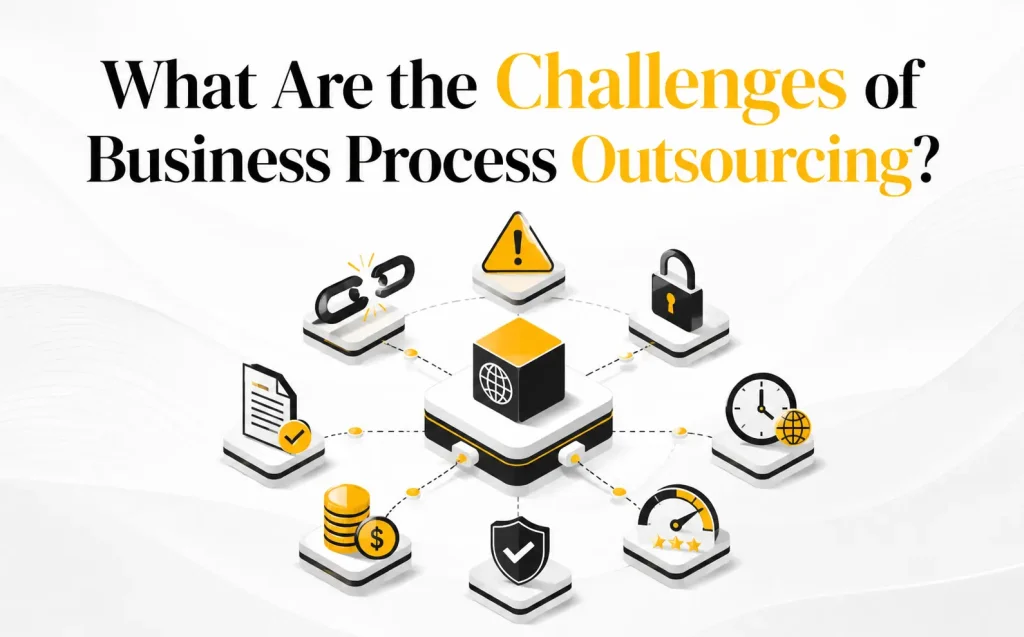
The challenges of business process outsourcing include data security risks, communication barriers, loss of operational control, quality inconsistencies, system integration friction, vendor dependency, productivity measurement difficulty, infrastructure disruptions, and regulatory compliance risks.
BPO challenges are inevitable for any buyer because outsourcing inherently transfers execution authority to a third party operating under different systems, cultures, and incentives.
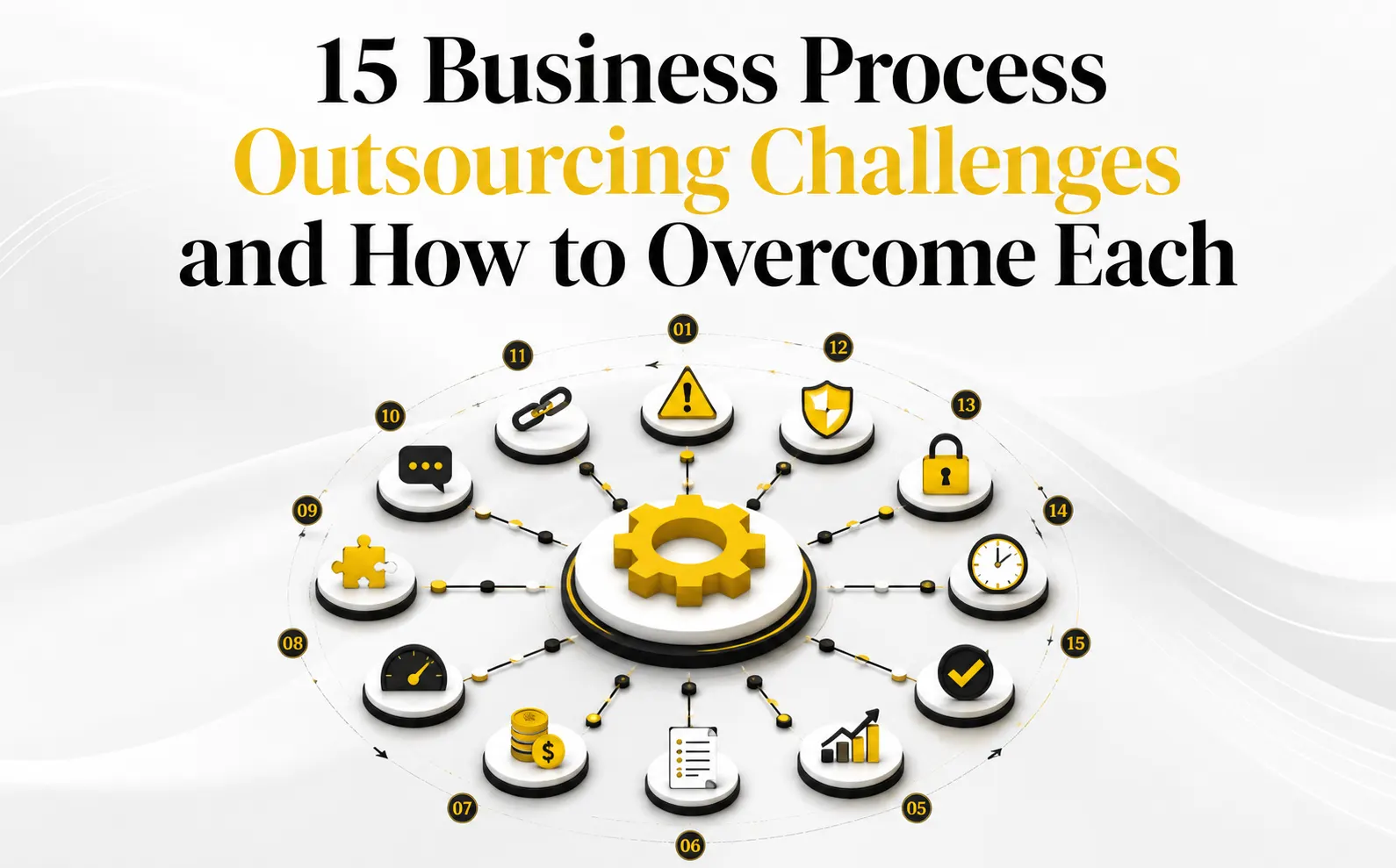
The 15 main BPO challenges are listed below.
1. Data Security and Privacy Risks
2. Communication and Cultural Barriers
3. Loss of Operational Control
4. Quality Control Inconsistency
5. Process and System Integration Friction
6. Vendor Dependency and Single-Provider Risk
7. Knowledge Transfer Gaps
8. Provider Employee Turnover Impact
9. Customer Attrition Risk
10. Hidden Costs and Budget Overruns
11. Service Disruption from Provider Burnout
12. Provider Talent Shortage
13. Productivity Measurement Difficulty
14. Technical and Infrastructure Disruptions
15. Political and Regulatory Compliance Risks
1. Data Security and Privacy Risks
Data security and privacy risks refer to the exposure of sensitive business or customer information to unauthorized access, breach, or misuse when that data is shared with a BPO provider.
These risks directly affect BPO buyers by creating liability under regulations such as GDPR or HIPAA and undermining customer trust. To overcome this challenge, buyers should require vendors to hold current SOC 2 or ISO 27001 certifications and enforce strict data handling obligations within the BPO contract.
2. Communication and Cultural Barriers
Communication and cultural barriers are the misalignments in language proficiency, workplace norms, and expectations that disrupt coordination between a buyer’s team and the BPO provider’s team.
For BPO buyers, these barriers result in misunderstood deliverables, slower resolution cycles, and inconsistent customer experiences. To overcome this, buyers should establish structured communication protocols, shared glossaries, and regular cross-team syncs during onboarding.
3. Loss of Operational Control
Loss of operational control means the reduction in a buyer’s ability to monitor, direct, and adjust day-to-day processes once those processes are transferred to a BPO provider.
This affects buyers by creating blind spots in workflow quality and slowing responses to operational changes. To overcome this, buyers must embed performance dashboards, defined escalation paths, and structured reporting cadences into the service agreement from day one.
4. Quality Control Inconsistency
Quality control inconsistency refers to the variability in output standards that occurs when a BPO provider’s delivery does not match the buyer’s defined benchmarks over time.
BPO buyers experience this as fluctuating customer satisfaction scores, compliance gaps, or rework costs. To overcome it, buyers should define measurable quality thresholds in the SLA structure and require mandatory quality audits on a recurring schedule.
5. Process and System Integration Friction
Process and system integration friction refers to the technical and operational difficulty that arises when a buyer’s existing workflows, platforms, or data formats are incompatible with those of a BPO provider.
This challenge causes delays, data silos, and manual workarounds that erode outsourcing efficiency. To overcome it, buyers should map integration requirements before contract signing and include technology compatibility assessments as part of vendor due diligence.
6. Vendor Dependency and Single-Provider Risk
Vendor dependency and single-provider risk refer to the over-reliance on one BPO provider to the point where switching costs, knowledge concentration, or contractual lock-in limits the buyer’s operational flexibility.
Buyers affected by this challenge face disproportionate disruption if the provider underperforms or exits the market. To mitigate it, buyers should diversify across two or more providers for critical functions and negotiate clear exit clauses within every BPO contract.
7. Knowledge Transfer Gaps
Knowledge transfer gaps are the incomplete or inaccurate transmissions of institutional knowledge, process logic, and business context from the buyer’s team to the BPO provider’s team during onboarding or transitions.
These gaps cause error rates to spike early in the engagement and can persist if documentation is inadequate. Buyers can overcome this by investing in structured knowledge transfer programs, detailed process runbooks, and recorded training sessions before go-live.
8. Provider Employee Turnover Impact
Provider employee turnover impact refers to the service degradation that occurs when trained agents at a BPO provider leave and are replaced by less experienced personnel without adequate transition support.
BPO buyers experience this as quality drops, longer handle times, and broken client relationships. To reduce this risk, buyers should require the BPO provider to report turnover metrics monthly and maintain minimum tenure ratios for dedicated client teams.
9. Customer Attrition Risk
Customer attrition risk refers to the likelihood that end customers disengage from the buyer’s brand due to poor service quality delivered by a BPO provider acting on the buyer’s behalf.
This challenge directly damages the buyer’s revenue and brand equity without the buyer having immediate visibility into the root cause. To overcome it, buyers must monitor end-customer satisfaction metrics independently, not only internal SLA compliance and tie provider compensation to customer retention outcomes.
10. Hidden Costs and Budget Overruns
Hidden costs and budget overruns refer to the unplanned financial obligations that emerge after BPO contract execution, including transition fees, governance overhead, rework costs, and technology licensing not included in the base pricing.
Buyers underestimate total cost of ownership when they evaluate only the headline rate. To overcome this, buyers should conduct a total cost modeling exercise before signing and require full itemized transparency on all billable components in the contract.
11. Service Disruption from Provider Burnout
Service disruption from provider burnout refers to the decline in service continuity and output quality that results when BPO provider teams are understaffed, overloaded, or operating without adequate management support.
Buyers experience this as missed SLAs, reduced accuracy, and inconsistent availability. To overcome it, buyers should assess provider workload distribution, team sizing, and internal wellness programs during both vendor selection and quarterly business reviews.
12. Provider Talent Shortage
Provider talent shortage refers to the BPO provider’s inability to recruit or retain professionals with the specialized skills required to fulfill a buyer’s service scope at the agreed quality level.
This challenge becomes acute in high-demand areas like KPO, cybersecurity support, and multilingual service delivery. Buyers can mitigate it by evaluating provider recruitment pipelines, training capacity, and talent bench depth as part of the RFP process.
13. Productivity Measurement Difficulty
Productivity measurement difficulty refers to the challenge buyers face in accurately tracking and attributing output, effort, and value generated by a BPO provider’s team across distributed and often opaque processes.
Without reliable productivity data, buyers cannot distinguish between genuine underperformance and scope underestimation. To overcome this, buyers should co-design productivity metrics with providers during contracting and require access to live performance dashboards with agreed-upon definitions for each KPI.
14. Technical and Infrastructure Disruptions
Technical and infrastructure disruptions refer to the service interruptions caused by failures in the BPO provider’s IT systems, connectivity, power supply, or cloud platforms that prevent delivery of contracted services.
These disruptions directly impact the buyer’s operations when outsourced functions are business-critical. To overcome this challenge, buyers must require providers to document, test, and share business continuity and disaster recovery plans before contract execution.
15. Political and Regulatory Compliance Risks
Political and regulatory compliance risks refer to the legal and operational exposure buyers face when their BPO provider operates in a jurisdiction subject to shifting regulations, political instability, or inconsistent enforcement of data and labor laws.
These risks can result in regulatory penalties for the buyer despite the outsourcing arrangement. To overcome them, buyers should conduct geopolitical risk assessments during provider selection and require contractual indemnification clauses tied to compliance failures.
How to Choose a BPO Provider That Minimizes These Challenges?
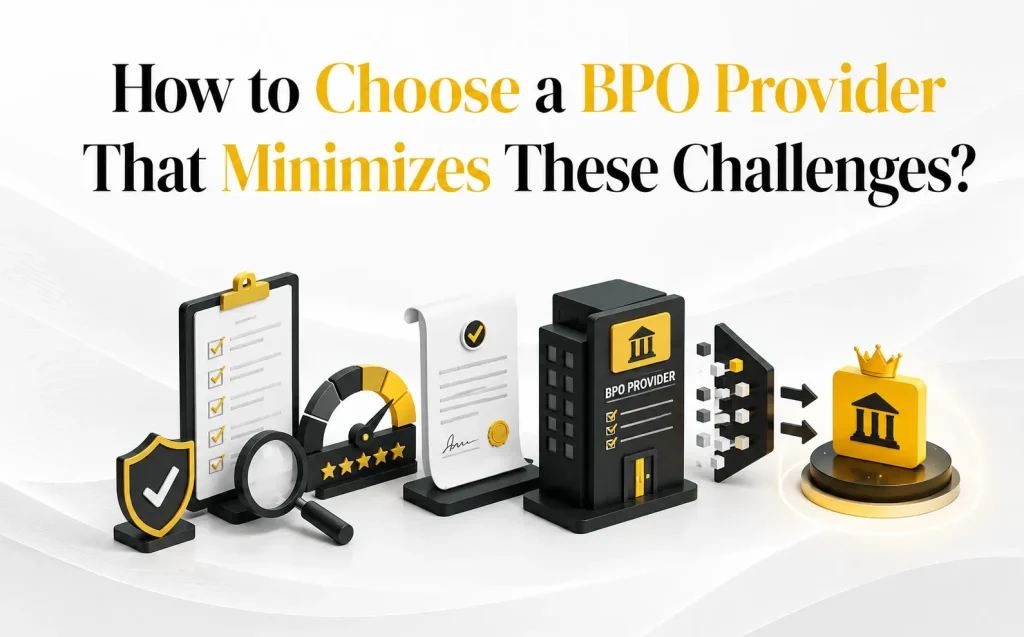
To choose a BPO provider that minimizes the challenges a business faces, it must follow a structured evaluation process that treats each of the 15 risks above as a selection criterion. The right BPO partner mitigates most challenges proactively through transparent governance, proven delivery models, and contractual accountability.
Reviewing all 15 challenges before provider selection gives buyers a decision-support framework grounded in real outsourcing failure patterns. To choose a BPO provider that minimizes challenges, a business needs to follow the tips listed below.
- Audit security certifications: Verify that the provider holds current ISO 27001, SOC 2, or industry-specific compliance credentials before shortlisting. Security posture is non-negotiable.
- Assess communication infrastructure: Evaluate the provider’s language capabilities, escalation structures, and collaboration tooling to confirm alignment with your team’s time zone and operational cadence.
- Review SLA structure rigor: Examine how the provider defines, measures, and reports performance. A mature SLA structure ties penalties directly to business outcomes, not just activity counts.
- Demand full cost transparency: Request itemized pricing that includes transition costs, technology fees, governance overhead, and exit costs. Opaque pricing is a leading indicator of hidden-cost risk.
- Evaluate talent stability: Ask for turnover data, bench strength reports, and training curricula. Provider talent depth directly predicts service continuity across the BPO contract lifecycle.
- Test integration compatibility: Run a pre-contract technical discovery session to surface system incompatibilities early. Integration friction is easier to resolve before go-live than after.
- Require business continuity documentation: Mandate documented and tested disaster recovery protocols. Providers without verifiable BCP represent an unacceptable single point of failure for any buyer.
- Negotiate exit provisions: Ensure every BPO contract includes clear exit, transition, and termination clauses with defined knowledge handbooks and obligations and wind-down timelines.
What Should Be Included in a BPO Contract?
A BPO contract should include a clearly defined scope of work and deliverables specifying the processes the vendor handles, including volume assumptions and exclusions. It should also cover SLAs and KPIs with measurable benchmarks and reporting schedules. Data security, confidentiality, and compliance clauses must outline obligations under data protection laws and liability for breaches.
Payment terms should define the billing model, invoicing frequency, and pricing adjustment conditions. Exit, transition, and termination clauses need to explain termination terms, notice periods, and knowledge transfer obligations. Finally, dispute resolution and governing law provisions should identify the legal jurisdiction, arbitration procedures, and escalation paths for disagreements.
What Is a Good SLA Structure for BPO?
A good BPO SLA structure includes performance metrics tied to business outcomes, such as customer satisfaction or first-call resolution rates, instead of raw activity volume. It should define clear response and resolution time benchmarks for different task categories based on business impact and overall BPO cost efficiency.
Strong SLAs also include automatic penalty and credit mechanisms when performance falls below agreed standards, ensuring financial accountability. Reporting schedules and live dashboard access should provide continuous visibility into performance. Finally, the SLA must include review and revision triggers so both parties can reassess targets as business conditions change.
How Much Does BPO Cost?
BPO costs vary depending on the pricing model, geography, and service complexity tier selected. Pricing models generally fall into three categories; FTE-based (a fixed monthly cost per dedicated agent), transaction-based (a cost-per-unit-of-output model), and outcome-based (a cost tied to a business result such as revenue generated or cases resolved).
Geographically, onshore BPO in the US or Western Europe commands the highest rates, nearshore providers in Latin America or Eastern Europe fall in the mid-range, and offshore providers in South and Southeast Asia offer the lowest labor costs. Service complexity also drives cost; back-office functions like data entry are priced lower than front-office customer support, while Knowledge Process Outsourcing commands a premium for specialized expertise.
Hidden costs, including transition management, technology setup, governance staffing, and training, frequently add 15 to 30 percent to the headline rate and must be factored into the total cost of ownership calculation. ROI from BPO should be measured not only in cost reduction but also in quality improvement, scalability gains, and speed-to-market benefits that are difficult to capture in an hourly rate comparison alone.
Is BPO Right for Small Businesses?
Yes, BPO is right for small businesses depending on their growth stage, internal capacity, and the nature of the work being considered for outsourcing.
BPO makes sense for SMBs when they are scaling faster than their internal teams can support, lack in-house expertise in specific functions, or face operational bottlenecks in areas like customer support, bookkeeping, or administrative management.
However, BPO is not the right fit when the work is deeply tied to the owner’s personal judgment, involves very low transaction volumes that do not justify vendor setup costs, or represents a core differentiator that must remain in-house. The best BPO functions for small businesses are typically administrative support, customer service, and accounting. High-volume, process-driven tasks with clear performance criteria. Cost-benefit considerations at small business scale favor transaction-based pricing models that avoid large fixed overhead commitments.
Boutique and mid-tier BPO providers are generally better partners for SMBs than large enterprise-focused vendors, as they offer more flexible contracts, lower volume minimums, and closer account management. Understanding BPO challenges before engaging any outsourcing provider helps small businesses set realistic expectations, structure smarter BPO services agreements, and extract the full benefits of BPO from day one.