
AI in BPO refers to the use of artificial intelligence technologies to automate, augment, and optimize outsourced business processes. The main AI use cases in BPO include intelligent automation, conversational AI, document processing, sentiment analysis, predictive analytics, speech recognition, and workforce management.
The main benefits of AI in BPO encompass operational efficiency, cost reduction, faster resolutions, 24/7 support, and data-driven insights. The challenges and risks of artificial intelligence in business process outsourcing include over-reliance on automation, data privacy exposure, legacy system integration complexity, and workforce displacement anxiety.
What Is Artificial Intelligence in BPO?
Artificial intelligence in the BPO is the integration of machine learning, natural language processing, and robotic process automation into outsourced functions to execute tasks, analyze data, and interact with customers. Artificial intelligence is applied to business process outsourcing through intelligent automation, conversational systems, document extraction, and predictive modeling that augment or replace manual execution.
According to Market.us, the AI in BPO market generated USD 2.6 billion in 2023 and projects expansion to USD 49.6 billion by 2033 at a 34.3% CAGR. AI in BPO spans automation, language models, and AI agents handling outsourced work. AI-powered BPO differs from traditional BPO in three fundamental ways. First, AI-powered BPO replaces rule-based human execution with cognitive systems that learn, adapt, and make decisions. Second, traditional BPO scales through headcount expansion; AI-powered BPO scales through compute capacity. Third, traditional BPO charges time-and-materials; AI-powered BPO uses consumption-based or outcome-based pricing. AI solves the core problems of human error, slow turnaround, high turnover, scaling limitations, and rising labor costs.
What Is the Difference Between AI-Powered BPO and Traditional BPO?
The difference between AI-powered BPO and traditional BPO is that AI-powered BPO uses cognitive technologies to execute, optimize, and scale outsourced processes, while traditional BPO relies primarily on human labor for manual execution.
AI-powered BPO introduces four structural changes. Routine, rule-based work shifts from human agents to AI systems. Pricing moves from time-and-materials toward consumption-based or outcome-based models. Scaling no longer depends on headcount but on computational capacity. Humans move to complex, judgment-heavy tasks that require empathy, creativity, and problem-solving.
Traditional BPO remains labor-led. Human agents perform repetitive data entry, respond to routine inquiries, and process documents manually. This model incurs hidden costs such as recruitment expenses of USD 10,000–20,000 per agent, 30–45% annual attrition rates, and facility overhead of USD 150–300 per seat per month.
What BPO Problems Does AI Solve?
AI solves 5 operational problems in the BPO industry, including human error, slow turnaround, high agent turnover, scaling difficulty, and rising labor costs.
Problems AI solves are listed below.
- Human error in repetitive tasks. AI eliminates data entry mistakes, document misclassification, and reconciliation errors in high-volume workflows.
- Slow turnaround times. AI processes invoices, claims, and tickets in seconds rather than hours or days.
- High agent turnover in some functions. AI absorbs monotonous tier-0 and tier-1 work, reducing burnout and attrition.
- Difficulty scaling for seasonal demand spikes. AI deploys additional capacity instantly without recruitment cycles or training lag.
- Rising labor costs. AI mitigates it by automating tasks that previously required full-time equivalents.
How Is AI Used in the BPO Industry?
The ways in which AI is used in the BPO industry include intelligent automation, conversational AI, document processing, sentiment analysis, predictive analytics, speech recognition, and workforce management.
The applications of AI in the BPO industry are listed below.
- Intelligent Automation (RPA + Machine Learning)
- Chatbots and Virtual Assistants
- Intelligent Document Processing (OCR + NLP)
- Sentiment and Behavior Analysis
- Predictive Analytics and Forecasting
- Speech Recognition, QA, and Compliance Monitoring
- AI‑Driven Workforce Management
1. Intelligent Automation (RPA + Machine Learning)
Intelligent automation in BPO is the combination of robotic process automation with machine learning to execute, validate, and adapt back-office workflows without static rule sets. Intelligent automation handles data entry, document verification, and reconciliation across ERP and CRM systems. Unlike rules-only RPA, intelligent automation learns from exceptions, adjusts to format variations, and improves accuracy over time based on different work examples.
2. Chatbots and Virtual Assistants
AI chatbots and virtual assistants in BPO are conversational systems that interpret natural language, retrieve structured knowledge, and resolve customer inquiries through voice, chat, and email channels. These systems handle tier-0 and tier-1 inquiries 24/7, eliminating wait times and increasing first-contact resolution rates. By deploying Decagon’s AI agents across its chat and voice channels, Chime achieved a 70%+ customer resolution rate for automated tickets, which helped reduce its contact center operational costs.
3. Intelligent Document Processing (OCR + NLP)
Intelligent document processing is the extraction, classification, and validation of unstructured data from invoices, forms, and contracts using optical character recognition and natural language processing. OCR converts scanned images into machine-readable text. NLP identifies entities, amounts, dates, and terms. IDP pushes structured data into enterprise systems, eliminating manual transcription.
4. Sentiment and Behavior Analysis
AI sentiment and behavior analysis in BPO is the real-time detection of customer emotion, intent, and tone during interactions using natural language processing and acoustic modeling. NLP detects frustration, satisfaction, and urgency in voice and text channels. This analysis triggers proactive interventions, personalized responses, and escalation protocols that improve retention.
5. Predictive Analytics and Forecasting
Predictive analytics in BPO operations is the use of historical data and machine learning models to forecast call volumes, ticket loads, and staffing requirements. Predictive analytics reduces idle time by 20–30% through precise resource planning. BPO providers use these forecasts to adjust schedules, allocate agents, and prevent service-level breaches.
6. Speech Recognition, QA, and Compliance Monitoring
AI speech recognition and real-time call analysis is the automated transcription, scoring, and monitoring of voice interactions for quality assurance and regulatory adherence. Automated QA evaluates 100% of interactions rather than the 2–5% sample typical of manual review. Speech analysis verifies script adherence, detects compliance gaps, and generates agent coaching alerts in real time.
7. AI-Driven Workforce Management
AI-driven workforce management is the optimization of agent scheduling, performance tracking, and peak-time prediction through machine learning algorithms. AI scheduling aligns agent shifts with predicted demand patterns, reducing overstaffing and understaffing. Performance tracking identifies coaching opportunities. Peak-time prediction reduces agent burnout by distributing workload evenly.
What Are Some AI in BPO Examples Across Industries?
Some AI in BPO examples across industries include healthcare revenue cycle management and claims processing, transportation freight audit and fraud detection, and finance claims processing and compliance monitoring.
Some major AI in BPO examples across industries are mentioned below.
1. Healthcare Industry
AI in healthcare BPO automates revenue cycle management, claims processing, and billing verification while maintaining HIPAA compliance. AI extracts patient data from EOBs and superbills, validates coding accuracy, and submits clean claims. Gains in speed and accuracy must hold while AI systems maintain encryption, access controls, and audit trails that satisfy HIPAA requirements.
2. Transportation Industry
AI in transportation and logistics BPO automates invoice reconciliation, freight audit, and fraud detection across supply chain networks. AI matches carrier invoices to shipment records, identifies duplicate charges, and flags anomalous transactions for investigation. This automation reduces payment cycles and minimizes revenue leakage.
3. Finance Industry
AI in finance and insurance BPO processes claims, manages collections calls, and monitors compliance for banking and insurance clients. AI evaluates claim validity, predicts settlement amounts, and routes complex cases to specialized adjusters. Collections AI prioritizes accounts by propensity-to-pay scores. Compliance monitoring tracks script adherence and regulatory requirements. This deployment is beneficial for risk management and customer retention.
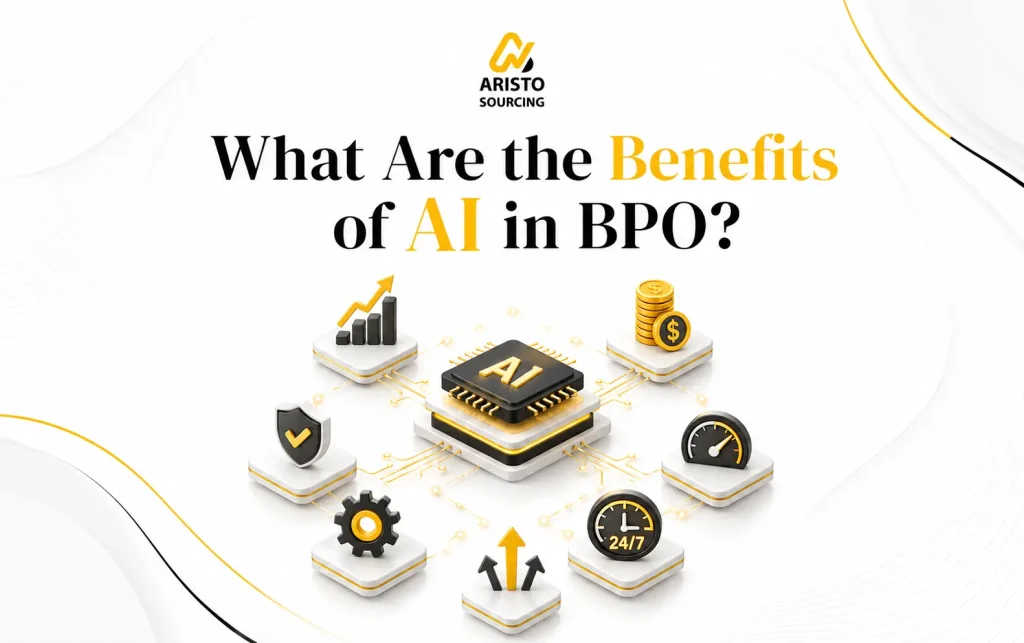
What Are the Benefits of AI in BPO?
The benefits of AI in BPO include operational efficiency, cost reduction, faster resolutions, faster turnaround, 24/7 availability, improved accuracy, multilingual support, and data-driven insights.
The benefits of AI in BPO are listed below.
- Reduces operational costs: Deloitte (2022, “Automation with Intelligence”) reports that AI‑driven automation can reduce operational costs by up to 30% in the first year in business‑process‑heavy environments such as BPO and contact centers.
- Improves customer experience: According to real-world production metrics compiled by NICE, enterprise organizations deploying agentic AI solutions are achieving up to a 20% boost in Customer Satisfaction (CSAT) scores by resolving consumer issues faster and more accurately.
- Provides 24/7 support: AI systems operate continuously across global time zones without shift premiums, overtime expenses, or fatigue-based quality degradation, ensuring constant availability.
- Handles high-volume tasks: AI processes thousands of simultaneous transactions, customer inquiries, and complex documents without queue buildup, delay, or quality degradation.
- Reduces error rates: According to Retica.ai, their AI-driven data-entry automation reduces errors by 90%, decreases processing time by 75%, and cuts labor costs by 40% compared to traditional manual document processing.
- Enables multilingual support: AI translates and responds in multiple languages in real time, expanding global market coverage without hiring native linguists.
- Generates data-driven insights: AI converts interaction data into actionable business insights through sentiment trends, predictive models, and behavioral analytics for strategic decisions.
- Increases operational efficiency: AI streamlines complex workflows, eliminates process bottlenecks, and accelerates turnaround times across front-office and back-office functions for enterprise-wide gains.
There are some challenges of AI in BPO that need to be managed properly.
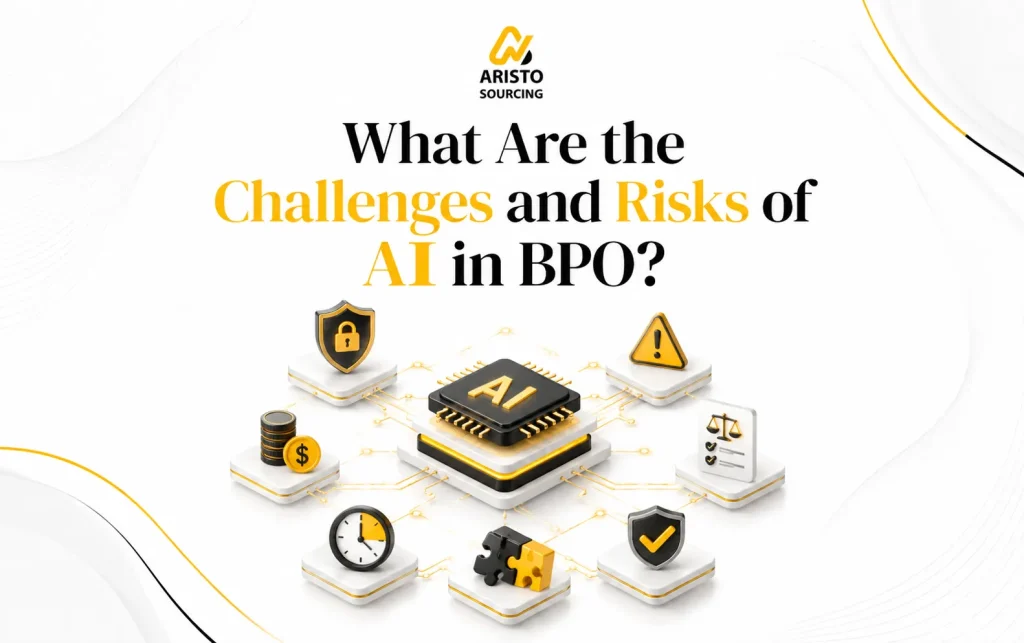
What Are the Challenges and Risks of AI in BPO?
The challenges and risks of AI in BPO include over-reliance on automation, data privacy exposure, legacy integration complexity, and workforce displacement anxiety.
The challenges and risks of AI in BPO are listed below.
- Risk of Over-Reliance on Automation
- Data Privacy and Security Challenges
- Challenges of Integrating AI with Legacy BPO Systems
- Risk of Workforce Displacement Fears
Risk of Over-Reliance on Automation
Over-automation in BPO erodes customer trust when AI systems handle emotional or complex interactions without human empathy. AI resolves routine inquiries efficiently, but loss of human nuance in escalations damages brand perception. The balance requires AI for routine cases and humans for complex or emotional cases.
Data Privacy and Security Challenges
Data privacy and security risks in AI-powered BPO arise from the storage, processing, and transmission of sensitive customer data through AI pipelines. Breach exposure increases when data flows through multiple AI vendors and cloud environments. Compliance requirements include GDPR for EU data subjects and HIPAA for US health information.
Challenges of Integrating AI with Legacy BPO Systems
Legacy BPO platforms lack APIs, data formats, and connectivity standards required for AI integration. Systems built for human data entry do not expose structured endpoints for machine consumption. Phased integration mitigates this risk: middleware layers translate legacy formats, and pilot workflows validate data integrity before full deployment.
Risk of Workforce Displacement Fears
Workforce displacement concerns among BPO employees generate job-security anxiety and resistance to AI adoption. Employees fear redundancy when AI automates tasks they perform daily. Reskilling programs and transparent communication reduce this resistance by repositioning staff into quality assurance, exception handling, and client relationship roles. Initial training involves costing that yields long-term retention gains.
How Much Does AI in BPO Cost?
AI in BPO costs between USD 0.10 and USD 0.30 per minute for consumption-based models, while traditional BPO labor costs between USD 6 and USD 25 per hour depending on location and complexity.
Traditional BPO labor uses time-and-materials billing; AI-powered BPO uses consumption-based or outcome-based pricing. Upfront implementation costs include infrastructure provisioning, training data curation, system automation and system integration. AI-based BPO pricing models include AI-as-a-Service, subscription tiers, and performance-based contracts tied to resolution rates or accuracy scores.
AI vs Automation in BPO: What Is the Difference?
AI and automation in BPO differ in that automation executes predefined rules without adaptation, while AI learns from data, makes decisions, and improves performance over time. Automation is different from AI. It’s a robotic process automation that follows static scripts.
Machine learning models recognize patterns, predict outcomes, and optimize processes dynamically. AI handles exceptions, ambiguity, and variability that break rule-based systems.
How Should a Business Adopt AI in Its BPO Operations?
A business adopts AI in its BPO operations by auditing current processes, identifying high-volume repetitive workflows, selecting AI tools with proven ROI, and deploying through phased pilots with clear success metrics.
The importance of a good partner determines adoption speed and outcome quality. A qualified AI BPO partner provides pre-trained models, integration expertise, change management support, and ongoing optimization.
How to Choose an AI-Powered BPO Partner?
The right AI-powered BPO partner is chosen via evaluation of technical capabilities, domain expertise, integration experience, compliance certifications, and transparent pricing structures. Best practices include verifying SOC 2 and ISO 27001 certifications, reviewing case studies in the same industry, assessing multilingual and omnichannel capabilities, and confirming consumption-based pricing with no hidden fees. The partner must demonstrate AI use cases in BPO, articulate the benefits of AI clearly, and address challenges and risks of artificial intelligence with documented mitigation protocols.