
Front office BPO is the outsourcing of client-facing functions to external vendors, and back office BPO is the outsourcing of internal administrative functions to external vendors. The main differences involve customer interaction levels, primary goals, cost classifications, common roles, and key business impacts.
Front office examples include customer service, sales, and technical support. Back office examples include accounting, HR, data entry, and IT support. The process of choosing between front and back office BPO requires matching the office type to the function being outsourced, evaluating revenue impact against cost reduction goals, and determining whether a hybrid model serves the business better. Process-based BPO, among the 4 types of BPOs, includes both front office and back office BPO as its two functional categories.
What Is Business Process Outsourcing (BPO)?
Business process outsourcing or BPO is the strategic practice of contracting specific non-core business functions to external service providers who specialize in efficient process execution, management, and optimization across customer service, finance, human resources, and technology domains. BPO is a strategic operational model that enables organizations to delegate non-core activities to specialized vendors. According to Mordor Intelligence, the global BPO market reached $436.37 billion in 2026 and projects growth to $623.26 billion by 2031 at a 7.39% CAGR. Companies use BPO to reduce operational costs, access specialized expertise, improve process efficiency, and scale operations without expanding internal infrastructure.
BPO divides into 2 main types, including location-based BPO and process-based BPO. Location-based BPO includes onshore BPO (outsourcing within the same country), nearshore BPO (outsourcing to geographically close countries), and offshore BPO (outsourcing to distant overseas countries). Process-based BPO classifies outsourcing by function type and contains 2 categories, and they are front office BPO and back office BPO. The front office and back office sit inside the process-based split as the 2 primary functional divisions of outsourced business operations.
What Is Front Office BPO?
Front office BPO is the outsourcing of customer-facing, revenue-supporting business functions to external providers who manage direct client interactions through multiple communication channels and contact center infrastructure. Front office BPO covers 5 core service areas, including client-facing and customer-facing services, sales and marketing operations, customer service and technical support, inbound and outbound contact center work, and digital customer engagement. According to data from Grand View Research, the global customer experience (front-office) business process outsourcing market was valued at USD $113.0 billion in 2025 and is projected to expand to $125.6 billion.
Companies outsource front office functions for 3 primary reasons: direct impact on revenue generation and brand reputation, access to trained agents and established contact center infrastructure, and the ability to scale customer touchpoints without in-house overhead. Front office BPO is different from back office BPO because front office functions interact directly with customers while back office functions operate internally without client contact.
What Is Back Office BPO?
Back office BPO is the outsourcing of non-client-facing administrative and operational support functions to external providers who execute internal workflows without direct customer interaction or revenue generation responsibility. Back office BPO covers 6 core service areas, including accounting, bookkeeping, and payroll processing; human resources administration and recruitment support; data entry and data management; IT support and infrastructure management; supply chain, procurement, and inventory management; and internal operational support. According to Grand View Research, the global back-office support BPO market reached $13,116.1 million in 2025 and grows at a 9.1% CAGR through 2033.
Back office BPO branches into 3 specialized subcategories, and they are IT-Enabled Services (ITES) for IT-driven back office work, Legal Process Outsourcing (LPO) for paralegal and legal administrative work, and Knowledge Process Outsourcing (KPO) for research and analytical work. Understanding the difference between front and back office BPO is important because the distinction determines vendor selection criteria, cost structures, performance metrics, and strategic alignment with business objectives.
What Is the Difference Between Front Office BPO and Back Office BPO?
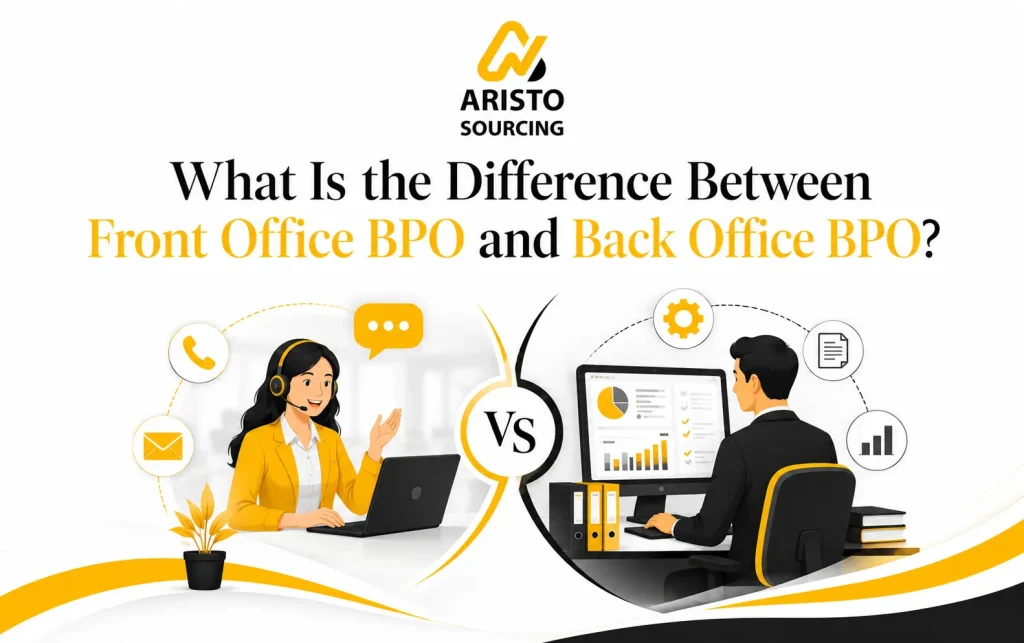
The difference between front office BPO and back office BPO involves the difference in customer interaction levels, primary strategic goals, cost classification methods, common operational roles, and key business impacts that determine vendor selection and performance measurement frameworks. The difference between front office BPO and back office BPO is presented in the table below.
| Comparison Factor | Front Office BPO | Back Office BPO |
| Primary Goal | Revenue generation, customer acquisition, brand reputation management, and satisfaction improvement | Cost reduction, operational efficiency, compliance maintenance, and process accuracy |
| Customer Interaction | Direct, continuous, and multichannel engagement with customers and prospects | Minimal to zero direct customer contact; internal process execution |
| Cost Classification | Revenue-generating cost with direct return on investment measurement | Operating expense with indirect cost savings and efficiency gains |
| Common Roles | Customer service representatives, sales agents, technical support specialists, contact center operators, digital engagement managers | Accountants, payroll processors, data entry clerks, HR administrators, IT support technicians, procurement specialists |
| Key Business Impact | Direct influence on customer lifetime value, market share expansion, and brand equity | Direct influence on operational margins, regulatory compliance, and organizational scalability |
Difference in Primary Goal
The difference in primary goal refers to the distinct strategic objectives that front office BPO and back office BPO serve within outsourced operational structures. The front office primary goal involves revenue generation through customer acquisition, retention, and satisfaction improvement. The back office’s primary goal involves cost optimization through process efficiency, accuracy improvement, and resource consolidation.
This difference involves 2 operational focuses, including front office BPO, which drives top-line growth through customer-facing activities, and back office BPO, which drives bottom-line performance through internal optimization. A front office example is a company outsourcing sales calls to increase lead conversion rates by 15%. A back office example is a company outsourcing invoice processing to reduce administrative costs by 25%.
Difference in Customer Interaction
Difference in customer interaction refers to the level of direct contact that outsourced functions maintain with external customers. Front office BPO requires continuous, direct, and multichannel customer interaction through voice, chat, email, and social media platforms. Back office BPO requires zero or minimal direct customer interaction and focuses entirely on internal process execution.
This difference creates 2 distinct workforce profiles, including front office BPO, which employs communication-skilled agents trained in customer engagement protocols, and back office BPO, which employs process-skilled specialists trained in administrative and technical workflows.
Difference in Cost Classification
Difference in cost classification refers to how organizations account for front office BPO spending versus back office BPO spending. Front office BPO costs are classified as revenue-generating investments with measurable returns through customer acquisition and sales conversion metrics. Back office BPO costs classify as operating expenses with returns measured through efficiency gains, error reduction, and compliance maintenance.
This difference affects 2 financial metrics, including front office BPO, which evaluates performance through revenue per agent, customer satisfaction scores, and conversion rates; back office BPO, which evaluates performance through cost per transaction, accuracy rates, and process completion times.
Difference in Common Roles
Difference in common roles refers to the distinct job functions that front office BPO and back office BPO employ. Front office BPO common roles include customer service representatives, outbound sales agents, inbound support specialists, technical helpdesk operators, and social media community managers. Back office BPO common roles include accountants, payroll administrators, data entry operators, HR coordinators, IT support technicians, and procurement analysts.
Front office roles demand communication, persuasion, and emotional intelligence competencies; back office roles demand analytical, procedural, and technical competencies.
Difference in Key Business Impact
The difference in key business impact refers to the distinct organizational outcomes that front office BPO and back office BPO produce. Front office BPO impacts customer lifetime value, market share, brand reputation, and revenue per customer. Back office BPO impacts operational margins, regulatory compliance status, data accuracy, and organizational scalability.
Front office BPO success measures through Net Promoter Score, customer retention rates, and revenue growth; back office BPO success measures through cost reduction percentages, error rates, and audit compliance scores.
What Are Front Office BPO Examples?
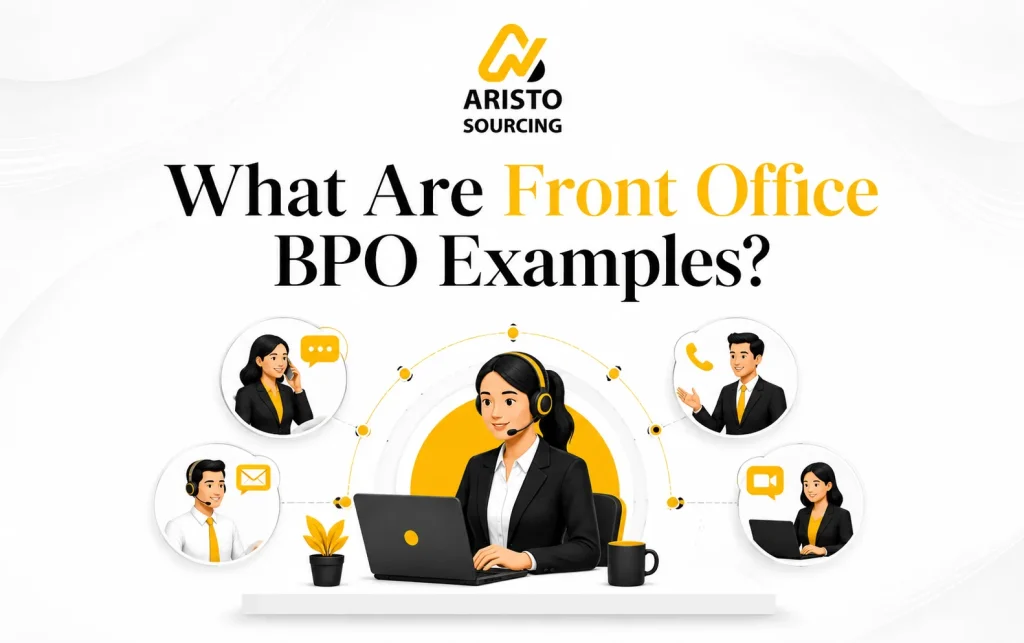
Examples of the front office BPO include customer service outsourcing for inbound query management, sales and telemarketing for lead generation, technical support and helpdesk for product issue resolution, and live chat with social media support for digital customer engagement.
Examples of front-office BPO are mentioned below.
- Outsource customer service operations: Handling inbound customer inquiries, resolving complaints, processing orders, and providing support across phone, email, and live chat channels to improve customer satisfaction.
- Outsource sales and telemarketing: Managing outbound sales calls, qualifying leads, setting appointments, and nurturing prospects to help internal sales teams generate more revenue opportunities.
- Outsource technical support and helpdesk: Providing technical troubleshooting, resolving product or software issues, coordinating repair support, and assisting customers with product usability and functionality concerns.
- Outsource live chat and social media support: Managing real-time customer engagement across websites, messaging apps, and social media platforms while responding to inquiries, resolving public-facing issues, and maintaining brand reputation.
Front office BPO is different from back office BPO because front office functions maintain direct customer relationships while back office functions execute internal processes without external contact.
What Are Back Office BPO Examples?
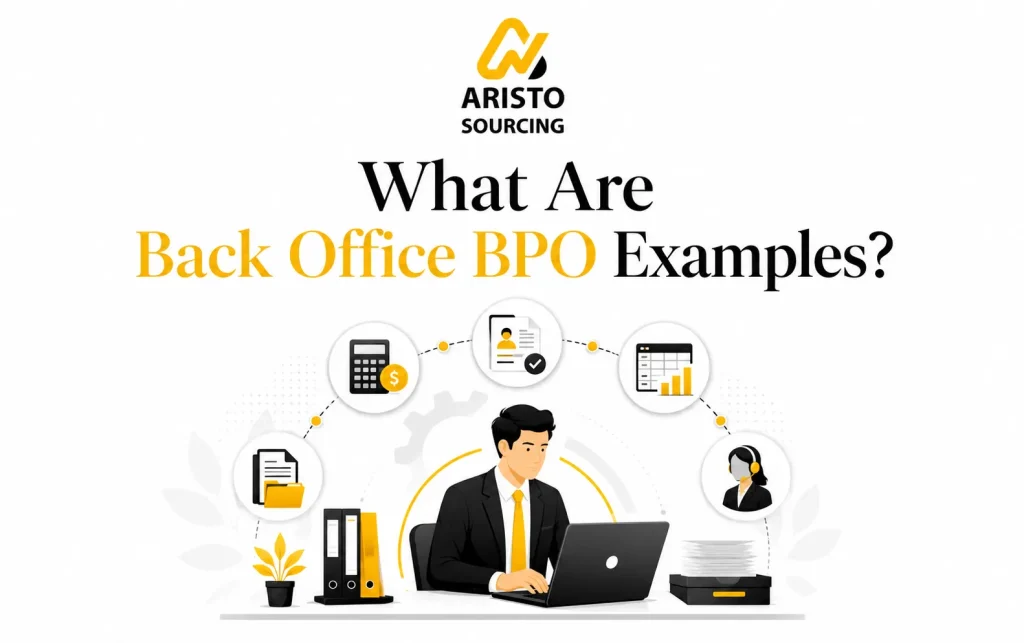
Examples of the back office BPO include accounting and payroll processing, human resources administration and recruitment, data entry and database management, IT support and infrastructure monitoring, supply chain and procurement management, and invoice processing with accounts payable functions.
Examples of back-office BPO functions are mentioned below.
- Outsource accounting, bookkeeping, and payroll processing: Managing financial records, processing payroll, preparing reports, handling tax-related documentation, and maintaining compliance with financial regulations to support accurate business operations.
- Outsource human resources administration and recruitment support: Handling employee onboarding, payroll coordination, benefits administration, resume screening, interview scheduling, and recruitment workflows to improve workforce management and reduce hiring delays.
- Outsource data entry and data management: Processing business forms, updating databases, organizing records, verifying information accuracy, and maintaining structured data across internal systems to support daily operations and reporting.
- Outsource IT support and infrastructure management: Monitoring networks, maintaining hardware and software systems, resolving internal technical issues, managing cybersecurity updates, and ensuring system performance and uptime.
- Outsource supply chain, procurement, and inventory management: Coordinating vendor communication, tracking inventory levels, managing purchase orders, monitoring shipments, and optimizing stock replenishment processes to improve operational efficiency.
- Outsource invoice processing and accounts payable: Reviewing vendor invoices, processing payments, maintaining payment records, reconciling accounts, and supporting cash flow management to ensure timely and accurate financial transactions.
Deciding between front office and back office BPO requires mapping specific functions to the appropriate outsourcing category based on customer contact requirements and strategic priorities.
How Do You Choose Between Front Office and Back Office BPO?
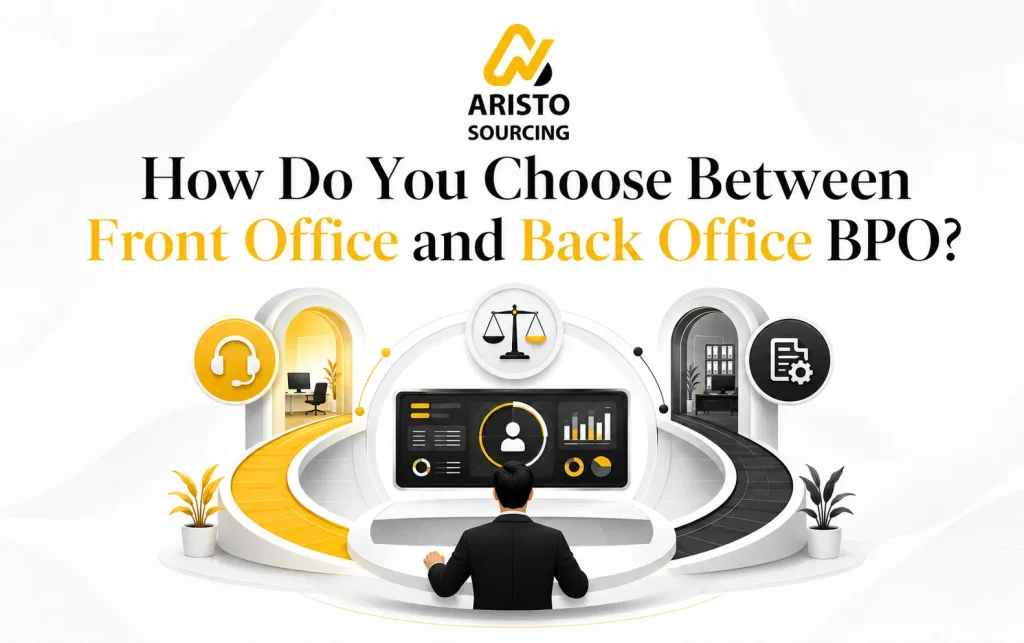
To choose between front office and back office BPO, match the office type to the function being outsourced, evaluate based on revenue impact and cost reduction goals, and determine whether a hybrid model serves the business better.
To choose between front office and back office BPO, follow the tips listed below.
- Match the function type: Front office BPO should be chosen when the work directly involves customers, such as sales, customer support, and marketing, because it impacts customer experience and revenue. Back office BPO should be chosen when the work is internal, such as accounting, HR, payroll, and data management, because it supports operations without direct customer interaction.
- Evaluate based on business goals: Front office BPO is the better choice when the priority is revenue growth, customer acquisition, and brand expansion through active customer engagement. Back office BPO is the better choice when the priority is cost reduction, process efficiency, and improving internal workflow performance.
- Consider impact on revenue vs cost structure: Front office BPO should be used when outsourcing is expected to directly influence sales performance, lead generation, and customer retention. Back office BPO should be used when the goal is to reduce operational costs and improve accuracy in non-revenue-generating processes.
- Assess customer interaction level: Front office BPO is suitable when the role requires direct, continuous interaction with customers through calls, chat, or social media. Back office BPO is suitable when the role involves minimal or no customer contact and focuses on internal execution and support functions.
- Weigh risk and brand exposure: Front office BPO should be chosen when a company is comfortable outsourcing customer-facing touchpoints that affect brand perception and customer satisfaction. Back office BPO should be chosen when the company prefers outsourcing standardized, controlled processes with lower direct brand exposure.
- Decide based on speed of scaling needs: Front office BPO is ideal when scaling customer engagement, sales teams, or support coverage quickly across markets. Back office BPO is ideal when scaling internal processes like finance, HR, or data handling without increasing internal headcount.
- Consider hybrid BPO when both are needed: A hybrid approach should be chosen when a business needs both customer-facing functions, front office BPO, and internal operational support back office BPO outsourced together to balance growth and efficiency at the same time.
Can You Use Both Front Office and Back Office BPO Together?
Yes, front office and back office BPO can be used together when a business needs to manage both customer-facing operations and internal support functions in a coordinated and scalable way.
This approach is commonly used when companies want to balance growth and efficiency at the same time. Most mid-to-large businesses combine different types of BPO because it allows them to improve customer experience through front office outsourcing while also reducing operational costs and improving accuracy through back office outsourcing.
A hybrid BPO model typically works in two ways. Some businesses use a single provider that offers both front office and back office services under one contract for easier management. Others use multiple specialized vendors, where each provider focuses on a specific function such as customer support, finance, HR, or IT, depending on expertise and performance needs.
For example, a company may outsource customer service and sales operations to a front office BPO while outsourcing accounting, payroll, and data management to a back office BPO. This combination helps businesses scale faster, stay efficient, and maintain consistent performance across both customer-facing and internal operations. Different types of BPO serve different organizational needs, and the hybrid approach leverages the strengths of each category.
What Are the 4 Types of BPO?
The 4 types of BPO include offshore BPO, nearshore BPO, onshore BPO, and process-based BPO. Offshore BPO involves outsourcing to a vendor in an overseas country with significant cost advantages. Nearshore BPO involves outsourcing to a vendor in a geographically close country with time zone alignment. Onshore BPO involves outsourcing to a vendor in the same country with cultural and regulatory alignment. Process-based BPO involves outsourcing classified by function type and contains front office and back office categories.
Process-based BPO works by categorizing outsourced functions according to their business purpose rather than their geographic location. The front office and back office work differently in process-based BPO. Front office functions generate revenue through customer interaction, and back office functions reduce costs through internal process execution. This difference in meaning and examples determines vendor selection, pricing models, and performance measurement frameworks for each BPO category.