
Business process outsourcing refers to the delegation of specific business functions, such as customer service, finance, or IT operations, to third-party specialists, enabling companies to focus on core competencies while reducing operational overhead. The global BPO market was valued at approximately $328.37 billion in 2025 and is projected to reach $695.77 billion by 2033, growing at a CAGR of 9.9% according to Grand View Research.
The history of business process outsourcing is not a single origin story but a layered evolution. It began with 18th-century manufacturing subcontracting, formalized as a corporate strategy in the 1980s, and is now accelerating into an AI-driven, cloud-based industry. Understanding this BPO evolution geographically and era-by-era is essential for any organization evaluating outsourcing as a strategic lever.

How Did Business Process Outsourcing Start?
Business process outsourcing, or BPO, started as a natural extension of manufacturing subcontracting during the Industrial Revolution, evolved through 19th-century merchant networks in New York and London, and crystallized into a formal business strategy in the late 20th century when companies like Electronic Data Systems Corporation (EDS) and Eastman Kodak demonstrated that non-core functions could be delegated without sacrificing quality. Knowing the BPO origin matters because it reveals how outsourcing shifted from a cost-cutting tactic to a strategic partnership model and why that distinction shapes vendor selection today.
The roots of the modern BPO and IT outsourcing industry trace back to Electronic Data Systems (EDS), founded by Ross Perot in 1962. Perot pioneered the concept of ‘facilities management,’ where companies handed over their data processing to external experts. Morton H. Meyerson, a systems engineer who joined EDS in 1966 and later rose to become its President, became a key architect of this model. Under Meyerson’s operational leadership, EDS scaled these structured data-automation services into a repeatable corporate strategy, creating the template for enterprise outsourcing adopted worldwide. Other pivotal figures include Peter Drucker, who emphasized the strategic importance of outsourcing in management theory, and Jack Welch, who championed outsourcing at General Electric during the 1990s.
What Is the Origin of Outsourcing?
The origin of outsourcing refers to the historical and economic practice of contracting specific business tasks, operations, or services to external third parties rather than performing them in-house, a concept that emerged alongside industrialization and gained formal recognition in the 20th century. This origin can be traced across three centuries of commercial evolution.
During the 18th-century Industrial Revolution, factory owners began subcontracting specific production tasks, such as textile weaving or component assembly, to smaller workshops. This was not yet “outsourcing” as we define it today, but it established the foundational principle which is, specialized external labor can deliver efficiency gains that vertical integration cannot.
By the 19th century, merchant subcontracting networks flourished in New York and London. Entrepreneurs in footwear, brushes, cigars, furniture, clocks, and clothing contracted out manufacturing to independent artisans and small factories. This manufacturing supply-chain subcontracting became the conceptual template for what would later be called BPO, externalizing a process while retaining brand control and quality standards.
After World War II, outsourcing normalized as a regular business practice. However, it remained largely confined to manufacturing and supply-chain contexts. The critical distinction between outsourcing and BPO is that outsourcing is the broader parent concept (encompassing manufacturing, IT, and business functions), while BPO specifically refers to the delegation of business processes such as customer service, payroll, accounting, HR, and the like. The term “BPO” was coined by IBM in the 1990s.
Who Is the Father of the BPO Industry?
The father of the BPO industry is Morton H. Meyerson (also known as Mort Meyerson) of Electronic Data Systems Corporation (EDS). Meyerson joined EDS as a systems engineer and later became President of the company. In 1967, Meyerson authored a formal proposal that positioned outsourcing as a business strategy rather than an operational convenience.
This strategic reframing would evolve over time to generate explosive growth at EDS and establish the template adopted by millions of companies. Meyerson’s model demonstrated that external service providers could function as a company’s de facto IT department, delivering superior results at lower cost than internal teams.
Two additional names shaped the BPO origin and evolution. Peter Drucker emphasized the strategic importance of outsourcing through his management philosophy, arguing that companies should focus on core competencies. Jack Welch championed outsourcing at General Electric (GE) during the 1990s, proving that large-scale offshore operations could deliver competitive advantage.
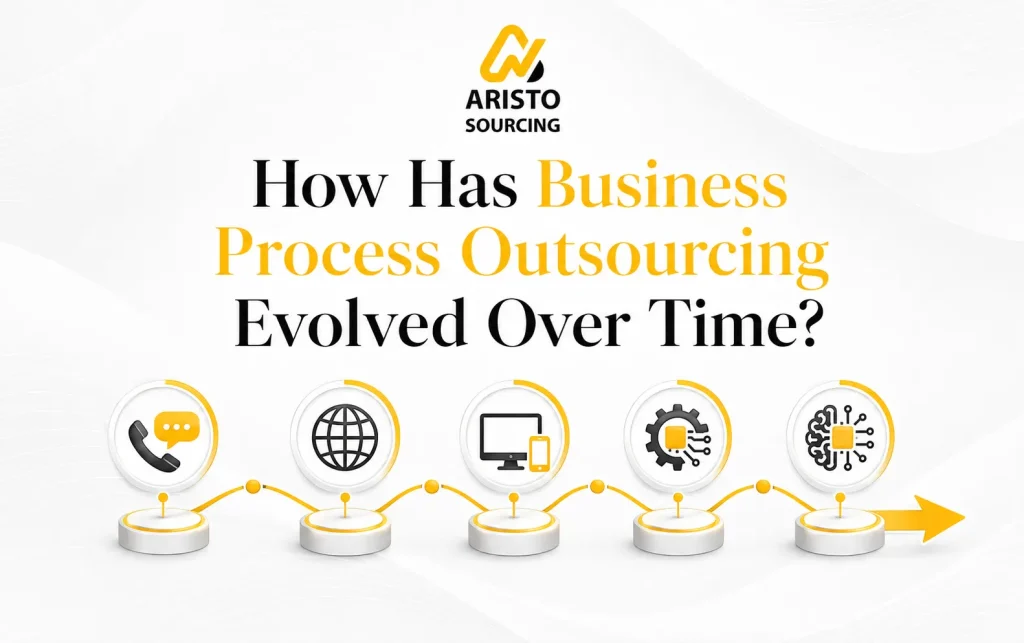
How Has Business Process Outsourcing Evolved Over Time?
BPO evolved in 6 distinct eras from the pre-BPO era (1950s–1970s) to the modern AI e
ra (2020s-Beyond), each defined by a technological breakthrough, a geographic shift, or a strategic reframe that changed what companies outsourced, where they outsourced it, and why.
The 6 eras in business process outsourcing evolved over time are listed below:
- Pre-BPO Era (1950s–1970s): Time-Sharing and Early Data Processing
- The 1980s: Formalization, the Coca-Cola Bottling Model, and the Eastman Kodak IT Outsourcing Milestone
- The 1990s: Telecommunications, the Internet, and IBM Coining the Term ‘BPO’
- The 2000s: From Cost-Cutting to Strategic Partnership
- The 2010s: Knowledge Process Outsourcing (KPO) and Higher-Value Work
- The 2020s and Beyond: Cloud, Remote Work, and AI-Driven BPO
1. Pre-BPO Era (1950s–1970s): Time-Sharing and Early Data Processing
The pre-BPO era covers the period before “business process outsourcing” existed as a named discipline, when companies externalized computing and back-office tasks without conceptualizing them as a unified strategy. During this era, mainframe and time-sharing arrangements with companies like IBM allowed organizations to access computing power without owning infrastructure.
Basic back-office tasks like data entry, payroll processing, and transcription were farmed out to specialized services. Manufacturing subcontracting remained the dominant template for externalization. EDS was founded in 1962, providing IT services to companies as their de facto IT department. Meanwhile, answering services and early contact-center precursors emerged in the 1940s–50s, laying the groundwork for the voice-BPO explosion that would come decades later. This era established that external providers could handle information-based work, not just physical production.
2. The 1980s: Formalization, the Coca-Cola Bottling Model, and the Eastman Kodak IT Outsourcing Milestone
The 1980s marked the decade when BPO became a formal corporate strategy, validated by landmark decisions that proved outsourcing could deliver both cost savings and operational excellence. The Coca-Cola franchising system stands as a classic early precedent to modern BPO structures. In 1927, The Coca-Cola Company established its foundational Asian bottling partnership in the Philippines by granting an exclusive franchise to San Miguel Brewery. This is often overlooked in Philippines-as-BPO-hub origin narratives, yet it demonstrates that the geographic logic of BPO, placing operations where labor and infrastructure are optimal, predates the digital era by decades.
In 1984, General Motors acquired EDS, signaling that IT services had become strategically valuable enough to merit corporate investment at the highest level. Then, in 1989, Eastman Kodak outsourced its IT operations, an inflection point that validated outsourcing as a mainstream corporate strategy. The philosophy of “do what you do best, outsource the rest” entered mainstream corporate thinking, and a wave of large corporations followed Kodak’s lead.
3. The 1990s: Telecommunications, the Internet, and IBM Coining the Term “BPO”
The 1990s were BPO’s globalization decade, enabled by the commercialization of the internet and falling telecommunications costs that made remote service delivery economically viable for the first time. IBM coined the term “BPO” while outsourcing data entry processes to Asia, giving the practice its modern nomenclature. Economic liberalization in India, the Philippines, and other Asian economies unlocked vast pools of English-proficient, technically skilled labor. General Electric and American Express set up captive offshore centers, proving that complex business functions could be executed thousands of miles from headquarters. Jack Welch at GE championed outsourcing as a strategic move, embedding it in the playbook of global corporations. This era established India and the Philippines as the primary offshore destinations—a geographic pattern that persists today.
4. The 2000s: From Cost-Cutting to Strategic Partnership
The 2000s reframed BPO from a cost-arbitrage vendor relationship to a strategic partnership. BPO companies reached business maturity and began offering higher-value services beyond back-office tasks. The scope expanded into HR, Finance & Accounting, and Legal services. Asia remained the dominant destination, but providers began offering services that required domain expertise, not just labor cost advantages. Lean and Six Sigma methodologies—borrowed from manufacturing—were adopted to improve process quality and efficiency. By the end of this era, BPO had shed its reputation as a purely transactional, low-margin industry and began positioning itself as a transformation partner.
5. The 2010s: Knowledge Process Outsourcing (KPO) and Higher-Value Work
The 2010s introduced Knowledge Process Outsourcing (KPO)—the outsourcing of specialized, knowledge-intensive work requiring domain expertise. Examples include financial research, data analytics, market research, engineering R&D support, healthcare analytics, and Legal Process Outsourcing (LPO). Programming, software development, and creative design joined the outsourceable stack. China and Vietnam joined India and the Philippines on the offshore map, offering higher-volume and specialized work. New categories emerged: social media moderation and data annotation became critical BPO functions as digital platforms scaled globally. This era proved that even high-skill, judgment-based work could be externalized effectively.
6. The 2020s and Beyond: Cloud, Remote Work, and AI-Driven BPO
The current era is defined by four converging forces. Cloud infrastructure is replacing the centralized call-center model, allowing distributed delivery. Remote work and work-from-home have become the dominant delivery format, accelerated by the COVID-19 pandemic. Robotic Process Automation (RPA) handles repetitive, rule-based tasks at scale. Artificial Intelligence and Generative AI are augmenting human BPO agents, enabling hyper-personalization that replaces one-size-fits-all services. Outcome-based pricing models are replacing FTE-based pricing, aligning vendor incentives with client results. BPO evolved geographically during this era as well: delivery is no longer tied to physical centers in India or the Philippines, but distributed across cloud-enabled workforces worldwide.
How Has BPO Evolved Geographically Around the World?
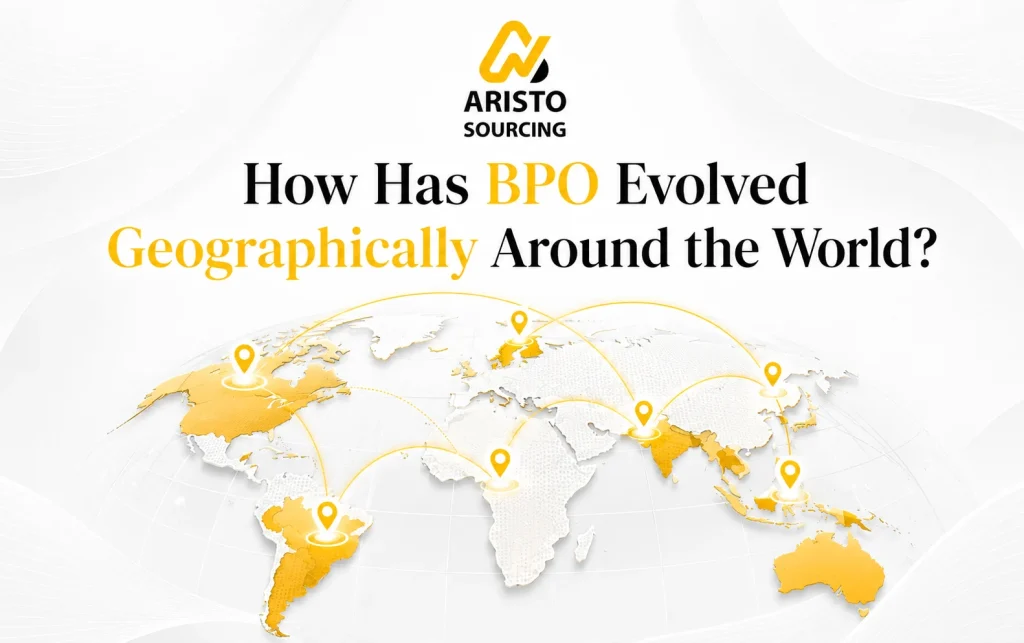
BPO has evolved geographically around the world by following a pattern of demand concentration in developed economies and supply expansion across emerging markets, with each region contributing a distinct specialization.
The major countries around the world where BPO evolution took place are mentioned below:
- United States and Western Europe: The primary outsourcers and driving demand source, generating the majority of global BPO spend. According to the official Mordor Intelligence Business Process Outsourcing (BPO) Market Report, North America officially accounted for exactly 43.28% of global BPO spending in 2025.
- India: The primary offshore destination from the 1990s onward, driven by English-proficient labor, a strong IT services ecosystem, and government support for the industry.
- Philippines: The primary voice-BPO destination, with the Coca-Cola 1921 bottling partnership as its often-forgotten first chapter. The country’s cultural affinity for Western customer service norms made it the global hub for call-center operations.
- China and Vietnam: Joined the offshore map in the 2010s for higher-volume manufacturing-related BPO and specialized technical work.
- Bangladesh: An emerging destination in the 2010s and 2020s, leveraging cost advantages and a growing English-speaking workforce.
- Pakistan: An emerging destination with a formal national BPO strategy spanning 2023–2027.
- Eastern Europe (Bulgaria, Romania) and Africa (Egypt, Madagascar): Nearshore and multilingual destinations serving European markets with timezone alignment and language diversity.
What Are the Driving Forces Behind the Evolution of BPO?
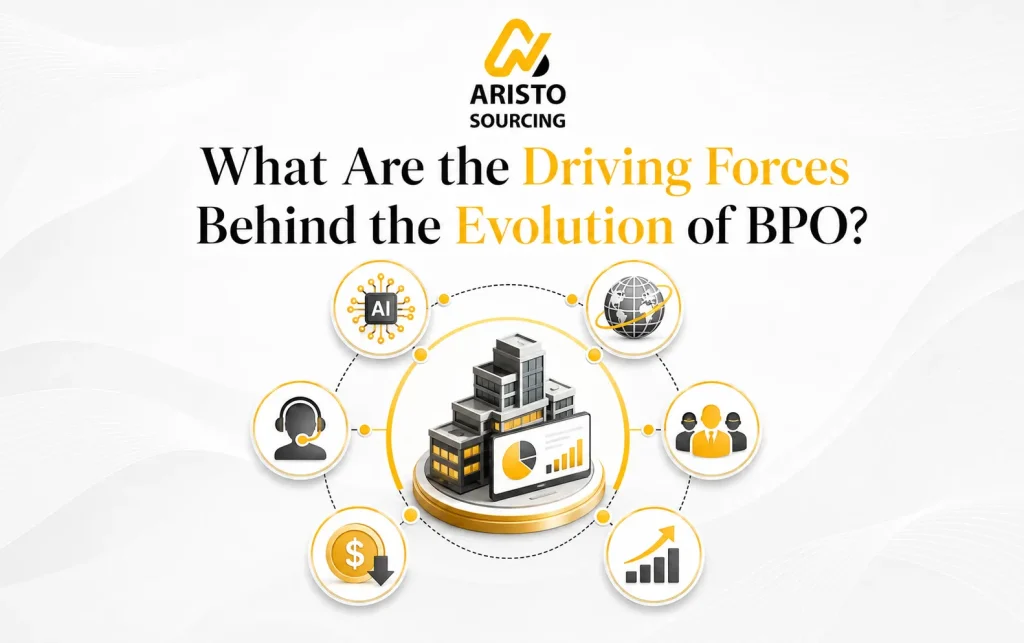
The driving forces behind the evolution of BPO involve four interconnected macro trends that transformed outsourcing from a niche practice into a global industry.
The driving forces behind the evolution of BPO are listed below:
- Cost Reduction and Labor Arbitrage: Cost reduction is the original and most persistent driver of BPO evolution. Companies report up to 80% savings when shifting work from the US and Western Europe to offshore destinations. Wage differentials between developed and developing economies form the foundational economics, while real estate and overhead reduction serve as secondary cost levers. Cost has never disappeared as a motive, even as strategic value has been added.
- The Telecommunications and Internet Revolution: ICT (Information and Communications Technologies) is the enabler that broke geographic shackles. Falling international telecom costs in the 1990s, the commercialization of the internet, and voice infrastructure (PBX, IVR, VoIP) made the contact-center BPO model possible. Without ICT, BPO would remain domestic or near-shore.
- Economic Liberalization in Asia: Asian economic liberalization is the geographic-supply driver. The 1990s liberalization in India opened the IT and BPO services market. The Philippines’ policy environment and English-language education infrastructure created a workforce ready for global service delivery. China and Vietnam’s gradual market opening in the 2000s and 2010s added volume and specialization. English proficiency and large labor pools turned policy reform into a BPO supply.
- AI, RPA, and the Digital Transformation Era: Digital transformation is the current driving force. RPA automates repetitive, rule-based tasks. AI and Machine Learning handle pattern recognition and judgment-light decisions. Generative AI compresses onboarding, training, and agent-support workflows. Cloud-based delivery decouples BPO operations from physical delivery centers. AI is reshaping the future of BPO from a labor-arbitrage industry into a hybrid human-machine industry.

What Is the Future of Business Process Outsourcing?
The future of BPO is being shaped by AI, cloud, and outcome-based pricing, which are compressing delivery timelines, expanding the scope of outsourceable work, and redefining the value proposition from cost savings to strategic transformation. The global BPO market is projected to grow at a CAGR of 7.2% to 10.05% through the early 2030s, with estimates ranging from $623 billion to over $900 billion by 2035, according to multiple research firms, including Technavio, Precedence Research, and Mordor Intelligence.
What Are the Global Impacts of Business Process Outsourcing?
The global impacts of business process outsourcing include economic cost arbitrage and cross-border investment, job shifts (creation in destination countries, displacement in origin nations), sectoral specialization, and structural reorganization of global value chains.
The global impacts on BPO are the creation of millions of jobs in destination countries (India and the Philippines alone employ millions in BPO roles), the reallocation of capital in source countries toward higher-value activities, the elevation of the services sector’s share of global GDP (a trend documented by Deloitte), and the transformation of the modern multinational operating model, where companies now maintain lean headquarters and distributed execution networks. Offshore BPO centers are accelerating technology adoption in developing economies, training workforces in cloud platforms, CRM systems, data analytics tools, and AI applications.
Where Is Artificial Intelligence Taking the BPO Industry Next?
Artificial intelligence is taking the BPO industry toward a hybrid human-machine model where AI handles routine interactions, RPA executes rule-based workflows, and human agents focus on complex problem-solving, emotional intelligence, and exception management. AI in BPO is evolving through phases such as automation of repetitive tasks, augmentation of agent capabilities with real-time guidance, and autonomous resolution of customer queries through Generative AI. Over the next decade, expect the global BPO market to shift from labor-based pricing to outcome-based models, with AI-driven personalization becoming the default service standard.
The history of business process outsourcing is a story of continuous expansion, from 18th-century factory subcontracting to 21st-century AI-driven global networks. The BPO origin lies not in a single moment but in the gradual recognition that specialized external providers can deliver superior outcomes for non-core functions. The era-by-era evolution, from the pre-BPO foundations of the 1950s through the AI-driven present, shows an industry that reinvents itself with every technological wave. The future direction points toward cloud-native, AI-augmented, outcome-priced partnerships that transcend geography and redefine what “outsourcing” means.