
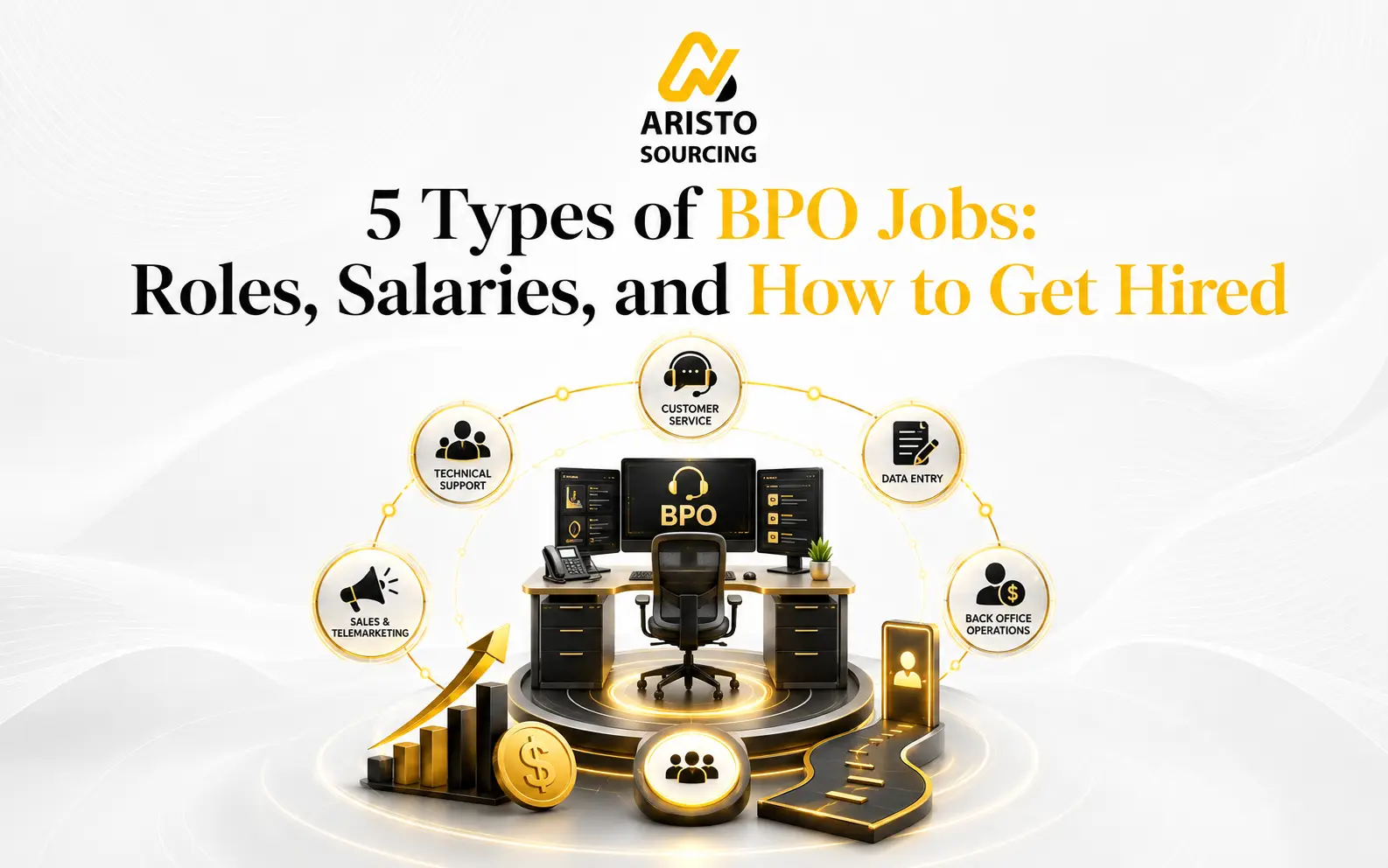
A BPO job refers to the outsourced handling of business functions by third-party providers. The 5 main types of BPO jobs are inbound, outbound, back office, KPO, and ITES. BPO jobs pay between $18,720 and $243,000 annually, depending on role complexity, geography, and experience level.
Getting hired requires communication clarity, CRM proficiency, and situational interview performance. As of 2026, AI is automating Tier-1 queries across the BPO industry. However, human-judgment roles in KPO and compliance remain secure, supported by job seekers who are actively upskilling with prompt-driven CRM tools.
What Are the 5 Main Types of BPO Jobs?
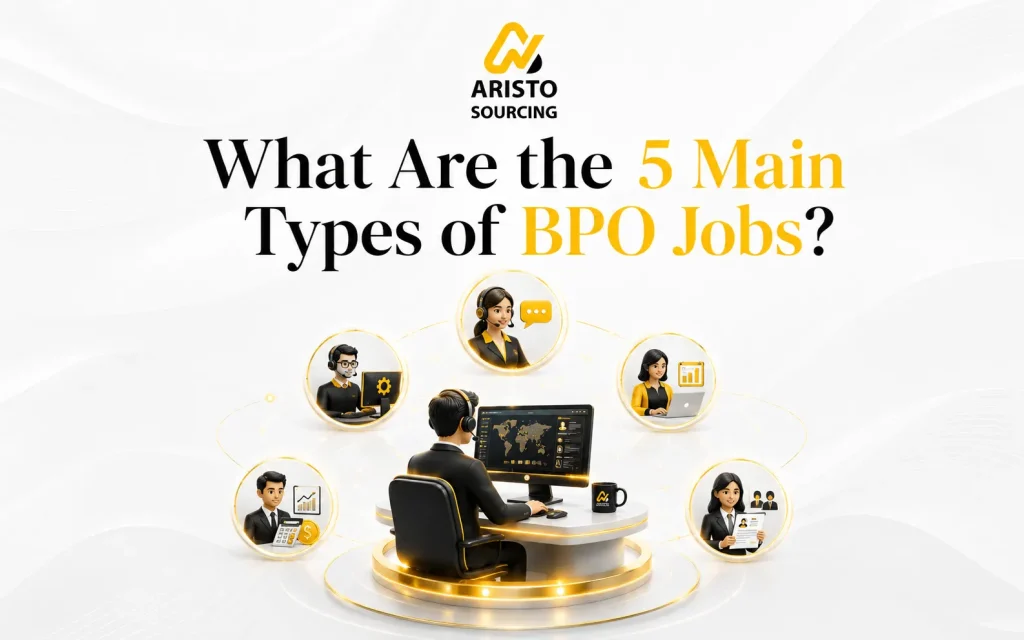
The five main types of BPO jobs are classified into two dimensions, including process-based (which includes inbound, outbound, and back office jobs) and operational-based (which includes KPO and ITES jobs). This classification matters for job seekers because it determines whether a role requires voice-based customer interaction, non-voice data processing, or specialized domain expertise.
The 5 types of BPO jobs are listed below.
1. Inbound BPO Jobs: Customer Service Representative, Care Specialist, and Technical Support
2. Outbound BPO Jobs: Telecaller, Sales Executive, and Lead Generation Specialist
3. Back Office BPO Jobs: Data Entry Clerk, Bookkeeper, and Payroll Executive
4. KPO Jobs: Market Research Analyst, Financial Analyst, and Legal Process Executive
5. ITES Jobs: Technical Support Engineer, Network Administrator, and IT Helpdesk Executive
1. Inbound BPO Jobs
Inbound BPO jobs refer to the reception and resolution of customer-initiated communications through voice, chat, or email channels. These jobs involve query resolution, complaint handling, order support, and technical troubleshooting.
Named roles include Customer Service Representative, Care Specialist, and Technical Support Agent. Typical industries that hire for inbound BPO jobs are telecommunications, e-commerce, healthcare, and financial services. The current US national average salary range for inbound BPO jobs is $32,000 to $48,000 per year.
2. Outbound BPO Jobs
Outbound BPO jobs refer to the initiation of customer contact for sales, surveys, or appointment setting on behalf of client organizations. These jobs involve cold calling, upselling, cross-selling, market research outreach, and appointment scheduling.
Named roles include Telecaller, Sales Executive, and Lead Generation Specialist. Typical industries that hire for outbound BPO jobs are insurance, real estate, retail, and SaaS. The current US national average salary range for outbound BPO jobs is $35,000 to $75,000 per year, with commission structures pushing top performers beyond base pay.
3. Back Office BPO Jobs
Back office BPO jobs refer to the internal administrative processing of data, financial records, and payroll operations without direct customer interaction. These jobs involve data entry, invoice processing, ledger maintenance, payroll calculation, and compliance documentation.
Named roles include Data Entry Clerk, Bookkeeper, and Payroll Executive. Typical industries that hire for back office BPO jobs are accounting firms, logistics, retail chains, and manufacturing. The current US national average salary range for back office BPO jobs is $34,000 to $58,000 per year.
4. KPO Jobs
KPO jobs refer to the outsourcing of knowledge-intensive processes requiring domain expertise in research, analytics, or legal interpretation. These jobs involve market trend analysis, financial modeling, investment research, legal document review, and regulatory compliance assessment.
Named roles include Market Research Analyst, Financial Analyst, and Legal Process Executive. Typical industries that hire for KPO jobs are consulting, investment banking, pharmaceutical research, and law firms. The current US national average salary range for KPO jobs is $55,000 to $115,000 per year.
5. ITES Jobs
ITES jobs refer to the outsourcing of information technology-enabled services encompassing infrastructure support, software troubleshooting, and network management. These jobs involve remote desktop support, server monitoring, software installation, network configuration, and cybersecurity incident logging.
Named roles include Technical Support Engineer, Network Administrator, and IT Helpdesk Executive. Typical industries that hire for ITES jobs are technology vendors, cloud service providers, enterprise software companies, and telecom operators. The current US national average salary range for ITES jobs is $48,000 to $92,000 per year.

How Much Do BPO Jobs Pay?
BPO jobs pay between $18,720 and $243,000 annually, depending on role tier, geographic labor market, years of experience, certification level, account complexity, and voice versus non-voice classification.
According to Payscale.com, US national average salaries for top BPO roles in 2026 include Customer Service Representative $37,000/yr, Call Center Representative $44,000/yr, Call Center Supervisor $56,341/yr, Customer Success Manager $72,000/yr, Bookkeeper $47,000/yr, and Compliance Consultant $112,931/yr.
According to Armasourcing.com, India BPO salary bands by career level in 2026 include entry-level ₹15,000–25,000/month ($400–$800/month at full-time equivalency), mid-level ₹35,000–50,000/month, and senior-level ₹60,000–120,000/month. According to official industry metrics from NASSCOM, the Indian IT-BPM sector is a global powerhouse generating over USD $250 billion in revenue and directly employing 5.4 million workers.
Bangladesh BPO, call center, and customer service outsourcing roles command $1,105–$3,177 annually.
According to Vamasters.com, Philippines BPO salaries average PHP 25,000–35,000/month ($440–$620 USD), with entry-level call center agents at PHP 15,000–25,000/month and senior supervisors at PHP 60,000–120,000/month.
The Philippines ranks #1 globally in the 2026 Ataraxis Global Outsourcing Talent Index based on English proficiency (90/100), cost competitiveness, and workforce capability.
Six-figure BPO tracks include Customer Success Manager, Compliance Consultant, Senior Operations Manager, and Finance Agent. These roles require 5+ years of experience, domain certifications, and complex account oversight.
Commission reshapes the math for outbound and sales roles. Base salaries for outbound Telecallers and Sales Executives start at $35,000/yr, but performance-linked commissions and bonuses frequently add 30–60% to total compensation, pushing top performers into $75,000+ territory.
Salary drivers in BPO are location (US metro markets pay 25–40% above national averages), years of experience (each year adds $1,500–$3,000 in voice roles and $3,000–$6,000 in KPO roles), certifications (ITIL, Six Sigma, PMP increase starting offers by 10–15%), account complexity (healthcare and finance accounts pay premium rates), and voice versus non-voice classification (non-voice technical roles command 15–25% higher salaries than voice-only roles).

How Do You Get Hired for a BPO Job?
To get hired for a BPO job, you need communication proficiency, active listening ability, CRM software competence, and situational judgment demonstrated through roleplay-based interviews and skills assessments.
Core skills employers screen for are verbal communication clarity (measured through accent neutralization and grammar tests), active listening (validated through mock call evaluations), and CRM proficiency in Salesforce, Zendesk, HubSpot, or Freshdesk. Technical Support and ITES roles require additional screening in remote desktop protocols, ticketing systems, and basic network troubleshooting.
Main application channels for BPO jobs are Indeed (largest volume listings), TTEC Careers (direct employer portal), ZipRecruiter (aggregated remote and hybrid roles), Naukri (India-focused BPO listings), and walk-in interviews (used by 40% of Philippines and India BPO employers for bulk hiring cycles).
Interview formats BPO companies use are roleplay simulations (live customer scenario acting), situational judgment tests (multiple-choice escalation scenarios), language assessments (spoken and written English scoring), and CRM navigation trials (timed ticket-resolution exercises). Top employers, including Concentrix, Teleperformance, and Accenture, use AI-proctored video interviews for initial screening in 2026.
To position retail, hospitality, or administrative experience on a BPO resume, map transferable competencies directly: retail cash handling maps to payment processing accuracy, hospitality complaint resolution maps to de-escalation and customer satisfaction metrics, and administrative scheduling maps to workforce management and calendar coordination. Quantify every claim with numeric outcomes (e.g., “resolved 45+ customer complaints per shift” or “maintained 98% schedule adherence”).
How to Write a BPO Job Description and Experience on Your Resume?
To write a BPO job description and experience on your resume, you list the role title, account or process name, KPIs achieved, and tools used, then replace generic “call center” language with process-specific terminology and quantified business outcomes.
Resume fields hiring managers look for include role title (e.g., “Customer Service Representative — Healthcare Accounts”), account or process name (e.g., “Aetna Member Services” or “Amazon Seller Support”), KPIs (e.g., “maintained 94% first-call resolution” or “achieved 4.8/5 customer satisfaction score”), and tools used (e.g., “Salesforce Case Management,” “Zendesk Chat,” “Genesys Cloud”).
To describe BPO work without reducing it to “call center,” use function-specific labels: inbound query resolution, outbound lead qualification, back-office ledger reconciliation, KPO financial variance analysis, or ITES L1 server troubleshooting. These terms signal domain depth and differentiate voice-only roles from technical or analytical BPO functions.
Action verbs and quantified metrics that strengthen a BPO resume include resolved (e.g., “resolved 120+ tickets daily”), reduced (e.g., “reduced average handle time by 18 seconds”), escalated (e.g., “escalated 3% of cases to Tier-2 with full documentation), maintained (e.g., “maintained 99.2% quality assurance score”), and processed (e.g., “processed 850+ payroll records per cycle”).
BPO resume writing in 2026 requires explicit mention of using AI tools (e.g., “used AI-assisted QA dashboards to flag sentiment anomalies in real time”) because 60% of Tier-1 queries are now AI-handled, and employers value candidates who can co-manage human-AI workflows.
Will AI Replace BPO Jobs?
No, AI will not fully replace BPO jobs because complex empathy, regulatory judgment, and escalation management require human cognition that natural language processing models cannot replicate at scale.
AI in the BPO industry augments Tier-1 chat support, data entry validation, and routine appointment scheduling. AI replaces repetitive, script-bound roles, including basic FAQ chatbots, simple order-status lookups, and standardized survey collection.
In 2026, AI-driven platforms handle up to 60% of customer queries, cutting response times by 40% and boosting first-contact resolution by 40%, according to AutomateIQ and Goodcall industry data.
Top BPO workers upskill with AI tools through prompt-driven CRM query generation, AI-assisted QA scorecard analysis, and automated sentiment-tagging workflows. These workers transition from pure resolution agents to AI workflow supervisors who audit machine outputs, handle exception cases, and train conversational models.
Human judgment roles in KPO, compliance, and senior account management remain safe because these functions require interpretive reasoning, ethical discretion, and client-specific nuance.
A Market Research Analyst evaluates ambiguous consumer sentiment signals; a Compliance Consultant applies regulatory frameworks to non-standard contract terms; a Senior Operations Manager balances SLA commitments against workforce attrition. These different types of BPO jobs operate above the automation ceiling because their salary range ($72,000–$243,000) correlates directly with irreplaceable cognitive complexity.
Getting hired in the AI-transformed BPO landscape requires candidates to demonstrate dual competence, including traditional customer communication skills plus AI-tool fluency. The salary range gap between AI-fluent and non-technical BPO workers widened by 12–18% in 2026, making AI upskilling a direct income driver.