
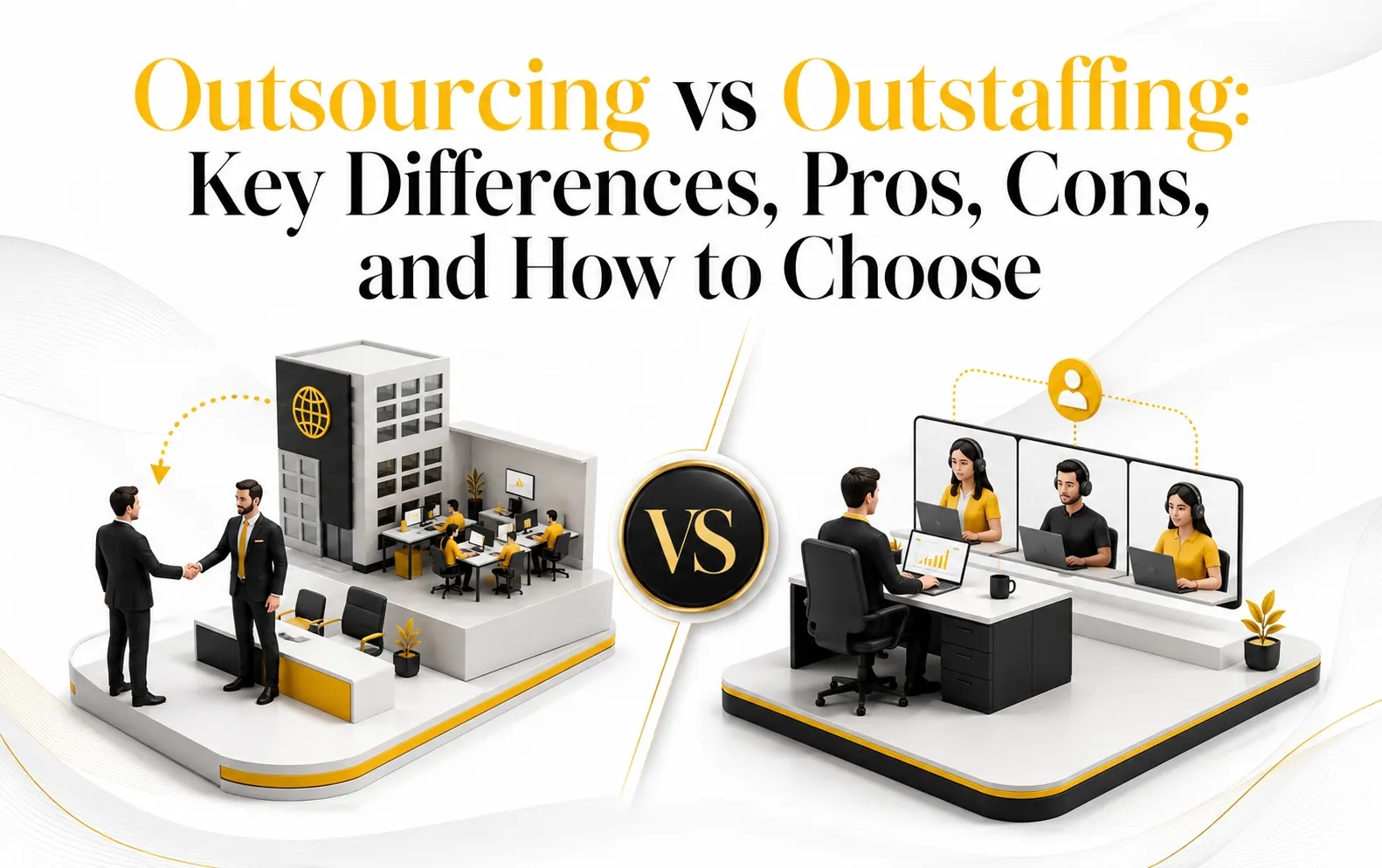
The main difference between outsourcing and outstaffing is who manages the work. Outsourcing delegates an entire project to an external vendor who manages delivery. Outstaffing hires remote specialists through a vendor while the client retains direct management. The choice between outsourcing vs outstaffing depends on whether a company needs full delegation or embedded technical talent.
From a cost perspective, outsourcing typically costs more upfront because it bundles project management and overhead into the price. Outstaffing carries a lower hourly or monthly rate but places the management burden on the client. To choose between them, consider your internal tech leadership, project scope, and how much control you need. If you have no in-house CTO and a fixed scope, outsource. If you have technical leadership and need specific skills for a long-term project, outstaff. The factors to consider include team structure, budget model, regulatory requirements, and project duration.

What Is Outsourcing?
Outsourcing is the delegation of a project or business process to an external vendor who provides the team, infrastructure, and final delivery. The vendor is accountable for the end result.
Outsourcing works through a structured vendor-client relationship. The client defines requirements, the vendor assembles a team, assigns a project manager, provisions infrastructure, and delivers the completed work. The vendor assumes accountability for timelines, quality, and outcomes.
Common types of outsourcing include IT outsourcing (ITO), Business Process Outsourcing (BPO), and Knowledge Process Outsourcing (KPO). Each can be structured as onshore, nearshore, or offshore, depending on geography and cost targets.
According to Statista, the global IT outsourcing market reached over $542 billion in 2024 and is projected to reach $634.18 billion by 2026, with growth expected to continue through 2030. Companies typically choose outsourcing when they lack in-house technical expertise, need a fixed deliverable, or want to reduce operational overhead.
What Are the Benefits of Outsourcing?
The benefits of outsourcing are listed below.
- Reduces operational overhead: The vendor manages recruitment, payroll, equipment, and workspace, eliminating internal administrative burden.
- Delivers predictable costs: Fixed-price or project-based contracts provide upfront cost certainty for budget planning.
- Accelerates time-to-market: Established vendor teams begin work immediately without lengthy internal hiring cycles.
- Provides access to specialized expertise: Vendors maintain diverse skill pools including niche technologies and industry-specific knowledge.
- Shifts accountability: The vendor bears full responsibility for deliverables, timelines, and quality standards.
There is no major disadvantage when outsourcing is executed with proper vendor selection, clear contracts, and defined acceptance criteria.
Are There Any Risks and Drawbacks of Outsourcing?
Yes, there are some risks and drawbacks of outsourcing, such as reduced direct control, communication latency, and potential misalignment with internal culture. These are not major disadvantages when mitigated proactively.
Unlike outstaffing, outsourcing places the vendor between the client and the development team. This distance can create information gaps. To avoid these risks, companies should define detailed requirements, establish regular reporting cadences, include penalty clauses for missed deadlines, and conduct thorough vendor due diligence.

What Is Outstaffing?
Outstaffing is the hiring of remote specialists through a vendor while the client manages day-to-day work directly. The specialists remain legally employed by the vendor.
Outstaffing works through a staffing augmentation model. The client identifies skill gaps, and the vendor provides pre-vetted candidates from its talent pool. The client interviews and selects specialists, and the vendor handles HR administration, payroll processing, tax compliance, equipment provisioning, and workspace arrangements. The client directs daily tasks, sprint planning, and technical decisions.
According to Grand View Research, the global staff augmentation services market was valued at $147.2 billion in 2023 and is projected to grow at a CAGR of 6.8% from 2024 to 2030. Companies typically choose outstaffing when they have in-house technical leadership, need to scale team capacity quickly, or require specific skills for an extended duration.
What Are the Benefits of Outstaffing?
The benefits of outstaffing are listed below.
- Retains direct management control: The client directs daily work, sprint planning, and technical architecture without intermediary layers.
- Integrates specialists into internal workflows: Outstaffed developers participate in stand-ups, code reviews, and team rituals as embedded members.
- Eliminates recruitment overhead: The vendor sources, vets, and onboards candidates, reducing time-to-productivity to 1–2 weeks.
- Provides cost transparency: Hourly or monthly rates per specialist contain no risky hidden project management margins.
- Enables rapid team scaling: Clients add or remove specialists based on project phase without employment liability.
What Are the Risks and Drawbacks of Outstaffing?
The risks and drawbacks of outstaffing are listed below.
- Requires internal management capacity: The client must provide project management, technical leadership, and quality assurance.
- Creates integration challenges: Remote specialists may face cultural or communication barriers with in-house teams.
- Increases client liability for outcomes: The client retains accountability for deliverables, timelines, and technical decisions.
- Demands active oversight: Without structured management, outstaffed talent can become disengaged or misaligned.

What Is the Difference Between Outsourcing and Outstaffing?
The difference between outsourcing and outstaffing includes differences in project management, pricing, control, communication, engagement type, equipment, and contract subject. The difference between outsourcing and outstaffing is presented below.
- Difference in Project Management: The difference in project management means the party responsible for planning, execution, and delivery. In outsourcing, the vendor manages the project through an assigned project manager who coordinates timelines, resources, and milestones. In outstaffing, the client manages the project directly, also in cost terms, since no vendor project management overhead is charged.
- Difference in Pricing: The difference in pricing refers to the cost structure and billing methodology. Outsourcing uses fixed-price or end-to-end project fees that include management overhead, project manager time, and vendor margin. Outstaffing uses hourly or monthly rates per specialist, with no project management overhead charged in the rate.
- Difference in Control: The difference in control means the degree of direct influence over work execution. Outsourcing limits client control to milestone reviews and acceptance testing. Outstaffing grants the client full control over daily tasks, technical decisions, and workflow integration.
- Difference in Communication: The difference in communication means the channel and frequency of interaction. Outsourcing routes communication through vendor account managers or project leads. Outstaffing enables direct communication between the client and individual specialists.
- Difference in Engagement Type: The difference in engagement type means the legal and operational relationship structure. Outsourcing is a project-based vendor contract focused on deliverables. Outstaffing is a personnel-based staffing agreement focused on individual contributor access.
- Difference in Equipment: The difference in equipment means the party responsible for provisioning hardware and software. The vendor provides all equipment and infrastructure in outsourcing. The vendor typically provides equipment in outstaffing, though arrangements vary by contract.
- Difference in Contract Subject: The difference in contract subject refers to the legal focus of the agreement. Outsourcing contracts specify deliverables, timelines, and acceptance criteria. Outstaffing contracts specify individual specialist roles, hourly rates, and engagement duration.
How Much Does Outsourcing Cost vs Outstaffing?
The cost difference of outsourcing vs outstaffing is usually in the pricing model and overhead allocation.
The cost difference of outsourcing vs outstaffing is presented below.
How outsourcing is priced:
- Fixed price or end-to-end project fee
- Includes management overhead, PM time, vendor margin
- Predictable total cost up front
How outstaffing is priced:
- Hourly or monthly rate per specialist
- No project management overhead is charged in the rate
- Client absorbs PM and management time as an internal cost
Choosing the right option is important because cost predictability must align with internal management capacity and project scope stability.
How Do I Choose Between Outsourcing and Outstaffing?
To choose between outsourcing and outstaffing, you have to answer some questions on in-house capability, scope definition, duration, control requirements, compliance needs, and funding constraints.
An individual or a business should ask the following questions before they choose between outsourcing and outstaffing:
- Do you have an in-house CTO or tech lead?
- Is the scope fixed or open-ended?
- What is the project duration, one-off or long-term?
- How much day-to-day control do you need?
- Is your industry regulated (HIPAA, SOC 2, ISO)?
- What is your funding stage and investor sensitivity?
The decision rules are to outsource when you have no in-house tech, a fixed scope, and want full delegation, and outstaff when you have in-house tech, need specific skills, and want control. Different IT engagement models serve different strategic objectives, and matching the model to organizational readiness determines project success.
How Do Outsourcing and Outstaffing Compare to Other IT Engagement Models?
How outsourcing and outstaffing differ from other IT engagement models is defined by the accountability structure and integration depth. Freelance hiring places a full legal and management burden on the client. Managed services shift ongoing operational responsibility to the vendor. Consulting engagements provide advisory input without execution. Outsourcing and outstaffing occupy the middle ground, as outsourcing provides execution with vendor accountability, while outstaffing provides execution with client accountability. Hiring through either model reduces legal complexity compared to direct employment.
How Long Does It Take to Hire Through Outsourcing vs Outstaffing?
The hiring timeline difference between outsourcing and outstaffing is presented below.
- Typical outsourcing timeline: Slower start, often 2 to 6 weeks, as the vendor needs time for scoping, team assembly, process alignment, and project onboarding before delivery can begin in earnest.
- Typical outstaffing timeline: 1 to 2 weeks for vetted specialists from the vendor bench, since the vendor can usually match available talent quickly and the client can move straight into interviews or onboarding.
Outstaffing is faster because of established processes, pre-vetted talent pools, and no scope negotiation. The vendor maintains active candidate pipelines and can present matched profiles within days. Outsourcing requires project discovery, proposal development, contract negotiation, and team formation.
Factors that affect both timelines include role specificity, seniority level, niche skill requirements, tax and vendor capacity. Hiring virtual assistance through outstaffing accelerates even further for administrative or support roles.
What Are the Tax Implications of Outstaffing Internationally?
The tax implications of outstaffing internationally include employer tax obligations, permanent establishment risk, and compliance with local labor laws. This is important because misclassification or non-compliance can trigger audits, penalties, and legal liability.
The employer of record (EOR) model mitigates these risks. The vendor acts as the legal employer in the specialist’s jurisdiction, handling payroll taxes, social contributions, and statutory benefits. The client pays the vendor a consolidated rate. For a long-term project, structuring the engagement through an EOR ensures continuous compliance without establishing a local entity.
Which Option Is More Effective for a Long-Term Project?
For long-term projects, outstaffing is generally more effective because it provides continuity, institutional knowledge accumulation, and cost efficiency over extended durations. The dedicated team model embeds specialists into the client’s culture and codebase, reducing onboarding friction for each new phase.
Outstaffing for long-term projects in 2026 requires structured onboarding, regular performance reviews, clear escalation paths, and integration into the client’s communication stack. The cost structure of outstaffing becomes more favorable as duration increases because monthly rates amortize across sustained engagement. Choosing outstaffing for long-term initiatives leverages the pros of embedded talent while mitigating the cons of management overhead through mature internal processes.