
Web development outsourcing refers to the practice of hiring external teams or agencies to build, maintain, or scale web products in place of in-house developers.
The types of web development outsourcing include frontend, backend, full-stack, web app, and e-commerce development. The web development outsourcing models define how and where you engage vendors structurally and geographically. The benefits of web development outsourcing include cost reduction, access to global talent, faster time-to-market, scalability, core business focus, and technology access.
According to Mordor Intelligence, the global IT outsourcing market was valued at USD 618.13 billion in 2025 and is projected to grow from USD 638.65 billion in 2026 to USD 752.08 billion by 2031, registering a CAGR of 3.32% during the forecast period. For companies building web products today, outsourcing is not a cost-cutting workaround; it is a deliberate strategic model.
What Is Web Development Outsourcing?
Web development outsourcing is the business practice of contracting external developers, agencies, or distributed teams to handle web development tasks that would otherwise be performed by internal employees.
Web development outsourcing works by transferring responsibility for part or all of a company’s web development lifecycle from scoping and design through coding, testing, and deployment, to a third-party provider. The client retains ownership of the product and its strategy; the vendor provides execution capacity.
Understanding the different website development outsourcing types is essential because each type serves distinct project requirements, budget thresholds, and business goals. Selecting the wrong type creates misaligned delivery, wasted spend, and timeline failure.
What Are The Types Of Web Development Outsourcing?
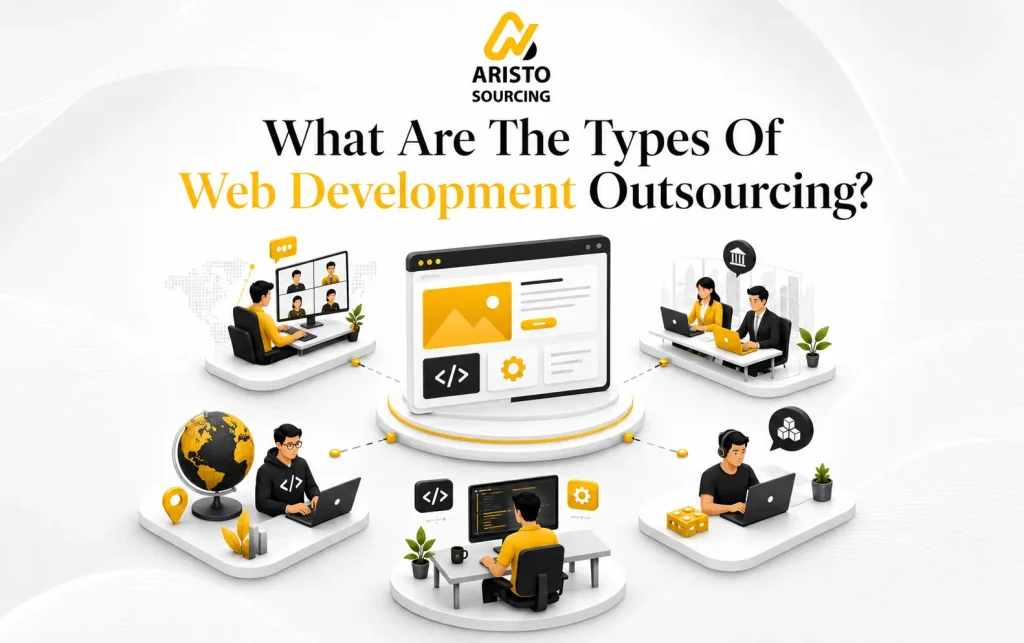
The types of web development outsourcing include frontend development outsourcing, backend development outsourcing, full-stack development outsourcing, web app development outsourcing, and eCommerce development outsourcing.
Web development outsourcing isn’t monolithic; it varies by which layer of the stack you outsource. Each type has distinct skill requirements, costs, and use cases. You can outsource a single layer or hand off the full stack.
The types of web development outsourcing are listed below.
1. Frontend Development Outsourcing
Frontend development outsourcing is the practice of hiring external developers to build the client-side layer of a web product, the visual interface users see and interact with directly.
Frontend development covers HTML, CSS, JavaScript frameworks, accessibility implementation, performance optimization, and cross-browser rendering. Common frontend technologies outsourced include React, Next.js, Vue.js, Svelte, Tailwind CSS, and TypeScript.
Common frontend deliverables include:
- Responsive design implementation from Figma or Sketch files
- Component library or design system
- Single-page application (SPA)
- Progressive web app (PWA)
- Browser-based dashboard or internal tool
2. Backend Development Outsourcing
Backend development outsourcing is the process of contracting external developers to build and maintain the server-side logic, APIs, databases, and infrastructure that power a web product.
Backend development covers API design and development, authentication systems, server-side business logic, database architecture, third-party integrations, and performance tuning. Common backend technologies outsourced include Node.js, Python (Django, FastAPI), Ruby on Rails, Go, PHP (Laravel), PostgreSQL, MongoDB, and Redis.
3. Full-Stack Development Outsourcing
Full-stack development outsourcing is the strategy of hiring external developers capable of building both the frontend and backend layers of a web product within a single engagement.
Full-stack outsourcing works by assigning developers or a small team, who own the entire product from UI to database, which reduces coordination overhead and vendor management complexity. It is the preferred model for early-stage companies and MVPs where speed and budget efficiency matter more than layer-specific specialization.
4. Web App Development Outsourcing
Web app development outsourcing is the approach of contracting external teams to build interactive, functionality-driven web applications rather than static or content-driven websites.
A web app is distinguished from a website by interaction depth: websites primarily deliver content, while web apps process user input, manage state, and execute business logic in real time. Web apps are suited for tools, platforms, dashboards, SaaS products, and internal business systems. Websites are suited for marketing, portfolios, and informational content.
5. E-Commerce Development Outsourcing
E-commerce development outsourcing is the practice of hiring external developers to build and maintain online retail platforms, including all commerce-specific functionality.
E-commerce development covers:
- Online store creation and customization
- Product catalog and inventory management
- Shopping cart and checkout flow
- Payment gateway integration
- Order management and fulfillment workflows
- Customer account systems
- Email automation and abandoned cart recovery
- Tax and shipping calculation
- Multi-currency and multi-language support
What Are The Models Of Web Development Outsourcing?
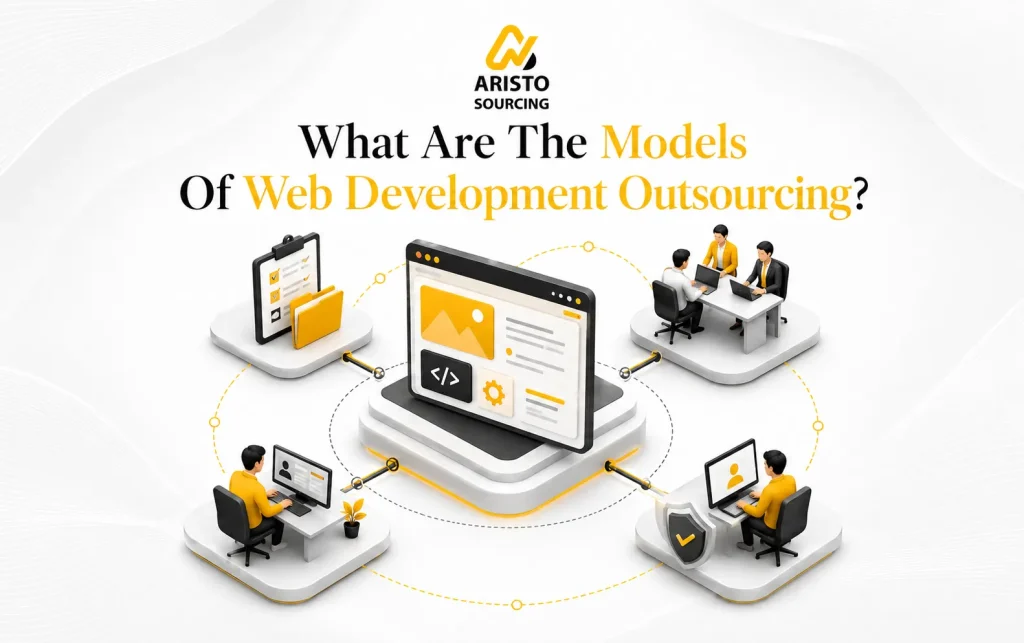
The models of web development outsourcing include project-based outsourcing, dedicated team outsourcing, staff augmentation, custom web application development, web integration services, onshore, nearshore, and offshore outsourcing.
Models define how you engage a vendor versus types, which define what you outsource.
Models are split into two dimensions: engagement structure (project-based, dedicated team, staff augmentation, custom application, integration services) and geographic location (onshore, nearshore, offshore). You combine one engagement model with one geographic model for any engagement.
The models of web development outsourcing are listed below.
1. Project-Based Web Development Outsourcing
Project-based web development outsourcing is a fixed-scope engagement model where a vendor delivers a defined web project for an agreed price and timeline.
Project-based outsourcing works as follows:
- Vendor estimates the total project budget upfront
- Detailed specification is approved by the client before work begins
- The vendor assigns the necessary developers under their own management
- Scope, timeline, and price are fixed throughout the engagement
- Vendor delivers a complete project at the end of the engagement
2. Dedicated Web Development Team Outsourcing
Dedicated web development team outsourcing is an engagement model where a client builds and retains a full-time external development team that works exclusively on their product.
The dedicated team model works by the vendor recruiting and vetting developers to match the client’s requirements, then embedding them as a long-term extension of the client’s internal team.
The client manages the team’s work directly while the vendor handles HR, payroll, legal, and infrastructure. It is best suited for long-running product development where deep codebase knowledge and team continuity create compounding value.
3. Staff Augmentation Development Outsourcing
Staff augmentation development outsourcing is an engagement model where external developers are placed within an existing in-house team on a contract basis to fill skill or capacity gaps.
Staff augmentation works by the vendor supplying individual developers or small groups, who operate under the client’s direct management and integrate into existing workflows, communication tools, and codebases.
It provides on-demand headcount without the cost or time of permanent hiring. It is best suited for teams with defined processes that need temporary capacity or specific technical skills not available internally.
4. Custom Web Application Development Outsourcing
Custom web application development outsourcing is an engagement model where an external team builds a fully bespoke web application designed around unique business requirements that off-the-shelf solutions cannot meet.
What makes it “custom” is defined by the following factors:
- Built from scratch for unique business requirements
- No off-the-shelf SaaS or platform fits the use case
- Encodes proprietary business logic and workflows
- Uses unique data models and integrations
- Often becomes a core competitive advantage for the business
5. Web Integration Services Outsourcing
Web integration services outsourcing is an engagement model where external specialists connect a web product to external systems, APIs, and platforms.
Integration services cover:
- Connecting web products to external systems and APIs
- Data synchronization between platforms
- Single Sign-On (SSO) and authentication integration
- Payment gateway connections
- CRM, ERP, and marketing automation integration
- Third-party API consumption
- Webhook setup and event-driven workflows
- Legacy system modernization through APIs
6. Onshore Web Development Outsourcing
Onshore web development outsourcing is the practice of hiring an external development agency or team located within the same country as the client.
Onshore means operating under the same legal jurisdiction, currency, language, and business culture. Time zones are identical or fully overlapping.
For US clients, this means working with US-based agencies and independent developers. Onshore rates are the highest of the three geographic models, offset by frictionless communication, no legal complexity, and identical working hours.
7. Nearshore Web Development Outsourcing
Nearshore web development outsourcing is the practice of hiring an external development team in a neighboring or geographically close country.
Nearshore means hiring in a country with a time zone overlap of typically 0–3 hours with the client, often shared cultural similarities, and strong language proficiency.
Nearshore rates are significantly lower than onshore, while collaboration remains easier than fully offshore engagements. For US companies, common nearshore markets include Mexico, Colombia, Brazil, and Argentina.
8. Offshore Web Development Outsourcing
Offshore web development outsourcing is the practice of hiring an external development team in a distant country with a significant time zone and cultural distance from the client.
Offshore means working with a team typically 8–12 hours apart, operating in a different cultural and business context. Offshore engagements offer the lowest cost option among the three geographic models.
Common offshore destinations include India, Ukraine, Poland, Vietnam, and the Philippines. The cost advantage is largest here; the coordination investment required is also the highest.
What Are The Benefits Of Web Development Outsourcing?
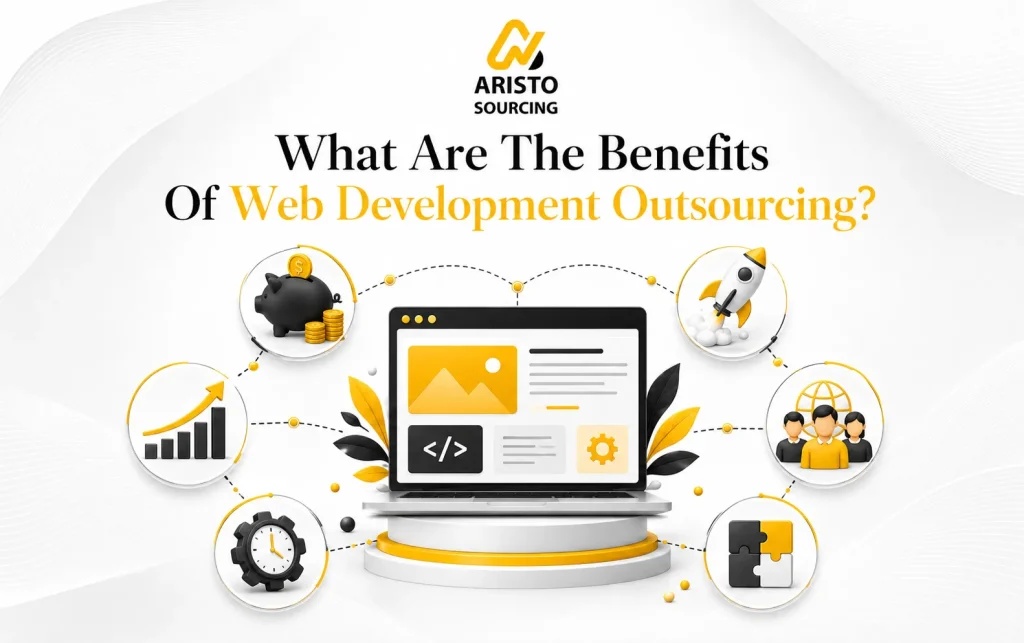
The benefits of web development outsourcing include cost reduction and resource optimization, access to global tech talent pools, accelerated project time-to-market, scalability and flexibility, focus on core business functions, and access to the latest technologies.
Web development outsourcing has become mainstream because the benefits are measurable. Different benefits matter to different business stages and project types. The 6 benefits that follow are the most commonly cited across SERP and industry research.
The benefits of web development outsourcing are listed below.
1. Cost Reduction and Resource Optimization
Cost reduction is the primary driver of outsourcing adoption. It is the #1 reason companies outsource web development: 59% of companies outsource primarily for cost savings (SPDLoad), and outsourcing can reduce development budgets by up to 70% compared to equivalent in-house teams (QArea).
Cost reduction remains the dominant motivator across industry surveys.
Outsourcing eliminates recruiting costs, employee benefits, office infrastructure, and idle-time risk. It converts fixed labor costs into variable, project-aligned expenditure, a structural efficiency unavailable through in-house hiring.
2. Access to Global Tech Talent Pools
Talent access is a structural driver of outsourcing adoption that extends beyond cost. The “global talent pool” means the full availability of specialized developers across 195 countries, engineers with niche framework expertise, domain experience, or platform certifications that are difficult or impossible to hire locally.
Regions such as Eastern Europe, South and Southeast Asia, and Latin America produce large volumes of high-quality engineering graduates who are available to global clients through outsourcing arrangements.
Local talent shortages in the US and Western Europe make global access a competitive necessity, not a luxury.
3. Accelerated Project Time-to-Market
Speed is a critical competitive variable for modern web projects: delayed product launches mean delayed revenue and ceded market position. The time-to-market gap that outsourcing closes is measurable.
Local hiring takes 4–8 weeks for engineering roles (Pinpoint HQ). Senior developer hiring averages 30–70 days (nCube). Outsourced engineers can be onboarded in 8–12 days (Ideaware) to 2–4 weeks. Pre-vetted vendor talent bypasses the interview-cycle delay entirely.
Concrete time-to-market benchmarks for outsourced web projects:
- MVP: 8–12 weeks with the right vendor
- Marketing site redesign: 8–16 weeks typical
- eCommerce platform: 3–6 months
- Custom web application: 6+ months
4. Scalability and Flexibility
Scalability matters for web projects because requirements change: feature scope grows, traffic demands increase, and product pivots require new technical capabilities. In-house teams are constrained by headcount, hiring timelines, and severance obligations.
Scalability through outsourcing works as follows:
- Add or remove developers based on the project pipeline
- Vendors tap their bench for rapid scaling
- New candidates from the provider’s pool can be onboarded in 2–4 weeks
- Scale down by ending individual engagements — no layoffs
- Convert top performers to full-time employees if needed
5. Focus on Core Business Functions
Focus is a strategic benefit because companies excel at what they concentrate on — distraction reduces excellence. The core competency principle is well-documented: 57% of companies outsource to focus on core competencies (SPDLoad), and outsourcing non-core functions frees internal resources for strategic work.
Web development is a non-core function for most non-technology companies. Outsourcing it allows internal teams to redirect bandwidth toward product strategy, customer relationships, revenue generation, and market expansion. The compounding effect of sustained focus typically outweighs any short-term vendor management overhead.
6. Access to Latest Technologies
Technology access matters for web outsourcing because specialized vendors actively maintain expertise in emerging tools, frameworks, and platforms that in-house teams rarely have the capacity to learn and implement at the same pace.
Technology categories accessible through outsourcing include:
- Modern JavaScript frameworks (React 18, Next.js 14, Astro)
- AI/ML-integrated web applications
- Headless CMS architectures
- Web3 and blockchain integrations
- Cloud-native infrastructure (AWS, GCP, Azure)
- DevOps automation and CI/CD pipelines
Vendors with specialist teams distribute technology investment across multiple clients, making high-end capability available at a fraction of the cost of building it internally.
How to Outsource Web Development?
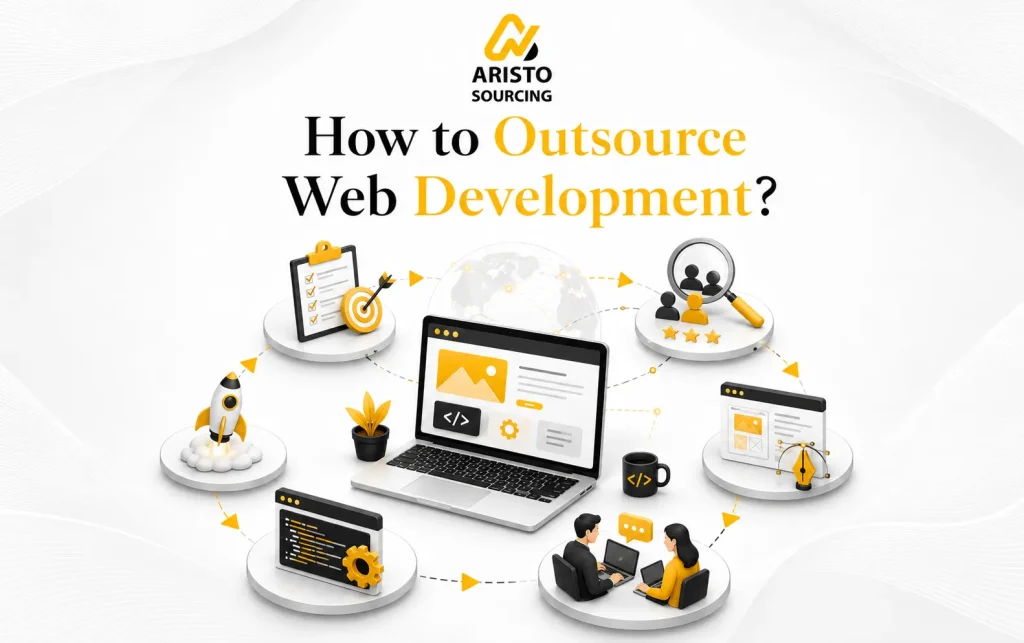
To outsource web development, follow steps such as defining your project scope and requirements, identifying features and functionalities needed, choosing the right tech stack, setting a realistic budget and timeline, vetting the agency’s portfolio and track record, running a structured kickoff meeting, and finding the right outsourcing company through directories and platforms.
Define Your Project Scope and Requirements
Project scope in web development outsourcing is the documented boundary of what an external vendor is responsible for delivering. This includes the features, integrations, platforms, and outcomes included in the engagement.
Scope definition determines outsourcing success because an ambiguous scope produces misaligned delivery, scope creep, and cost overruns.
A functional scope document includes business objectives, user personas, feature lists prioritized by the MoSCoW method, technical requirements, exclusions, and acceptance criteria.
SMART goals, Specific, Measurable, Achievable, Relevant, Time-bound, applied to scope items, prevent vague deliverables. Stakeholder workshops drawing input from marketing, sales, and customer service teams surface requirements that technical stakeholders miss.
A clear scope statement protects the engagement by creating a contract-grade reference for dispute resolution.
Recommended tools for scope definition include Confluence, Notion, Linear, and Google Docs.
What Features and Functionalities Do You Need?
Features are the distinct capabilities a web product offers its users, for example, user authentication, search, or a checkout system. Functionalities are the specific behaviors that those features perform, for example, OAuth login, full-text product search with filters, or multi-step checkout with address validation.
Distinguishing the two helps outsourcing teams write more precise requirements and allows vendors to scope more accurately. Feature lists that lack functional detail create estimation gaps and misdelivery risk.
What Tech Stack Does Your Project Require?
A tech stack in web development is the combination of programming languages, frameworks, databases, and infrastructure tools that together make a web product function.
A web tech stack consists of four layers:
- Frontend — what users see and interact with
- Backend — server-side logic and APIs
- Database — data storage and retrieval
- Infrastructure — hosting, servers, deployment
Defining the required stack before vendor selection ensures alignment on expertise, maintenance capability, and long-term support.
Set Your Budget and Timeline
Budget structure for outsourced web development is primarily driven by regional hourly rates and project complexity.
Average hourly rates by region:
- North America — $150–$200/hour
- Western Europe — $70–$190/hour
- Eastern Europe — $20–$60/hour
- Asia — $10–$40/hour
- Latin America — $25–$99/hour
Estimated project costs by website type:
- Personal blog or portfolio — $500–$3,000
- Corporate website — $3,000–$10,000
- E-commerce platform — $10,000–$50,000
- Custom web application — $20,000 or above
Check Portfolio and Track Record
Portfolio review is the strongest predictor of vendor delivery quality because it provides empirical evidence of past execution, not promises. Each portfolio item should be evaluated for complexity match to your project, technology alignment, design quality, and production status.
High-quality case studies include project objectives, technical challenges encountered, solutions implemented, measurable outcomes, and verifiable client details. References and testimonials should be independently confirmed by contacting listed clients directly rather than accepting published quotes at face value.
Conduct a Kick-Off Meeting
A project kickoff meeting in web development outsourcing is the structured first formal session between the client and vendor following contract and SOW signing, establishing a shared understanding of goals, processes, and responsibilities.
The kickoff meeting takes place:
- After the contract and SOW signing
- Before any development work begins
- Typically, within the first week of engagement
- 60–90 minutes is the standard duration
Agenda items include project objectives, team introductions, communication protocols, tooling setup, milestone review, and risk identification.
Where to Find Web Development Outsourcing Companies?
To find web development outsourcing companies, use trusted directories, talent platforms, and referral networks.
Top agency directories to use:
| Platform | Definition |
| Clutch.co | Clutch.co is a leading directory featuring verified client reviews, detailed company profiles, and industry‑specific rankings. |
| Aristo Sourcing | Aristo Sourcing is a global platform that connects businesses with vetted outsourcing talent across development, design, and marketing. |
| GoodFirms.co | GoodFirms.co is an agency comparison site that emphasizes portfolios, client feedback, and service quality metrics. |
| DesignRush | DesignRush is a curated directory that ranks agencies by category, expertise, and project type for easier selection. |
| Behance | Behance is a creative showcase platform where agencies and professionals present web design and development portfolios. |
| Awwwards | Awwwards is an international directory recognizing award‑winning web design agencies for innovation and visual excellence. |
| The Manifest | The Manifest is a business directory offering agency shortlists and rankings based on industry, budget, and client reviews. |
Combining directory research with direct referrals from trusted professional networks produces the most reliable vendor shortlists.
Reviewing candidates for documented types of web development outsourcing experience, the web development outsourcing models they support, and the benefits of web development outsourcing they have delivered for past clients accelerates final vendor selection.