
TL;DR: BPO meaning – BPO (Business Process Outsourcing) is when companies hire outside specialists to handle tasks like customer service, accounting, or IT so they can focus on core business goals. It helps reduce costs, boosts efficiency, and gives access to skilled workers around the world. BPO comes in three forms: onshore, nearshore, and offshore, and can include both customer-facing and back-office work.
BPO stands for business process outsourcing. Business process outsourcing is the practice of contracting a specific business function, such as customer service, accounting, payroll, or IT support, to a third-party provider rather than running it in-house. An example of BPO is a retailer contracting a call centre in the Philippines to answer its customer enquiries.
Businesses use BPO to cut operating costs, convert fixed staffing costs into variable ones, and reach specialist skills without building a department. The global BPO market was valued at USD 328.37 billion in 2025 and is projected to reach USD 695.77 billion by 2033, a compound annual growth rate of 9.9% from 2026 to 2033, according to Grand View Research. North America held the largest regional share at 37.4% in 2025.
BPO is classified two ways at once: by what is outsourced, which splits into back-office and front-office work, and by where the provider sits, which splits into onshore, nearshore, and offshore delivery. Both classifications are explained below, along with how a BPO engagement is set up, what it costs, and where the risks sit.

What Does BPO Mean?
Business process outsourcing (BPO) refers to outsourcing specific business processes or functions to a third-party provider.
An example of BPO is when a company contracts a call center service to manage customer inquiries, enabling the business to allocate resources more effectively. This can include various activities, such as customer service, data entry, accounting, human resources, and IT support.
The BPO industry aims to allow companies to focus on their core competencies and strategic activities while outsourcing non-core or support functions to specialized providers who can perform them more efficiently and cost-effectively. According to Shafiee and Emadi, BPO services are needed because businesses function in a highly competitive environment.
These companies, tiny to medium-sized businesses, need to evolve. Moreover, this was required to enhance the quality of products and services and boost customer satisfaction. BPO helps optimize processes and outsource non-core tasks to reduce the vertical integration rate and add value to the company (Shafiee and Emadi).
Entities benefitting from this outsourcing include private sector businesses, charities, non-profit organizations, educational and research institutions, and governments.
What Are the Types of Business Process Outsourcing?
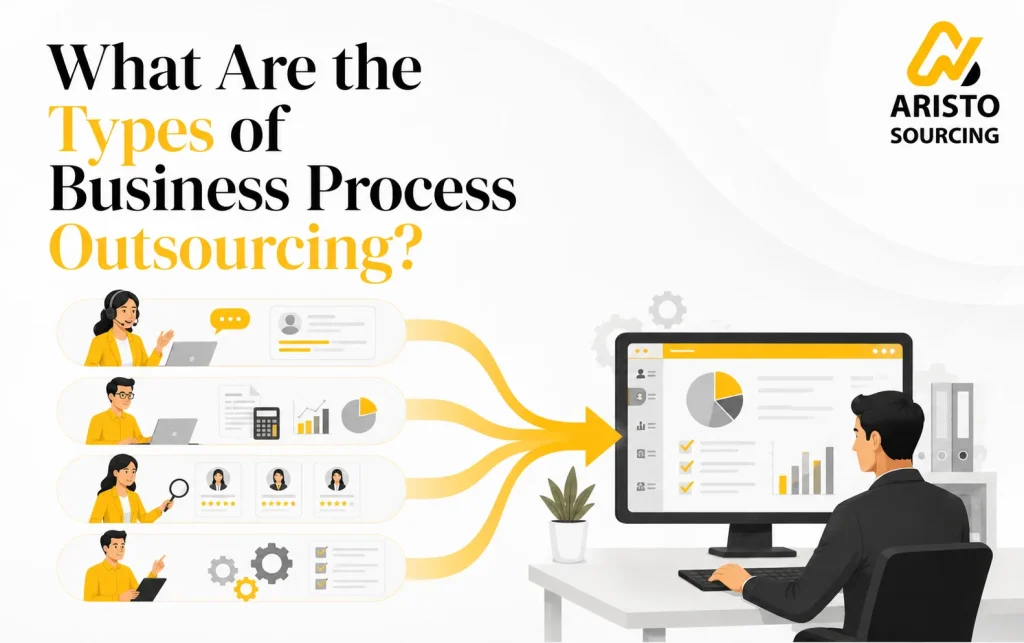
Business process outsourcing types are classified by the operational function and outsourcing location involved. BPO ranges from customer-facing support services to administrative processing, global offshore delivery models, regional outsourcing partnerships, and domestic service operations.
1. Back-Office Business Process Outsourcing
Back-office business process outsourcing (BPO) handles internal business operations through third-party service providers.
These operations usually include accounting, bookkeeping, payroll processing, data entry, database management, human resources administration, IT support, procurement, supply chain coordination, and inventory management.
Companies outsource back-office functions because the work is repetitive, process-driven, and easier to standardize through automation systems and service-level agreements.
According to Deloitte outsourcing research, cost reduction remains one of the biggest reasons businesses adopt back-office BPO models. While back-office outsourcing focuses on internal operations, customer communication, sales, and support activities are typically managed through front-office BPO services.
2. Front-Office Business Process Outsourcing
Front-office business process outsourcing (BPO) manages customer-facing business operations through third-party service providers.
These services commonly include customer support, inbound and outbound call centers, technical support, helpdesk services, telemarketing, sales assistance, marketing support, reception handling, and appointment scheduling.
Unlike back-office BPO, front-office outsourcing directly impacts customer satisfaction, brand reputation, retention rates, and service quality. This requires stronger communication skills, language fluency, and cultural alignment.
Many businesses choose nearshore or onshore outsourcing models to improve customer interaction accuracy and service consistency, while expertise-driven operations are increasingly outsourced through knowledge process outsourcing (KPO) services.
3. Knowledge Process Outsourcing (KPO)
Knowledge Process Outsourcing (KPO) transfers specialized business functions to third-party professionals with advanced analytical, technical, or industry expertise. These operations focus on high-value work that requires subject-matter knowledge, research capability, and strategic decision-making.
Unlike standard BPO models, Knowledge Process Outsourcing manages complex analytical operations instead of repetitive process-driven tasks. Many Business Process Outsourcing providers now offer KPO services through teams with advanced academic qualifications, certifications, and domain-specific expertise.
Knowledge Process Outsourcing providers commonly employ analysts, engineers, researchers, healthcare specialists, and financial experts. Common KPO functions include financial analysis, equity research, market research, healthcare analytics, business intelligence, engineering support, and research operations. According to McKinsey & Company, rising demand for data-driven decision-making continues to increase outsourcing adoption across regulated industries where legal process outsourcing (LPO) services also play an important operational role.
4. Legal Process Outsourcing (LPO)
Legal Process Outsourcing (LPO) manages legal and compliance-related operations through specialized third-party providers. Common services include legal research, contract drafting, document review, litigation support, eDiscovery, compliance management, and intellectual property documentation.
Legal Process Outsourcing requires strict confidentiality controls because legal records, contracts, and regulatory documents contain sensitive business information. Law firms, insurance companies, and corporate legal departments increasingly integrate these services into broader Business Process Outsourcing strategies to reduce administrative costs and improve workflow efficiency.
According to American Bar Association legal industry research, outsourcing adoption continues to increase as organizations prioritize compliance efficiency, scalable legal support operations, and specialized analytical services commonly managed through research process outsourcing (RPO) models.
5. Research Process Outsourcing (RPO)
Research Process Outsourcing (RPO) transfers research-driven business functions to specialized third-party providers that manage data collection, analysis, and industry intelligence operations. Common RPO services include market research, competitive intelligence, pharmaceutical research support, financial analysis, investment research, academic studies, and policy research.
In many outsourcing frameworks, Research Process Outsourcing is considered a subset of Knowledge Process Outsourcing (KPO) because both require analytical expertise, research capability, and domain-specific knowledge. Companies operating through large-scale Business Process Outsourcing models often separate RPO services to support research-focused operational structures and specialized industry applications.
Research Process Outsourcing should not be confused with Recruitment Process Outsourcing, which uses the same RPO abbreviation but focuses on hiring, recruitment management, and talent acquisition services.
How Does Business Process Outsourcing Work?
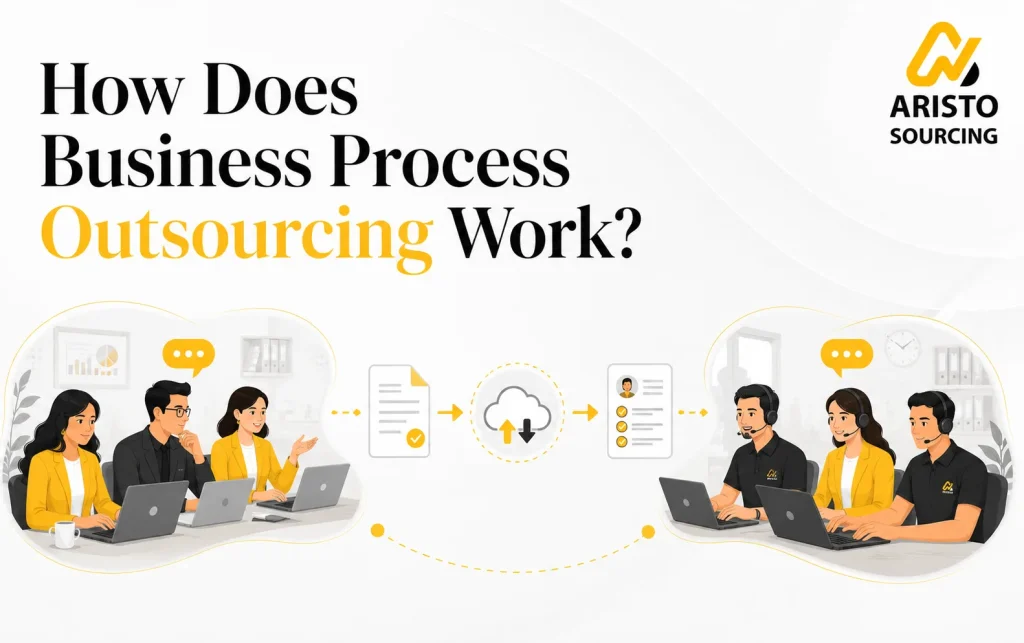
Business process outsourcing follows a structured operational lifecycle that helps companies transfer business functions to external providers. The process usually includes identifying outsourcing candidates, selecting vendors through RFPs, managing contracts and SLAs, and evaluating long-term vendor performance.
Identifying Which Processes to Outsource
Companies identify outsourcing candidates by evaluating operational complexity, scalability, process standardization, and cost efficiency opportunities. Business functions with repetitive workflows, measurable outputs, and high transaction volume are commonly outsourced because they are easier to document, automate, and manage through Business Process Outsourcing operational frameworks.
Organizations also prioritize processes that do not directly affect competitive differentiation or require deep institutional knowledge. Common outsourcing candidates include payroll processing, customer support, data entry, IT helpdesk operations, and administrative services.
Businesses with clearly documented workflows typically move to vendor selection through formal request for proposal (RFP) frameworks.
Request for Proposal (RFP) in a BPO Engagement
A request for proposal (RFP) in a BPO engagement is a structured document used to evaluate outsourcing vendors based on operational, technical, financial, and compliance requirements. An RFP standardizes vendor comparisons and helps companies define project scope, service expectations, pricing models, security requirements, SLA benchmarks, geographic delivery preferences, and contract terms before vendor selection.
Business Process Outsourcing engagements often use detailed RFP frameworks to reduce procurement risk and improve operational transparency during vendor evaluation. Most BPO RFPs include service volume estimates, integration requirements, compliance obligations, and vendor qualification criteria. Finalized vendor selection typically leads to contract management and SLA development stages.
BPO Contract Management and Service Level Agreements (SLAs)
BPO contract management defines the legal, operational, financial, and performance responsibilities between a company and its outsourcing provider. Service level agreements (SLAs) establish measurable performance standards such as turnaround time, error rate, first call resolution, uptime, customer satisfaction score, and SLA compliance percentage.
Most outsourcing contracts also include pricing terms, confidentiality obligations, change management procedures, intellectual property clauses, breach penalties, termination rights, and dispute resolution mechanisms to reduce operational and legal risk across Business Process Outsourcing engagements.
Companies use service credits, escalation procedures, and financial penalties to enforce SLA compliance, while ongoing operational oversight depends heavily on continuous vendor performance evaluation systems.
Evaluating BPO Vendor Performance
Companies evaluate BPO vendor performance through continuous operational monitoring, compliance reviews, reporting systems, and service quality assessments after outsourcing implementation. Common evaluation methods include monthly review meetings, real-time performance dashboards, third-party audits, customer satisfaction analysis, mystery shopping programs, and employee feedback surveys for client-facing operations.
Ongoing SLA tracking is also common across Business Process Outsourcing agreements to measure operational consistency and identify outsourcing risks before performance issues escalate. Businesses commonly monitor metrics such as accuracy rate, response time, customer satisfaction score, average handle time, and operational uptime.
Organizations typically trigger contract renegotiation, service expansion, or vendor replacement decisions when long-term performance data shows declining operational efficiency or SLA compliance failures.
What Are the Benefits of Business Process Outsourcing?
Business process outsourcing creates measurable operational advantages when companies transfer standardized business functions to experienced service providers. According to Deloitte outsourcing research, businesses primarily adopt BPO models to improve cost efficiency, operational flexibility, workforce scalability, and service continuity.
1. Reduced Operational and Labor Costs
Reduced operational and labor costs remain one of the primary reasons companies adopt business process outsourcing models. Businesses reduce spending related to salaries, employee benefits, recruitment, office infrastructure, software licensing, and internal management by outsourcing repetitive operational functions.
Offshore outsourcing also provides access to lower-cost labor markets without reducing operational capacity. According to Deloitte outsourcing research, many organizations reduce operating expenses by 15% to 30% through outsourcing strategies, especially when transitioning toward more flexible fixed-to-variable cost conversion structures.
2. Fixed-to-Variable Cost Conversion
Fixed-to-variable cost conversion replaces fixed operational expenses with usage-based outsourcing pricing structures. Instead of maintaining full-time employees during low-demand periods, companies pay BPO providers per transaction, hourly workload, or full-time equivalent (FTE) arrangement.
Many pricing models help companies stabilize operational spending by aligning outsourcing costs directly with workload volume and service demand across Business Process Outsourcing operations. This structure reduces financial exposure during slower business cycles and improves budgeting predictability.
Businesses managing fluctuating operational demand also prioritize access to specialized expertise through experienced outsourcing providers.
3. Access to Specialized Expertise
Access to specialized expertise gives companies direct access to trained professionals without building expensive in-house operational departments. BPO providers commonly maintain teams with expertise in healthcare billing, financial compliance, multilingual customer support, ERP systems, analytics platforms, and regulatory frameworks such as HIPAA, GDPR, and PCI-DSS.
Providers operating within large-scale Business Process Outsourcing environments often invest heavily in compliance training, enterprise technology systems, certifications, and process specialization that would require significant internal investment for most companies. This outsourcing structure helps businesses access experienced operational talent faster and at lower cost. Companies operating across international markets also depend on these outsourcing capabilities to support scalable 24/7 global operations.
4. Business Scalability and 24/7 Global Operations
Business scalability and 24/7 global operations help companies expand operational capacity across multiple regions and time zones without major infrastructure investments. Global BPO providers support round-the-clock customer service, multilingual communication, technical support operations, and rapid workforce scaling during high-demand periods.
Global delivery centers are a core part of many Business Process Outsourcing operations because they maintain continuous operational coverage across international markets and customer support channels. This structure improves response speed and supports uninterrupted business operations.
Industries including eCommerce, healthcare, banking, travel, and SaaS frequently rely on outsourcing providers to maintain faster customer response times and scalable international business growth without large permanent staffing expansions.
What Are the Risks and Challenges of Business Process Outsourcing?
Business process outsourcing delivers operational and financial benefits only when outsourcing risks are properly managed. According to industry outsourcing research, data security, vendor dependence, hidden costs, and regulatory compliance failures remain the most common causes of unsuccessful BPO engagements.
Data Security Risks of Sharing Information with a BPO Vendor
Data security risks increase when companies share customer, financial, healthcare, or operational data with third-party outsourcing providers. Sensitive information often moves across multiple systems, countries, cloud platforms, and vendor networks, increasing exposure to data breaches, insider threats, unauthorized access, and compliance failures involving GDPR, HIPAA, and PCI-DSS regulations.
Businesses operating through global Business Process Outsourcing networks also face fourth-party risk when outsourcing vendors rely on subcontractors, while companies managing long-term outsourcing relationships often encounter operational dependence on a single BPO provider.
Signs of Over-Dependence on a Single BPO Provider
Signs of over-dependence on a single BPO provider appear when critical operations rely too heavily on one outsourcing partner. Businesses may face service disruption, pricing pressure during contract renewal, declining operational quality, and loss of institutional knowledge if the vendor relationship fails.
Over-dependence also weakens negotiation leverage and reduces operational flexibility during scaling or transition periods. Long-term Business Process Outsourcing contracts can also create operational reliance when hidden contract costs are not identified early.
Hidden and Unforeseen Costs in BPO Contracts
Hidden and unforeseen costs in BPO contracts often increase total outsourcing expenses beyond initial budget estimates. Common hidden costs include scope expansion fees, technology integration expenses, vendor onboarding costs, transition support charges, currency fluctuation exposure, and internal management overhead required to supervise outsourcing operations.
Offshore Business Process Outsourcing agreements may also include termination penalties and change-order fees for operational modifications outside the original contract scope, while global outsourcing operations frequently create additional regulatory and compliance management challenges.
Regulatory and Compliance Issues in Offshore BPO
Regulatory and compliance issues in offshore BPO become more complex when companies transfer data, operations, and customer services across multiple legal jurisdictions. Offshore outsourcing agreements must comply with data privacy laws such as GDPR, CCPA, HIPAA, PCI-DSS, and country-specific data localization requirements in regions including China, Russia, and India. Cross-border Business Process Outsourcing operations also face data transfer restrictions, employment law differences, and vendor compliance monitoring obligations. These regulatory risks often require stronger governance frameworks, legal oversight, and continuous operational auditing throughout the outsourcing relationship.
BPO vs. Outsourcing
BPO (Business Process Outsourcing) is a specific type of outsourcing where a company contracts third-party service providers to handle entire business functions, such as customer support or accounting.
On the other hand, outsourcing is a broader term that refers to contracting any business process, task, or service to external vendors, which may include individual tasks or entire projects. More than just the definition of outsourcing being different, BPO focuses on long-term partnerships for specific business functions.
Outsourcing can encompass a broader range of tasks, from short-term projects to specialized services.

Two Core Aspects of BPO Depend on the Type of BPO Services Offered
BPO services can be done onshore, when the service provider or BPO company is located in the same country as the business outsourcing the work, and offshoring, when the service provider is in a different country, usually where labor costs are lower, or nearshoring, when the service provider is in a nearby country.
Also, BPO outsourcing can offer various benefits to companies that outsource their business processes, such as cost savings, improved efficiency and productivity, access to specialized expertise and technologies, and the ability to focus on core business activities.
Moreover, in addition to the location, BPO can also be centered around the type of service offered, such as back office BPO or front office BPO.
- Back office BPO focuses on non-customer-facing business processes such as finance and accounting, human resources, and IT support.
- Front office BPO focuses on customer-facing activities such as customer service, sales, and marketing.
Front-office BPO providers typically handle customer communication across all channels rather than a single one. That includes inbound and outbound phone, email support queues, live chat, and social media message management. The operational term for this is omnichannel customer service: a single provider coordinating responses across every channel a customer uses to reach the business. BPO providers managing these functions also track channel-specific KPIs, including CSAT (customer satisfaction score), first contact resolution rate, and first reply time, and report against them through the service level agreement.
However, it is vital for companies to carefully evaluate the potential risks and benefits of BPO before making a decision and choosing a reputable and reliable service provider. The BPO’s meaning is broader, as you will see below.

The Goal of BPO
BPO is a well-known business practice. Besides yielding business-added value, BPO aims to enhance the business’s operational efficiency, cut costs, and improve its flexibility by allowing it to outsource specific processes to a specialized virtual assistant who can perform the tasks more efficiently and effectively (Shafiee and Emadi).
Much of this relates to subcontracting services to a third party, which strategically helps the company to manage its resources (i.e., time, money, and labor) better.
BPO is generally performed off-site, often in a different geographic location, and can range from short-term projects to long-term outsourcing arrangements. BPO or business process outsourcing services have positive and negative aspects.
As such, BPO is defined as “the management of [a] specific business process [. . .] by a third party, together with the IT that supports the process” (Halvey and Melby 1), while a business process is defined as a “set of logically related tasks performed to achieve a defined business outcome” (Davenport and Short 12).

Offshore BPO
Offshore BPO is a growing industry, with companies looking to outsource their business processes to countries with lower living costs. While this may seem like a bad idea, it can benefit your business. The government may have a lower standard of living and less access to technology than you’re used to.
The dominant offshore BPO destinations each have a different profile. India leads in IT services, software development, and back-office financial processing, with a large graduate talent pool and established provider infrastructure. The Philippines is the most common destination for English-language customer service and call center operations, due to cultural affinity with Western markets and strong spoken English proficiency. Eastern Europe, particularly Poland, Romania, and Ukraine, attracts technical development outsourcing and finance functions from European businesses that want offshore cost savings with a smaller time zone gap. South Africa has grown as an offshore destination for English-language customer support serving the UK and Australian markets, offering comparable language quality to the Philippines with a favorable time zone overlap for European businesses.
However, the quality of work will still be high because they value education more than we do in America (and other developed countries). While outsourcing can save your company money on labor costs by using skilled workers who are willing to work for less money than their counterparts in America or Europe would charge for similar services, you’ll also find yourself saving time by not having as many employees working on specific tasks within your organization.
Onshore BPO
Business process outsourcing (BPO) is a business model that allows companies to outsource their non-core activities. It also refers to an outsourcing service enabling companies to focus on their core business by transferring non-core processes and functions to third-party providers. Moreover, with onshore BPO, also referred to as domestic outsourcing, a company would outsource services to a third party in the same country.
By outsourcing their non-core activities, companies can reduce costs and increase productivity while maintaining high-quality standards. “business process” refers to any function performed in an organization that adds value or produces something beneficial for customers or other stakeholders—for example, customer service, accounting, human resources management, etc.
Nearshore BPO
Nearshore BPO is an outsourcing model where the service provider is located in a neighboring country.
It’s often used as a cost-effective way to outsource business processes, especially for small teams that need help with simple tasks like data entry or customer service.
In Practice
To make these distinctions concrete: a Toronto-based electronics retailer contracting its accounting function to a Canadian firm is using onshore BPO, paying a premium for proximity and cultural alignment. A US cosmetics brand routing customer service to a provider in Mexico is using nearshore BPO, balancing cost savings against the time zone compatibility that keeps service hours aligned. A UK fashion retailer running its customer support through a Philippines-based call center is using offshore BPO, capturing significant labor cost savings at the cost of a larger time zone gap to manage. Many mid-sized businesses use all three simultaneously: IT support offshore, logistics in a neighboring country, and marketing retained domestically.
How Do You Choose the Right Business Process Outsourcing Provider?
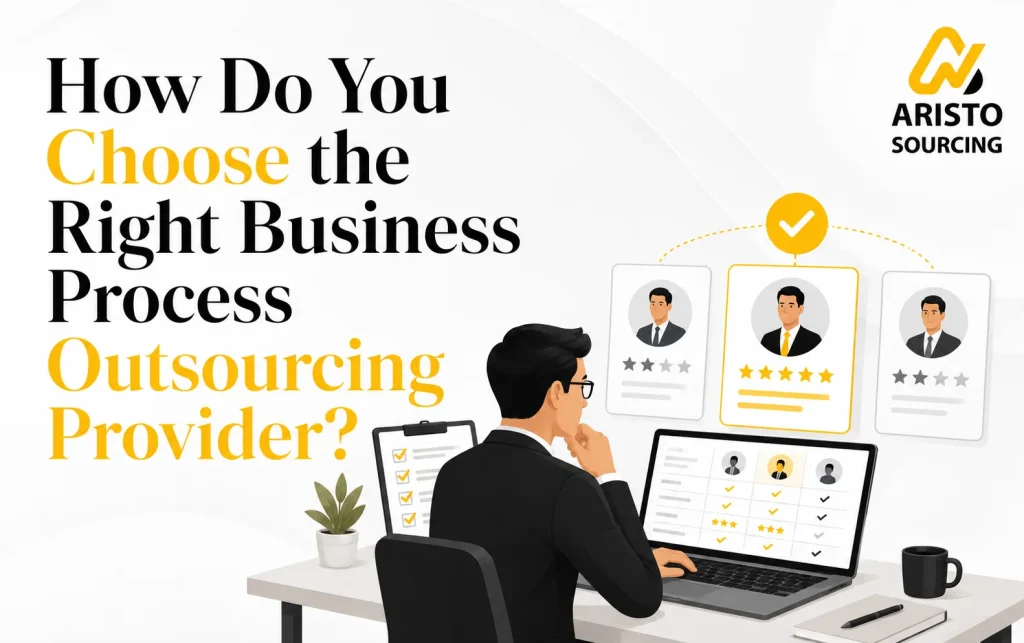
Choosing a business process outsourcing provider requires structured vendor evaluation across security, pricing, performance metrics, operational capability, and delivery models. Companies commonly assess providers through RFP frameworks, KPI analysis, compliance reviews, pricing transparency, and operational due diligence.
BPO Request for Proposal
BPO request for proposal (RFP) documents help companies compare outsourcing vendors using standardized operational, technical, and financial requirements. Most BPO RFPs include project scope, service volumes, language requirements, security standards, SLA expectations, pricing structure, integration requirements, and vendor qualification criteria. Businesses also request references, case studies, and compliance documentation before vendor selection. Well-structured RFP frameworks improve procurement transparency and support measurable vendor evaluation through defined performance KPIs across Business Process Outsourcing engagements.
KPIs for Evaluating BPO Vendor Performance
KPIs for evaluating BPO vendor performance measure operational accuracy, service quality, customer satisfaction, and financial efficiency across outsourcing engagements. Common operational KPIs include turnaround time, error rate, first call resolution, average handle time, throughput volume, abandonment rate, and system availability.
Companies also monitor CSAT scores, quality audit results, cost per transaction, and SLA compliance percentages through monthly or quarterly reporting cycles. Businesses reviewing vendor performance data within Business Process Outsourcing operations also monitor operational red flags during outsourcing evaluations and contract negotiations.
Red Flags to Watch for When Vetting a BPO Company
Red flags during BPO vendor evaluation often indicate operational risk, weak compliance controls, or hidden contractual issues. Common warning signs include vague SLA commitments, missing ISO 27001 or SOC 2 certifications, refusal to provide references, generic proposals, unusually low pricing, and unclear quality assurance processes.
During due diligence, companies also monitor staff attrition rates, escalation structures, compliance workflows, and pricing transparency before signing outsourcing agreements. Strong vendor evaluation frameworks reduce operational risk and improve long-term Business Process Outsourcing stability.
Is Amazon a BPO Company?
Amazon is not traditionally classified as a business process outsourcing company. The company primarily operates as an eCommerce, cloud computing, logistics, and technology platform through services such as Amazon Web Services (AWS) and Amazon Marketplace.
However, services including Mechanical Turk and Fulfillment by Amazon (FBA) share characteristics with outsourced operational support models. These services help businesses manage repetitive operational tasks commonly associated with Business Process Outsourcing structures, while outsourcing pricing depends on several operational and contractual factors.
What Factors Determine BPO Pricing?
BPO pricing depends on operational complexity, service location, workforce requirements, compliance obligations, and contract structure. Offshore delivery centers generally cost less than onshore outsourcing models, while specialized services such as financial analysis or healthcare compliance increase pricing due to expertise requirements. Companies also pay higher costs for multilingual support, 24/7 operations, stricter SLA commitments, and enterprise technology integration.
Pricing models commonly include per-hour, per-transaction, project-based, or dedicated FTE structures across Business Process Outsourcing engagements, while outsourcing demand varies significantly across industries. Run your own comparison with our outsourcing cost calculator before requesting quotes.
Which Industries Rely on Business Process Outsourcing the Most?
Banking, healthcare, insurance, eCommerce, and retail industries rely heavily on business process outsourcing to manage large operational workloads and customer service demand. Banking and finance companies outsource compliance operations, fraud monitoring, and customer support, while healthcare organizations outsource medical billing, claims processing, and healthcare administration.
Insurance companies frequently outsource policy servicing and claims management operations. eCommerce and retail businesses depend on outsourced customer support, order processing, logistics coordination, and 24/7 service operations to manage global transaction volume efficiently through Business Process Outsourcing models.
How Do You Find and Compare BPO Providers?
Sourcing a BPO provider means running a structured comparison rather than collecting quotes. Buyers typically shortlist on delivery location and service specialism first, then narrow on compliance credentials, pricing model, and named client references before issuing a request for proposal.
The practical sequence most buyers follow is listed below.
- Define the function and the volume: Name the exact process, the monthly transaction or contact volume, and the hours of coverage required. Providers cannot quote comparably without these three numbers.
- Choose a delivery model: Offshore buys the largest cost gap, nearshore buys time-zone overlap, onshore buys proximity at a premium. This decision filters the provider list faster than any other.
- Shortlist by specialism, not size: A provider with depth in your specific function usually outperforms a larger generalist. Review case studies in your industry rather than headline client logos.
- Verify compliance before pricing: Ask for current ISO 27001 or SOC 2 documentation. A provider that cannot produce it should leave the shortlist regardless of quote.
- Pilot before committing: Run a limited-scope trial against a written SLA. Onboarding quality and responsiveness show up in a pilot and do not show up in a proposal.
For a starting shortlist, our guide to the best offshore outsourcing companies compares providers by specialism and delivery region. Businesses outsourcing individual roles rather than whole functions usually find a dedicated remote staffing arrangement a closer fit than a full BPO contract.
Where BPO Is Heading
Two shifts are reshaping the BPO industry in the near term.
The first is automation. Artificial intelligence and machine learning are absorbing the most repetitive BPO tasks: basic data entry, first-level customer query routing, invoice matching, and compliance document review. This is not reducing demand for BPO overall; it is pushing BPO providers up the value chain toward work that requires judgment, communication, and domain knowledge rather than pure repetition. Businesses evaluating a BPO partner today should ask how that provider integrates automation into its workflows, as providers that do not are already carrying a cost disadvantage.
The second shift is toward nearshoring and reshoring. Post-pandemic supply chain disruptions and rising geopolitical uncertainty have made long-distance offshore dependency a risk management conversation as well as a cost one. Many businesses are either shortening the geographic gap with nearshore providers or bringing selected functions back onshore where the strategic value of proximity outweighs the cost premium.
Frequently Asked Questions
What Does BPO Stand For?
BPO stands for business process outsourcing. The full form is used in economics and management literature to describe the transfer of a defined business process to an external provider, together with the technology that supports it.
What Is BPO in Simple Words?
BPO in simple words is paying another company to run part of your business for you. Instead of hiring and managing staff to handle payroll, customer calls, or data entry, a business signs a contract with a provider that already has trained people and systems for that work.
Is BPO Private Sector or Public Sector?
BPO providers are private sector companies. The organisations that buy BPO services are mostly private businesses too, though governments, universities, charities, and non-profits also outsource processes such as payroll and records management. The service itself is delivered commercially, which is what places BPO in the private sector regardless of who the client is.
What Is BPO in a Call Center?
BPO in a call centre means the call centre is operated by a third-party provider on behalf of another company. The agents answering the phone work for the BPO provider, not for the brand the caller is contacting. Call centre work is front-office BPO, and it remains the single largest category of BPO by revenue.
What Is the Difference Between BPO and KPO?
BPO covers process-driven work that follows documented rules, while KPO covers judgement-driven work that needs domain expertise. A BPO team processes invoices against a defined procedure; a KPO team analyses what those invoices reveal about supplier risk. KPO is usually treated as a higher-value subset of the wider outsourcing market rather than a separate industry.
Key Takeaways
- BPO is a strategy businesses use to outsource tasks to a third party. This allows the company to focus on its core competencies, cut operating costs, and access expertise when needed.
- BPO is classified two ways: by function, into back-office and front-office work, and by provider location, into onshore, nearshore, and offshore delivery. Related models include KPO, LPO, and RPO.
- BPO includes advantages such as cost savings and enhanced efficiency, but disadvantages such as communication challenges, loss of control, and security concerns. It is the business’s onus to consider the risks and benefits.
Sources:
Davenport, T. H., and J. E. Short. “The new industrial engineering: information technology and business process redesign.” Sloan Management Review, vol. 31, 1990, pp. 11–27.
Halvey, John K., and Barbara Murphy Melby. Business Process Outsourcing: Process, Strategies, and Contracts. John Wiley & Sons, 2007.
Lacity, Mary C, et al. “Business Process Outsourcing Studies: A critical review and research directions.” Journal of Information Technology, vol. 26, no. 4, 27 Dec. 2011, pp. 221–258, https://doi.org/10.1057/jit.2011.25.
Shafiee, Morteza, and Sara Emadi. “Calculating benefits received from Business Process Outsourcing (BPO): An empirical study of a food industry company in Iran.” Journal of Industrial Engineering and Management Studies, vol. 7, no. 1, 2020, pp. 1–18, https://doi.org/DOI: 10.22116/JIEMS.2020.110000.
Outsourcing Isn’t Just a Trend: It’s a Growth Strategy
Business Process Outsourcing (BPO) lets you cut costs, boost efficiency, and focus on what matters: growing your business.
Let’s discuss which processes slow you down and how the right virtual assistant can streamline your operations.
Book your free consultation with Aristo Sourcing and unlock the full power of outsourcing done right.
