
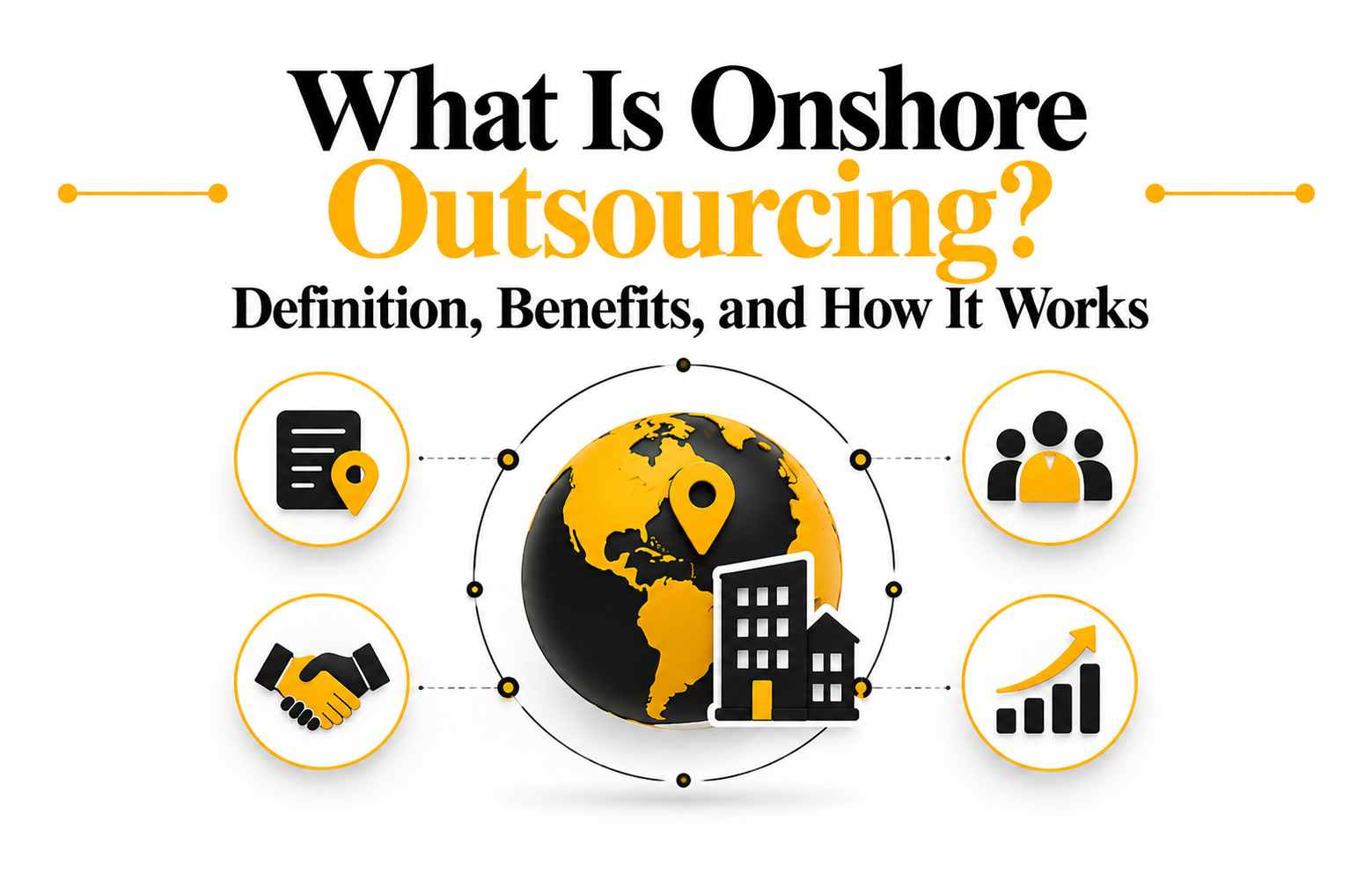
Onshore outsourcing means hiring a third-party provider based in your own country rather than sending work overseas. Businesses choose this domestic model to preserve cultural fit, shared time zones, and consistent legal compliance with their outsourcing partner. According to Grand View Research, the onshore segment held the largest market share within the global business process outsourcing industry in 2025, ahead of both offshore and nearshore alternatives.
This guide covers what onshore outsourcing means, the terminology surrounding it, the services it typically includes, and the benefits driving its adoption. It also looks at the emerging rural sourcing model, compares onshore against offshore and nearshore options, breaks down real costs, and offers a framework for deciding if this model suits your business. Start with the definition below.
What Is Onshore Outsourcing?
Onshore outsourcing means contracting a third-party provider in your own country, also called domestic outsourcing. As part of the broader outsourcing landscape and the types of outsourcing by location, it trades cost for full culture, language, time zone, and legal alignment compared to offshore.
How Does Onshore Outsourcing Work?
Onshore outsourcing works by identifying a process to hand off, then vetting a domestic provider under a managed team, dedicated team, or staff augmentation model. Scope and SLAs get set quickly since time zones and language are already aligned.
Onboarding, integration, and review follow the same domestic contract, giving businesses tighter day-to-day control than offshore or nearshore arrangements. That control comes into sharper focus once you weigh onshore against its geographic counterparts, covered next in onshore vs offshore vs nearshore outsourcing.
Onshore vs Offshore vs Nearshore Outsourcing
The difference between onshore, offshore, and nearshore outsourcing is location, and location sets cost and control. Onshore keeps the provider in the same country, delivering the tightest culture and time-zone alignment at the highest price, sitting as the direct opposite of offshore.
Nearshore moves to a neighboring country, holding onto strong time-zone overlap at a mid-range cost. Offshore reaches a distant country for the lowest cost and the widest gap in culture and time zone. The naming around onshore itself carries its own confusion, sorted out next in onshoring vs domestic outsourcing vs homeshoring.
Onshoring vs Domestic Outsourcing vs Homeshoring
Onshore outsourcing goes by several names: onshoring, domestic outsourcing, and homeshoring all describe the same setup, an external provider working from inside your own country. Rural sourcing, sometimes called farm-shoring, narrows that further to domestic work delivered from rural areas rather than major metros.
Right-shoring means choosing the best mix of onshore, nearshore, and offshore locations rather than committing to just one. None of these terms should be confused with onsite outsourcing, where the provider’s staff work physically at the client’s own location.
What Services Are Commonly Outsourced Onshore?
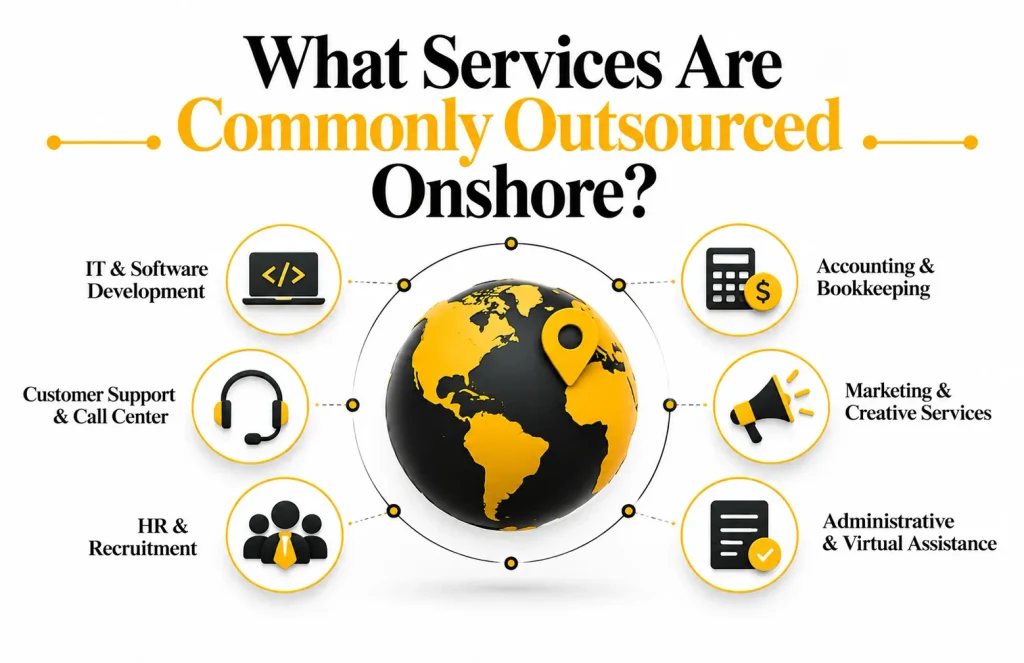
The services most commonly outsourced onshore are IT and software development, customer service, and regulated back-office functions. IT and software development sit at the core of onshore and rural-sourcing work, since complex technical builds benefit from same-language collaboration and overlapping work hours with in-house teams.
Customer service and contact center work follow close behind, with domestic agents delivering accent-neutral, culturally fluent support that offshore centers often struggle to match. Regulated and compliance-sensitive functions, such as healthcare billing or financial processing, round out the list, since domestic providers already operate under the same legal and data-protection framework as the client. Each of these service categories carries its own depth beyond this summary, worth exploring on their dedicated pages.

What Are the Benefits of Onshore Outsourcing?
Onshore outsourcing’s biggest advantage is shared culture and language, the trait offshore struggles hardest to match. That same-country footprint carries five more gains: real-time collaboration across aligned time zones, single-jurisdiction data compliance, tighter day-to-day control, easy in-person contact, and a direct boost to the local economy.
Shared Culture and Language
Shared culture and language means the outsourced team communicates, jokes, and makes decisions the way your own staff would. Onshore outsourcing delivers this by drawing talent from the same national culture, so tone, idiom, and business etiquette need no translation.
Customer-facing businesses, such as retail and hospitality brands, gain the most from this fit, since a mismatched tone reaches the end customer directly. Offshore providers can train around accent and phrasing, but they rarely close the cultural gap entirely. That same alignment carries into scheduling, which is where time-zone alignment and real-time collaboration take over.
Time-Zone Alignment and Real-Time Collaboration
Time-zone alignment means both teams share working hours, so a question asked at 10 a.m. gets answered before lunch instead of the next day. Onshore outsourcing aligns schedules automatically, since the provider sits in the same, or a nearly identical, time zone as the client.
Fast-moving functions such as software development and live customer support gain the most, since standups, escalations, and same-day fixes depend on overlap. Offshore arrangements, by contrast, often lean on overnight handoffs that stretch a five-minute question into a full day’s wait. Real-time access to a domestic team also matters for a different reason: keeping sensitive data inside one legal system, covered next under data security and legal compliance.
Data Security and Legal Compliance
Data security and legal compliance means the outsourced provider handles information under the same laws and enforcement bodies as the client, with no cross-border transfer involved. Onshore outsourcing complies by default, since data never leaves the country’s regulatory perimeter, simplifying obligations under frameworks like HIPAA or state privacy laws.
The stakes are steep regardless of location. IBM’s 2025 Cost of a Data Breach Report puts the global average breach cost at $4.44 million, a figure that climbs further once cross-border regulatory penalties enter the picture. Healthcare, finance, and legal firms gain the most from onshore’s simpler compliance path, since their data is the most tightly regulated. Offshore setups add GDPR-style cross-border transfer rules on top of the base risk, a layer onshore avoids entirely. That same regulatory simplicity feeds into a broader theme: the closer oversight that comes with higher control and closer collaboration.
Higher Control and Closer Collaboration
Higher control means the client can monitor, adjust, and course-correct the outsourced work without waiting on distance or time-zone lag. Onshore outsourcing controls delivery by keeping reporting lines, quality checks, and escalation paths inside a single working day.
Businesses running complex, evolving projects, such as custom software builds, gain the most from this tighter grip, since requirements shift often enough that distant oversight becomes a liability. Offshore engagements typically lean on scheduled check-ins rather than continuous oversight, leaving more room for drift between reviews. That same closeness also makes it easier to simply show up, which is the advantage covered next under easier in-person contact.
Easier In-Person Contact
Easier in-person contact means a client can visit the provider’s office, sit in on a working session, or resolve a dispute face-to-face without booking international travel. Onshore outsourcing enables this by keeping the provider a short flight or drive away rather than a multi-continent trip.
Manufacturing and healthcare businesses gain the most from this proximity, since both rely on physical inspection to confirm quality and compliance. Offshore due diligence, by comparison, often gets compressed or skipped entirely because of the distance and cost involved in getting there. Beyond convenience, that same domestic footprint carries a broader upside for the communities where the work lands, covered next under supporting the local economy.
Supporting the Local Economy
Supporting the local economy means the wages and spending generated by onshore outsourcing stay inside the country instead of flowing overseas. Onshore outsourcing supports local economies by creating jobs, often in smaller cities and rural areas where a domestic delivery center becomes a meaningful local employer.
Rural communities and secondary cities gain the most, since a single domestic delivery center can shift local employment noticeably in a smaller labor market. Offshore outsourcing, whatever its cost advantage, sends that same spending outside the country’s economy entirely. Together, these six benefits explain why so many businesses still choose onshore despite the higher price tag, a trade-off examined next under onshore outsourcing costs.
What Are the Disadvantages of Onshore Outsourcing?
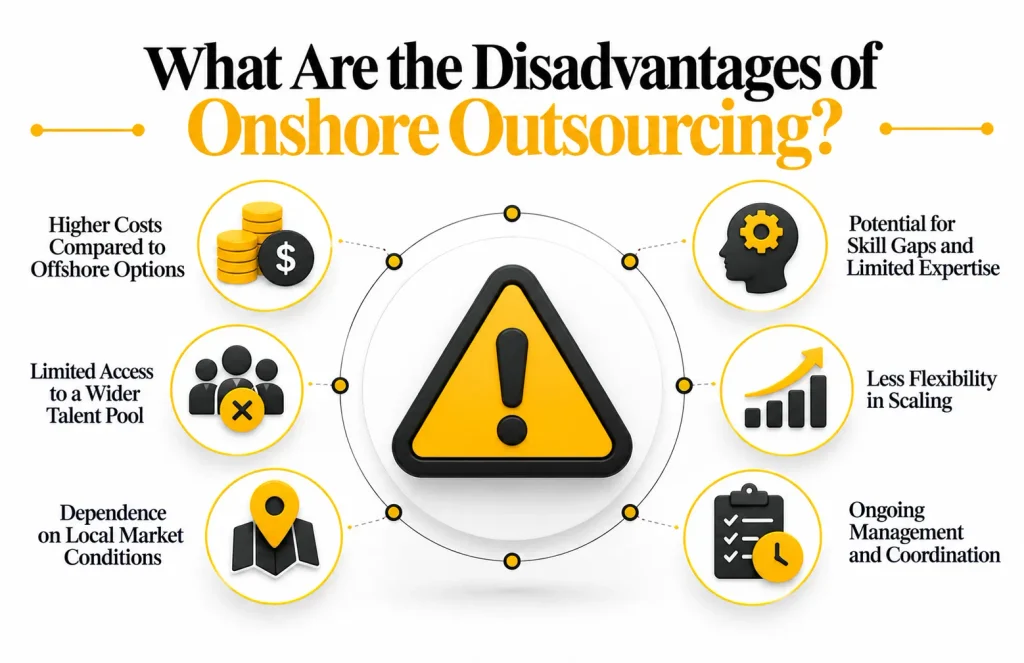
The main disadvantages of onshore outsourcing are higher cost, limited savings, and a smaller talent pool for niche skills. Cost sits at the center of the trade-off: domestic labor rates run well above nearshore or offshore rates, which erodes the arbitrage that makes outsourcing attractive to many businesses in the first place.
That smaller cost gap narrows further once niche skills enter the picture. Specialized technical or scientific roles can be hard to source domestically at any price, and smaller firms often hit scaling limits faster than larger companies with broader vendor networks. Vendor dependency adds another layer of risk, since a limited domestic pool leaves fewer alternatives if a provider underperforms or exits the relationship.
Pricing also swings by location within the same country. Metro-area providers typically charge more than rural or secondary-city vendors, even though both fall under the same onshore umbrella.
Businesses can mitigate most of these downsides with deliberate vendor selection. Rural sourcing providers narrow the cost gap without leaving the country, multi-vendor contracts reduce dependency risk, and a hybrid model that pairs onshore oversight with nearshore or offshore execution can offset the talent and cost limits directly. Together with the benefits already covered, this gives a full picture of the pros and cons of onshore outsourcing, weighed next against real cost figures in onshore outsourcing pricing.
What Is the Rural Sourcing Model?
The rural sourcing model is domestic outsourcing delivered from small towns and rural areas instead of major metro centers, cutting cost while staying inside the country. Rural sourcing keeps everything that defines onshore, shared language, aligned time zones, and single-jurisdiction compliance, while trading expensive metro wages for lower rural labor costs.
Research firm ISG found that rural sourcing providers can access wage rates 20 to 40 percent lower than metropolitan areas, based on their analysis of rural-based U.S. service centers. That gap narrows the arbitrage advantage of nearshore or offshore, without requiring a business to leave the country. Rural centers also tend to report lower staff turnover, since technical roles are scarcer locally and workers have fewer competing employers nearby.
Beyond the balance sheet, rural sourcing carries a community angle that no other location model shares. Delivery centers bring skilled jobs and training to areas that otherwise see limited career opportunities, giving businesses a cost story and a goodwill story in the same contract. That combination is what separates rural sourcing from simply being “onshore, but cheaper,” a distinction worth keeping in mind heading into the direct comparison of onshore, offshore, and nearshore costs next.
Onshore vs Offshore: Which Should You Choose?
The choice between onshore and offshore outsourcing depends on whether control and compliance matter more to the business than cost. Onshore wins on control, regulatory compliance, cultural and language fit, data security, and close quality oversight, while offshore wins on the lowest labor cost, round-the-clock coverage across time zones, and the largest available talent pools.
The decision comes down to two axes: how tight the budget is, and how much the work depends on control or compliance. Regulated work generally points onshore, while flexible, cost-sensitive, non-regulated work tends to favor offshore. The right fit becomes clearer once you look at when onshore specifically makes sense, covered next.
When Is Onshore Outsourcing the Right Choice?
Onshore outsourcing is the right choice when a business operates in a regulated industry, such as finance, healthcare, or government, where compliance and data security carry real legal weight. These sectors need a provider operating under the same regulatory framework, since a compliance failure lands on the client regardless of where the vendor sits.
It also fits work that demands tight control, real-time collaboration, or strong intellectual property protection, since distance and time-zone gaps make all three harder to maintain.
Customer-facing roles benefit as well, particularly where native language and cultural fluency shape how customers perceive the brand. In short, onshore makes sense whenever quality and alignment matter more than shaving cost, the sweet spot regulated industries occupy almost by default.
What Does Onshore Outsourcing Cost?
Onshore outsourcing costs depend on location within the country, skill level, and seniority, and it sits at the highest end of the three location models. Industry rate guides for 2026 put US and Canadian onshore software development in the roughly $80 to $250 per hour range, compared to roughly $15 to $90 per hour for offshore regions like South Asia, Southeast Asia, and Eastern Europe. These figures vary by source and vendor, so treat them as a directional range rather than a fixed benchmark.
Within that onshore range, metro-area providers charge more than rural or secondary-city vendors, and senior, specialized talent costs more than generalist roles. A senior compliance-focused developer in a major metro will run well above a comparable generalist in a smaller city, even before regional cost-of-living differences are factored in.
The premium is justified by what it buys rather than the rate itself. Compliance built in from the start, tighter quality control, and less rework from miscommunication all offset the higher sticker price, particularly for regulated or IP-sensitive work where a cheaper offshore mistake costs more to fix than it saved.
Rural sourcing is the exception inside onshore’s cost profile. Research firm ISG found that rural sourcing providers can access wage rates 20 to 40 percent lower than metropolitan areas, giving businesses a way to stay onshore and keep every alignment benefit that comes with it, without paying full metro rates. That rural discount is the clearest lever for narrowing onshore’s cost gap, a decision point worth weighing directly against the final question of whether onshore fits your business at all.
How Do You Choose an Onshore Outsourcing Partner?
Choosing an onshore outsourcing partner starts with defining scope and goals clearly, then deciding between a metro or rural provider based on budget. Metro providers suit work needing deep local talent pools or client proximity, while rural providers fit cost-sensitive work that still needs to stay onshore.
Vetting comes next. Confirm the provider’s domain expertise against your actual use case, check references from clients in a similar industry, and verify their compliance and security posture directly rather than taking certifications at face value.
Scaling capacity deserves particular scrutiny, since it’s onshore’s weak point. Smaller domestic providers can hit capacity limits fast, so confirm the provider can grow with your project before signing, and settle on a delivery model- managed team, dedicated team, or staff augmentation- that matches how much day-to-day control you want to keep.
Finally, set clear SLAs and KPIs before work begins. Response times, quality thresholds, and escalation paths should all be defined upfront, not worked out after the first miscommunication.
If onshore costs put it out of reach for your budget, offshore outsourcing is the direct alternative, trading some control and time-zone overlap for significantly lower rates. Aristo Sourcing’s offshore staffing lane, built around talent in the Philippines and South Africa, is worth a look if that’s the trade-off you’re weighing.