
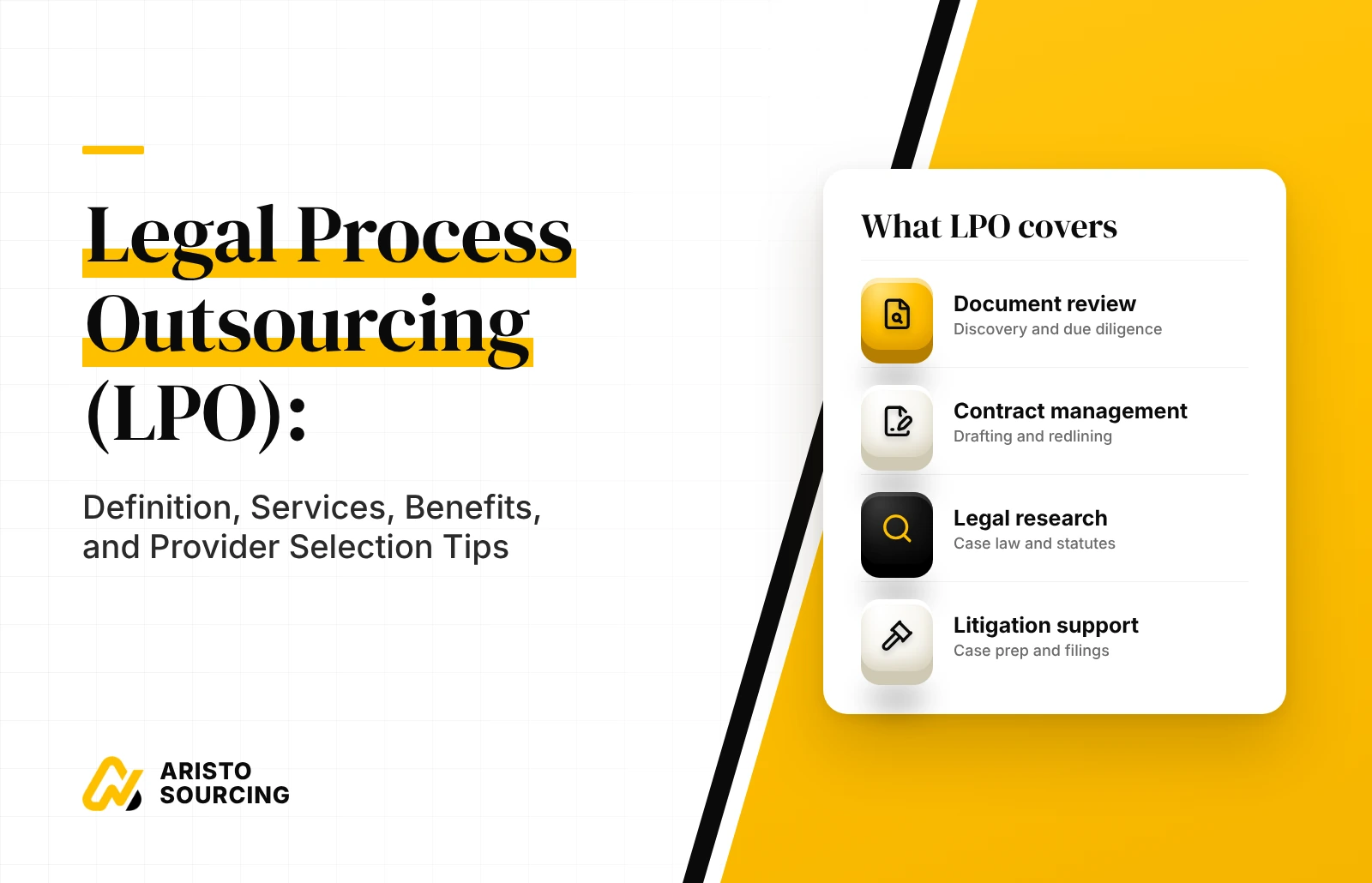
Legal Process Outsourcing (LPO) basically refers to hiring an external provider to handle defined legal support work. Law firms and corporate legal departments use LPO to manage document-heavy, repeatable, and high-volume legal tasks without expanding their in-house legal teams. The main LPO services include document review, legal research, contract management, litigation support, eDiscovery, patent research, compliance, legal administrative support, intellectual property support, and due diligence. These services help legal teams control costs, scale operations during workload spikes, and access specialized expertise and legal technology. LPO also carries risks, including quality control gaps, communication issues, and confidentiality concerns, so attorney supervision remains essential.
LPO works when a legal team defines the scope of a task, an LPO provider performs the work, and internal attorneys review the output before final approval. Providers deliver this work through onshore, nearshore, or offshore models, depending on whether they operate in the same country, a nearby region, or a more distant country. LPO differs from business process outsourcing (BPO) because it focuses on legal support services rather than general business functions such as customer support or accounting. LPO also differs from Alternative Legal Service Providers (ALSPs), which offer a broader range of technology-enabled legal services.
Technology is now reshaping the LPO model, as AI, automation, and eDiscovery platforms speed up document-heavy legal workflows. Choosing the right LPO provider still determines whether outsourcing improves quality and efficiency or adds new risk to legal work.
What Is Legal Process Outsourcing (LPO)?
Legal Process Outsourcing (LPO) is the practice of delegating defined legal support tasks, such as document review, legal research, and contract management, to an external provider with trained legal professionals. LPO stands for Legal Process Outsourcing, a form of legal outsourcing in which a law firm or in-house legal team transfers specific legal processes, not its legal authority, to a specialized service provider. LPO complements in-house legal services rather than replacing them.
Outsourcing a legal process is different from outsourcing final legal decision-making. Outsourcing a legal process means an external provider executes the work, such as reviewing documents or summarizing case law. Outsourcing final legal decision-making would mean handing over legal judgment, which LPO does not do, because licensed attorneys at the hiring firm or department keep control of legal advice, strategy, and sign-off.
The process of LPO works best for routine legal tasks, repeatable legal tasks, specialized work such as patent research, and high-volume legal work such as large discovery reviews. These tasks follow clear rules and standards, so an external provider can perform them consistently while the client’s attorneys focus on legal judgment.
How Does Legal Process Outsourcing Work?
Legal process outsourcing works by transferring clearly defined legal tasks to an external provider, whose trained team completes the work while the client’s attorneys supervise, review, and approve the output. The basic LPO workflow starts when a law firm or corporate legal department identifies a task that is repetitive, time-consuming, or high in volume, such as contract review or document coding.
The client then defines the scope, requirements, deadlines, and quality standards for the task, usually through a statement of work and detailed review guidelines. These instructions tell the provider what to review, how to classify findings, which format to use, and when to deliver results.
The external LPO provider assigns legal professionals, such as paralegals, lawyers, or subject-matter specialists, to execute the work according to those instructions. The provider also manages staffing, workflow tools, internal quality checks, and progress reporting, which keeps LPO services consistent across large or ongoing projects.
The internal legal team stays involved throughout the engagement. Attorney supervision makes sure the work meets professional standards, and in-house lawyers complete a review of the delivered output before giving final approval. The LPO model gives the client outside capacity without giving up control over legal judgment.
What Are the Common LPO Services?
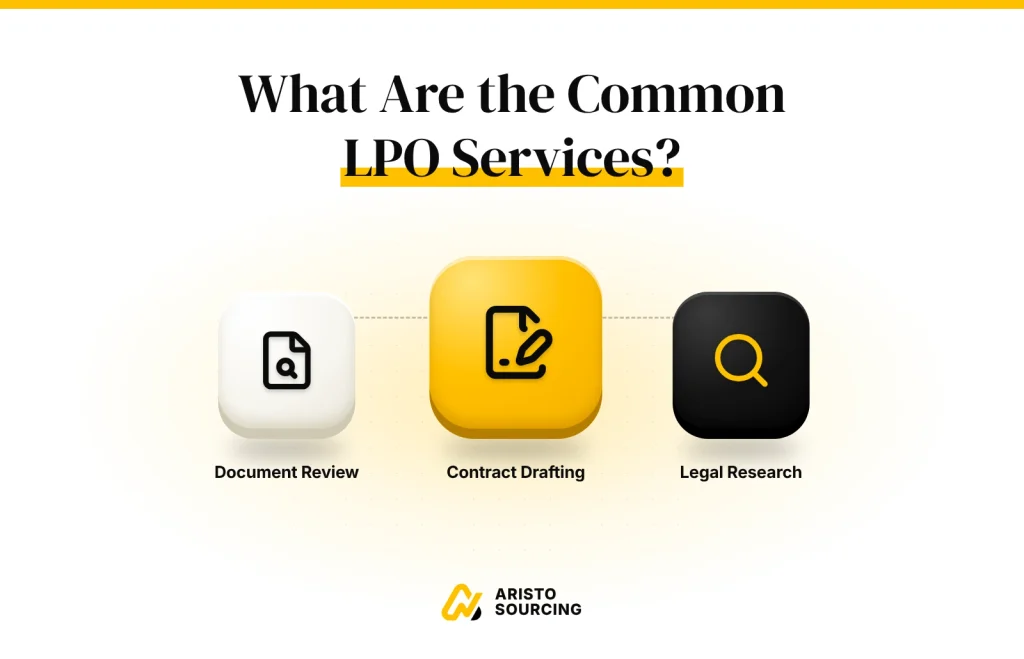
The common LPO services include document review, legal research, contract management, litigation support, eDiscovery, patent research, compliance, legal administrative support, intellectual property support, and due diligence. Each service covers a defined legal process that an external provider performs under the client’s supervision.
The common legal process outsourcing services are listed below.
- Document Review
- Legal Research
- Contract Management
- Litigation Support
- eDiscovery
- Patent Research
- Compliance
- Legal Administrative Support
- Intellectual Property Support
- Due Diligence
Document Review
Document review refers to the process of examining legal documents to identify relevant, privileged, or confidential information for litigation, investigations, regulatory requests, or corporate transactions. High-volume document review often involves thousands or even millions of emails, contracts, and files that reviewers must check against the same review protocol. LPO providers support this work through document organization, classification, analysis, and the coding of discovery data for attorney review. Law firms use LPO for document review because it adds trained reviewers quickly, shortens review timelines, and typically costs less than staffing the same project with in-house associates.
Legal Research
Legal research outsourcing refers to hiring an external provider to find, analyze, and summarize legal authorities that support a law firm’s or legal department’s cases, transactions, and advisory work. Providers research case law, statutes, and regulations across the relevant jurisdictions and track changes that affect the client’s legal position. Where appropriate, they prepare research memoranda and supporting legal analysis, which the client’s attorneys review before relying on the findings. Legal teams use LPO for research because it frees attorney time, adds capacity for complex questions, and provides fast access to researchers who know specific practice areas.
Contract Management
Contract management outsourcing refers to delegating contract-related tasks, such as drafting support, review, and tracking, to an LPO provider that manages agreements throughout their lifecycle for a legal team. Providers prepare first drafts from approved templates, review terms against contract playbooks, redline deviations, and flag risky clauses for attorney attention. They also track renewal dates, obligations, and amendments, which supports contract lifecycle management from creation to expiration. Corporate legal departments use LPO for contract management because contract volume often grows faster than in-house capacity, and outsourcing keeps routine agreements moving without delaying business deals.
Litigation Support
Litigation support outsourcing refers to using an external provider to prepare, organize, and manage the documents, data, and materials that attorneys need before and during a lawsuit. Providers prepare and organize litigation materials such as deposition summaries, case chronologies, exhibit lists, and trial binders. They also handle document management and data extraction, pulling key facts, dates, and names from large case files into searchable formats. Law firms use LPO for litigation support because case workloads rise sharply before court deadlines, and outside teams absorb that pressure without permanent hiring.
eDiscovery
eDiscovery outsourcing refers to engaging an LPO provider to manage electronically stored information (ESI), such as emails, chats, and digital files, that may be relevant to litigation or investigations. LPO providers support the identification, collection, processing, review, and organization of ESI, usually inside dedicated eDiscovery platforms. Their work includes document review, data filtering to remove duplicate and irrelevant files, and the preparation of discovery data for production. Legal teams use LPO for eDiscovery because data volumes keep growing, and providers combine trained reviewers with technology that most firms do not maintain in-house.
Patent Research
Patent research outsourcing refers to hiring specialized LPO professionals to search, analyze, and report on patents and technical literature that affect an invention, product, or intellectual property strategy. Providers conduct patent searches, prior art research, and analysis of patent databases, including USPTO, EPO, and WIPO records. This research supports patentability, validity, infringement, and freedom-to-operate assessments that patent attorneys then evaluate. IP teams use LPO for patent research because the work requires both technical and legal knowledge, which is expensive to keep in-house for irregular demand.
Compliance
Compliance outsourcing refers to using an LPO provider to support the research, review, and documentation tasks that help an organization follow applicable laws, regulations, and internal policies. LPO providers support legal and regulatory compliance activities by monitoring regulatory changes and mapping new requirements to the client’s operations. Where appropriate, they handle regulatory research, compliance reviews, policy checks, and documentation such as audit files and compliance reports. Organizations use LPO for compliance because regulations change often, and outside specialists help in-house teams keep pace without adding permanent headcount.
Legal Administrative Support
Legal administrative support outsourcing refers to delegating routine, non-advisory tasks, such as document preparation, scheduling, and file management, to remote legal support professionals who work for a legal team. Providers support the daily administrative work that keeps attorneys, paralegals, and case teams organized and on schedule. Typical tasks include legal document preparation, file management, calendar scheduling, data entry, and case-related administrative work such as tracking deadlines and updating case records. Law firms use LPOs for administrative support because these tasks consume valuable attorney hours, and delegating them gives legal staff more time for client work.
Intellectual Property Support
Intellectual property support outsourcing refers to delegating IP-related legal and administrative tasks to an LPO provider that helps protect, track, and maintain a client’s patents, trademarks, and copyrights. LPO providers support IP portfolio management by maintaining records, tracking renewal deadlines, and monitoring the status of pending applications. They also prepare trademark or patent documentation, support filings, monitor registries for conflicting marks, and keep portfolio records accurate. IP teams use LPO for this work because portfolios involve strict deadlines across multiple jurisdictions, and a missed date can lead to lost rights.
Due Diligence
Due diligence refers to the detailed investigation of a company’s legal, financial, and operational records before a merger, acquisition, investment, or other major business transaction. Legal due diligence is document-intensive because reviewers must examine contracts, corporate filings, litigation history, licenses, and employment records within tight deal timelines. Legal teams use LPO for due diligence because providers can review large data rooms quickly, summarize key terms, and flag risks such as change-of-control clauses for attorney review. An LPO service like this is for those who handle transactions with fixed closing dates, such as M&A law firms, private equity investors, and corporate development teams.
Who Uses Legal Process Outsourcing?
Legal process outsourcing is used by law firms, corporate legal departments, government agencies, insurance companies, and large enterprises that need extra capacity for document-heavy, repeatable, or specialized legal work. Law firms of every size use LPO to support attorneys, lawyers, and paralegals on litigation, transactions, and research without adding permanent staff. Small and midsize firms often outsource to compete on large matters, while large firms outsource to manage cost and volume across practice groups.
In-house legal teams, led by internal counsel, use LPO for contract management, compliance, and intellectual property work, often coordinated through their legal operations function. Enterprises in regulated industries, such as banking and healthcare, also rely on LPO providers for regulatory reviews and internal investigations.
Different legal teams need external capacity for different reasons. A litigation firm may face a sudden discovery deadline, a corporate legal department may receive hundreds of contracts during a vendor migration, and an acquisition may require a full due diligence review within weeks. Hiring permanent staff for these spikes is slow and costly, because the workload often drops once the project ends. For these teams, the benefit of LPO encompasses flexible capacity for high-volume projects, faster turnaround, and lower fixed costs, while internal attorneys keep control of legal judgment.
What Are the Benefits of LPO?
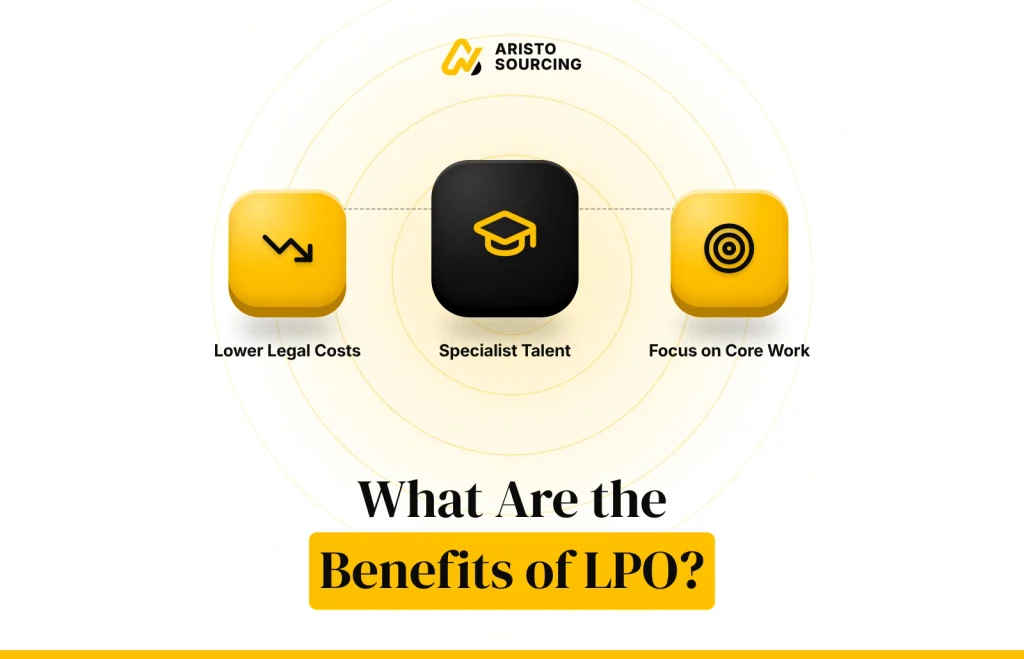
The benefits of legal process outsourcing include lower legal costs, scalable legal operations, streamlined legal processes, specialized expertise, access to legal technology, and a stronger focus on higher-value legal work.
The benefits of legal process outsourcing are listed below.
- Reduces Legal Costs: Reducing legal costs means lowering or better controlling the total spend on legal support work. LPO supports cost efficiency by turning fixed staffing costs into project-based or per-task fees, so a legal team pays only for the capacity it uses. Outsourcing is not always cheaper, however, because savings depend on the task type, provider rates, and the internal review time each project requires.
- Scales Legal Operations: Scaling legal operations means adjusting legal support capacity up or down to match demand. LPO provides scalability by adding trained reviewers or researchers during workload spikes, such as discovery deadlines or deal closings, and releasing them when volume returns to normal. Flexible workload management also prevents staff burnout and avoids the cost of permanent hires for temporary peaks.
- Streamlines Legal Processes: Streamlining legal processes means making repeatable legal tasks faster, more consistent, and easier to manage. LPO providers improve operational efficiency by applying standardized workflows, checklists, and quality checks to tasks such as contract review or document coding. Standardized workflows also raise productivity, because work moves through defined steps instead of ad hoc handoffs.
- Provides Specialized Expertise: Specialized expertise means skills and experience in a specific legal process, such as patent research or eDiscovery review. LPO gives legal teams access to trained legal professionals who perform these tasks every day and understand their standards and common errors. Access to these professionals helps firms take on specialized work without recruiting niche talent full-time.
- Supports Access to Legal Technology: Access to legal technology means using software built for legal work, such as eDiscovery platforms, contract management tools, and document management systems. LPO providers bring established tools and trained users that internal teams may not have or cannot justify buying. Clients gain the output of this legal technology without the licensing, setup, and training costs.
- Strengthens Focus on Higher-Value Legal Work: Higher-value legal work means tasks that require attorney judgment, such as legal strategy, client advisory, negotiation, and courtroom advocacy. LPO moves routine tasks off attorneys’ desks, so they can spend more time on the core legal work that clients value most. A lighter routine workload also helps attorneys avoid risks that come from rushed analysis on important matters.
Are There Any Risks of LPO?
Yes, there are risks of LPO, such as inconsistent quality, communication gaps, weak oversight, missed deadlines, and breaches of confidentiality or data privacy. Most of these risks are manageable when the client sets clear standards and supervises the provider closely.
Operational risks arise when legal work moves outside the organization. Quality control can suffer if the provider’s reviewers apply instructions differently from the client’s own team. Communication problems, time-zone gaps, and limited oversight can also delay feedback, which may lengthen turnaround times and create inconsistent results across a large project.
Ethical and regulatory risks are more serious because they affect clients directly. Sharing case files with an external provider raises confidentiality and data privacy concerns, especially under regulations such as GDPR or HIPAA. Poor handling of privileged documents can threaten attorney-client privilege, and attorneys must still meet their professional responsibility obligations, including the duty to supervise nonlawyer assistance under ABA Model Rule 5.3. Because legal responsibility stays with the hiring firm, any compliance failure by the provider can become the firm’s problem.
Legal teams can avoid most of these risks by vetting each provider’s security certifications, signing confidentiality and data protection agreements, starting with a pilot project, and setting clear review protocols. Regular quality audits, defined communication channels, and attorney review of all final work keep the engagement compliant and consistent.

Who Retains Legal Responsibility in LPO?
Legal responsibility in LPO stays with the hiring law firm or legal department, while the provider is responsible for completing the assigned tasks accurately, securely, and according to agreed instructions. Outsourced execution covers the work itself, such as reviewing documents, summarizing case law, or tracking contract terms. Legal judgment covers what that work means for the client, including legal advice, case strategy, and the final decision on any filing or recommendation. LPO transfers execution only, never legal judgment.
Internal attorneys and legal teams maintain appropriate supervision by setting instructions, sampling the provider’s output, and reviewing all work before it reaches a client or court. Under professional conduct rules, lawyers remain accountable for the work of the nonlawyers they rely on, so supervision is an obligation rather than an option.
Confidentiality and professional responsibility also stay with the hiring legal team. Attorneys must make sure that any provider, whether onshore or offshore, protects client information, avoids conflicts of interest, and follows applicable data protection laws. In some cases, attorneys may also need client consent before sharing confidential information with an outside provider.
The LPO provider’s role is to deliver accurate, secure, and timely legal support work under the client’s instructions. The hiring legal team’s role is to direct that work, verify it, and stand behind the final result.
What’s the Difference Among Onshore, Nearshore, and Offshore Legal Process Outsourcing?
The difference among onshore, nearshore, and offshore legal process outsourcing is the location of the LPO provider relative to the client, which affects cost, compliance, and collaboration. Onshore providers operate within the same country as the client, nearshore providers operate in nearby countries or regions, and offshore providers operate in more distant countries, such as India or the Philippines for US law firms. Onshore LPO usually costs the most but offers the closest alignment in time zone, communication, legal culture, and data protection regulations. Offshore LPO typically offers the lowest rates, nearshore LPO sits between the two, and greater geographic distance can complicate collaboration, add cross-border regulatory requirements, and reduce operating costs. All three models describe where the work happens rather than which services are offered, which makes LPO different from ALSP, a category defined by service scope.
What’s the Difference Between LPO and ALSP?
The difference between LPO and ALSP is that LPO outsources specific legal processes or support tasks, while an Alternative Legal Service Provider (ALSP) offers a broader range of technology-enabled legal services. LPO typically covers process-based work such as legal research, document review, and contract support, whereas ALSPs also provide specialized services, technology solutions, AI-driven tools, and managed legal support. LPO can be considered one type of outsourced legal service, while ALSP is a broader category that can include LPO along with other alternative legal service models.
How Is AI Changing LPO?
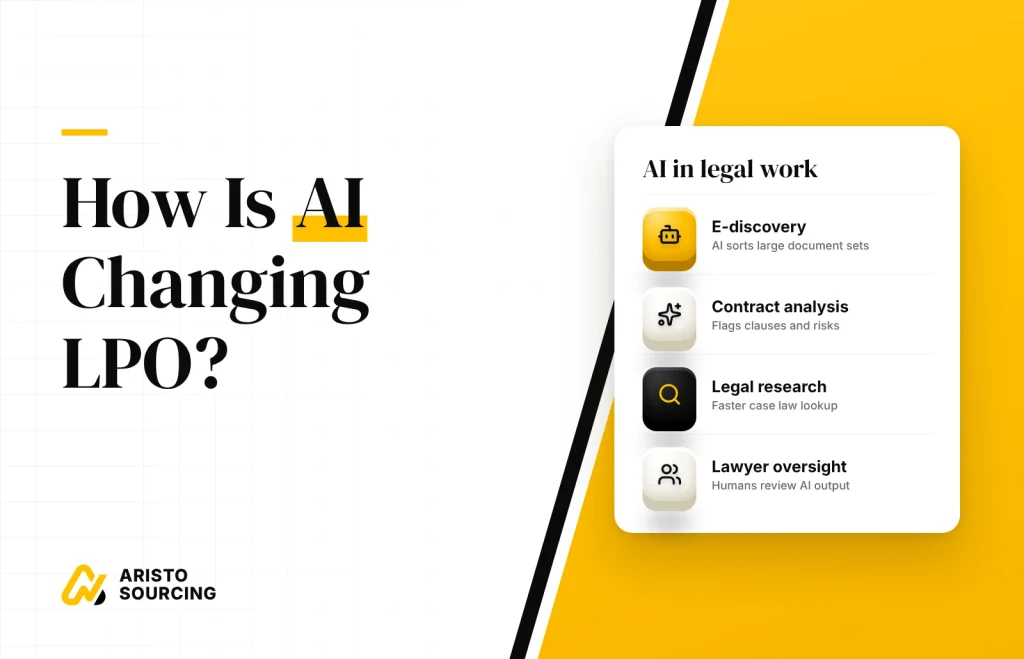
AI is changing legal process outsourcing by automating repetitive document tasks, accelerating review and research, and helping providers deliver faster, more consistent results while attorneys keep control of legal judgment. Legal technology plays a central role in document-heavy workflows, where a single matter can involve millions of pages.
eDiscovery platforms use artificial intelligence features such as technology-assisted review (TAR) and predictive coding to rank documents by likely relevance, so reviewers examine the most important files first. Document management systems organize, version, and secure case files, while automation handles routine steps such as data extraction, de-duplication, and contract metadata tagging. AI-assisted analysis now supports contract review, clause comparison, research summaries, and due diligence reporting, which shortens the time between data intake and attorney review.
Technology assists legal work, but it does not replace human legal judgment. AI tools can miss context, misread nuance, or produce inaccurate citations, so trained legal professionals must verify every output, and attorneys must approve any conclusion that reaches a client or court. A good LPO provider combines AI and automation with human review, documented quality control, and secure data handling, which gives legal teams speed without sacrificing accuracy.
How to Choose a Legal Process Outsourcing Provider?
The main criteria for choosing a legal process outsourcing provider include legal expertise, data security, quality control, legal technology, scalability, communication, and pricing.
The criteria for choosing a legal process outsourcing provider are listed below.
- Legal Expertise: Legal expertise is the provider’s knowledge of the practice area and legal process being outsourced. Legal teams should check the provider’s experience with similar matters, jurisdictions, and document types, because a strong eDiscovery team may not be the right fit for patent research.
- Data Security: Data security determines how well the provider protects confidential client information. Strong providers hold certifications such as ISO 27001 or SOC 2, use encrypted systems and access controls, and sign confidentiality agreements that cover every team member.
- Quality Control: Quality control is the system a provider uses to check accuracy before work reaches the client. A reliable provider documents its quality assurance process, including multi-level review, sampling, error tracking, and accuracy benchmarks for each workflow.
- Legal Technology: Legal technology covers the platforms and tools a provider uses, such as eDiscovery platforms, contract management software, and AI-assisted review. The provider’s systems should integrate with the client’s existing tools and match the complexity of the outsourced workflow.
- Scalability: Scalability is the provider’s ability to add or reduce capacity as workloads change. A scalable provider can staff a large review within days without hurting turnaround time or quality.
- Communication: Communication determines how smoothly instructions, questions, and updates move between the client and the virtual paralegal provider. Effective providers assign a dedicated point of contact, share regular progress reports, and keep working hours that overlap with the client’s team.
- Pricing: Pricing should be transparent and suited to the type of work, whether the model is hourly, per document, per project, or a monthly fee for dedicated staff. A clear service agreement should define scope, deliverables, turnaround times, confidentiality terms, and remedies for missed standards, so costs stay predictable.
A provider that performs well in one workflow may not suit another, so legal teams should evaluate each provider against the exact tasks, volumes, and standards of the work they plan to outsource.
How Can Law Firms Benefit from Hiring Legal Virtual Assistants?
The benefits law firms can gain from hiring Legal Virtual Assistants include higher productivity, lower operational costs, easier scalability, and a healthier work-life balance for attorneys and legal staff. Legal Virtual Assistants (LVAs) or virtual paralegals handle time-consuming legal administrative tasks, such as document preparation, scheduling, and client intake, so attorneys and legal staff can focus on higher-value legal work. Outsourcing these duties to remote professionals through an LPO provider such as Aristo Sourcing can reduce operational overhead and help firms manage a larger caseload without adding office space or full-time in-house hires. Delegating routine tasks by hiring a legal virtual assistant also reduces attorneys’ administrative workload, which supports a healthier work-life balance and lowers the risk of burnout.
How Does Aristo Sourcing Help With LPO?
Aristo Sourcing helps with LPO by recruiting, screening, and matching qualified remote legal professionals who support law firms with outsourced legal tasks. Instead of sorting through hundreds of applicants, law firms rely on Aristo Sourcing to handle candidate screening and filter the global talent pool for qualified legal outsourcing professionals, such as legal virtual assistants, virtual paralegals, and legal researchers.
Aristo Sourcing presents only the top 1% of candidates, matched to each law firm’s specific practice area and requirements, so firms interview professionals who already understand their type of work. Aristo Sourcing reports a 93% hiring success rate and a 7% replacement rate, which reflects how closely its placements match client needs.
For law firms, a major advantage of legal process outsourcing is gaining skilled legal support without the cost and delay of traditional hiring, and that advantage depends on selecting the right provider. Aristo Sourcing combines LPO services with a practice-specific matching process, so law firms can add legal support quickly while their attorneys keep control of legal judgment and final approval.