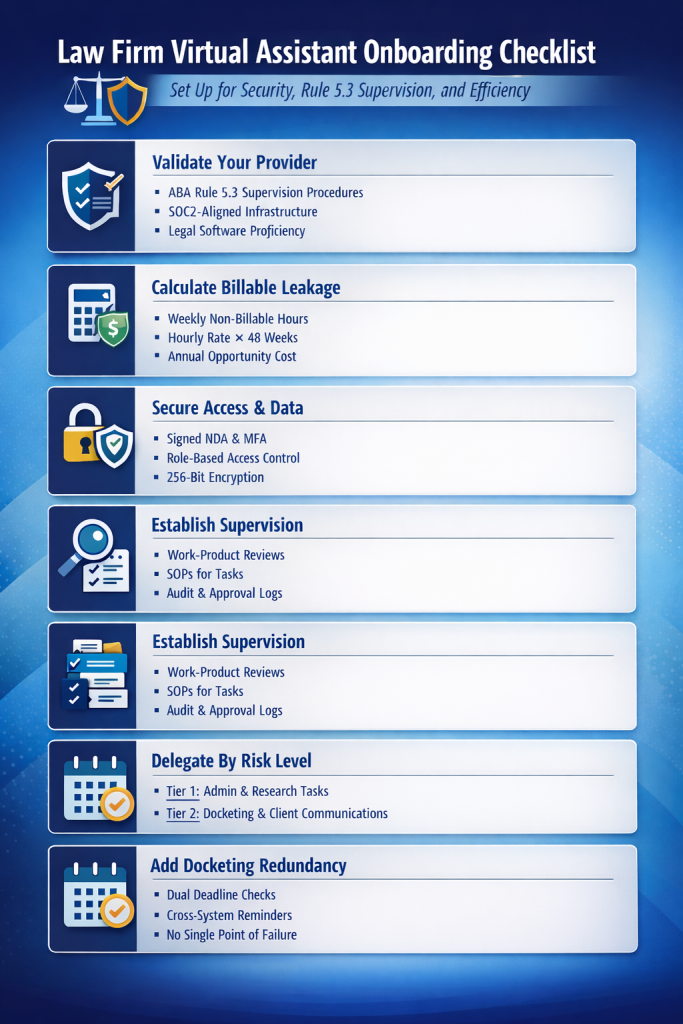
You’ve decided to hire a VA and here is your essential Law Firm VA Onboarding Checklist.
Hiring a legal virtual assistant changes how a law firm allocates billable time.
The outcome depends on the onboarding architecture.
Without a structured integration process, firms introduce supervision gaps, security exposure, and workflow fragmentation. With the correct framework, a legal virtual assistant becomes an operational multiplier that protects billable capacity while maintaining compliance with professional conduct rules.
In modern legal operations (LawOps) environments, virtual assistants function as workflow infrastructure; supporting intake pipelines, discovery processing, document management, and administrative throughput while attorneys focus on strategic legal work.
This framework outlines the operational phases required to onboard a legal virtual assistant safely—from provider validation and security configuration to supervision protocols and structured delegation.

Phase 1: Validate Provider Infrastructure
Not all virtual staffing providers understand the operational requirements of a law firm.
Before onboarding begins, confirm your provider meets these baseline standards.
Provider Infrastructure Checklist
Compliance Oversight
- Documented procedures aligned with ABA Rule 5.3 supervision requirements
Technical Competency
- Proven proficiency in legal platforms such as Clio, MyCase, or PracticePanther
Data Governance
- Clear policies regarding data residency, encrypted storage, and client file access
Operational Redundancy
- Defined protocols for deadline and docketing management
Security Infrastructure
- SOC2-aligned or equivalent enterprise-grade systems
If a provider cannot explain their security architecture or supervision procedures clearly, they represent operational risk rather than support.
Legal environments require specialized workflow discipline.
Phase 2: The Administrative Audit (Billable Leakage)
Before day one, determine exactly what the virtual assistant will handle.
Most firms underestimate how much billable capacity disappears into administrative work.
Calculate the financial impact first.
Billable Leakage Formula
Weekly non-billable hours
× hourly billing rate
× 48 working weeks
= Annual Opportunity Cost
Example
Partner billing rate: $325/hour
Administrative hours weekly: 12
Annual lost billable capacity: $187,200
Law firms often refer to this gap as utilization leakage, the difference between available billable hours and hours actually billed to clients. This calculation identifies which tasks should be delegated first

Phase 3: Technical Screening and Security Configuration
Software gaps discovered after onboarding create unnecessary operational friction.
Before granting system access, verify technical competency through simulations.
Software Proficiency Benchmarks
A legal virtual assistant should demonstrate competency in:
- Intake triage and lead processing within the firm’s CRM
- Conflict check procedures
- Document formatting for pleadings and discovery responses
- Matter management workflows within practice management systems
Zero-Trust Security Framework
Complete these steps before a VA interacts with any client matter.
Security Configuration Checklist
- Signed NDA aligned with state bar confidentiality obligations
- Role-based access control (RBAC) limiting access to relevant files
- Multi-factor authentication (MFA) on all platforms
- Zero-trust cloud access environment
- Activity logging for system access
- Disabled local file downloads
- 256-bit encrypted file transfers
For firms handling personal injury matters or medical records, these systems should also align with HIPAA data protection standards for Protected Health Information (PHI).
Protecting attorney–client privilege requires strict access control.
Phase 4: Implement Rule 5.3 Supervision Protocols
The ABA Model Rules of Professional Conduct require attorneys to implement reasonable supervisory measureswhen working with non-lawyer staff.
This responsibility does not disappear with remote support.
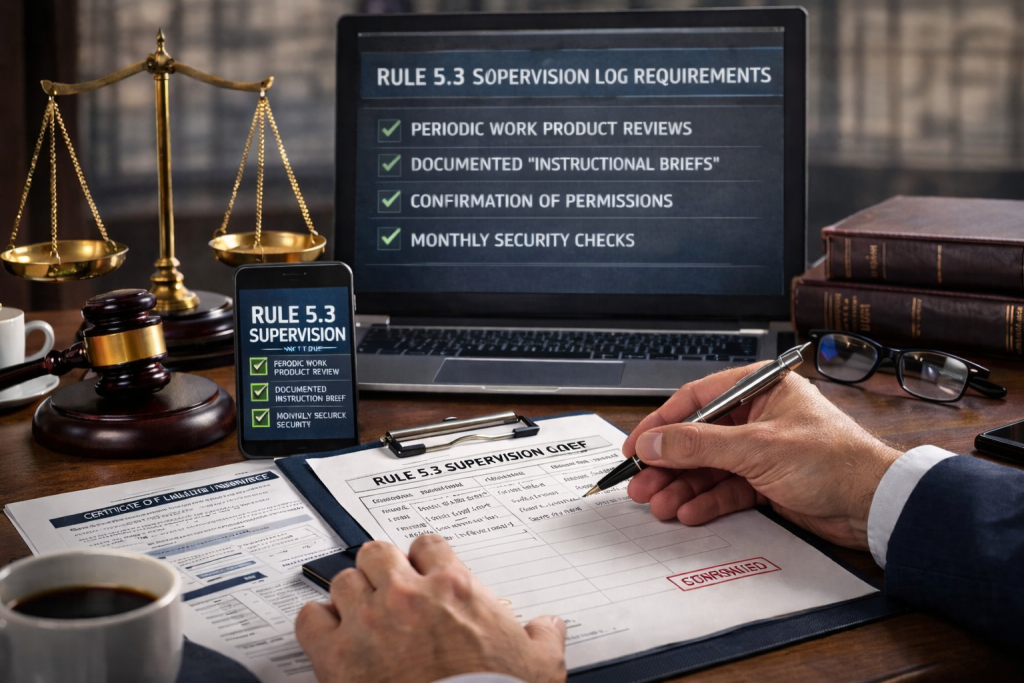
A structured supervision log protects both the firm and the attorney.
Supervision Log Framework
Your supervision system should include:
- Scheduled work-product reviews
- Written Standard Operating Procedures (SOPs) for recurring tasks
- Monthly access permission audits
- Documented timestamps confirming attorney review
Professional liability insurers increasingly assess supervision processes.
Maintaining a clear supervision log protects the firm if oversight questions arise.
Phase 5: Tiered Delegation Strategy
Not all legal tasks carry equal risk.
Introducing work gradually ensures operational safety.
Delegation Risk Model
| Tier | Task Category | Examples |
|---|---|---|
| Tier 1 – Low Risk | Immediate delegation | Public records research, document formatting, CRM updates, calendar management |
| Tier 2 – Supervised Tasks | Requires attorney oversight | Client communications, docketing, billing reconciliation, jurisdiction-specific filings |
Begin with Tier 1 tasks and expand scope once competency and compliance are established.
AI Integration Safeguards
Many firms now use generative AI tools for drafting summaries or organizing discovery.
When AI is used:
- Every citation must be verified against primary legal sources
- Jurisdiction accuracy must be confirmed
- AI-generated drafts must undergo attorney review before client use
AI can accelerate administrative workflows, but it cannot replace legal verification.
Phase 6: Docketing Redundancy Protocol
Missed deadlines are one of the most common causes of malpractice claims.
Critical dates should never depend on one person.
Three-Layer Deadline Protection
Input
The virtual assistant enters the deadline into the practice management system.
Verification
A secondary team member or attorney confirms the entry.
Automation
Cross-system alerts trigger reminders through email, dashboard notifications, or SMS.
This redundancy ensures no single point of failure in deadline management.
Phase 7: Workflow Integration and Knowledge Management
A legal virtual assistant performs best when embedded within a structured operational environment.
Modern legal operations rely on centralized knowledge systems.
Core Knowledge Management Infrastructure
- Centralized SOP library (Notion, ClickUp, or similar)
- Standardized intake scripts
- Document naming conventions
- Matter lifecycle checklists
- Automated task routing within the case management platform
Knowledge management systems allow new team members to assume responsibilities quickly if staffing changes occur.
Operational continuity is essential for law firms handling active litigation or strict filing deadlines.

Strategic Outcome
A properly onboarded legal virtual assistant increases operational control rather than reducing it.
Law firms implementing structured delegation models typically recover 10–20 billable hours per week previously lost to administrative work.
This reclaimed capacity improves revenue while allowing attorneys to focus on client strategy.
Aristo Sourcing reports 93% long-term client retention among firms using its vetted virtual assistant placements.
Structured onboarding transforms a VA from administrative support into an operational asset.

Ready to Integrate a Legal Virtual Assistant?
Aristo Sourcing connects law firms with pre-vetted legal virtual assistants trained in Clio, MyCase, and law firm intake workflows.
- identify billable leakage within your practice
- design a secure delegation framework
- deploy a Rule-5.3-compliant virtual assistant
The right onboarding structure allows your firm to expand capacity while maintaining full operational control.

Frequently Asked Questions
How do law firms onboard a virtual assistant securely?
Law firms onboard virtual assistants through a structured process that includes provider vetting, security configuration, Rule 5.3 supervision protocols, and tiered delegation of tasks. Security measures typically include role-based access controls, multi-factor authentication, and encrypted file access to protect attorney–client privilege.
What tasks can a legal virtual assistant perform?
Legal virtual assistants commonly assist with intake processing, document formatting, public records research, calendar management, discovery organization, CRM updates, and administrative support. Higher-risk tasks such as client communication or docketing should be supervised by an attorney.
Do lawyers need to supervise virtual assistants under Rule 5.3?
Yes. Under the ABA Model Rules of Professional Conduct, Rule 5.3 requires attorneys to implement reasonable supervisory measures to ensure that non-lawyer assistants comply with professional obligations. This includes reviewing work products and maintaining oversight of delegated tasks.