
The cost of offshore outsourcing depends on the job function, country, skill level, and outsourcing model. Hourly and monthly rates for offshore outsourcing usually range from $5 to $50+ per hour, or $800 to $5,000+ per month for one full-time dedicated role. A data entry assistant in the Philippines and a senior software developer in Poland sit at opposite ends of that range, because job function, country, skill level, and outsourcing model each change the rate.
The sections below cover direct offshore outsourcing costs by role and region, common pricing models, hidden costs, the total cost of ownership (TCO), and realistic cost savings. The quoted rate alone does not show the real cost of an offshore team, because management time, training, transition, and turnover add expenses that rarely appear on a vendor’s invoice. Choosing a provider with transparent, itemized pricing keeps the real cost of offshore outsourcing predictable.
How Much Does Offshore Outsourcing Cost?
Offshore outsourcing costs between $800 and $5,000+ per month per full-time role, depending on the job function, country, skill level, and outsourcing model. The average outsourcing cost translates to hourly rates of $5 to $50+, with entry-level data entry roles starting near $600 per month and senior technical roles exceeding $6,000 per month.
A quoted monthly rate usually includes the employee’s salary, the vendor fee, workspace, equipment, and payroll administration. The same quote usually excludes internal management time, training, software licenses, overtime, and replacement fees, so monthly staffing costs often run higher than the vendor fees alone suggest. Job function sets the baseline for that range, while country, skill level, and outsourcing model move the final price up or down.
How Much Does Offshore Outsourcing Cost by Job Function?
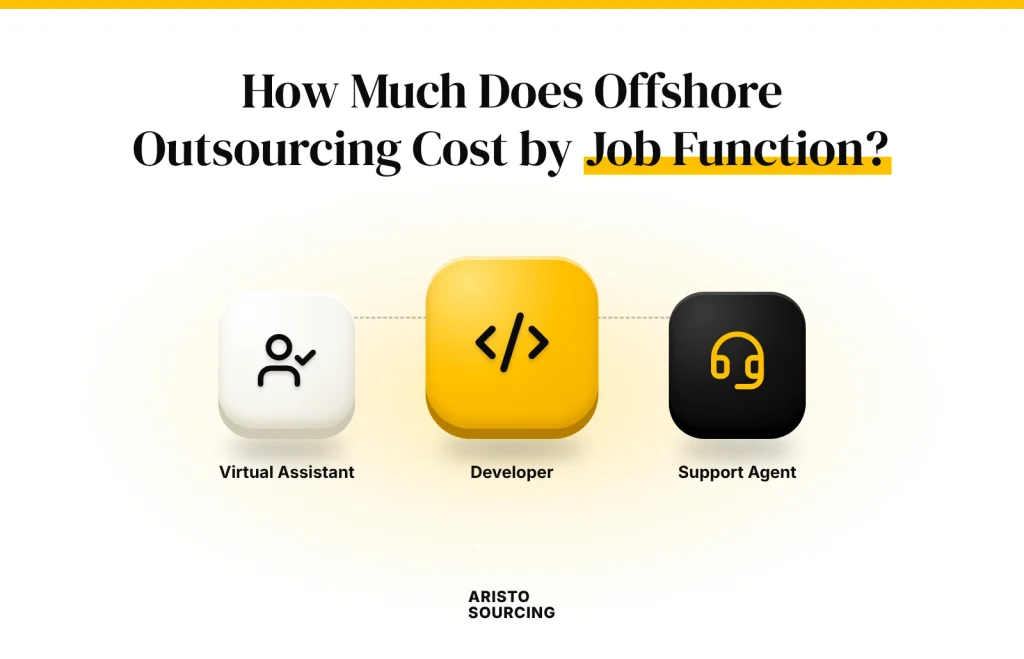
Offshore outsourcing costs by job function are presented in the table below.
| Job Function / Role | Offshore Cost (Monthly) | Explanation |
| Administrative & Data Entry | $600–$1,500 | Virtual assistants handle scheduling, inbox management, and data entry, which need general skills and short training. |
| Customer Support Agent | $1,000–$2,000 | Customer support rates rise with language fluency, channel mix (voice, chat, email), and night-shift coverage. |
| Accountant / Bookkeeper | $1,000–$2,200 | Finance and accounting roles cost more when they require a CPA license or knowledge of US GAAP and tax rules. |
| Digital Marketing / Graphic Design | $1,200–$2,500 | Marketing and design rates depend on portfolio quality, tool expertise, and campaign experience. |
| Software Developer (Mid-Level) | $2,000–$4,500 | Software development rates depend on the tech stack, years of experience, and codebase complexity. |
| QA / Automation Tester | $1,800–$3,500 | Manual testers sit at the lower end, while automation testers who write test scripts sit at the upper end. |
| Senior Technical / IT Infrastructure | $3,500–$6,000 | Cloud, DevOps, and cybersecurity specialists command the highest rates because their skills are scarce. |
Administrative and customer support roles cost the least, while software development and senior IT infrastructure roles cost the most. Within each job function, skill level shifts the rate, so a senior hire costs more than a junior hire in the same role. The same role also costs more or less depending on the country where the offshore team works.
How Much Does Offshore Outsourcing Cost by Country and Region?
Offshore outsourcing costs by country and region are listed below.
- South Asia: The cost of offshore outsourcing in South Asia ranges between $4 and $40 per hour, depending on the role, seniority, and provider. South Asia offers a low cost level, with India and Pakistan providing large English-speaking talent pools for software development and back-office work, although the wide time zone gap with the US often requires night shifts.
- Southeast Asia: The cost of offshore outsourcing in Southeast Asia ranges between $5 and $40 per hour, depending on the job function, experience, and staffing model. Southeast Asia also sits at a low cost level, with the Philippines known for strong English and customer support and Vietnam known for affordable software engineering, but both countries offer limited overlap with US business hours.
- Africa: The cost of offshore outsourcing in Africa ranges between $7 and $40 per hour, depending on the country, role complexity, and service level. South Africa and Kenya offer a low-to-moderate cost level with neutral English accents and time zones close to the UK and Europe, but smaller talent pools and occasional power or connectivity disruptions can limit scale.
- Latin America: The cost of offshore outsourcing in Latin America ranges between $10 and $60 per hour, depending on the role, English proficiency, and seniority. Colombia, Brazil, and Argentina sit at a moderate cost level and share working hours with the US, which supports real-time collaboration, but their rates run higher than rates in Asia or Africa.
- Eastern Europe: The cost of offshore outsourcing in Eastern Europe ranges between $15 and $70 per hour. Poland, Romania, and Ukraine sit at the highest offshore cost level and offer deep expertise in complex software, cybersecurity, and AI development, but those higher rates reduce the savings on routine support work.
Is AI Affecting Offshore Outsourcing Cost?
Yes, AI is affecting offshore outsourcing costs by shifting pricing from labor hours toward tasks and outcomes. AI automation reduces the time and labor required for repetitive tasks such as data entry, ticket triage, and basic testing, so AI-assisted services deliver the same output with fewer billable hours.
Providers are responding with task-based and outcome-based pricing models instead of traditional labor-hour pricing, and 67% of executives already use outcome-based outsourcing services, according to Deloitte’s 2024 Global Outsourcing Survey. The impact depends on the job function and level of automation, because roles that rely on human expertise, judgment, and client relationships still need the same paid hours.
What Are the Common Offshore Outsourcing Pricing Models?
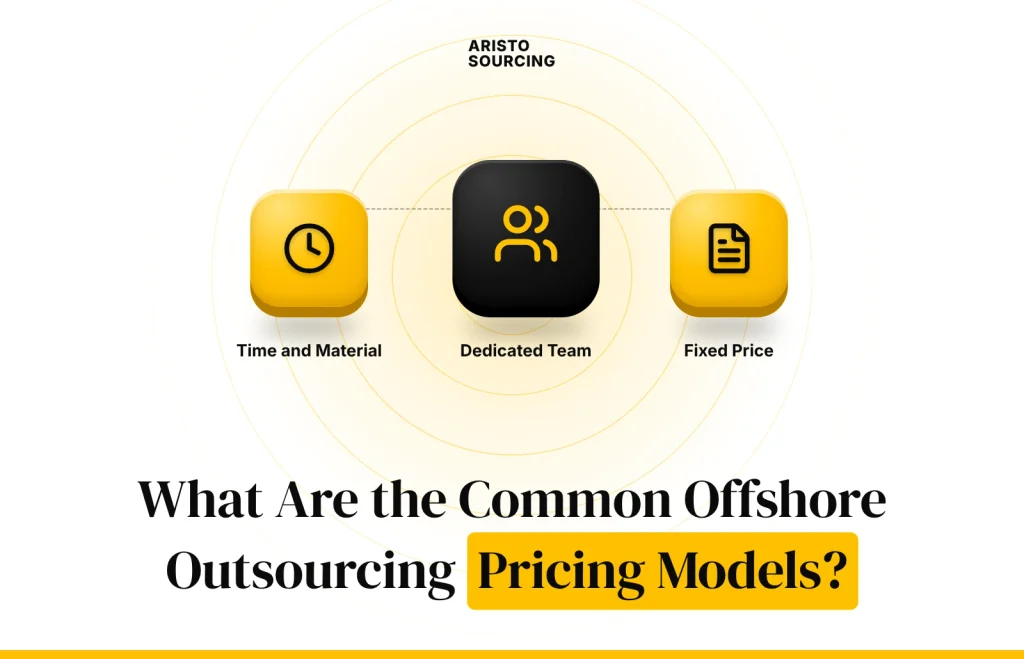
The common offshore outsourcing pricing models include hourly billing, fixed-price contracts, monthly retainers, dedicated teams, and managed services, and each model splits cost risk differently between the client and the provider. The main offshore outsourcing pricing models are listed below.
- Hourly Billing: Hourly billing refers to a pricing model in which the client pays the offshore provider a fixed rate for each hour worked, usually tracked through timesheets or time-tracking software. Hourly billing suits short-term, flexible, or loosely defined work, but its main cost risk is an open-ended budget, because total spend rises with every extra hour.
- Fixed-Price Contracts: Fixed-price contracts refer to agreements in which the client and offshore provider agree on one total price for a defined scope, timeline, and set of deliverables before work starts. Project-based pricing suits well-defined work such as a website build or an app release, but its main cost risk is change requests, which vendors bill separately and often at a premium.
- Monthly Retainers: Monthly retainers refer to recurring agreements in which the client pays a set monthly fee for an agreed number of hours or a defined range of ongoing services. Monthly retainers suit steady, ongoing work such as bookkeeping, marketing, or IT support, but their main cost risk is paying for unused hours in slow months.
- Dedicated Teams: A dedicated team refers to a group of full-time offshore professionals who work exclusively for one client, while the provider handles recruitment, payroll, workspace, equipment, and HR administration. Dedicated teams suit long-term roles that need deep product or process knowledge, but their main cost risk is a fixed monthly cost per person that continues even when the workload drops.
- Managed Services: Managed services refer to a model in which the offshore provider takes full responsibility for running a business function and delivering agreed results, usually measured through service-level agreements. Managed services suit businesses that want to outsource an entire function, such as customer support or an IT helpdesk, but their main cost risk is vendor markups, which add management and margin layers on top of labor costs.
What Affects Vendor Markups in Offshore Outsourcing?
Vendor markups in offshore outsourcing are affected by the provider’s overhead, service level, pricing model, and the extra services bundled into the rate. Markups and additional service charges usually come from setup fees, replacement fees, equipment, and overtime premiums, which push vendor fees above the base salary of the offshore staff.
Businesses should review contract terms, minimum commitments, notice periods, and service-level agreements (SLAs) before signing, especially for monthly retainers that lock in a fixed number of hours or staff. Any fee that the contract does not define clearly can become a hidden cost later in the engagement.
What Are the Hidden Costs of Offshore Outsourcing?
The hidden costs of offshore outsourcing include vendor selection, internal management, training, transition, and replacement expenses that are not part of the quoted fee.
The hidden costs of offshore outsourcing are listed below.
- Vendor Selection and Vendor Management: Vendor selection takes internal time for research, interviews, reference checks, and legal review before any work begins. Vendor management continues after signing through performance reviews, invoice checks, and contract renegotiations.
- Internal Management: Internal management covers the hours that in-house managers spend assigning work, answering questions, and reviewing the offshore team’s output. Internal management hours are rarely budgeted, yet each hour carries the full cost of a domestic manager’s salary.
- Training and Transition: Training and transition include documenting processes, transferring knowledge, and onboarding offshore staff to internal tools and quality standards. Productivity is usually lower during the first one to three months, while the business still pays the full rate.
- Employee Turnover: Employee turnover forces the business to repeat recruitment, onboarding, and training whenever an offshore team member leaves. Some vendors charge replacement fees, and every departure causes a temporary drop in output.
- Rework: Rework occurs when deliverables miss requirements because of unclear instructions, skill gaps, or weak quality control. Every corrected task adds labor cost to work that was already paid for and can delay later deadlines.
- Communication Barriers: Communication barriers come from time zone gaps, language differences, and cultural differences in how teams raise problems. Slower feedback loops extend timelines and increase the risk of misunderstandings that lead to rework.
- Contract Exit: Contract exit costs include early termination fees, notice periods, and the expense of moving work back in-house or to a new vendor. Knowledge transfer during an exit can take several weeks and often means paying two teams at the same time.
Each of these hidden costs belongs in the TCO, which shows what an offshore team really costs over the life of the contract.
What Is the Total Cost of Ownership (TCO) of Offshore Outsourcing?
The total cost of ownership (TCO) of offshore outsourcing is the full amount a business spends to set up, run, and manage an offshore team over a defined contract period. Direct costs, such as vendor fees and salaries, combine with indirect costs, such as management overhead and rework, while one-time expenses for setup and transition add to recurring expenses for monthly fees and software licenses. The TCO formula in its simplest form is shown below.
TCO = One-time costs + (Monthly direct costs + Monthly indirect costs) × Number of months
First-year costs are higher than ongoing operating costs because the first year carries one-time expenses such as recruitment, onboarding, training, and knowledge transfer. To avoid double-counting, leave out workspace, equipment, and payroll administration when vendor pricing already includes them, and add separate budget lines only where specific factors increase the cost.
What Factors Increase Offshore Outsourcing Costs?
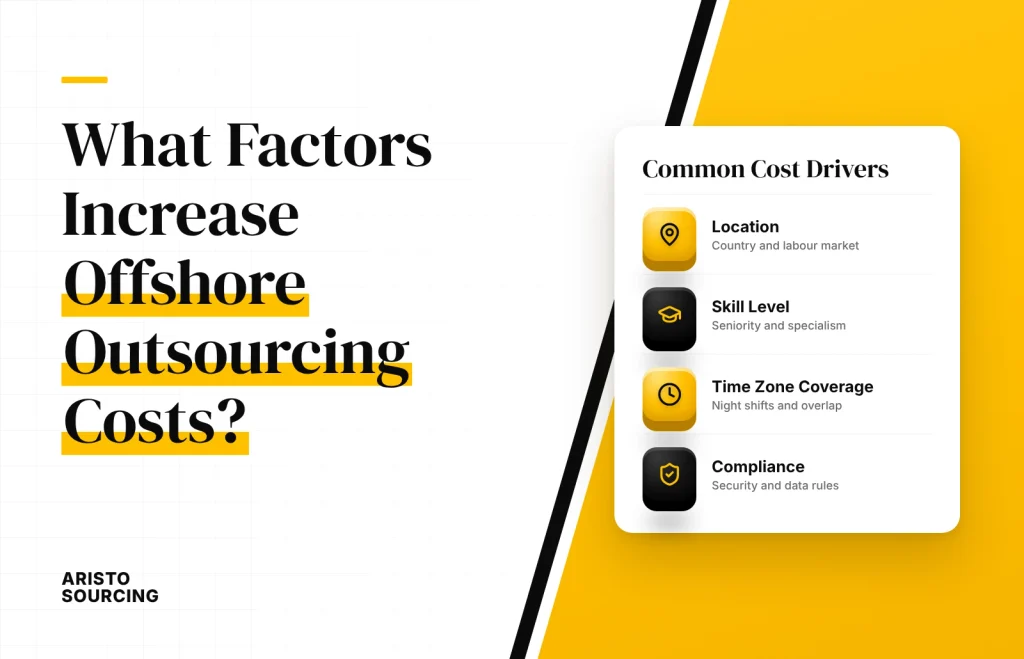
The factors that increase offshore outsourcing costs include skill shortages, project complexity, scope creep, project delays, data security requirements, regulatory compliance, integration work, and currency fluctuations.
The factors that increase offshore outsourcing costs are listed below.
- Skill Shortages: Skill shortages refer to a limited supply of qualified offshore professionals for a specific role, which raises the price that providers charge to recruit and retain that talent. Scarce skills such as cloud architecture, cybersecurity, and machine learning, along with senior-level requirements, push rates higher as wages rise in high-demand roles.
- Project Complexity: Project complexity refers to the number of features, technologies, business rules, and dependencies in a project, which determines how much skilled effort an offshore team needs to deliver it. Specialized requirements, such as custom algorithms or industry-specific logic, need extra senior time for architecture, code review, and problem-solving.
- Scope Creep: Scope creep refers to the gradual expansion of a project’s requirements beyond the original agreement, usually through new features, extra tasks, or changing priorities added after work begins. Unplanned requests trigger paid change orders on fixed-price contracts and add billable hours on hourly contracts, which inflates both budgets.
- Project Delays: Project delays refer to the time a project runs past its planned schedule, caused by unclear requirements, slow approvals, dependencies, or resource gaps on the client or provider side. Delays extend billable time, and missed deadlines can push back product launches or revenue that depend on the offshore team’s work.
- Data Security Requirements: Data security requirements refer to the technical and procedural controls an offshore provider must apply to protect client data, systems, and intellectual property from unauthorized access or loss. Secure infrastructure, role-based access controls, encrypted devices, and regular security audits either raise the monthly rate or appear as separate fees.
- Regulatory Compliance: Regulatory compliance refers to the legal and industry rules that an offshore engagement must follow in both the client’s country and the provider’s country, which adds administrative and operational costs. Data protection laws such as GDPR and HIPAA, local labor regulations, and industry standards such as PCI DSS require extra training, documentation, and audits.
- Integration Work: Integration work refers to the effort required to connect an offshore team to a client’s existing tools, systems, and workflows so the team can work as part of daily operations. Setting up accounts, software licenses, VPN access, and permissions for CRM, ERP, and project management platforms adds setup time and recurring license fees.
- Currency Fluctuations: Currency fluctuations refer to changes in the exchange rate between the client’s currency and the provider’s currency, which alter the real cost of an offshore contract over time. A weaker home currency raises the real cost of rates quoted in another currency and reduces cost savings, so many businesses prefer contracts priced in US dollars.

How Much Can Be Saved with Offshore Outsourcing?
Offshore outsourcing can reduce labor and operating costs by 50% to 70% compared with hiring in Western markets, according to a comparison of US Bureau of Labor Statistics (BLS) compensation data with current offshore staffing rates. The savings percentage can reach up to 80% for certain support or administrative functions, depending on the role, location, and staffing model.
For example, a US customer service representative earns a median wage of $20.59 per hour (BLS, May 2024), or about $29 per hour once benefits are included, while an offshore customer support agent typically costs $6 to $12 per hour. Domestic hiring costs also include recruitment, office space, equipment, and ongoing management, and an offshore staffing arrangement bundles most of these costs into one monthly rate. Net savings equal domestic hiring costs minus the full TCO of the offshore team, so the return on investment (ROI) depends on productivity and on choosing the right offshore outsourcing provider.
How to Choose a Cost-Effective Offshore Outsourcing Provider
To choose a cost-effective offshore outsourcing provider, compare quotations on equivalent scope and judge long-term value instead of the lowest hourly rate. Vendor selection works best when every provider quotes the same service scope, staffing requirements, working hours, and seniority levels, so the quotations are directly comparable. Technical expertise, industry experience, and service quality matter as much as price, and client references confirm whether a provider delivers on those claims.
Pricing transparency means the quote lists the salary, vendor fee, setup costs, and extra charges separately, which makes hidden fees easier to spot. Replacement policies, security controls, notice periods, and exit terms also need review before signing. The most cost-effective provider is the one with the lowest total cost of ownership over the full contract, not the lowest quoted rate.
How Does Aristo Sourcing Help Save Money with Offshore Outsourcing?
Aristo Sourcing helps businesses save money through offshore outsourcing by providing access to skilled remote professionals at lower operating costs than an equivalent local hire. The main cost savings come from reduced recruitment expenses, lower staffing costs, and less spending on office space and equipment, because Aristo Sourcing sources, screens, and places each remote professional. Through its remote staffing and outsourcing services, Aristo Sourcing connects businesses with skilled professionals in the Philippines and South Africa for administrative, customer support, bookkeeping, marketing, and technical roles without building a full in-house team.
Businesses that compare the cost of offshore outsourcing across different pricing models and check every contract for hidden costs keep more of those savings. Actual savings depend on the roles, staffing requirements, and outsourcing arrangement, and the wider benefits of offshore outsourcing also include flexible scaling, faster hiring, and access to larger talent pools.