
The history of offshore outsourcing evolved from manufacturing offshoring in the 1960s into today’s model of digital services, IT support, and remote teams. Companies outsource work overseas to lower labor costs, access skilled talent, and take advantage of globalization. The roots of offshore outsourcing trace back to the Industrial Revolution, when global trade first linked factories in one country with raw materials and markets in others.
The modern history of offshore outsourcing covers five phases, including the 1960s and 1970s, the 1980s and 1990s, the 2000s to 2015, 2016 to 2019, and the years since 2020. China, India, the Philippines, Mexico, and Eastern Europe shaped that history, while AI, automation, and nearshoring are shaping its future. Each period also holds a lesson for businesses that are choosing an outsourcing partner today.
What Is Offshore Outsourcing?
Offshore outsourcing is a business practice in which a company contracts a third-party provider in another country to perform work that in-house staff would otherwise do. Offshore outsourcing combines both, because the work moves to another country and a third-party provider performs it.
For example, a US company that hires a provider in the Philippines to run its customer support, or a firm in India to handle its software development, is using offshore outsourcing. The history of early offshoring involved moving company-owned factories abroad, while later phases handed entire business functions to outside providers.
What Is the History of Offshore Outsourcing?
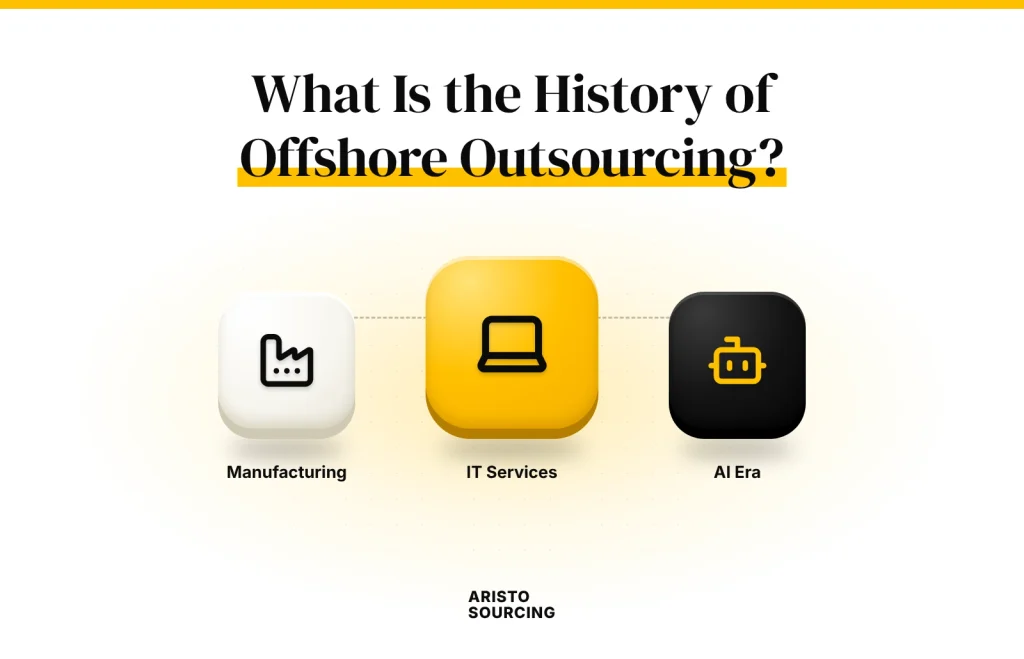
The historical phases of offshore outsourcing include the rise of manufacturing offshoring in the 1960s and 1970s, globalization and IT outsourcing in the 1980s and 1990s, BPO growth in the 2000s, specialized talent from 2016 to 2019, and remote work and AI since 2020.
The historical phases of offshore outsourcing are listed below.
- Phase 1 — The 1960s and 1970s: The Rise of Manufacturing Offshoring
- Phase 2 — The 1980s and 1990s: Globalization and IT Outsourcing
- Phase 3 — The 2000s to 2015: The Growth of BPO and Knowledge Work
- Phase 4 — From 2016 to 2019: The Shift Toward Specialized Talent
- Phase 5 — Offshore Outsourcing Since 2020: Remote Work and AI
Phase 1 — The 1960s and 1970s: The Rise of Manufacturing Offshoring
Phase 1 of offshore outsourcing involves the move of American factory work to lower-wage countries in the 1960s and 1970s, a trend known as manufacturing offshoring. American companies moved production overseas because foreign wages were far lower, cheap imports were squeezing their margins, and offshore assembly gave them a cost advantage over domestic rivals.
Electronics manufacturing grew quickly in East Asia after Fairchild Semiconductor opened an assembly plant in Hong Kong in 1963, and Taiwan and South Korea soon attracted similar plants for radios, televisions, and components. Mexico launched the Maquiladora program in 1965, which let foreign companies import parts and machinery duty-free and assemble goods for export in factories along the northern border zone.
According to INEGI data published by the International Labour Organization, Mexico’s maquiladora sector grew from 120 plants employing about 20,300 workers in 1970 to 620 plants employing about 119,500 workers in 1980.
Phase 2 — The 1980s and 1990s: Globalization and IT Outsourcing
Phase 2 of offshore outsourcing involves the spread of outsourcing from factories to services, driven by globalization and IT outsourcing in the 1980s and 1990s. Cheaper telecommunications, satellite data links, and networked computers let companies send data processing and software work to providers thousands of miles away.
Kodak made large-scale IT outsourcing a mainstream strategy in 1989 and 1990, when it handed its data center operations to IBM, its telecommunications services to Digital Equipment Corporation, and its personal computer support to Businessland. India emerged as a major IT services destination after its 1991 economic reforms opened the economy to foreign firms, while Software Technology Parks with satellite links and a large pool of low-cost, English-speaking engineers attracted Western clients.
Trade liberalization, including NAFTA in 1994 and the creation of the World Trade Organization in 1995, lowered cross-border barriers and accelerated the growth of international outsourcing.
Phase 3 — The 2000s to 2015: The Growth of BPO and Knowledge Work
Phase 3 of offshore outsourcing involves the growth of Business Process Outsourcing (BPO) and Knowledge Process Outsourcing (KPO) between the 2000s and 2015. Outsourcing expanded beyond IT into customer support, accounting, software development, and specialized services such as legal research and data analysis.
India led back-office and non-voice services, while the Philippines overtook India in voice-based call center work around 2010 and 2011. The rapid growth raised concerns about domestic job losses, service quality, and communication problems such as accent barriers, time zone gaps, and cultural differences.
Quality concerns and rising wages in China started an early reshoring trend, and a 2011 Boston Consulting Group report predicted that manufacturing in parts of the US would be as economical as manufacturing in China for many goods by around 2015.
Phase 4 — From 2016 to 2019: The Shift Toward Specialized Talent
Phase 4 of offshore outsourcing involves the shift from cost-driven outsourcing to expertise-driven outsourcing between 2016 and 2019. Companies increasingly outsourced work to access global talent with skills that were scarce or expensive at home, not only to cut labor costs.
Demand grew fastest for software development and specialized digital services, including cloud migration, data analytics, and cybersecurity. Rising wages in older destinations pushed many companies toward newer talent hubs in Eastern Europe, Latin America, and Vietnam.
In 2018, the United States placed tariffs on about $250 billion of Chinese imports, which pushed many manufacturers to rethink their supply chains and move some production to countries such as Vietnam.
Phase 5 — Offshore Outsourcing Since 2020: Remote Work and AI
Phase 5 of offshore outsourcing involves the rise of remote work and artificial intelligence (AI) since 2020. The COVID-19 pandemic forced companies to run their operations remotely in 2020, and distributed offshore teams became popular as a normal way of working instead of an exception.
Cloud computing gave those teams shared access to company systems, while AI tools began to automate routine tasks and raise the value of human judgment. Cybersecurity and data protection became central to outsourcing decisions, because remote teams handle sensitive customer and company data across borders.
Supply chain disruption during the pandemic also pushed companies to diversify their outsourcing locations instead of relying on a single country.
Why Did Offshore Outsourcing Become Popular?
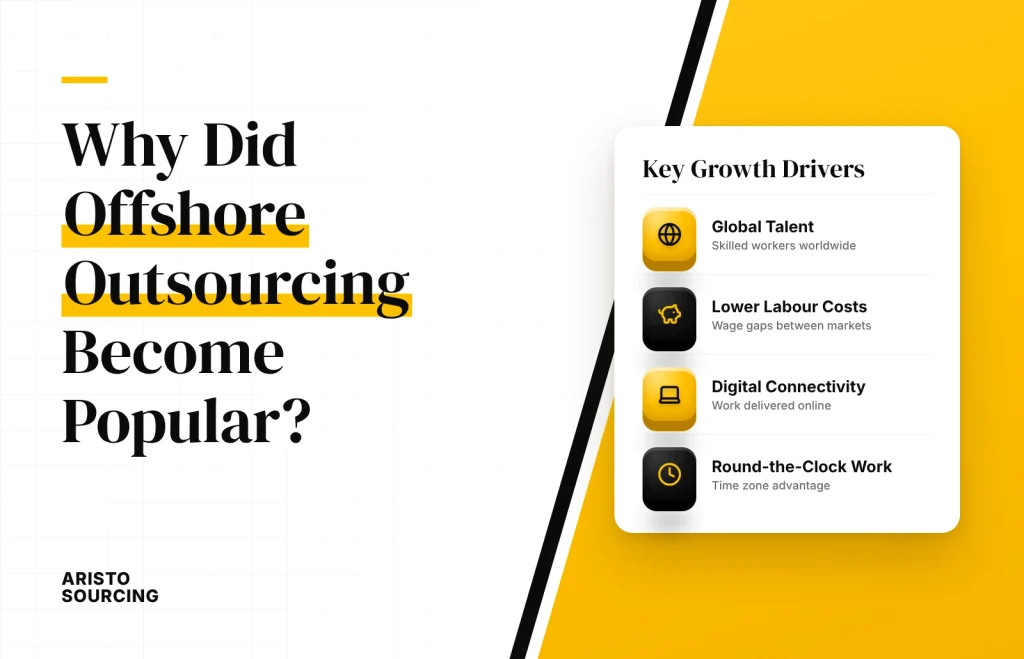
Offshore outsourcing became popular because it gave companies lower labor costs, access to skilled workers, and new markets during decades of rapid globalization. Lower labor costs came first, because workers in East Asia and Mexico earned a fraction of US wages, which let companies in the USA cut production costs sharply.
Access to skilled workers mattered next, as India and the Philippines built large pools of English-speaking graduates in engineering, IT, and business services. Better communication technology, from satellite links in the 1980s to broadband internet and cloud tools later, made it practical to manage offshore teams across continents. Trade liberalization through agreements such as NAFTA and the creation of the World Trade Organization lowered tariffs and opened new markets for cross-border work.
According to Deloitte’s 2020 Global Outsourcing Survey, 70% of surveyed executives cited cost reduction as a primary reason for outsourcing. Deloitte’s 2024 survey found that this share had dropped to 34%, as skilled talent and agility joined cost reduction as key drivers.
When Did the USA Start Offshoring Jobs?
The USA started offshoring jobs in the 1960s, when American electronics and manufacturing companies moved assembly work to lower-wage countries to compete with cheaper imports. Electronics manufacturing was the first industry affected, with radios, televisions, and semiconductor components assembled overseas, followed closely by textiles and apparel.
The first main destinations were East Asia, especially Hong Kong, Taiwan, and South Korea, and the northern Mexico border zone under the Maquiladora program. Services offshoring began much later, in the 1980s and 1990s, when telecommunications and computers made it possible to move IT and back-office work abroad. Over the following decades, different countries became good at different types of work, which explains why manufacturing, IT, and customer support each found a different home.
What Countries Shaped the History of Offshore Outsourcing?
The countries that shaped the history of offshore outsourcing include China, India, the Philippines, Mexico, and the countries of Eastern Europe, and each one led a different type of outsourced work.
The countries that shaped the history of offshore outsourcing are listed below.
- China in Manufacturing: China became the world’s leading manufacturing destination by combining a vast low-cost workforce, export-focused industrial zones, and large-scale infrastructure that few other countries could match. The key turning points were the economic reforms that began in 1978 and China’s membership in the World Trade Organization in 2001, which gave Chinese manufacturing stable access to global markets. By 2018, China was home to about a fifth of global manufacturing, according to Reuters.
- India in IT Outsourcing: India became the leading IT outsourcing destination by supplying large numbers of English-speaking engineers who could build, test, and maintain software for Western clients at a lower cost. The industry centered on IT services and software, and the 1991 economic reforms opened the market to foreign companies and export-focused technology parks.
- The Philippines in BPO and Customer Support: The Philippines became a leading BPO destination by offering strong English proficiency, a service-oriented workforce, and cultural familiarity with the United States, which suited voice-based customer support work. The Philippines overtook India in call center revenue in 2010, with an estimated $5.7 billion compared with India’s $5.5 billion, according to the Everest Group. By 2024, the Philippine IT-BPM industry employed about 1.82 million people and generated $38 billion in revenue, according to the IT and Business Process Association of the Philippines (IBPAP).
- Mexico in Manufacturing and Nearshoring: Mexico became a major manufacturing and nearshoring destination because its factories sit next to the US market, which cuts shipping time, simplifies logistics, and keeps working hours aligned. The industry grew around maquiladora assembly plants along the northern border, which turn imported parts into finished goods for export. Proximity to the US market remains the key driver, which is why Mexico is a leading choice for companies that move production out of Asia.
- Eastern Europe in Software Development: Eastern Europe became a major software development destination by producing strong engineering graduates in countries such as Poland, Ukraine, and Romania, with working hours that overlap with Western Europe. The region specializes in software engineering and IT services, and its technical education systems give companies access to global talent in complex fields such as cybersecurity and data engineering. Time zone overlap with Western Europe lets teams collaborate during the same business day.
What Is the Economic and Social Impact of Offshore Outsourcing?
The economic and social impact of offshore outsourcing involves cost savings and access to skilled workers for companies, alongside domestic job losses and new operational risks for workers and businesses. The cost savings come from labor arbitrage, the practice of paying lower wages abroad for work that costs more at home, and this cross-border wage gap makes offshore outsourcing different from other outsourcing models.
The same shift caused domestic job losses in manufacturing and later in IT and call center work, which turned offshoring into a political issue in the USA. Companies also faced quality concerns and operational risks, including communication gaps, data security threats, and dependence on a single vendor. Operational risks, rising overseas wages, and supply chain disruption later led some companies to start reshoring work back to their home countries.
What Is the Difference Between Offshore vs. Nearshore vs. Onshore Outsourcing?
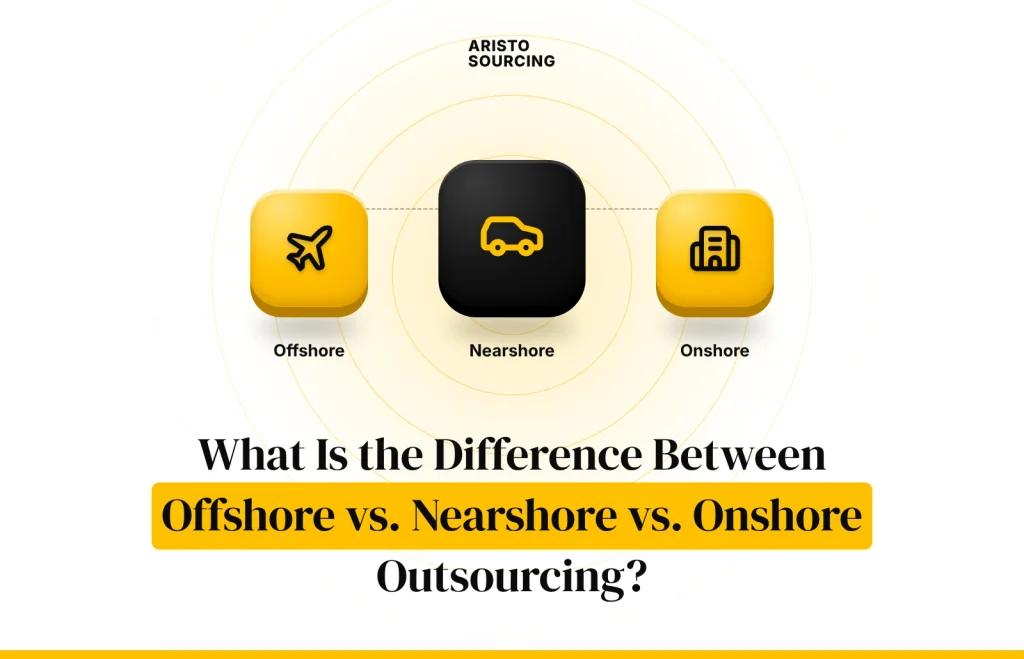
The main difference between offshore, nearshore, and onshore outsourcing is the distance and time zone gap between a company and its provider: offshore outsourcing uses a distant country, nearshoring uses a nearby country, and onshore outsourcing uses a provider in the same country. Offshore outsourcing grew first, through Asian electronics plants in the 1960s and Indian IT services in the 1990s, while nearshoring grew through Mexico’s maquiladoras and later through Latin American and Eastern European service hubs. Onshore outsourcing kept a steady role for work that needs a local presence, and it regained attention during the reshoring trend of the 2010s. The right model depends on the business goal, and because the future of outsourcing will likely blend all three, an experienced partner can help you compare the options.
What Is the Future of Offshore Outsourcing?
The future of offshore outsourcing is getting shaped by artificial intelligence, automation, and a growing demand for specialized human skills. Automation tools now handle many routine tasks that once filled offshore workdays, such as data entry, ticket routing, and basic reporting.
Human work is shifting toward oversight, analysis, and judgment, including reviewing AI output, handling exceptions, and managing customer relationships. According to Deloitte’s 2024 Global Outsourcing Survey, 83% of surveyed executives are already using AI as part of their outsourced services.
Specialized talent will remain a main reason to outsource, because AI raises the value of people who can design, manage, and improve these systems. Global talent and global collaboration will matter more as companies build teams that span several countries and time zones.
Location decisions are changing as well. Nearshoring is growing as companies move work closer to home to shorten time zone gaps and reduce exposure to geopolitical risk, such as trade disputes, tariffs, and regional conflicts. Data security regulations, including the EU’s General Data Protection Regulation (GDPR) and the EU AI Act, are pushing companies toward locations and providers that can prove compliance. Businesses also increasingly want partners that can build dedicated offshore teams and manage hiring, payroll, and compliance for them.
How to Choose an Offshore Outsourcing Partner?
Choosing an offshore outsourcing partner starts with a clear business goal, because the goal decides which roles, skills, and locations you need. From there, a simple selection framework checks four more areas: talent quality and location, security and compliance, transparent pricing, and replacement and retention terms.
A strong partner gives you vetted global talent in a workable time zone, protects your data with clear security practices, explains its fees up front, and backs each hire with a replacement guarantee. The selection framework reflects the history of offshore outsourcing, because companies that chased cost alone often ran into quality problems, communication gaps, and costly reshoring decisions. The lesson from six decades of offshoring is that quality, communication, and risk control matter as much as price.
How Is Aristo Sourcing Helping with Offshore Outsourcing Through History?
Aristo Sourcing is helping businesses with offshore outsourcing through history by applying the lessons of the history of outsourcing to a modern remote staffing model. Founder Mads Singers had used virtual assistants since 2007, and he founded Aristo Sourcing in January 2014 to help companies build remote workforces without setting up their own recruitment or offshore management infrastructure. Since then, Aristo Sourcing has recruited talent primarily from the Philippines and South Africa, two hubs with strong English proficiency and time zones that can cover US, European, and Asia-Pacific working hours.
Aristo Sourcing builds each dedicated offshore team from pre-vetted talent, and every candidate completes a knowledge, skills, and abilities (KSA) evaluation, a criminal background check, and a signed NDA before a client sees the profile. Every hire also comes with a dedicated account manager, structured onboarding, and a replacement guarantee during the 30- to 60-day trial period.
Early offshoring chased cost alone, and Aristo Sourcing’s model is built around the quality, communication, and risk lessons that came after. As AI automates more routine tasks, the future of offshoring will favor this kind of model, where skilled people handle the judgment-based work that machines cannot.