
IT outsourcing refers to hiring external vendors to manage a company’s IT functions. Companies outsource information technology services across 4 primary models, including onshore, nearshore, offshore, and multisourcing, to get the benefits of cutting costs, accessing specialized expertise, and keeping internal teams focused on core priorities.
The main service areas covered include help desk support, cybersecurity, cloud and infrastructure management, software development, and network operations. Pricing follows one of 4 contract structures, including time-and-materials, fixed-price, unit-based, or outcome-based. Increasingly, AI is reshaping the economics of this industry by automating routine tasks and shifting the value of outsourcing from labor volume to strategic capability.
What Is IT Outsourcing?
IT outsourcing is the contractual arrangement in which an organization delegates its IT services, infrastructure, or operational functions to a third-party external provider. According to Statista’s IT Outsourcing Market Report, the global IT outsourcing market revenue reached approximately $514 billion in 2023, hit $617 billion in 2024, and is projected to grow significantly to over $800 billion by 2030. IT outsourcing spans a wide range of functions, including infrastructure, application development, technical support, security operations, and end-user services are the most common workloads transferred to vendors.
IT outsourcing differs from business process outsourcing (BPO) as BPO delegates broader operational functions such as HR, finance, and supply chain, while IT outsourcing is confined strictly to technology-specific services and systems. The core aim of IT outsourcing is to access specialized talent, reduce operational costs, and provide the freedom to redirect internal resources toward higher-value, core business activities. Organizations exploring different types of IT outsourcing select their engagement model based on cost tolerance, collaboration requirements, compliance obligations, and the strategic criticality of the function being delegated.
What Are the 4 Types of IT Outsourcing?
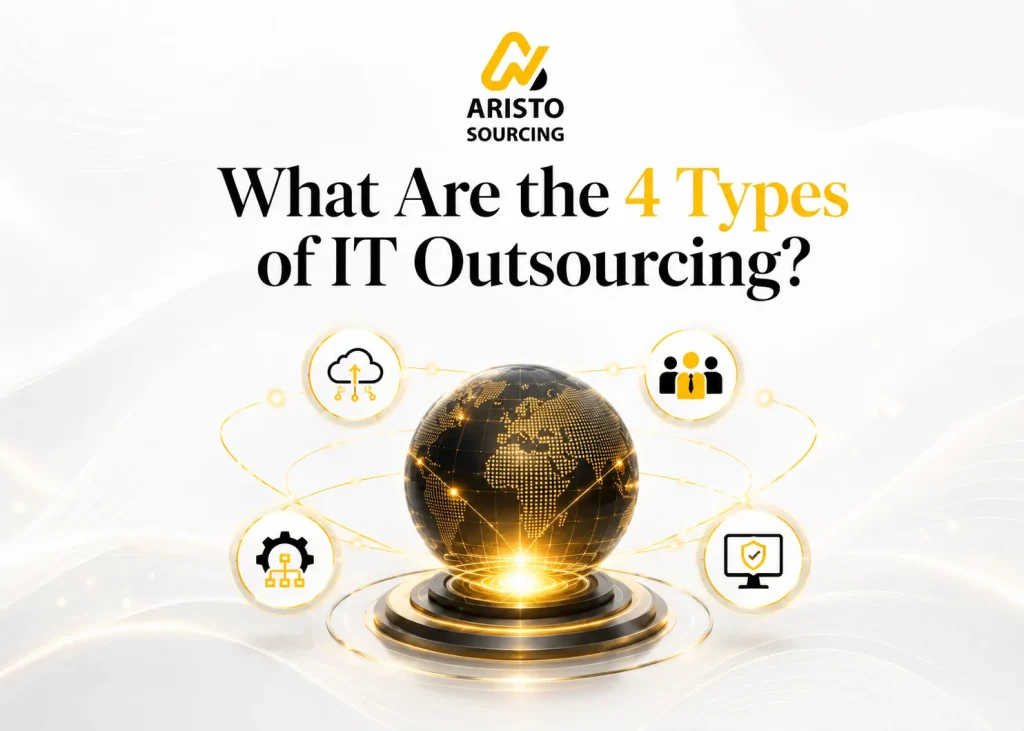
The 4 types of IT outsourcing include onshore IT outsourcing, nearshore IT outsourcing, offshore IT outsourcing, and multisourcing.
The 4 types of IT outsourcing are listed below.
- Onshore IT Outsourcing
- Nearshore IT Outsourcing
- Offshore IT Outsourcing
- Multisourcing (Multi-Vendor IT Outsourcing)
1. Onshore IT Outsourcing
Onshore IT outsourcing is the practice of contracting an IT service provider located within the same country as the client organization to manage defined technology functions. The client and provider share the same language, time zone, and cultural context, which eliminates scheduling friction and reduces the likelihood of miscommunication during project execution.
Collaboration is more natural at every level, including kickoff sessions, sprint reviews, and escalations; all operate on the same working calendar and within the same regulatory environment, simplifying contract compliance significantly. The trade-off is that onshore vendors charge the highest rates of the three location-based models, and the talent pool is limited to the domestic labor supply. This constraint can slow team scaling precisely when specialist capacity is needed quickly.
2. Nearshore IT Outsourcing
Nearshore IT outsourcing is the practice of engaging an IT provider based in a neighboring country or a region with closely aligned time-zone overlap to deliver outsourced technology services. The model balances cost reduction with the ability to conduct synchronous meetings and real-time collaboration without extreme scheduling adjustments or overnight communication gaps.
A US-based company partnering with a provider in Mexico, Colombia, or Canada represents a typical nearshore arrangement. Geographically close enough for same-day response cycles, yet different enough in labor markets to offer meaningful cost savings relative to domestic providers. Nearshore IT outsourcing suits organizations in sectors such as financial services, healthcare, and retail technology that require agile delivery rhythms, frequent stakeholder interaction, and faster iteration cycles than offshore models typically support.
3. Offshore IT Outsourcing
Offshore IT outsourcing is the practice of contracting an IT provider located in a geographically distant country, typically to access lower labor costs and large pools of technically trained professionals at scale. The most established offshore destinations include Bangladesh, India, and the Philippines, along with Eastern European countries, particularly Poland, Romania, and Ukraine. Each offers a mature IT talent ecosystem, supported by a strong STEM educational pipeline. The cost advantage is the most pronounced of any IT outsourcing model. Hourly developer rates in established offshore markets routinely run 60–75% lower than comparable US domestic rates, making offshore the default choice for cost-driven IT outsourcing decisions. The trade-offs involve time-zone separation, which can slow approval cycles and create asynchronous communication dependencies, and the additional process rigor required to manage handoffs, specifications, and quality assurance effectively across distances.
4. Multisourcing (Multi-Vendor Outsourcing)
Multisourcing, also known as multi-vendor IT outsourcing, is a strategy in which a company distributes its IT functions across multiple specialized external vendors rather than consolidating them with a single provider. The model is beneficial when no single vendor can match best-in-class performance across every required function; one vendor may lead in infrastructure management, another in application development, and a third in cybersecurity monitoring.
Avoiding vendor lock-in is a primary reason organizations adopt multisourcing. It allows them to renegotiate contracts or replace underperforming vendors for specific functions without disrupting the broader IT environment, increasing flexibility and strengthening their position during contract renewals. However, multisourcing delivers these benefits only when supported by mature governance. Organizations need aligned contracts, consistent visibility into vendor performance, and a dedicated vendor management function. Without these capabilities, multisourcing can increase coordination complexity and reduce the advantages gained from using multiple vendors.
What Are the Benefits of IT Outsourcing?
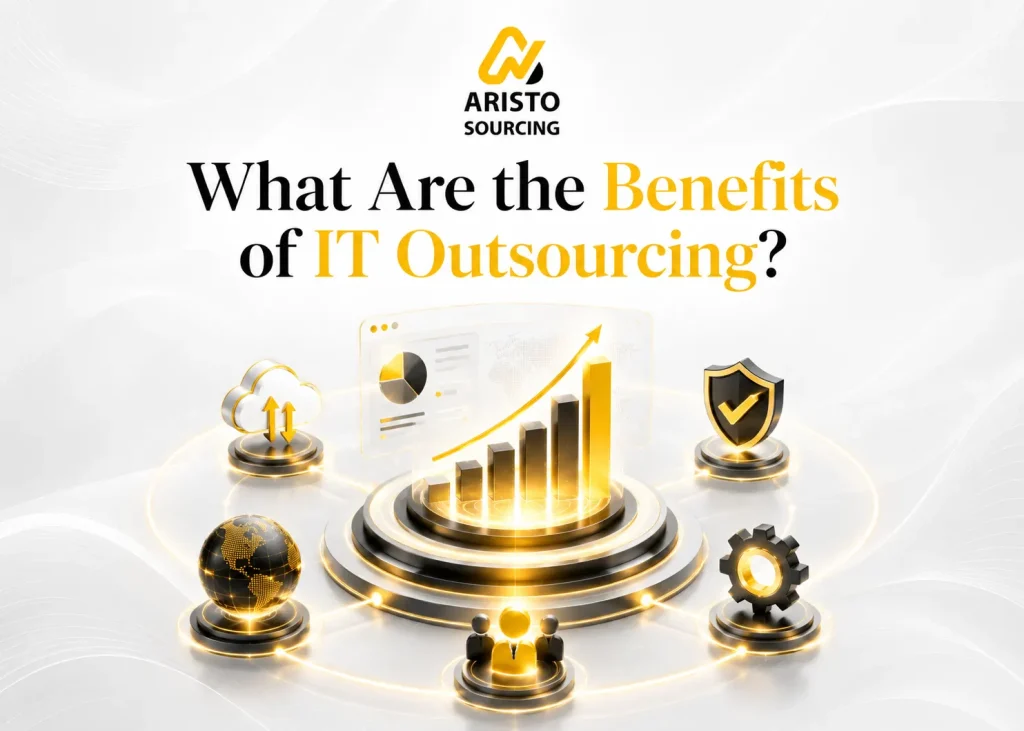
The benefits of IT outsourcing include reduced costs, access to specialized expertise, sharper focus on core business, scalability and flexibility, and improved security.
The benefits of IT outsourcing are listed below.
- Reduces Costs
- Leverages Specialized Expertise
- Preserves Focus on Core Business
- Provides Scalability and Flexibility
- Improves Security
Reduces Costs
Cost reduction is the primary driver of IT outsourcing decisions, achieved by replacing high fixed-cost internal IT departments with variable-cost vendor contracts priced against defined service levels. Labor arbitrage, particularly through offshore and nearshore delivery models, allows organizations across different industry types, from manufacturing and retail to healthcare and financial services, to access equivalent or superior technical capability at a fraction of domestic salary rates.
A mid-sized US company outsourcing its help desk and infrastructure management offshore can realistically reduce IT operational costs by 30–50% annually while eliminating the overhead associated with in-house recruiting, benefits administration, and attrition replacement. Beyond labor, outsourcing removes the capital expenditure required to maintain on-premises hardware, shifting IT spend from unpredictable CapEx cycles to predictable, budgetable OpEx, which simplifies financial planning across organizations of every size.
Leverages Specialized Expertise
IT outsourcing gives organizations access to deep technical expertise that most internal teams cannot justify hiring, onboarding, and retaining at the required skill level. Cybersecurity engineering, cloud architecture, AI/ML integration, and enterprise application development all represent domains where the talent market is expensive, competitive, and requires continuous upskilling to remain effective as the technology landscape evolves.
Outsourcing partners that specialize in these areas often operate at a scale that individual organizations cannot easily match. They maintain certified professionals, current threat intelligence, ongoing research and development programs, and proven delivery frameworks. Developing comparable capabilities internally can require substantial time, investment, and resources. This expertise is particularly valuable for organizations with complex regulatory requirements. For example, healthcare providers must comply with HIPAA, financial institutions with PCI-DSS, and government contractors with FedRAMP. By working with specialized outsourcing partners, these organizations can access qualified expertise more quickly and with less implementation risk than building equivalent capabilities internally.
Preserves Focus on Core Business
Delegating IT operations to a managed service provider frees leadership bandwidth and internal engineering capacity to concentrate on the activities that directly drive the company’s competitive position and revenue growth. An e-commerce business internally managing its own infrastructure patch cycles, help desk queues, and network uptime monitoring is consuming engineering hours that could otherwise accelerate product development, improve customer experience, or enable faster market entry.
IT outsourcing converts a reactive, resource-intensive operational function into a managed service running against defined SLAs, reducing the cognitive load on internal stakeholders and allowing them to focus forward rather than backward. The organizational benefit compincludingr time: as vendor relationships mature and handoff processes stabilize, the internal overhead required to oversee IT functions decreases further, returning progressively more capacity to core business priorities.
Provides Scalability and Flexibility
Outsourced IT structures allow companies to adjust their technology capacity in direct response to business demand without the lag, cost, and complexity of recruiting and onboarding permanent staff. Project-based software development, seasonal infrastructure scaling during peak demand periods, and rapid geographic expansion are all scenarios where internal headcount models cannot respond quickly enough to be commercially viable.
An outsourced arrangement enables a company to deploy a 20-person development team for a 6-month product launch and then release that capacity when the engagement concludes, a level of staffing elasticity that is structurally impossible with a fixed internal workforce. This flexibility is particularly valuable across different industry types that face unpredictable demand cycles, including retail organizations scaling for peak season, healthcare systems responding to outbreak events, and SaaS companies scaling infrastructure ahead of product launches.
Improves Security
Engaging a specialized managed security provider typically strengthens an organization’s security posture relative to an internally managed function, contrary to the common assumption that outsourcing introduces risk. Dedicated managed security service providers (MSSPs) operate Security Operations Centers (SOCs) with 24/7 monitoring, threat hunting, incident response, and forensic investigation capabilities that most organizations cannot staff or fund at the required level without prohibitive internal investment.
Compliance is another benefit of IT outsourcing. Providers that serve regulated industries often maintain certifications such as SOC 2 Type II, ISO 27001, and FedRAMP. They can also assist with audit preparation and evidence collection, reducing the workload placed on internal teams. IT outsourcing can also strengthen an organization’s security posture. Specialized providers invest heavily in security capabilities because their reputation and business success depend on protecting client systems and data. As a result, they often take a proactive approach to risk management. Internal security teams may face competing budget demands and changing organizational priorities, which can limit their ability to maintain the same level of focus and investment.
What Are the Main Areas of IT Outsourcing?
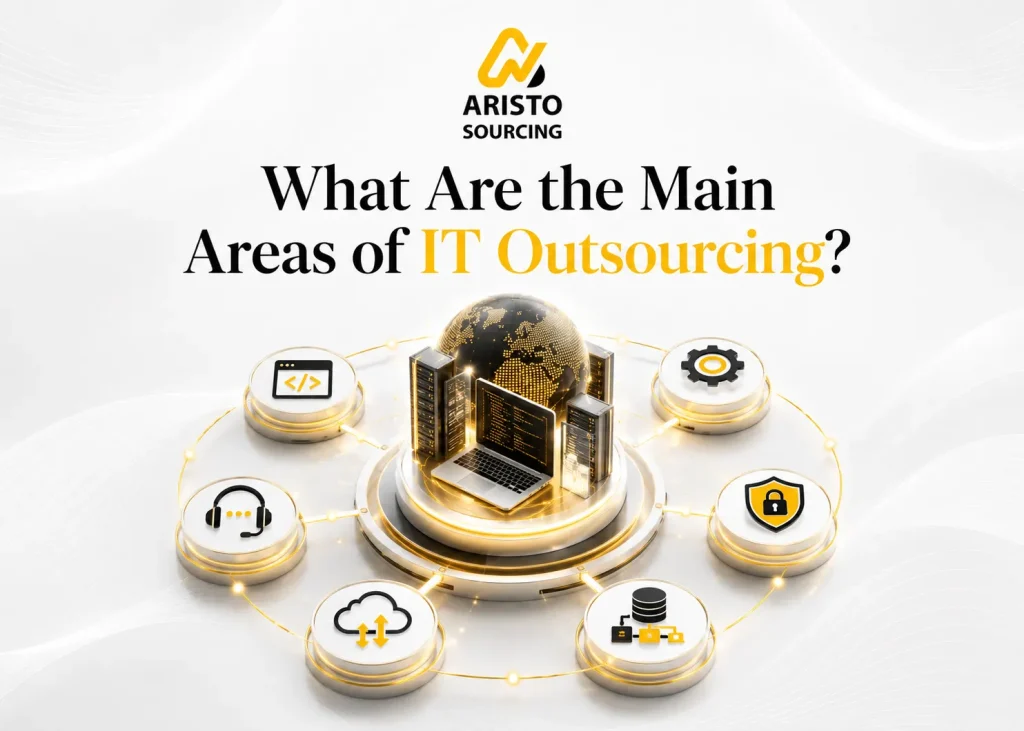
The main areas of IT outsourcing involve help desk and IT support, cybersecurity, cloud and infrastructure management, software development, and network and IT operations management.
The main areas of IT outsourcing are listed below.
- Help Desk and IT Support
- Cybersecurity
- Cloud and Infrastructure Management
- Software Development
- Network and IT Operations Management
Help Desk and IT Support
Help desk and IT support refers to the outsourced delivery of frontline technical assistance to end users, covering hardware issues, software errors, access and account problems, and connectivity failures across an organization’s IT environment. The service typically encompasses tiered support (Tier 1 through Tier 3), ITSM ticketing management, incident logging, knowledge base maintenance, and escalation protocols that route complex issues to specialist resolution teams.
Companies outsource help desk functions to eliminate the pricing costs of staffing a 24/7 internal support operation, which requires rotating shifts, absence coverage buffers, and continuous training investment as the IT environment changes. When evaluating providers, prioritize defined SLA response and resolution times with financial penalties for breach, multilingual capability for geographically dispersed workforces, and proven integration experience with your existing ITSM platform — whether ServiceNow, Jira Service Management, or Zendesk. Pricing costs in this area typically follow a per-ticket or per-seat monthly model, which converts an unpredictable internal cost center into a volume-aligned, forecastable line item.
Cybersecurity
Cybersecurity IT outsourcing is the practice of contracting external specialists to monitor, detect, investigate, and respond to threats across an organization’s IT environment on an ongoing basis. Services in this domain include SOC monitoring, vulnerability management, penetration testing, endpoint detection and response (EDR), security information and event management (SIEM), and regulatory compliance reporting.
Organizations often outsource cybersecurity because building and maintaining equivalent internal capabilities can be costly and resource-intensive. A fully staffed, 24/7 security operations center (SOC) requires specialized tools, threat intelligence resources, and qualified analysts, all of which can be difficult to acquire and retain, particularly for organizations below enterprise scale. The financial impact of cybersecurity incidents further supports this decision. According to IBM’s Cost of a Data Breach Report 2023, the average cost of a data breach was $4.45 million per incident. This highlights cybersecurity investment as an important risk management strategy rather than a discretionary expense. When evaluating cybersecurity providers, organizations should verify that they maintain relevant certifications, such as SOC 2 Type II, ISO 27001, or industry-specific credentials. They should also demonstrate experience managing the regulatory and compliance requirements applicable to the organization’s industry and jurisdiction.
Cloud and Infrastructure Management
Cloud and infrastructure management refers to the outsourced administration, optimization, and ongoing monitoring of an organization’s cloud platforms, physical servers, storage systems, virtualization layers, and networking components. Managed services in this area cover cloud provisioning, patch and configuration management, cost optimization and FinOps, disaster recovery orchestration, and uptime SLA enforcement across AWS, Azure, Google Cloud, and hybrid or multi-cloud architectures.
Companies outsource this function because cloud architecture and cost management require specialized expertise that evolves rapidly as hyperscalers continuously release new services, deprecate features, and restructure pricing — knowledge that is difficult to maintain in-house without dedicated investment. Pricing costs in this domain typically follow a monthly managed services retainer or a percentage-of-cloud-spend model, with the latter directly aligning provider incentives with client efficiency improvements. Providers should hold active certifications from the relevant cloud platforms (AWS Partner, Microsoft Azure Expert MSP, Google Cloud Partner) and must demonstrate proven experience with your specific stack and workload profile.
Software Development
Software development outsourcing refers to contracting external engineering teams to design, architect, build, test, and maintain software applications, APIs, data pipelines, or digital products on behalf of the client organization. Engagement scope ranges from selective staff augmentation, which places individual offshore developers within an existing internal team, to fully outsourced product development, where the vendor owns the entire delivery lifecycle.
Companies pursue software development outsourcing to accelerate time-to-market, access specific technology stacks or specialized frameworks, and manage the costs of maintaining a full-time engineering team through variable workload periods. The 3 primary engagement models are staff augmentation, dedicated development team, and fixed-scope project-based delivery; each carries different cost structures, oversight requirements, and risk profiles, and the right choice depends on how clearly the scope and timeline can be defined upfront. Providers should demonstrate proficiency in your exact technology stack, a defined QA and testing process with documented defect resolution SLAs, and contractual IP ownership clauses that explicitly transfer ownership of all work product to the client.
Network and IT Operations Management
Network and IT operations management refers to the external administration and monitoring of a company’s network infrastructure, such as routers, switches, firewalls, VPN gateways, WAN and SD-WAN connections, load balancers, and the systems that maintain operational uptime across the entire environment. This service area encompasses network performance monitoring, device configuration management, security policy enforcement, firmware and patch management, incident response, and capacity planning aligned to business growth projections.
Organizations outsource this function to reduce the pricing costs of employing specialized network engineers internally — professionals who are expensive, difficult to retain competitively, and are often significantly underutilized outside of active incident windows or major infrastructure changes. Providers should operate a dedicated Network Operations Center (NOC) with 24/7 coverage, clearly defined escalation paths, and contractual mean-time-to-resolution (MTTR) SLAs that carry financial accountability. The provider’s tooling ecosystem is a critical practical consideration; whether they integrate with your existing monitoring infrastructure or require substituting your current stack with vendor-preferred tools will affect both transition costs and ongoing operational workflow.
How Much Does IT Outsourcing Cost?
IT outsourcing costs typically range from $15 to over $250 per hour, depending on the service type, provider location, and engagement model. The most common pricing structures include time and materials, fixed price, usage-based, and performance-based models. Time and materials contracts bill based on hours worked and resources used, offering flexibility but less predictable total cost.
Fixed-price contracts set a defined cost for a clearly specified scope, providing budget certainty but requiring detailed requirements upfront. Usage-based pricing charges according to consumption, such as per ticket, user, or managed device, and is common in support and cloud services. Performance-based pricing ties compensation to outcomes such as uptime, service levels, or delivery milestones, aligning cost with results.
Rates also vary significantly by geography. Onshore providers in the United States and Canada typically charge the highest rates, while nearshore providers in regions such as Latin America and Eastern Europe are generally lower, and offshore providers in countries like India and the Philippines are often the most cost-effective. Infrastructure management, help desk, and cybersecurity services are more frequently priced using monthly or per-unit models rather than hourly billing.
In addition to rates, organizations should account for hidden costs that can materially affect total spend. These include the internal effort required for vendor selection, onboarding, and contract negotiation, as well as the time needed for knowledge transfer and transition during the early phases of an engagement. Ongoing vendor management also adds overhead through governance meetings, performance tracking, and scope coordination.
These indirect costs can accumulate over time, meaning that the lowest hourly rate does not always translate into the lowest overall cost when delivery quality and management effort are considered.
How to Choose an IT Outsourcing Provider?
To choose an IT outsourcing provider, begin by defining your ranked priorities, including cost efficiency, delivery speed, or access to specialized technical expertise as these will determine the right delivery model and narrow the vendor landscape before formal evaluation begins. Key evaluation criteria include a verifiable track record in the specific service area, client references from similar organizations, relevant security certifications, clear and enforceable SLAs with measurable penalties, and strong communication processes including escalation paths, reporting cadence, and language capability. Providers should also be assessed on whether they use artificial intelligence in their delivery processes in a transparent and controlled way, particularly for automation, support, or software development tasks.
Before signing a contract, confirm who owns the intellectual property for all deliverables, what exit and transition support terms apply if the relationship ends, and how scope changes are managed and priced during delivery. Red flags include unverifiable claims or case studies, weak or non-binding SLAs with broad liability exclusions, proposals without named team members or role assignments, and pricing that excludes onboarding, transition, or knowledge transfer costs that later appear as change orders.
How Is AI Changing the Future of IT Outsourcing?
AI is reshaping IT outsourcing by automating routine, high-volume tasks that have historically made up much of outsourced IT work, compressing the labor-arbitrage advantage and shifting differentiation toward higher-value technical expertise. This affects many service areas of IT outsourcing, including help desk triage, incident management, monitoring, testing, and security scanning, where automation is reducing reliance on manual effort and changing how different types of IT outsourcing are delivered.
As a result, pricing models in IT outsourcing are shifting. Traditional volume-based approaches such as per-ticket or hourly billing are giving way to output-based and outcome-based models that focus on service quality, reliability, and results rather than headcount or activity levels. These changes are increasingly reflected in the benefits of IT outsourcing, where cost savings are no longer the only driver, and efficiency, speed, and capability also matter.
This shift is also changing the balance between onshore, nearshore, and offshore providers. Geography matters less when AI can handle standardized tasks, increasing competition across delivery models and making capabilities like domain expertise, advisory quality, and AI-enabled delivery toolchains more important than labor cost alone. Organizations evaluating IT outsourcing today should account for these changes, as providers adopting artificial intelligence tend to remain more competitive as automation expands across core IT service areas.