
The difference between outsourcing and managed services involves scope, relationship structure, and accountability. Outsourcing refers to delegating a specific task or function to an external provider. Managed services refer to ongoing, proactive management of a business function under a subscription contract.
Cost-wise, outsourcing tends to be cheaper upfront but variable, while managed services carry a predictable monthly fee that reduces long-term risk. For most businesses running continuous, compliance-sensitive operations, managed services deliver stronger ROI. For one-off or project-based work, outsourcing remains the leaner choice.
In 2026, AI, cloud, and next-generation MSP models are reshaping both categories, introducing agentic automation, predictive monitoring, and outcome-based pricing that blur the traditional lines between managed services and outsourcing.
What Is Outsourcing?
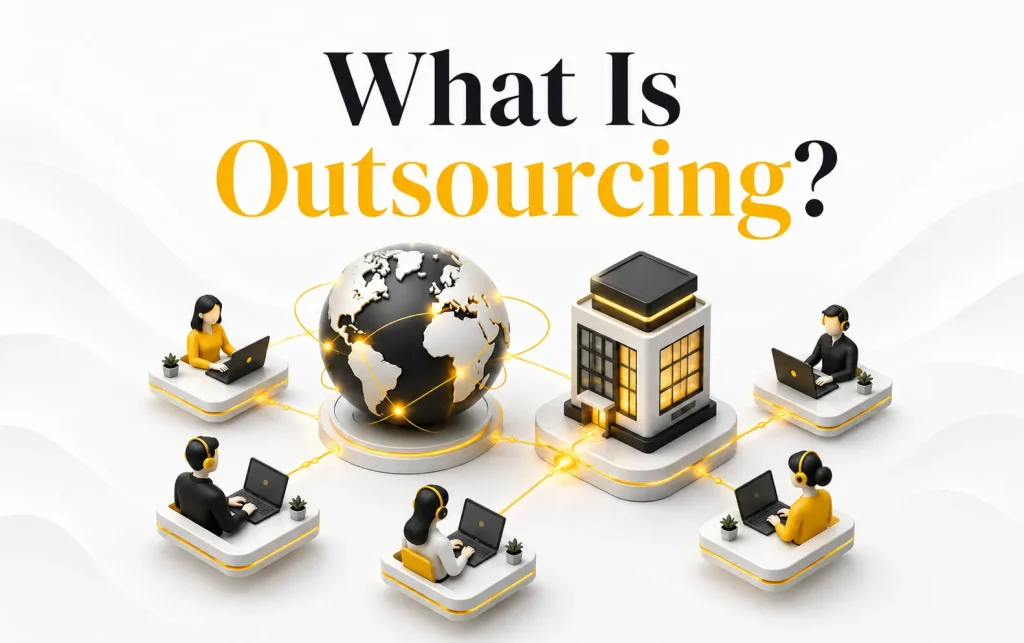
Outsourcing is the strategic delegation of a specific task, process, or function to an external third-party provider rather than performing it with in-house staff or resources. It works by transferring responsibility for a defined scope of work, such as data entry, software development, or payroll processing, to an outside vendor, typically under a project-based or time-bound contract.
The types of outsourcing span business process outsourcing (BPO), knowledge process outsourcing (KPO), and information technology outsourcing (ITO). Geographically, it falls into onshore, nearshore, and offshore models. Functions commonly outsourced include customer support, software development, accounting, HR administration, content production, and manufacturing.
Outsourcing is growing in popularity as organizations pursue leaner operations, faster execution, and specialized expertise without permanent hiring commitments. According to Deloitte’s Global Outsourcing Survey, only 34% of executives now cite cost reduction as their primary outsourcing driver, while 42% prioritize gaining access to specialized talent. Roles best suited for outsourcing include non-core, repeatable, or project-specific functions where consistent quality can be verified through deliverables.
What Are the Advantages of Outsourcing?
The advantages of outsourcing are listed below.
- Reduces Operating Costs Immediately: Outsourcing eliminates payroll, benefits, and overhead tied to permanent headcount, cutting costs fast.
- Scales Up or Down Without Hiring: Workloads expand or contract without long-term staffing commitments or severance obligations, or any other disadvantages.
- Unlocks Specialized Expertise On-Demand: Businesses access niche skills such as legal, technical, or creative, without training or retaining full-time specialists.
- Accelerates Project Deployment: External vendors with ready teams can mobilize faster than internal hiring pipelines allow.
- Enables Geographic Cost Arbitrage: Offshore outsourcing, particularly to regions like the Philippines, India, or Vietnam, can reduce staff costs by up to 70% compared to onshore equivalents.
Are There Any Disadvantages of Outsourcing?
Yes, there are a few disadvantages of outsourcing, such as reduced control over quality, potential data security risks, communication friction across time zones, and inconsistent output when vendor incentives don’t align with client expectations. These are generally negligible when properly managed.
Businesses can avoid most disadvantages of outsourcing by setting precise deliverable standards in contracts, conducting vendor due diligence, using secure data-sharing protocols, and maintaining a dedicated internal point of contact. It’s worth noting that outsourcing is very different from managed service in one key and that is the client retains full operational risk and remains responsible for oversight.
What Is a Managed Service?
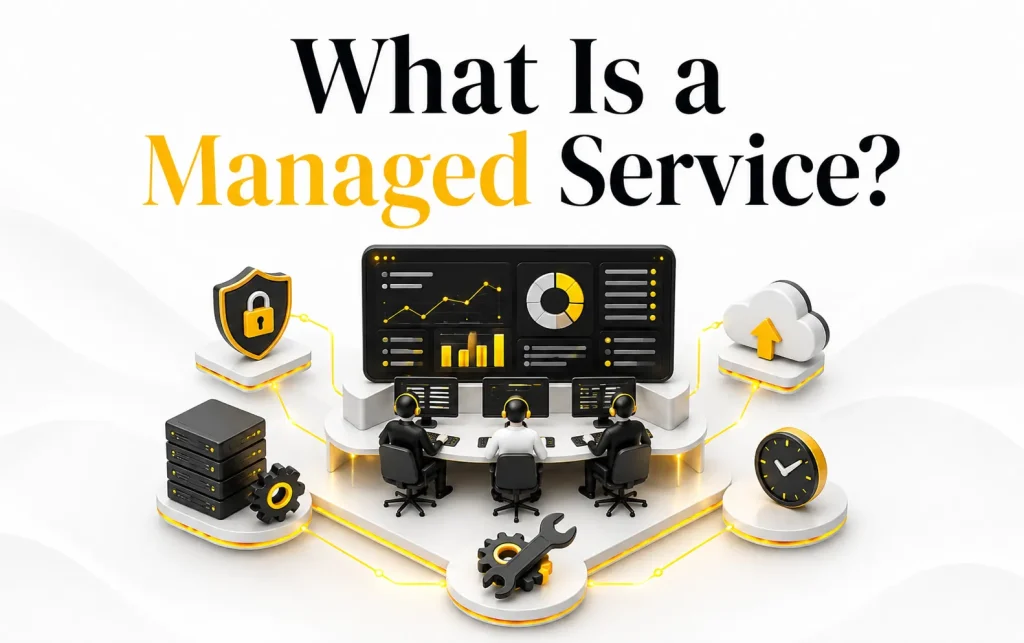
Managed service is the ongoing, proactive management of a defined business function by a third-party provider under a subscription-based service level agreement (SLA), where the provider assumes operational responsibility for performance and uptime. It works by embedding the managed service provider (MSP) as a continuous operational partner, monitoring systems, resolving issues, maintaining compliance, and delivering regular performance reporting, all within an agreed SLA framework.
Common types of managed services include managed IT services, managed security (MSSP), managed cloud, managed network, managed print, and managed compliance. Managed services are growing in popularity because organizations increasingly require always-on functions such as cybersecurity, cloud infrastructure, and endpoint management that demand 24/7 attention no internal team can sustain cost-effectively.
According to MarketsandMarkets, the global managed services market is projected to grow from $161 billion in 2021 to $311 billion by 2027, reflecting scale-driven demand for MSP benefits like predictability, accountability, and proactive risk management. Functions best suited for managed services include IT infrastructure, network operations, security monitoring, compliance management, and cloud operations.
What Are the Advantages of Managed Services?
The advantages of managed service are listed below.
- Delivers Predictable Monthly Costs: Fixed subscription fees eliminate surprise expenses and allow accurate budgeting without capital expenditure spikes.
- Provides 24/7 Monitoring and Availability: MSPs maintain continuous oversight, catching and resolving issues before they escalate into outages.
- Supplies Multi-Skillset Teams Immediately: Clients gain access to a cross-functional pool of specialists such as network engineers, security analysts, and cloud architects, without the disadvantages of individual hires.
- Includes Built-In Compliance Management: Providers integrate regulatory requirements like HIPAA, PCI DSS, SOC 2, and GDPR directly into their service delivery model.
- Prevents Issues Before They Occur: Proactive monitoring and maintenance reduce downtime and eliminate the reactive firefighting that consumes internal IT teams.
According to research from Gartner, organizations moving to managed services reduce their overall IT costs by 25% to 45% over three years. This predictable, subscription-based model allows CFOs to confidently forecast spending and completely bypass the volatile overhead of maintaining an expansive in-house IT team.
What Are the Disadvantages of Managed Service?
The disadvantages of managed service include higher monthly commitment costs compared to one-off outsourcing, potential vendor lock-in when proprietary tooling becomes deeply embedded, reduced direct control over day-to-day operations, and slower customization cycles when the client’s needs diverge from the provider’s standard service catalog.
The difference with outsourcing here is structural; outsourcing preserves client control and flexibility but transfers no operational risk, while managed services transfer risk and reduce control in exchange for reliability. Businesses can avoid these disadvantages by negotiating flexible exit clauses, insisting on open-standard tooling where possible, and conducting quarterly business reviews to keep the MSP aligned with evolving priorities.
What Is the Difference Between Managed Services and Outsourcing?
The difference between managed services and outsourcing includes structure, accountability, pricing, and the nature of the provider relationship.
The difference between managed services and outsourcing is presented below.
- Difference in Approach: Managed services operate on proactive prevention, identifying and resolving issues before they surface, while outsourcing executes reactive task completion when instructed by the client.
- Difference in Scope: Managed services cover comprehensive, end-to-end function management; outsourcing addresses a narrowly defined task or project scope.
- Difference in Relationship: Managed services establish a long-term strategic partnership where the MSP acts as an operational extension of the business; outsourcing creates a transactional engagement that ends when the deliverable is complete.
- Difference in Pricing: Managed services use predictable monthly subscriptions structured as operating expenditure (OpEx); outsourcing is typically priced per project or per hour, structured as capital expenditure (CapEx).
- Difference in Accountability: In a managed service model, the provider assumes system risk and is bound by SLAs; in outsourcing, the client retains ultimate accountability for outcomes.
- Difference in Delivery Focus: Managed services are outcome-driven — targeting uptime, optimization, and continuous improvement; outsourcing is output-driven, focused on completing a defined ticket or task.
- Difference in Talent Allocation: MSPs deploy shared pools of cross-functional experts across clients; outsourcing typically assigns named, siloed headcounts to a specific client engagement.
- Difference in Tech Stack Control: In managed services, the MSP introduces, manages, and updates tooling; in outsourcing, the client mandates and provides the tools the vendor must use.
- Difference in Business Alignment: Managed services embed an integrated strategic roadmap within the client’s operations; outsourcing runs as an isolated and independent type of engagement outside the client’s core strategy.
Are Managed Services a Type of Outsourcing?
Yes, managed services are a type of outsourcing, because both involve a third-party provider performing work on behalf of the client rather than the client performing that work internally. The relationship is hierarchical: all managed services are a form of outsourcing, but not all outsourcing is managed services.
Standard outsourcing covers a much broader category, including one-time projects, staff augmentation, different cost structures, and BPO, while managed services represent a specific, structured subset defined by continuous delivery, SLAs, and proactive provider accountability.
How Much Do Managed Services and Outsourcing Cost?
Managed IT services and outsourcing costs range from $100 to $400 per user per month, depending on service scope, industry complexity, compliance requirements, and provider tier.
The pricing structure of managed services and outsourcing is presented below.
Managed services pricing structures:
- Fixed Monthly Subscription (Per-Organization): A flat fee covering all contracted services for the entire organization, regardless of usage volume.
- Per-User or Per-Device Pricing: Costs scale directly with the number of covered users or endpoints, offering clean budget predictability.
- Tiered Subscription (Bronze/Silver/Gold): Packaged service levels allow businesses to select coverage depth based on their budget and operational risk tolerance.
- Consumption-Based Pricing: Fees align with actual resource usage, common in managed cloud services, making costs variable but usage-justified.
- Stair-Step Pricing: Volume thresholds trigger pricing tiers, rewarding growth with lower per-unit costs.
- Risk-Reward Sharing Arrangements: The provider’s compensation is partially tied to performance outcomes, aligning incentives between client and MSP.
Outsourcing pricing structures:
- Hourly Rate: Common for staff augmentation and development work; costs vary widely by geography and skill level.
- Per-Project Fixed Fee: A defined price for a scoped deliverable, suitable for software builds, migrations, or design projects.
- Time-and-Materials: Flexible billing for variable-scope work, where the client pays for actual hours and resources consumed.
- Retainer + Variable: A baseline monthly retainer covering a set capacity, with variable fees for work exceeding that threshold.
For context on scale: According to CompTIA, 46% of businesses using managed IT services cut annual IT costs by 25% or more. The managed services market is growing from $161 billion (2021) to a projected $311 billion by 2027. For outsourcing, Emapta data shows a good example of offshore outsourcing; offshore staff-heavy functions can reduce labor costs by up to 70% compared to domestic equivalents.
What Are the Examples of Managed Services and Outsourcing in Practice?
The in-practice examples of managed services and outsourcing are presented below.
- Managed IT Services and Managed Network Outsourcing: An MSP takes full ownership of a company’s infrastructure, servers, routers, endpoints, monitoring performance 24/7, applying patches, and managing network uptime under a monthly SLA.
- Managed Security, Compliance, and Cloud Services: A managed security service provider (MSSP) handles continuous threat monitoring, SOC operations, cloud posture management, and regulatory compliance, including HIPAA or SOC 2 reporting, as a bundled subscription service.
- Outsourced Helpdesk, Data Entry, and Back-Office Functions: A BPO provider handles defined, repeatable tasks, ticket resolution, invoice processing, and customer data entry, billed per transaction or per agent hour, with no ongoing management responsibility.
- Project-Based Outsourcing for Software Development, Cloud Migration, and Application Builds: A company hires an external development team for a fixed-scope engagement: building a web application, migrating a legacy system to AWS, or delivering a mobile product. When the project closes, the engagement ends. Deciding between MSP and outsourcing for these scenarios comes down to whether the function continues after the project concludes.
How to Decide Between Managed Services and Outsourcing?
To decide between managed services and outsourcing, a corporation should ask questions such as the nature of the function, budget structure, compliance obligations, and internal management capacity.
The questions a corporation or business should ask to decide between managed services and outsourcing are listed below.
- Is the function ongoing or one-off?
- Is the function mission-critical or non-core?
- Is the budget structured for OpEx or CapEx?
- Do you need predictability or flexibility in cost?
- Do you have the internal capacity to manage vendors?
- Are compliance requirements (HIPAA, PCI DSS, SOC 2) involved?
- What is your tolerance for vendor lock-in versus scope flexibility?
Business units best suited for managed services include IT infrastructure, cybersecurity, cloud operations, compliance management, and any function requiring continuous uptime. Managed services are the right choice when a function must operate without interruption, when internal expertise is unavailable or too expensive to maintain, and when regulatory accountability cannot be delegated loosely.
Outsourcing is the better choice for bounded projects with clear deliverables such as software development, content production, a cloud migration sprint, or a seasonal data-processing need, where the engagement has a natural endpoint, and the business retains direct oversight of outputs.
A hybrid model makes more sense when a company requires both ongoing management and project execution simultaneously. For example, an organization might engage an MSP to manage its cloud infrastructure while outsourcing a one-time ERP implementation to a project-based vendor.
In 2026, this hybrid approach is increasingly common as artificial intelligence and automation handle routine managed service tasks, freeing MSPs to support higher-value strategic initiatives.
How Are AI and Cloud Reshaping Managed Services and Outsourcing?
The ways AI and cloud are reshaping managed services and outsourcing are listed below.
- Enabling AI-Powered Proactive Monitoring: Machine learning models detect anomalies and predict incidents before they cause service degradation, enabling faster prevention than human monitoring allows.
- Automating Predictive Maintenance: AI forecasts hardware and software failures before they occur, shifting infrastructure management from reactive repair to preventive intervention.
- Delivering Automated Remediation: Self-healing infrastructure systems detect, diagnose, and resolve common issues without human intervention, reducing mean time to resolution.
- Augmenting SOC Operations with AI Assistance: AI handles alert triage and threat hunting in managed security operations, letting human analysts focus on complex, novel threats.
- Deploying Agentic AI for Tier-1 Support: Autonomous AI agents handle routine service desk requests and standard data entry tasks, reducing the volume of work routed to human agents.
- Replacing Entry-Level Roles with Conversational AI: Large language model-powered agents manage customer interactions that previously required outsourced contact center headcount.
- Automating Document Processing: Document AI extracts, validates, and routes invoices, claims, and forms, tasks that historically drove offshore BPO demand.
- Driving Demand for Managed Cloud and FinOps Services: Cloud-native application growth creates sustained demand for managed cloud providers who optimize spend, governance, and architecture continuously.
- Creating New MSP Categories Through Multi-Cloud Complexity: Hybrid and multi-cloud environments introduce operational complexity that few internal teams can manage, opening managed network and cloud categories that did not exist five years ago.
What Are the 4 Types of Outsourcing?
The 4 types of outsourcing are listed below.
- Onshore Outsourcing: Onshore outsourcing is delegating work to a provider located in the same country as the client, preserving timezone alignment and regulatory familiarity.
- Nearshore Outsourcing: Nearshore outsourcing is engaging a provider in a neighboring country with similar time zones, such as a US client working with a Costa Rica, Mexico, or Canada-based team.
- Offshore Outsourcing: Offshore outsourcing is contracting a provider in a distant country, commonly the Philippines, India, or Vietnam, primarily for significant cost arbitrage, with savings of up to 70% on staff-heavy functions.
- Multisourcing: Multisourcing is distributing outsourced work across multiple providers in multiple geographies to balance cost, capability, and risk across the vendor portfolio.
The 4 types of outsourcing map closely to the BPO, KPO, and ITO categories: BPO covers process-heavy work like customer service and data entry across all four geographic models, KPO covers knowledge-intensive functions like research and analytics, typically in offshore or nearshore arrangements, and ITO covers technology-specific work spanning onshore, nearshore, and offshore engagements depending on security requirements.
How Is BPO Different from Managed Services?
BPO is different from managed services in accountability, scope, and delivery model. BPO (business process outsourcing) is the delegation of specific, defined business processes such as payroll, customer support, or claims processing to an external provider, typically billed per transaction, per agent, or per hour. The provider executes the process; the client retains strategic control and system risk.
A managed service, by contrast, is an ongoing operational partnership where the MSP assumes accountability for the function’s performance under a formal SLA, often introducing its own tooling, monitoring, and remediation workflows.
The difference between BPO and outsourcing more broadly is narrower. BPO is a subset of outsourcing focused specifically on business process delegation, while outsourcing encompasses BPO, ITO, KPO, project-based development, and staff augmentation.
Choosing the right option between outsourcing, managed services, and BPO is important because mismatching the model to the function leads to accountability gaps, unpredictable costs, and operational failures, particularly in compliance-sensitive environments where outsourcing is different from managed services in ways that carry regulatory consequences.