

Many business owners eventually ask the same question:
Is hiring a virtual assistant actually worth it?
The hesitation is understandable. Small businesses operate with tight margins, and every hire feels like a financial risk.
But most founders approach the question from the wrong angle.
They ask:
“How much will hiring support cost?”
The more important question is:
“How much growth is my business losing because I am doing work someone else could handle?”
Modern companies increasingly rely on remote operational talent to manage administrative processes, customer communication, research, and internal systems. This model lowers labor costs while increasing operational efficiency.
Studies show that businesses can reduce staffing costs by 40–70% when using remote support professionals instead of traditional employees.
However, the real return on investment does not come from cost savings alone.
It comes from strategic delegation and operational leverage.

The Founder Bottleneck
Most businesses eventually reach a point where growth slows down.
Not because demand disappears.
But because the founder becomes responsible for too many operational tasks.
This situation is known as the Founder Bottleneck.
The founder manages everything:
- client communication
- scheduling
- administrative work
- marketing coordination
- research
- internal organization
- sales follow-ups
Each task seems small. Together they consume large amounts of time.
Instead of leading the business, the founder spends the day managing logistics.
Research from Harvard Business Review indicates that many leaders spend over 40% of their working time on administrative activities rather than strategic decision-making.
This imbalance limits growth.
A company cannot scale when its primary decision-maker spends hours managing routine operations.
The solution is not working longer hours.
The solution is strategic delegation supported by operational staff.

The Real Cost of the Founder’s Time
To determine whether hiring support makes sense, founders must calculate the value of their own time.
Consider a simple example.
A business owner generates $150,000 in annual income.
Assuming roughly 2,000 working hours per year, the value of their time equals:
$75 per hour
Now consider a typical weekly workload.
Many founders spend 10 hours per week on tasks such as:
- inbox management
- meeting scheduling
- document formatting
- research
- CRM updates
- data entry
That equals:
520 hours per year
Multiply that by the hourly value of the founder’s time:
520 × $75 = $39,000
This means the business effectively spends $39,000 of founder time each year on administrative tasks.
Those tasks still need to happen.
But they do not require the founder to perform them.
Delegating these activities allows the founder to focus on strategic work that grows the company.
ROI Workshop: Calculating the Value of Operational Support
Business owners often struggle to measure the financial value of hiring administrative support.
The calculation is straightforward.
Use the following four-step framework.
Step 1: Calculate the Value of Your Time
Divide annual income by working hours.
Example:
$150,000 ÷ 2,000 hours = $75 per hour
Step 2: Identify Delegatable Tasks
List the operational work that consumes your time.
Examples include:
- email management
- calendar coordination
- document preparation
- research tasks
- CRM maintenance
- customer follow-ups
Estimate how many hours these tasks require each month.
Step 3: Calculate Time Value Recovered
Multiply the delegated hours by your hourly value.
Example:
40 hours saved per month × $75 = $3,000 in recovered time value
Step 4: Subtract the Cost of the Support Role
If a remote administrative professional costs $1,200 per month, the net productivity gain becomes:
$3,000 – $1,200 = $1,800
This calculation measures the value of recovered time alone.
If the founder uses that time to increase sales, partnerships, or marketing output, the financial return becomes significantly higher.
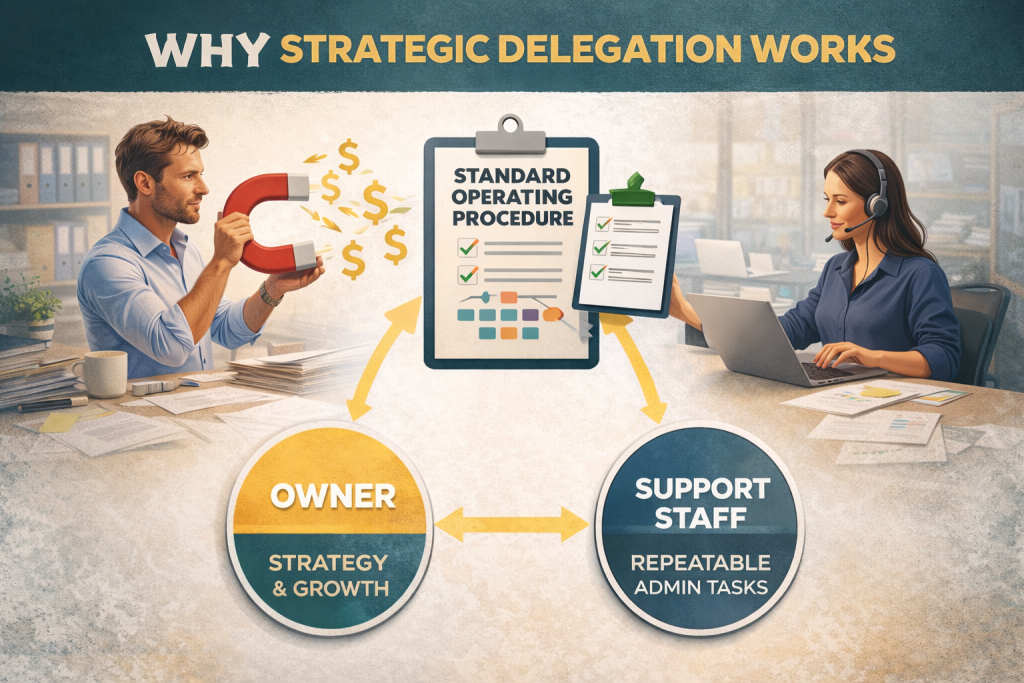
Why Strategic Delegation Works
Delegation is not simply about reducing workload.
It is about redirecting leadership time toward high-impact activities.
This concept is known as Strategic Delegation.
Instead of managing every task personally, the founder creates systems where trained support professionals execute repeatable workflows.
These workflows are documented through Standard Operating Procedures (SOPs).
An SOP allows operational staff to perform tasks consistently without requiring constant supervision.
Examples of SOP-driven workflows include:
- publishing blog content
- preparing weekly reports
- updating lead databases
- managing customer onboarding
- maintaining CRM records
Once processes are documented, the founder stops managing individual tasks.
They manage systems instead.
This shift removes the Founder Bottleneck and enables the business to scale.
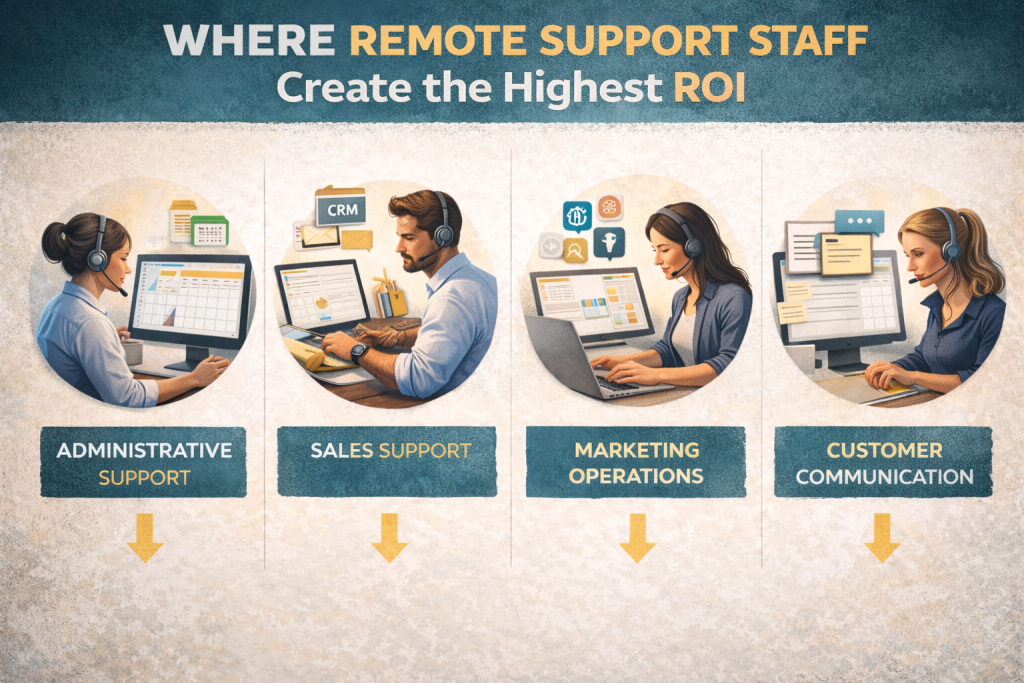
Where Remote Support Staff Create the Highest ROI
Certain business functions produce the greatest productivity gains when delegated.
These areas consistently deliver the strongest return.
Administrative Operations
Administrative work often consumes the largest share of a founder’s time.
Examples include:
- inbox organization
- meeting scheduling
- travel planning
- document formatting
A trained executive administrative partner can manage these processes using documented workflows.
Sales Support
Sales teams frequently lose opportunities when administrative work slows the pipeline.
Operational staff can assist with:
- CRM updates
- prospect research
- follow-up scheduling
- lead preparation
This allows sales professionals to focus entirely on closing deals.
Marketing Operations
Marketing requires consistency to produce results.
However, operational pressure often causes founders to postpone marketing tasks.
A remote operator can maintain systems such as:
- publishing blog posts
- scheduling social media
- organizing marketing assets
- updating email lists
This keeps marketing processes running continuously.
Customer Communication
Fast responses improve customer satisfaction and retention.
Operational staff can manage:
- email inquiries
- onboarding communication
- support ticket routing
This ensures professional communication without increasing internal workload.
Research and Data Preparation
Strategic decisions often require information gathering.
Support professionals can assist with:
- competitor research
- vendor analysis
- market data collection
- report preparation
This allows leadership to make decisions based on reliable data.
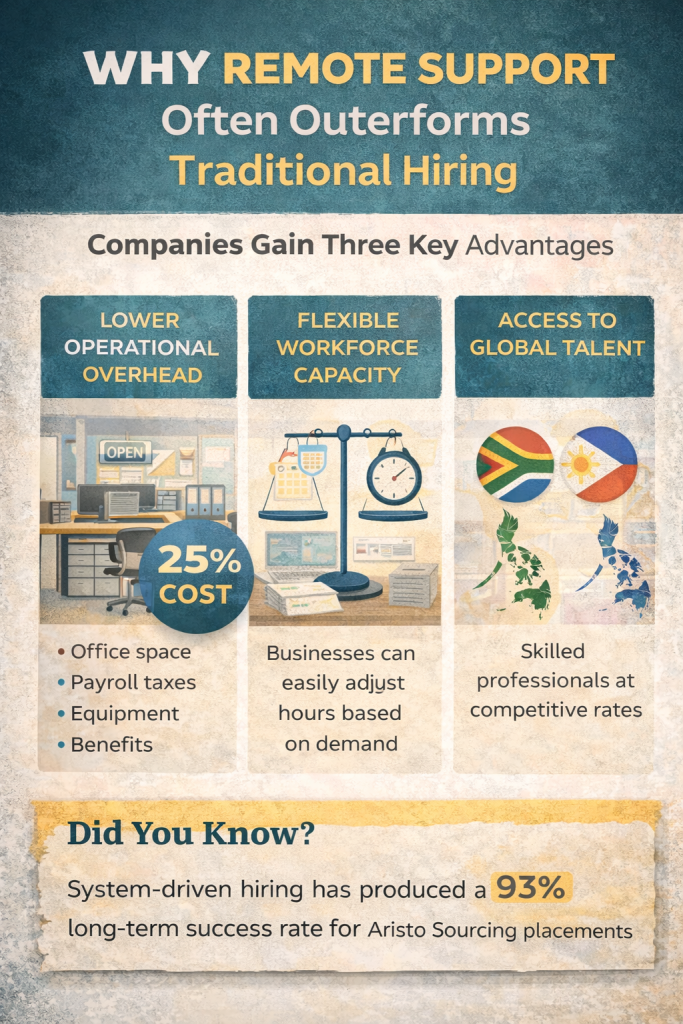
Why Remote Support Often Outperforms Traditional Hiring
Remote staffing models often deliver stronger ROI than traditional hiring.
Three structural advantages explain why.
Lower Operational Overhead
Traditional employees require additional expenses such as:
- office space
- payroll taxes
- equipment
- benefits administration
Remote staffing eliminates many of these costs.
Businesses pay primarily for productive work.
Flexible Workforce Capacity
Operational workloads fluctuate throughout the year.
Remote support allows businesses to scale working hours based on demand.
This flexibility reduces unnecessary payroll expenses.
Access to Global Talent
Remote hiring expands the available talent pool.
Regions such as South Africa and the Philippines have become major hubs for operational support professionals due to strong English proficiency and professional training standards.
For companies in North America or Europe, these regions also provide time-zone overlap, allowing operational work to continue outside standard office hours.
Did You Know?
Companies that implement structured outsourcing models with documented workflows report significantly higher retention and productivity rates.
Across Aristo Sourcing placements, businesses report a 93% long-term success rate for remote operational support roles.
This high success rate reflects a system-driven hiring model where professionals operate within defined processes rather than receiving ad-hoc task assignments.
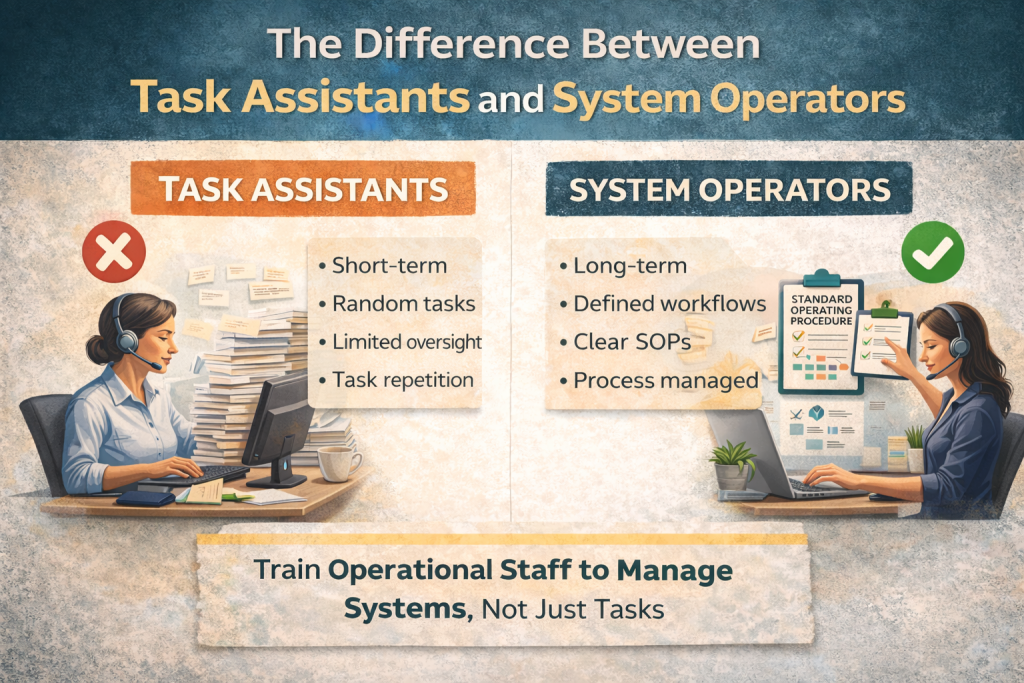
The Difference Between Task Assistants and System Operators
Many businesses misunderstand how support roles should function.
They treat assistants as task executors.
This approach limits productivity.
A more effective approach treats operational professionals as system operators.
Instead of assigning individual tasks repeatedly, the business builds repeatable workflows supported by SOPs.
The support professional then manages that process independently.
This shift dramatically increases efficiency.
The founder stops assigning individual tasks and instead oversees operational systems.
When Hiring Operational Support Makes the Most Sense
Hiring support staff becomes valuable when founders experience these signals:
- inbox overload
- delayed responses to clients
- inconsistent marketing output
- missed sales follow-ups
- operational work interrupting strategic thinking
These signals indicate the presence of the Founder Bottleneck.
Delegating operational functions removes that bottleneck.
When Hiring Support May Not Work
Support roles perform best within structured organizations.
Without structure, the relationship may struggle.
Common mistakes include:
- unclear task expectations
- missing documentation
- weak communication systems
- unrealistic workloads
Businesses achieve the best results when they implement clear SOPs and defined workflows.
How Aristo Sourcing Approaches Remote Staffing
Not all outsourcing models operate the same way.
Some agencies focus on short-term task assistance.
Others focus on building long-term operational partnerships.
Aristo Sourcing follows the second approach.
The company helps businesses hire trained operational professionals who execute defined systems.
These professionals work inside structured workflows supported by SOP documentation and performance monitoring.
The goal is not simply to outsource tasks.
The goal is to outsource operational functions that allow leadership to focus on growth.
The Bottom Line: Is Hiring a Virtual Assistant Worth It?
In many situations, the answer is yes.
Operational support roles deliver value in three key ways:
- They reduce operational workload
- They increase productivity
- They free founders to focus on strategic growth
When businesses calculate the numbers, a surprising conclusion emerges.
The greatest cost often comes from not delegating early enough.
Founders frequently wait until they feel overwhelmed before hiring help.
The companies that scale faster tend to do the opposite.
They build operational support systems early.
Final Thought
Successful businesses rarely grow because the founder works longer hours.
They grow because the founder builds systems, processes, and operational support around their role.
Strategic delegation removes the Founder Bottleneck.
It allows operational systems to run efficiently while leadership focuses on growth.
For many companies, hiring remote operational support is the first step toward that transformation.
And once the system is in place, the question changes from:
“Is hiring a virtual assistant worth it?”
to
“Why didn’t we build this system sooner?”
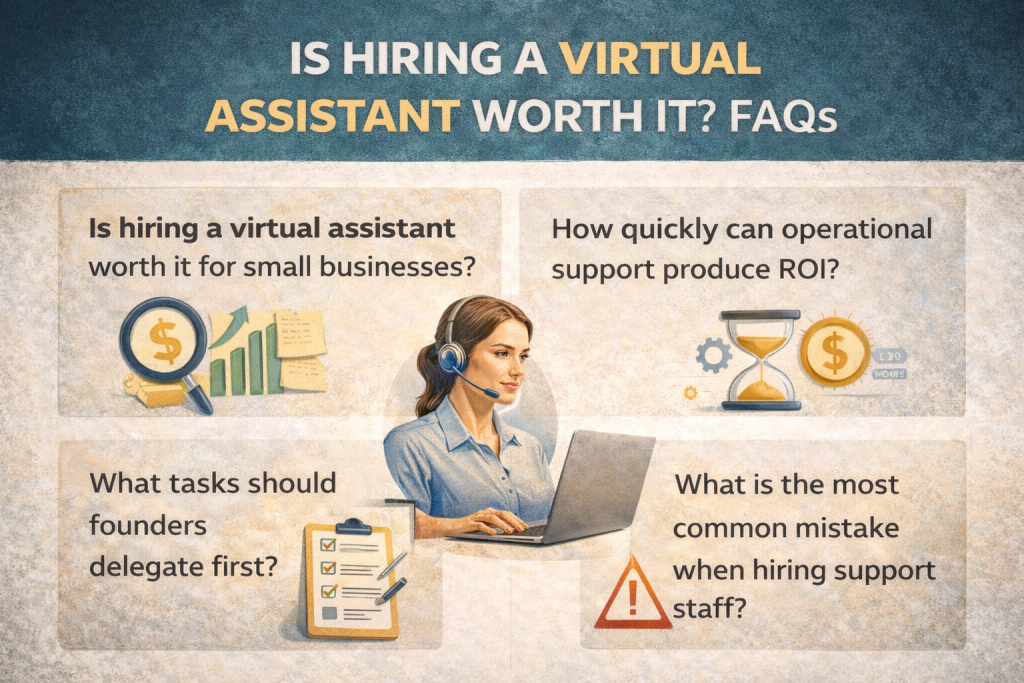
Frequently Asked Questions
Is hiring a virtual assistant worth it for small businesses?
Yes. Many businesses see strong returns when they delegate administrative work that costs less than the founder’s hourly value.
How quickly can operational support produce ROI?
Many businesses begin seeing productivity improvements within 30 to 90 days, once workflows and SOPs are implemented.
What tasks should founders delegate first?
Start with repeatable administrative tasks such as scheduling, email management, CRM updates, and research.
What is the most common mistake when hiring support staff?
The most common mistake is delegating tasks without clear Standard Operating Procedures (SOPs).
Documented workflows dramatically improve performance and consistency.
