
An IT outsourcing strategy is a deliberate plan to delegate technology functions to external providers, a critical move today for businesses seeking agility, cost efficiency, and access to global expertise. The main types include staff augmentation, dedicated teams, project-based outsourcing, and fully managed or co-managed services. The process typically follows five steps: define core versus non-core functions, select the engagement model, determine the optimal geographic sourcing, establish outcome-based SLAs, and lock down security and NDAs.
Strategic IT outsourcing delivers key advantages such as significant cost reduction, access to niche skills, rapid scalability, sharper focus on core activities, faster time‑to‑market, and risk mitigation. Costs vary widely, with hourly rates ranging from $25 to over $200, depending on region and expertise, while project or retainer models often yield 20–50% savings compared to in‑house teams. Choosing the right partner requires evaluating technical expertise, cultural fit, communication practices, security certifications (e.g., ISO 27001), verified client references, and flexible engagement options.
What Is an IT Outsourcing Strategy?
An IT outsourcing strategy is a planned, governance-framed approach to delegating specific IT functions to external vendors in deliberate alignment with measurable business objectives.
At a base level, IT outsourcing involves contracting third-party providers to manage technology functions that were previously handled in-house. A strategic approach goes further; it treats vendor relationships as structured business agreements rather than ad hoc arrangements, aligns each outsourced function with a core competency focus, specifies which engagement models apply to which types of work, and establishes governance mechanisms such as SLAs, performance reviews, and escalation procedures. Strategic IT outsourcing differs from opportunistic outsourcing in that it actively maps different types of vendor engagement to defined organizational outcomes, ensuring that each contracted function serves a specific business purpose rather than simply reducing a line item on a budget.
What Are the Types of IT Outsourcing?
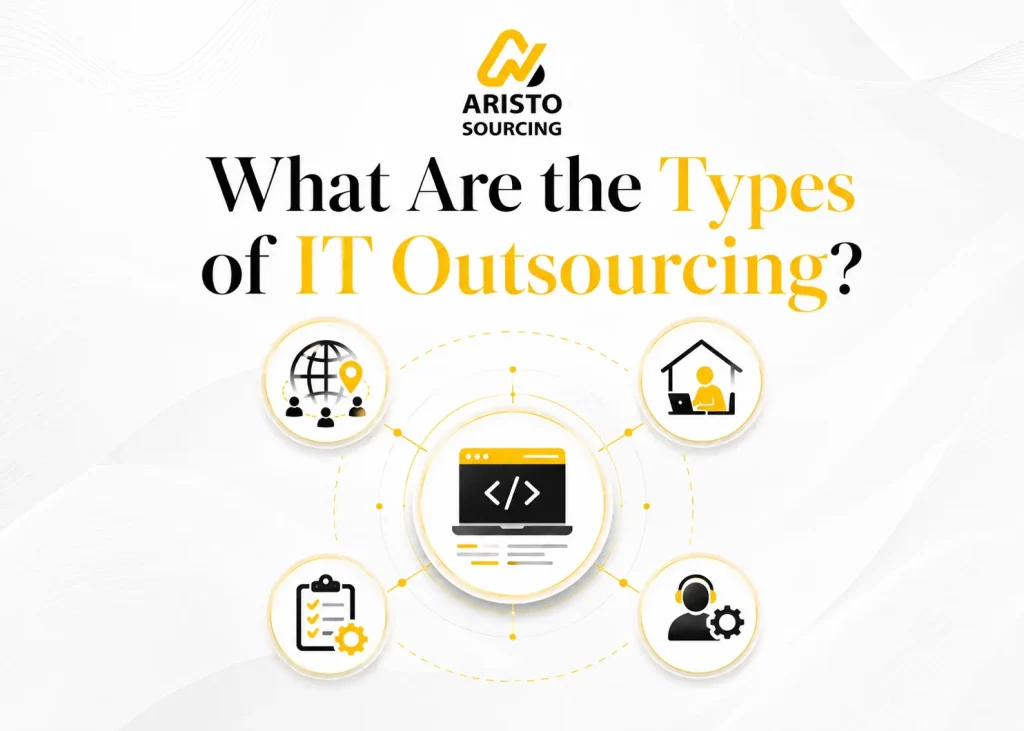
The types of IT outsourcing include staff augmentation, dedicated teams, project-based outsourcing, and fully managed or co-managed services.
The 4 types of IT outsourcing are listed below.
- Staff Augmentation
- Dedicated Teams
- Project-Based Outsourcing
- Fully Managed or Co-Managed
1. Staff Augmentation
Staff augmentation is the practice of integrating external talent into an in-house team while the client retains full management, task assignment, and day-to-day control over all work output.
This model fits best in situations involving skill gaps, short-term capacity needs, or seasonal demand spikes where adding headcount permanently would not be justified. Because the client manages the work directly and owns delivery accountability, staff augmentation differs from full outsourcing in a structurally important way: it is an extension of the internal team, not a transfer of responsibility. The distinction between staff augmentation and dedicated teams centers on control versus long-term cost efficiency. Augmentation gives the client complete operational authority, while dedicated teams trade that control for vendor-managed continuity and collective team ownership.
2. Dedicated Teams
A dedicated team is a vendor-managed group of specialists assigned exclusively to one client on an ongoing, long-term basis, with execution ownership and team management residing with the vendor.
This model fits best in long-term product development, continuous delivery pipelines, and engagements where workload consistency makes sustained capacity more cost-efficient than a series of separate project contracts. The client sets strategic priorities and business direction; the vendor manages how execution happens, who handles what, and at what cadence. Unlike staff augmentation, dedicated teams offer institutional continuity; the team accumulates product knowledge over time, which reduces onboarding costs and delivery friction as the engagement matures, making this model particularly effective for scaling product organizations.
3. Project-Based Outsourcing
Project-based outsourcing is a fixed-scope, fixed-outcome delivery model where the vendor owns full execution responsibility for a defined deliverable with a clear end date.
This model is best suited to engagements with a well-defined deliverable, a finite delivery window, and minimal expected iteration or maintenance after completion. Pricing typically follows either a fixed-bid structure, where the total cost is agreed upfront, or a milestone-based payment model, where payment is released in stages tied to verified deliverable completion. Risk allocation in project-based outsourcing places delivery execution responsibility on the vendor; however, the client carries the risk of requirements ambiguity — scope gaps and changing requirements are the leading drivers of cost overruns and disputes in this model, making requirements clarity a prerequisite before contract execution.
4. Fully Managed or Co-Managed
Fully managed and co-managed outsourcing are models defined by whether the vendor holds end-to-end ownership of delivery and operations or shares that responsibility with the client under a structured governance arrangement.
In a fully managed model, the vendor owns staffing decisions, tooling choices, process design, and performance accountability; the client defines business requirements and measures outcomes, but does not manage execution. Co-managed outsourcing distributes operational responsibility: the client retains partial oversight, decision-making authority, and sometimes internal team involvement, while the vendor handles the execution workload. The decision between the two is driven by how much internal capacity the client can commit, the organization’s risk tolerance, the degree of control required to satisfy internal governance or regulatory compliance, and how central the outsourced function is to the overall process of outsourcing maturity the organization is trying to build.
What Is the IT Outsourcing Process?
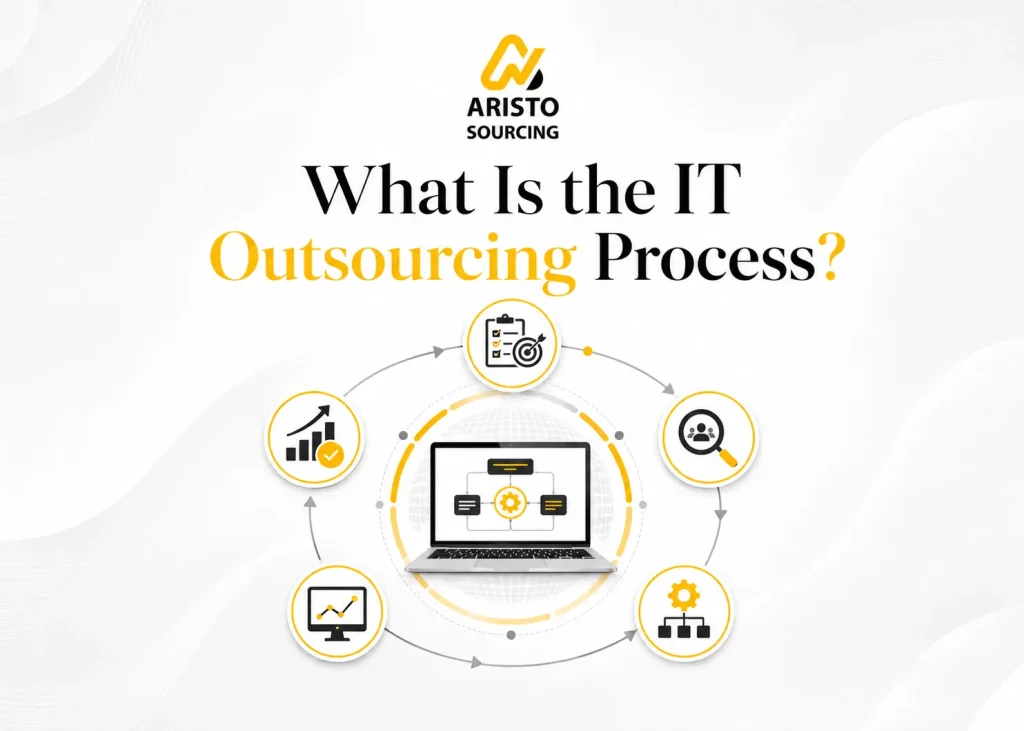
The IT outsourcing process involves defining function scope, selecting the appropriate engagement model, determining geographic sourcing, establishing outcome-based SLAs, and securing legal protections before work begins.
The IT outsourcing process or workflow follows the steps listed below.
Step 1 — Define Core vs Non-Core Functions
Step 2 — Select the Engagement Model
Step 3 — Determine Geographic Sourcing
Step 4 — Establish Outcome-Based SLAs
Step 5 — Lock Down Security and NDAs
Step 1 — Define Core vs Non-Core Functions
Defining core vs. non-core functions means separating the IT capabilities that drive competitive differentiation and must remain in-house from the outsourcing-eligible work that a vendor can deliver with equal or greater efficiency.
Functions that belong in-house typically include strategic architecture design, systems tied directly to competitive advantage, sensitive data infrastructure, and IP-critical development where external access creates unacceptable risk. Outsourcing-eligible IT work tends to be repetitive, well-documented, measurable, and non-differentiating. Tier 1 support, infrastructure monitoring, QA testing, and help desk operations are common examples. The core competency focus framework provides a practical decision rule: if removing a function from internal control would degrade your competitive position, it stays in-house; if a vendor can execute it with equivalent quality for lower cost, it becomes a commodity IT function and a viable candidate for delegation.
Step 2 — Select the Engagement Model
Selecting the engagement model means mapping the available engagement model types, staff augmentation, dedicated team, project-based, or managed services, to the specific scope, duration, and control requirements of each IT function being outsourced.
The match depends on three variables: how clearly the scope is defined, how long the engagement is expected to last, and how much operational control the client must retain. Staff augmentation is the right fit for skill gap coverage and short-term surge capacity; dedicated teams suit long-term product development with ongoing iteration; project-based contracts suit deliverables with fixed endpoints; managed services suit functions the client wants to hand off entirely. Misaligning the model to need is one of the most common structural errors in IT outsourcing strategy; it typically surfaces as escalating friction six to twelve months into the engagement, when expectations and reality no longer match.
Step 3 — Determine Geographic Sourcing
Determining geographic sourcing means choosing between onshore, nearshore, or offshore vendor locations based on an explicit evaluation of cost, time zone overlap, cultural proximity, and collaboration requirements for each workload.
Onshore vendors operate in the same country as the client; they offer the easiest collaboration, zero timezone friction, and the highest cost of the three options. Nearshore vendors are located in geographically adjacent time zones (such as Eastern Europe or Latin America for North American clients) and provide partial working-hour overlap, moderate cost, and reasonable cultural proximity. Offshore vendors, most commonly in India, Southeast Asia, or the Philippines, offer the lowest cost but require deliberate investment in asynchronous process design, documentation standards, and structured overlap windows to make the working relationship effective across significant timezone gaps.
Step 4 — Establish Outcome-Based SLAs
Establishing outcome-based SLAs means setting contractual performance targets defined as measurable business outcomes and delivery results, not activity counts or hours logged, with a formal review cadence built into the agreement from the start.
Outcome-based SLAs define what the vendor is accountable for producing: uptime percentages, defect rates, sprint velocity, and delivery milestone adherence are typical KPIs in IT outsourcing contracts. Penalty clauses and performance incentives, rate adjustments, or bonus structures should be explicitly tied to these metrics to create a real accountability mechanism, not just a contractual formality. A quarterly review cadence, where KPI performance is formally assessed, and targets are adjusted if scope has materially shifted, keeps the engagement calibrated to current business needs rather than conditions that existed at contract signing.
Step 5 — Lock Down Security and NDAs
Locking down security and NDAs means establishing enforceable contracts, structured access controls, and documented audit rights that protect data, intellectual property, and regulatory compliance before vendor access to any system is granted.
NDAs should explicitly address IP ownership at contract termination, work-for-hire classification for all deliverables, and what happens to proprietary code, data, or documentation if the engagement ends. Data protection obligations should be aligned with applicable compliance frameworks, GDPR for European data and HIPAA for US healthcare information, and vendors should be contractually required to hold relevant certifications such as SOC 2 or ISO 27001. Role-based access control (RBAC), multi-factor authentication (MFA), and formal audit rights are concrete operational advantages in limiting vendor-side exposure to sensitive systems and ensuring any access anomaly is reviewable without ambiguity.
What Are the Advantages and Disadvantages of Strategic Outsourcing?
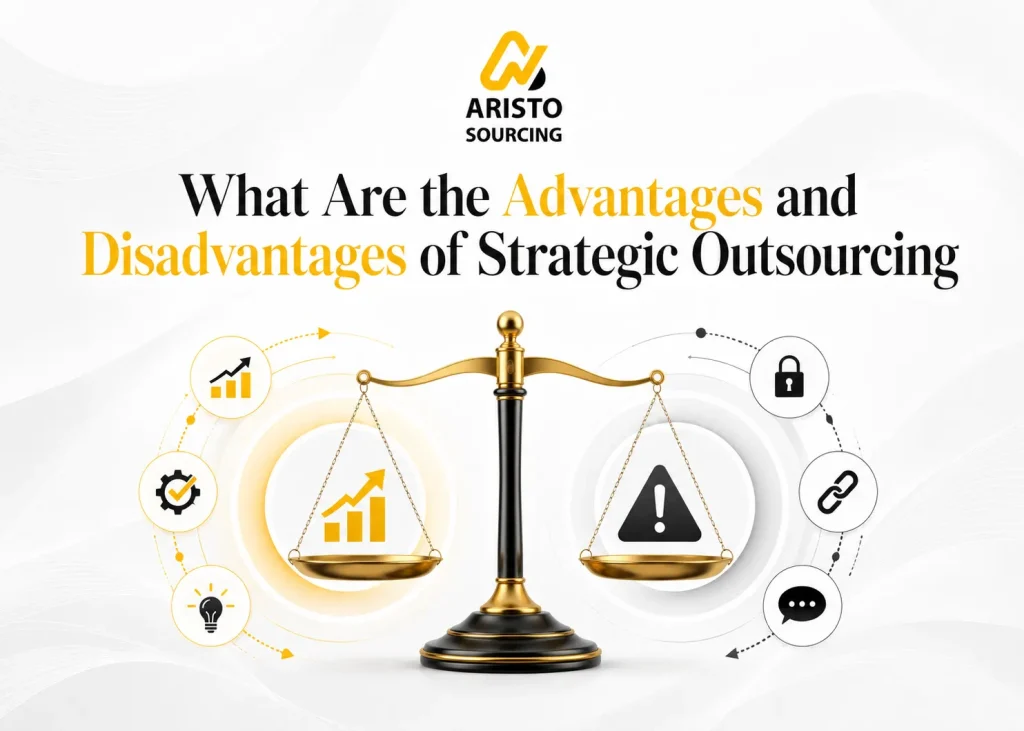
The advantages and disadvantages of strategic IT outsourcing include meaningful cost reductions and global talent access on one side, and communication overhead, security risk, and vendor dependency on the other. The net outcome depends entirely on how well the strategy is structured and governed.
The advantages and disadvantages of strategic IT outsourcing are listed below.
Advantages of IT Outsourcing
- Cost Savings and Labor Arbitrage: Labor arbitrage lowers IT costs by accessing skilled talent in lower-wage markets without reducing technical quality or output standards.
- Access to Global Talent and Specialized Skills: Global hiring reach enables immediate engagement with niche domain expertise that is unavailable in local hiring markets or prohibitively expensive to recruit full-time.
- Faster Scaling and Time to Market: External vendor capacity activates quickly, compressing delivery timelines and reducing the hiring lag that typically delays internal capacity growth.
- Focus on Core Business: Delegating non-core IT functions frees internal teams to concentrate on strategically significant work rather than operational maintenance and support overhead.
Disadvantages of IT Outsourcing
- Communication and Timezone Friction: Geographic and cultural distance create coordination overhead that compounds significantly in poorly structured or under-governed outsourcing arrangements.
- Security and IP Risk: External vendor access to sensitive systems, proprietary code, or business data introduces exposure that contractual protections mitigate but cannot fully eliminate.
- Quality Control and Vendor Dependency: Over-reliance on a single vendor or weak SLA enforcement reduces negotiating leverage and exposes the business to delivery inconsistency without viable alternatives.
How Much Does IT Outsourcing Cost?
IT outsourcing costs range from $20 to $200 per hour, depending on the engagement model selected, the vendor’s geographic location, the technical complexity of the work, and whether AI is being used to augment delivery throughput.
IT outsourcing cost ranges are presented in the table below.
| Region / Pricing Model | Hourly Rate | Fixed Bid (Typical Range) | Dedicated Team (Monthly) |
|---|---|---|---|
| United States (onshore) | $120–$200/hr | $50K–$500K+ per project | $15K–$25K/month per developer |
| Western Europe | $100–$160/hr | $40K–$400K per project | $12K–$20K/month per developer |
| Eastern Europe | $40–$90/hr | $15K–$150K per project | $5K–$10K/month per developer |
| India | $25–$60/hr | $8K–$100K per project | $3K–$7K/month per developer |
| Philippines | $20–$45/hr | $6K–$80K per project | $2.5K–$6K/month per developer |
| Latin America | $35–$75/hr | $12K–$120K per project | $4K–$9K/month per developer |
Hourly rates reflect market labor costs and timezone availability. Fixed bid pricing is typically a multiplied projection of hourly rates against the estimated scope. Clients should request detailed effort breakdowns before accepting fixed bids to ensure the estimate reflects actual complexity.
Dedicated team monthly costs represent the fully loaded vendor rate for one developer, which typically includes management overhead, tooling, HR, and benefits provided by the vendor, making the comparison to direct employment costs more accurate than hourly rates alone suggest.
How Is AI Changing IT Outsourcing Strategy?
AI is changing IT outsourcing strategy by automating the low-value task volume that once defined outsourcing contracts, shifting buyer demand toward higher-skill AI-augmented delivery, and forcing a re-evaluation of the scope. SLAs and vendor capability requirements should look like when artificial intelligence is reshaping how the work gets done.
Automation in outsourcing is already reducing the workload associated with Tier 1 support, data entry, basic QA, and routine monitoring, functions that historically represented the largest volume share of IT outsourcing engagements. The demand shift is moving toward architecture design, security engineering, complex development, and AI integration work that requires expert judgment rather than execution volume.
Buyers engaged in strategic partnering with vendors should immediately re-evaluate scope definitions, KPI structures, the technical composition of the teams they are contracting, and whether current vendors have developed genuine AI-augmented delivery capabilities or are simply rebranding existing services. The economics of AI in outsourcing are not a future scenario; they are structurally affecting vendor selection, contract scope, and pricing benchmarks in active engagements right now.
How Do You Choose the Right IT Outsourcing Partner?
To choose the right IT outsourcing partner, you evaluate candidates against a structured set of criteria, track record, domain fit, communication cadence, and security posture. Eliminate providers who present avoidable red flags before the contract stage rather than discovering problems during delivery.
Vendor selection should assess domain expertise and verifiable sector delivery evidence, communication structure and escalation path clarity, relevant compliance certifications, and transparent pricing with clearly defined rate change conditions. Red flags to screen out during vetting an outsourcing provider include the absence of verifiable client references, vague or inconsistently explained pricing, missing SLA commitments, and no relevant compliance certifications for regulated industry work.
Before signing any contract, directly ask: How is sensitive or regulated data handled? Who owns IP and all work product created during the engagement? What is the subcontractor disclosure and approval policy? What are the exit terms, including data return and system access revocation? An outsourcing strategy built on vendor relationships where these questions are answered clearly at the outset performs materially better than one where they surface as disputes mid-engagement.
Which Outsourcing Strategy Is Right for Your Business?
The right outsourcing strategy for your business depends on your growth stage, the nature of the specific functions being delegated, your internal capacity for vendor governance, and how much operational control your organization needs to retain over execution.
Startups building an MVP benefit most from project-based outsourcing for defined initial builds, or a dedicated team model once product direction is established and iteration becomes ongoing. Scaling product companies benefit from dedicated teams that accumulate institutional knowledge and maintain delivery continuity through growth phases without requiring repeated onboarding cycles. Businesses facing immediate skill gaps or temporary demand surges are best served by staff augmentation, which adds execution capacity without long-term vendor commitment or structural changes to internal team organization.
For a more precise outsourcing strategy selection, identifying the right partner begins with understanding the different types of IT outsourcing available and matching each to the current outsourcing process maturity of your organization. Consider exploring our IT outsourcing services at Aristo Sourcing for specific engagement model guidance.