
HR outsourcing means contracting HR work to an outside provider, and it comes in seven distinct types. The seven types include PEO, ASO, HRO, BPO, HR SaaS, EOR, and single-source arrangements, each shifting a different amount of employer responsibility and administrative work to the provider.
Costs range from $45 to over $400 per employee per month depending on which type a business chooses and how much of HR it hands off. Choosing the right type matters more than choosing the cheapest one, since the wrong fit can mean paying for services a business doesn’t need or, worse, keeping compliance risk that a different type would have absorbed instead.
What Is HR Outsourcing?
HR outsourcing is the practice of contracting a third-party HR service provider to handle some or all human resources functions on a business’s behalf, under a defined service agreement.
A business selects which functions to hand off, signs a services agreement defining scope and responsibility, and the provider then executes those functions using its own staff, technology, and compliance expertise. The functions most commonly outsourced are payroll, benefits administration, compliance, and recruitment- work that’s repetitive, compliance-heavy, and doesn’t require daily strategic judgment.
Companies outsource these functions for cost savings, access to specialized expertise they couldn’t justify hiring in-house, and stronger compliance coverage. Among the different types of HR outsourcing, which one fits best depends heavily on company size and how much control a business wants to keep.
What Are the 7 Types of HR Outsourcing?
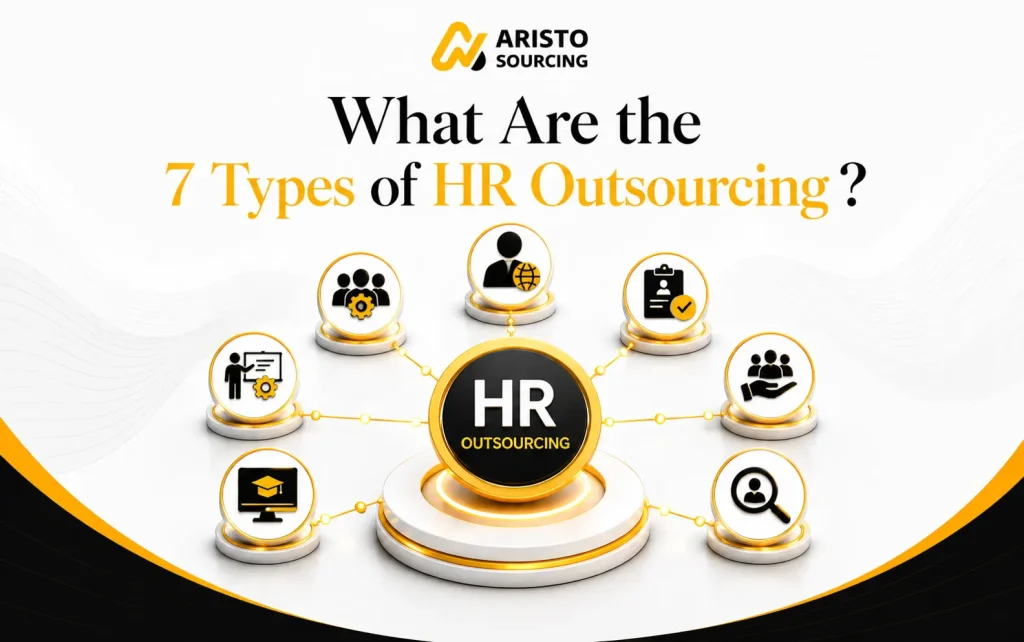
The 7 types of HR outsourcing include the Professional Employer Organization (PEO), Administrative Services Organization (ASO), Human Resources Outsourcing (HRO), HR Business Process Outsourcing (BPO), HR Software-as-a-Service (SaaS), Employer of Record (EOR), and Single-Source HR Outsourcing.
These types differ along two lines, including the employment relationship, whether the provider becomes a co-employer or the client stays the sole employer of record, and the scope, whether the arrangement covers the full HR function or just one task.
The 7 types of HR outsourcing are listed below.
- Professional Employer Organization (PEO)
- Administrative Services Organization (ASO)
- Human Resources Outsourcing (HRO)
- Business Process Outsourcing (BPO) for HR
- HR Software-as-a-Service (SaaS)
- Employer of Record (EOR)
- Single-Source HR Outsourcing
1. Professional Employer Organization (PEO)
A Professional Employer Organization (PEO) operates under a co-employment model, sharing employer responsibilities with the client. The PEO manages administrative HR tasks like payroll, taxes, and benefits, while the client retains complete daily operational control over the employees.
Under this model, the PEO handles payroll, benefits administration, risk management, and tax filings, while the client retains authority over contracts, hiring, and termination decisions. Because liability is shared under the co-employment structure, both the PEO and the client carry some responsibility if something goes wrong. While the PEO model is highly popular for small businesses with 10 to 49 employees, it remains economically highly advantageous for growing mid-market companies with up to 500 employees.
2. Administrative Services Organization (ASO)
An Administrative Services Organization (ASO) refers to a provider that delivers HR administration without entering a co-employment relationship, leaving the client as the sole employer of record throughout.
Under an ASO model, the vendor manages and executes HR administrative tasks independently, but does so under the client’s own EIN. The client retains sole employer status and carries all ultimate legal and compliance liability. Commercially, ASO providers often offer à la carte flexibility, allowing businesses to select exactly which functions to outsource rather than forcing a single bundled package. This model suits companies that want outsourced administrative support without sharing employer status with the provider.
3. Discrete/Selective HR Outsourcing
Discrete or Selective HR Outsourcing refers to outsourcing only specific HR tasks or services while the business continues to manage the rest of its HR operations internally. Rather than transferring an entire HR function, companies choose individual activities to outsource based on their expertise, capacity, or operational needs.
Under this model, organizations can outsource functions such as payroll processing, recruitment, background checks, employee training, benefits administration, or compliance support while keeping strategic HR responsibilities, employee relations, and workforce planning in-house. Because the client remains the sole employer and decides which services to delegate, this approach offers maximum flexibility and control. It is particularly suitable for businesses that have an established HR team but need external expertise, additional capacity during peak periods, or cost-effective support for specialized HR functions without committing to a broader outsourcing arrangement.
4. Business Process Outsourcing (BPO) for HR
Business Process Outsourcing (BPO) in an HR context refers to handing one specific, complex HR function entirely to a specialist firm rather than distributing pieces of work across several providers.
A common example is outsourcing payroll processing to a BPO specialist while keeping recruiting fully in-house, rather than moving both functions out at once. Worth remembering that business process outsourcing covers beyond HR, spanning finance, customer service, and IT functions too, so an HR-focused BPO provider is a specialist within a much larger outsourcing category.
5. HR Software-as-a-Service (SaaS)
HR Software-as-a-Service (SaaS) refers to a cloud-based platform that partially automates HR tasks while the company’s own in-house HR staff continues to operate it directly.
Typical features include self-service portals for PTO requests, applicant tracking during recruitment, and digital onboarding paperwork, all handled through software rather than an outside team of people. Because the business is licensing a tool rather than outsourcing labor, this is generally the cheapest entry point into HR outsourcing, and it keeps every decision in-house rather than delegating judgment to a provider.
6. Employer of Record (EOR)
An Employer of Record (EOR) refers to a provider that hires and pays employees in other states or countries on a client’s behalf, without the client needing to set up a local legal entity.
The EOR handles regional tax withholding and labor law compliance for that jurisdiction, which is why it’s sometimes called an “international PEO,” even though the two models work differently. The key distinction is legal employer status: an EOR is the sole legal employer of the worker, while a PEO shares that status with the client through co-employment. This model fits companies hiring in a new state or country where they have no existing entity or HR infrastructure.
7. Single-Source HR Outsourcing
Single-source HR outsourcing refers to an arrangement where one vendor handles every HR function for the full duration of an employee’s tenure, from hiring through offboarding, rather than splitting work across multiple providers.
The exact level of vendor involvement is negotiated between the parties, so it can range from heavily hands-on to more advisory depending on what the client wants. This model fits companies that want no in-house HR team at all, accepting a higher cost in exchange for not managing HR internally or coordinating between several outsourcing relationships.
How Much Does HR Outsourcing Cost?
HR outsourcing costs between $45 and over $400 per employee per month, depending on the type of arrangement, the scope of functions outsourced, and the headcount involved.
Price differences mostly come down to three factors. Scope, whether the arrangement covers one function or the full HR department. Headcount, since per-employee pricing scales directly with team size. And co-employment liability, which raises the price for PEO arrangements because the provider is sharing legal and tax risk rather than just administering tasks.
Different HR outsourcing pricing models reflect these factors too, per-employee-per-month fees, flat retainers, and percentage-of-payroll pricing all price scope and risk differently, so the cheapest quote on paper isn’t always the option with the fewest risks attached.
What Are the Risks of HR Outsourcing?
The risks of HR outsourcing are listed below.
- Loss of control / reduced oversight: Day-to-day execution shifts to the provider, which can slow down responses to situations that need immediate, company-specific judgment.
- Data security: Sharing payroll, health, and personal employee data with an outside provider adds exposure if that provider’s security controls fail.
- Less personalization, culture fit: A provider unfamiliar with a company’s specific culture may apply standardized processes that don’t match its actual working style.
These risks are best mitigated through clear SLAs, defined reporting expectations, and a documented escalation path for when something falls outside the provider’s normal process, safeguards worth confirming before signing rather than after a problem occurs.
How Do You Choose the Right Type of HR Outsourcing?
To choose the right type of HR outsourcing, start with company size as the first filter, then decide between full-service and task-specific support, and consider whether multi-state or international expansion is on the horizon.
Company size narrows the field quickly. Businesses under 50 employees often gravitate toward a PEO for the deepest support, while larger, self-sufficient companies tend toward an HRO or single-function BPO for targeted help. Whether a business needs full-service or task-specific support depends on how much HR capability already exists internally: a company with no HR staff at all leans toward single-source outsourcing or a PEO, while one with an existing team may only need an ASO or HR SaaS platform to fill specific gaps.
For international expansion, an EOR is ideal if a business wants to hire in a country where it lacks a local legal entity. Domestically, however, a PEO is a highly effective multi-state solution, as US state expansion requires local tax registration rather than full corporate incorporation.
Once the right type is clear, narrowing a shortlist of the best HR outsourcing companies within that category, rather than comparing across types, makes it much easier to judge the cost of HR outsourcing on an apples-to-apples basis.