
Staff augmentation vs outsourcing differs mainly in workforce control, project ownership, scalability, operational flexibility, and cost structure. Staff augmentation helps businesses extend internal teams with external talent while maintaining direct management control, whereas outsourcing transfers entire projects or business functions to third-party service providers.
The differences between staff augmentation and outsourcing become more important when companies compare hiring flexibility, communication control, long-term costs, risk exposure, and speed of scaling. Staff augmentation offers stronger team integration, transparency, and specialized talent access, while outsourcing improves operational efficiency, cost reduction, and end-to-end project delivery.
However, staff augmentation may increase internal management workload, while outsourcing can create communication gaps and vendor dependency risks. According to Deloitte’s 2024 Global Outsourcing Survey, organizations are increasingly adopting multidimensional workforce strategies that combine outsourcing, insourcing, and global in-house centers to improve agility, access specialized talent, and optimize service delivery.
Companies choosing between staff augmentation or outsourcing should evaluate project complexity, budget, internal expertise, scalability goals, and required operational control.
What Is Staff Augmentation?
Staff augmentation is a workforce model where companies hire external professionals to temporarily support their internal teams. According to IDC, by 2026 more than 90% of organizations worldwide will be affected by the IT skills crisis, resulting in an estimated $5.5 trillion in losses from product delays, impaired competitiveness, and lost business. This growing skills shortage is driving organizations to adopt staff augmentation to quickly access specialized talent without lengthy hiring cycles.
In staff augmentation, external specialists become part of the client’s in-house team and work under the company’s direct supervision. According to ManpowerGroup’s 2025 Global Talent Shortage Survey, 74% of employers worldwide report difficulty finding the skilled talent they need, highlighting why many organizations turn to flexible workforce models such as staff augmentation to fill critical skill gaps more quickly.
What Is Outsourcing?
Outsourcing is a business strategy where a company assigns a complete process, department, or service to an external provider instead of managing it internally. Businesses often outsource functions such as customer service, IT support, software development, accounting, and manufacturing to improve operational efficiency and reduce internal workload. The external vendor works independently and uses its own resources, systems, and management structure to handle the assigned responsibilities.
Unlike internal hiring models, outsourcing allows businesses to shift operational responsibility to a third-party company. According to Deloitte’s 2024 Global Outsourcing Survey, organizations increasingly use outsourcing to access specialized talent, improve business agility, and create strategic value, with 80% of executives planning to maintain or increase their investment in third-party providers. Depending on business objectives, outsourcing engagements may support long-term operations or short-term project delivery.
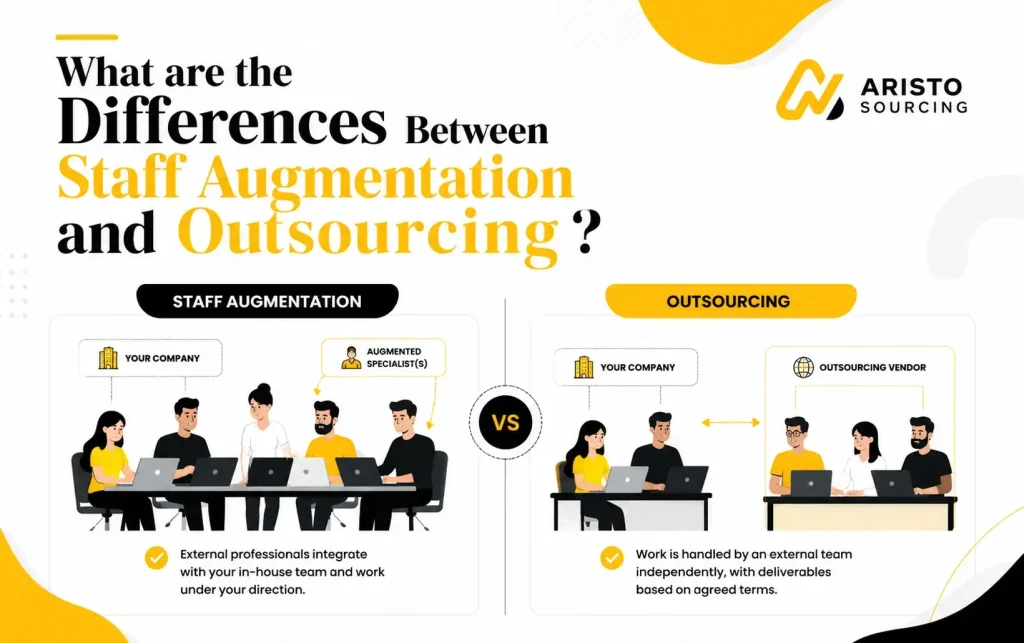
What are the Differences Between Staff Augmentation and Outsourcing?
The differences between staff augmentation and outsourcing cover multiple operational, financial, and strategic areas. Businesses often compare both models based on control, flexibility, scalability, cost, talent access, and risk management. The following comparison dimensions explain how each model performs in different business situations and growth stages.
1. Flexibility and Control
Flexibility and control differ significantly between staff augmentation and outsourcing models. Staff augmentation allows companies to manage external professionals directly within internal workflows. Businesses maintain full authority over daily tasks, communication, deadlines, and project direction. This structure provides stronger operational visibility and faster decision-making during changing project requirements.
Outsourcing reduces direct involvement because the external vendor manages delivery operations independently. The client mainly monitors outcomes through contracts, KPIs, and service-level agreements. While outsourcing lowers management burden, staff augmentation offers more flexibility when businesses need tighter supervision, faster pivots, and closer collaboration. Beyond operational control, businesses also compare both models based on overall financial impact and long-term spending.
2. Cost Implications
Cost implications vary because staff augmentation and outsourcing use different pricing and management structures. Staff augmentation usually follows hourly or daily billing models where businesses pay for external talent while handling internal supervision, onboarding, and operational coordination costs. This approach often works well for temporary projects and specialized short-term expertise needs.
Outsourcing commonly uses fixed-price, time-and-material, or performance-based contracts where the vendor absorbs delivery management and infrastructure expenses. However, outsourcing agreements may involve hidden transition costs, compliance fees, or contract modification charges over time. Staff augmentation may reduce short-term hiring costs, while outsourcing can become more economical for long-term operational management. Besides financial considerations, scalability also plays a major role when selecting the right workforce model.
3. Scalability
Scalability affects how quickly businesses can expand operations, adjust workforce size, and respond to changing demand. Staff augmentation allows companies to increase or reduce external headcount based on project phases, technical requirements, or temporary workloads. This model helps businesses scale teams rapidly without making permanent employment commitments.
Outsourcing providers scale operations internally by allocating additional resources, delivery teams, and infrastructure when business demand increases. Vendors often handle large-scale expansion more efficiently because they already maintain established operational systems and global talent pools. While outsourcing supports broader long-term scaling, staff augmentation offers faster workforce adjustments for evolving projects. Along with scalability, companies also evaluate how each model provides access to specialized talent and expertise.
4. Access to Talent
Access to talent differs because staff augmentation and outsourcing follow different hiring and resource allocation models. Staff augmentation allows businesses to directly select individual specialists from a vendor’s talent pool based on technical skills, industry experience, or project requirements. This model gives companies greater visibility into candidate expertise and team composition before onboarding.
Outsourcing providers usually assign their own internal teams to manage project delivery and operational responsibilities. Clients often evaluate the vendor’s overall capabilities instead of selecting individual professionals. Staff augmentation provides stronger control over niche expertise and role-specific hiring, while outsourcing offers broader access to established delivery teams across multiple global regions. Besides talent access, businesses also evaluate how both models integrate with existing internal operations and workflows.
5. Integration with Existing Teams
Integration with existing teams works differently in staff augmentation and outsourcing environments. Staff augmentation places external professionals directly inside the client’s internal workflows, communication channels, project management systems, and collaboration tools. This structure improves transparency, daily coordination, and cross-functional teamwork between internal employees and external specialists.
Outsourcing teams usually operate independently under the vendor’s own management structure, processes, and operational systems. Communication mainly happens through scheduled reporting, governance meetings, and performance reviews rather than continuous daily collaboration. Staff augmentation generally creates stronger cultural alignment and faster onboarding within internal teams, while outsourcing reduces direct operational involvement. Alongside integration differences, businesses must also understand how each model distributes operational and compliance-related risks.
6. Risk Management
Risk management varies because staff augmentation and outsourcing assign operational responsibilities differently. Staff augmentation places most project supervision, performance monitoring, and workflow management responsibilities on the client company. Businesses maintain direct oversight but also carry greater accountability for productivity, delivery quality, and resource coordination throughout the engagement.
Outsourcing transfers more delivery responsibility to the external vendor through contractual obligations, service-level agreements, and performance guarantees. Vendors often assume operational risks related to timelines, staffing, and project execution. However, outsourcing may increase concerns involving data security, intellectual property protection, regulatory compliance, and third-party dependency. Staff augmentation offers stronger internal control over sensitive operations, while outsourcing can provide better delivery protection for large-scale or process-driven business functions.
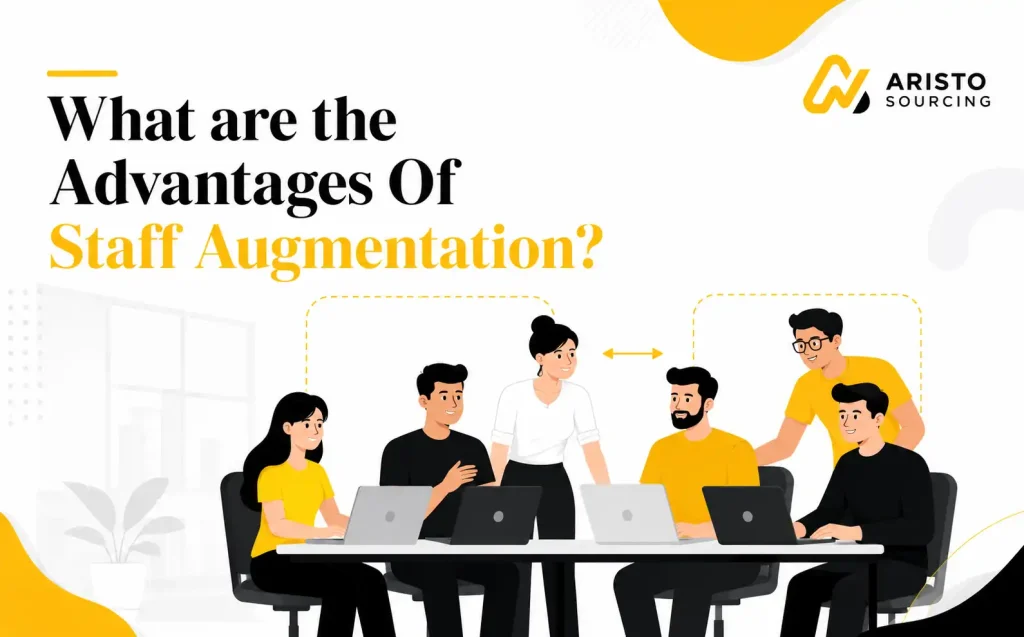
What are the Advantages Of Staff Augmentation?
Staff augmentation offers businesses a flexible way to expand internal capabilities without fully outsourcing operations or hiring permanent employees. Companies use this model to strengthen project delivery, access specialized expertise, and improve workforce scalability while maintaining direct control over internal processes. Unlike traditional outsourcing, staff augmentation keeps external professionals closely connected to the company’s existing teams, workflows, and operational goals.
1. More Control Over the Project
More control over the project is one of the primary benefits of staff augmentation. External professionals work under the client’s direct supervision, allowing managers to oversee daily operations, assign responsibilities, and adjust priorities whenever business requirements change. Companies maintain complete visibility into workflows, productivity, deadlines, and work quality throughout the engagement instead of relying on external vendors to manage delivery independently.
Staff augmentation also improves collaboration between external specialists and internal employees because everyone follows the same communication channels, project management systems, and operational processes. Businesses can maintain internal quality standards, protect company culture, and respond faster to project risks or operational changes. This level of direct involvement makes staff augmentation highly effective for complex projects that require continuous supervision, real-time decision-making, and close internal coordination.
2. Opportunity for Training
Opportunity for training is another major advantage of staff augmentation because external professionals become integrated into the company’s internal working environment. Businesses can train augmented staff on proprietary systems, operational procedures, internal workflows, and company-specific technologies to improve consistency and long-term project efficiency. This allows external professionals to contribute more effectively over time while adapting to internal business requirements.
As augmented staff continue working with internal teams, they gradually build institutional knowledge that supports operational continuity and long-term project success. Companies may also identify high-performing external professionals and transition them into permanent full-time roles when future hiring opportunities arise. Staff augmentation additionally encourages two-way knowledge sharing, where external specialists introduce new technical expertise while internal employees provide business-specific insights and operational experience.
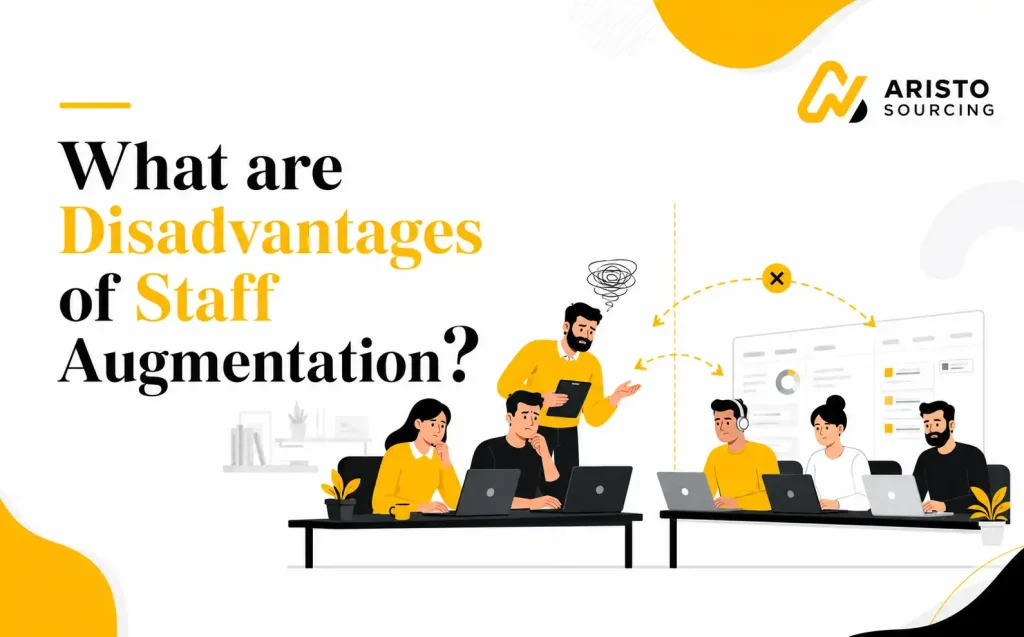
What are Disadvantages of Staff Augmentation?
Staff augmentation improves workforce flexibility and project scalability, but it also creates onboarding, coordination, and supervision challenges. Businesses must manage integration processes, daily operations, and external team performance internally throughout the engagement.
1. Integration and Onboarding Challenges
Integration and onboarding challenges are common because external professionals must adapt to the client’s internal systems, workflows, communication methods, and operational culture. Businesses often spend additional time and resources providing training, system access, technical documentation, and process guidance before augmented staff can contribute effectively. This onboarding phase may temporarily slow project momentum during the early stages of engagement.
Cultural alignment can also become difficult when external professionals join established in-house teams with existing work habits and communication structures. Companies may face delays related to access provisioning, compliance approvals, and security clearance requirements for sensitive systems or confidential data. In many cases, augmented professionals require a ramp-up period before reaching full productivity and operational efficiency. Along with onboarding complexity, staff augmentation also increases the amount of daily supervision required from internal management teams.
2. More Management and Supervision Required
More management and supervision required is another major disadvantage of staff augmentation because the client remains responsible for overseeing daily operations and workforce performance. Internal managers must assign tasks, monitor productivity, review deliverables, and provide continuous feedback to external professionals throughout the project lifecycle. This creates additional operational pressure on internal leadership teams and project coordinators.
Performance management responsibilities also remain entirely with the client instead of being transferred to an external vendor. Team leads and project managers may experience heavier workloads while coordinating communication between internal employees and augmented staff members. Managing a mixed workforce structure can sometimes reduce focus, slow decision-making, and increase operational complexity when collaboration processes are not properly organized.
What are the Advantages of Outsourcing?
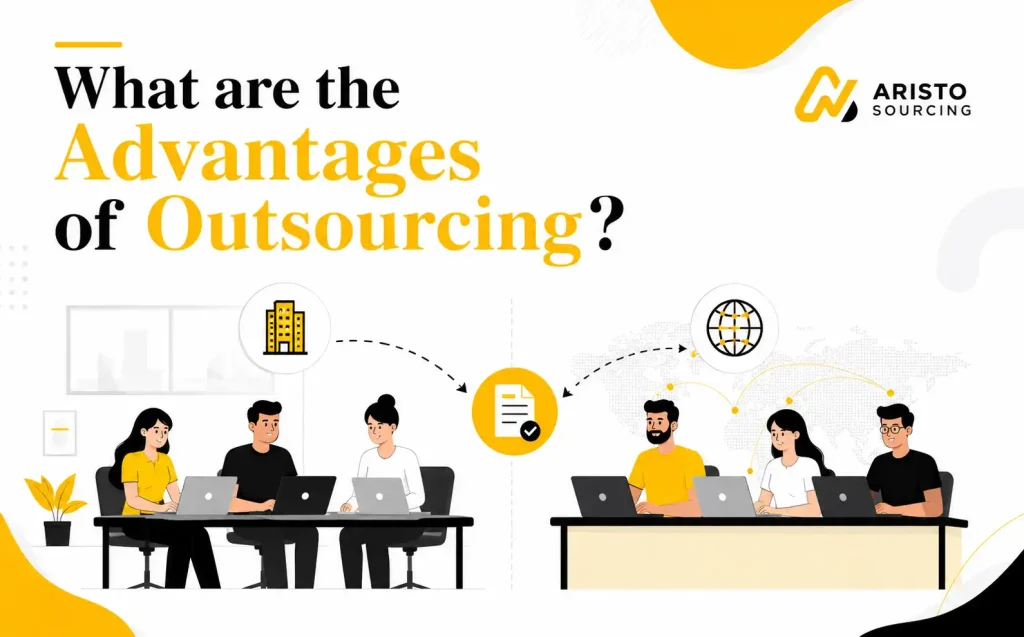
Outsourcing helps businesses improve operational efficiency by transferring specific functions, services, or processes to specialized external vendors. Companies often use outsourcing to reduce internal workload, lower operational costs, and focus more on strategic business growth and core organizational priorities.
1. Ability to Focus on Core Tasks
The ability to focus on core tasks is one of the main advantages of outsourcing. Businesses can delegate non-core operations such as customer support, IT management, payroll, accounting, or administrative work to external providers. This allows internal teams to focus more on strategic planning, innovation, customer acquisition, and revenue-generating activities.
Outsourcing also reduces operational complexity because the vendor manages staffing, workflows, infrastructure, and service delivery independently. Specialized vendors often complete tasks faster and more efficiently due to their industry expertise and established operational systems.
2. Liability Transfer and Reduced Risks
Liability transfer and reduced risks are important benefits of outsourcing for businesses handling complex operations or regulated processes. Vendors assume delivery responsibility through contracts, SLAs, and performance commitments, reducing the client’s operational burden and accountability.
Specialized outsourcing providers also manage compliance requirements, staffing responsibilities, and regulatory processes internally. Insurance coverage, indemnification clauses, and vendor accountability structures further reduce financial, legal, and operational risks for the client organization.
What are Disadvantages of Outsourcing?
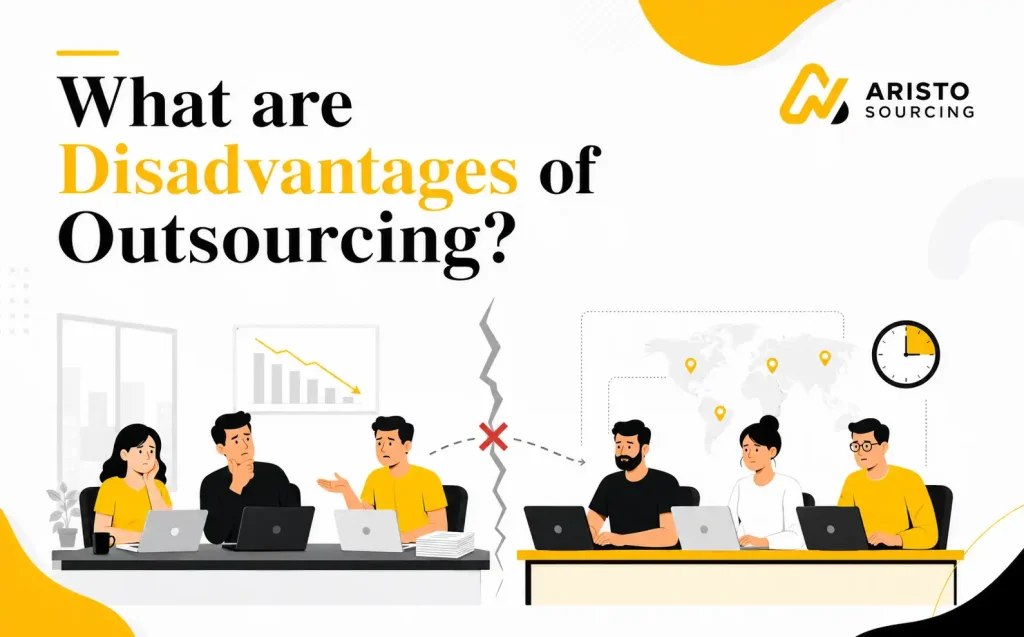
Outsourcing helps businesses reduce operational workload and improve efficiency, but it also creates challenges related to control, visibility, and data protection. Companies must carefully manage vendor relationships, compliance obligations, and security risks throughout the outsourcing engagement.
1. Loss of Control Over the Project
Loss of control over the project is one of the biggest disadvantages of outsourcing. The external vendor manages daily operations, workflows, staffing, and delivery processes independently, while the client mainly monitors final outcomes and service-level performance. This limits the company’s visibility into how tasks are executed and how operational decisions are made internally.
Businesses also become highly dependent on the vendor’s management quality, communication practices, and delivery capabilities. When priorities or project requirements change suddenly, course corrections may take longer because changes must pass through external management structures and contractual processes.
2. Data Security Risks
Data security risks increase because outsourcing vendors often receive access to sensitive client systems, operational data, customer records, and internal infrastructure. Third-party access creates additional exposure to cyberattacks, insider threats, unauthorized access, and compliance violations.
Outsourcing vendors may also rely on subcontractors or external processing partners, creating sub-processor risks and cross-border data transfer compliance challenges. A vendor security breach can still create legal, financial, and reputational liability for the client company. Businesses often reduce these risks through NDAs, data processing agreements, security audits, and contractual compliance controls.
Which is Best For You? Staff Augmentation vs Outsourcing
Staff augmentation is the better choice for businesses that need direct project control, flexible team scaling, and close collaboration with external professionals. It works best for companies managing specialized projects, filling temporary skill gaps, or expanding internal teams while maintaining full operational oversight. Businesses that require fast communication, workflow transparency, and stronger integration with in-house teams often prefer staff augmentation.
Outsourcing is more suitable for companies that want to delegate complete functions, reduce internal workload, and improve operational efficiency. It works well for repetitive processes, large-scale operations, customer support, back-office management, and long-term service delivery. Businesses seeking lower management involvement, predictable operational costs, and vendor-led execution often choose outsourcing. The right model depends on project complexity, budget, scalability goals, compliance requirements, and the level of control your business needs.
When To Choose Staff Augmentation?
Staff augmentation is the right choice when a business needs direct control over daily operations, project workflows, and team management while adding external expertise to internal teams. It works best when the required skill gap is temporary, specialized, or project-specific, but the company lacks enough internal headcount to complete the work efficiently. Staff augmentation is also effective when business processes are already well-defined and the organization wants external professionals to follow existing systems and workflows. Companies often choose this model when long-term knowledge retention, internal collaboration, and operational transparency are important priorities.
When To Choose Outsourcing?
Outsourcing is the right choice when a business wants to delegate non-core processes or operational functions to an external vendor without managing daily execution internally. It works best when the client lacks the internal bandwidth, infrastructure, or management capacity to supervise ongoing operations efficiently. Companies often choose outsourcing when reducing operational costs, accessing specialized vendor expertise, and improving scalability are more important than maintaining direct project control. Outsourcing is also highly effective when compliance requirements, large-scale service delivery, or operational complexity exceed the organization’s internal capabilities and available resources.
Is Staff Augmentation Considered Outsourcing?
Staff augmentation is a type of outsourcing because businesses use external professionals to support internal operations and project delivery. However, it differs from traditional outsourcing in how management responsibility is handled. In staff augmentation, external specialists work directly within the client’s internal team structure while the company maintains full control over daily tasks, workflows, and project supervision. Unlike full-service outsourcing, where vendors manage entire functions independently, staff augmentation focuses on extending internal workforce capacity with temporary or specialized talent support.
What is Project Outsourcing?
Project outsourcing is a business model where a company delegates a specific project or defined scope of work to an external vendor for end-to-end execution. The outsourcing provider manages planning, staffing, project delivery, timelines, and operational processes independently while the client mainly monitors milestones and final outcomes. Businesses commonly use project outsourcing for software development, IT implementation, marketing campaigns, design projects, and other specialized initiatives that require external expertise or additional delivery capacity.
What is Outstaffing?
Outstaffing is a workforce model where an external vendor officially employs the professionals, but the client company manages their daily work, tasks, and project responsibilities directly. In this arrangement, the vendor handles administrative functions such as payroll, contracts, benefits, and legal compliance, while the client controls workflows, communication, and operational supervision. Businesses commonly use outstaffing to access global talent, reduce hiring complexity, and expand internal teams without establishing full local employment infrastructure.