
IT Staff Augmentation helps companies extend internal teams with external tech professionals for specific skills or project gaps. Software Development Outsourcing allows businesses to delegate complete software projects or development functions to an external service provider.
IT Staff Augmentation offers greater control, direct collaboration, and flexible team scaling, while Software Development Outsourcing focuses on vendor-managed execution, faster delivery, and reduced operational involvement. Both models support software development but differ in management structure, responsibility, and communication flow.
IT Staff Augmentation improves flexibility and specialized hiring but may require stronger internal management. Software Development Outsourcing reduces workload and infrastructure costs, but can create communication barriers and less direct project visibility.
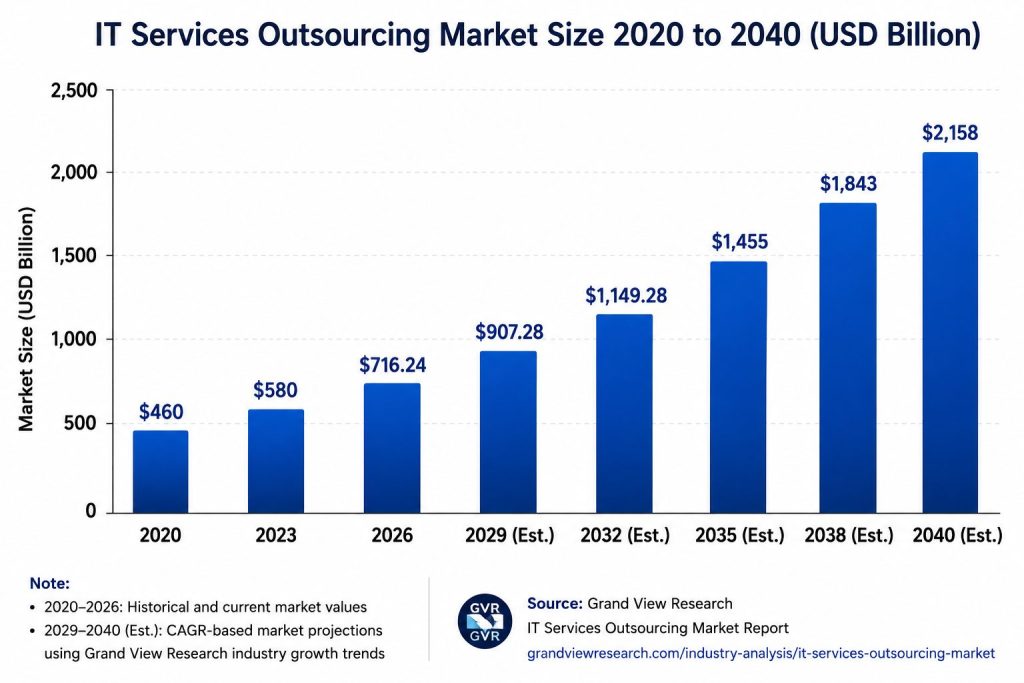
According to Researchgate, the global IT outsourcing market may exceed $812 billion in 2029. Businesses choose both models to improve scalability, reduce costs, and accelerate digital transformation strategies.
What Is Staff Augmentation?
IT Staff Augmentation is a software development hiring model where companies add external technical specialists to existing in-house teams to fill skill gaps, accelerate delivery, or expand development capacity. IT Staff Augmentation allows businesses to maintain direct control over workflows, priorities, communication, and the complete software development lifecycle while external engineers work as part of the internal team.
Core characteristics of staff augmentation include external specialists added to existing in-house teams, augmented engineers working under client management, and developers hired through a staffing agency or talent marketplace. Additional characteristics include vetted, full-time employed developers from the provider’s bench and client ownership of project management, delivery processes, and technical decisions.
Common terms often used interchangeably with staff augmentation include team extension, resource augmentation, outstaffing, contract development, and bench rotation, although bench rotation carries a slightly different operational meaning in software outsourcing environments.
How IT Staff Augmentation Works?
IT Staff Augmentation works by identifying technical skill gaps, selecting vetted developers from a provider’s talent bench, and integrating external engineers into an existing in-house software development team under direct client management. IT Staff Augmentation allows businesses to expand development capacity quickly while the provider manages sourcing, payroll, contracts, compliance, and developer replacement when necessary.
The process usually starts with project evaluation and workforce planning. Companies identify missing expertise, resource shortages, or delivery challenges across software engineering, DevOps, cloud infrastructure, mobile development, or quality assurance. Internal teams then define required technical skills, project scope, communication expectations, and engagement duration before contacting a staff augmentation provider.
After the requirement analysis, the provider shortlists qualified candidates from its internal bench or recruitment network. Technical interviews, coding assessments, and experience evaluations help verify developer capabilities before final approval. Many companies conduct direct interviews to confirm technical alignment and collaboration compatibility.
Once selected, augmented engineers join the client’s existing workflows, sprint planning sessions, project management systems, and communication channels. Client-side managers supervise priorities, timelines, development tasks, and product delivery while external developers operate as an extension of the internal engineering team. IT Staff Augmentation creates a scalable hiring model with greater flexibility, operational control, and faster access to specialized technical talent.
What Is Software Development Outsourcing?
Software Development Outsourcing is a business model where companies hire external technology vendors to manage software projects, application development, or specialized engineering functions. Software Development Outsourcing helps businesses access global technical expertise, reduce infrastructure costs, improve scalability, and accelerate software delivery without expanding internal teams.
Core characteristics of outsourcing include complete project delegation, vendor-managed engineering teams, independent execution workflows, and external project supervision under the provider’s management structure. Clients define business objectives and expected deliverables while vendors manage staffing, development operations, testing, deployment, and software quality assurance.
ISG’s 2024 study found that business process outsourcing delivers an average cost saving of 15% compared with in-house operations.
How Software Development Outsourcing Works
Software Development Outsourcing works by transferring software development responsibilities to an external technology vendor that manages engineering resources, project execution, testing, and delivery operations. Companies usually begin the outsourcing process by defining project scope, technical requirements, business objectives, budget expectations, and delivery timelines before selecting a qualified outsourcing partner.
After vendor onboarding, the outsourcing provider assembles a dedicated software development team that may include frontend developers, backend engineers, DevOps specialists, QA analysts, UI/UX designers, and project managers. The vendor then creates sprint plans, technical roadmaps, communication workflows, and delivery milestones based on agreed project requirements.
Client-side stakeholders mainly supervise strategic direction, feature approvals, and performance tracking while the external vendor independently manages day-to-day development tasks, infrastructure setup, testing cycles, deployment operations, and software quality assurance.
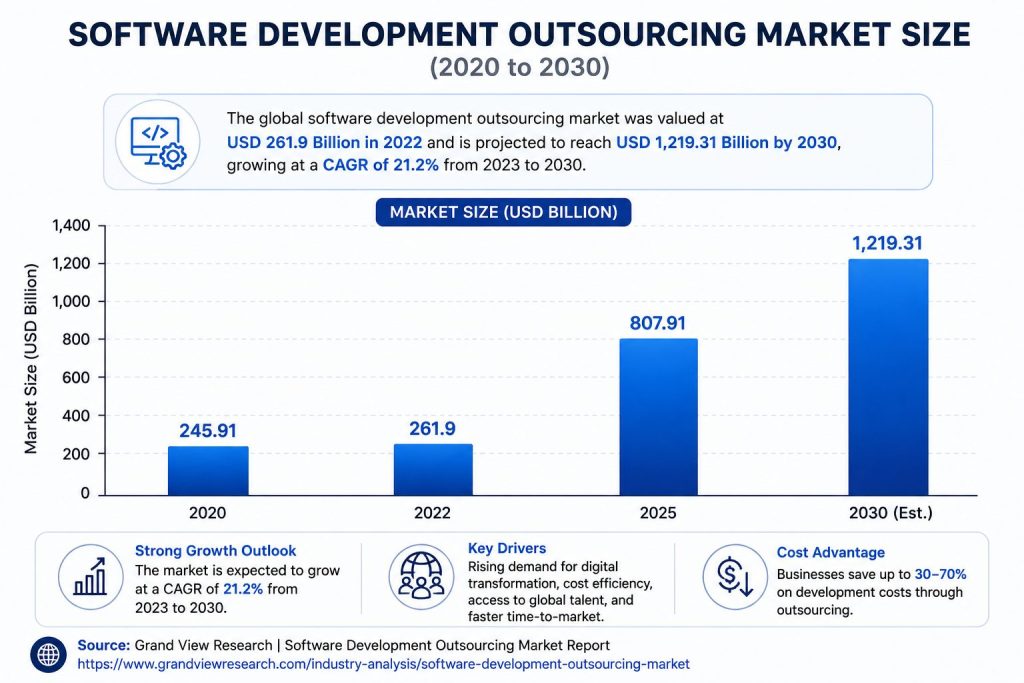
According to Market.us, the global software development outsourcing market was valued at USD 534.9 billion in 2024 and is projected to reach approximately USD 940.0 billion by 2034, growing at a CAGR of 5.8% from 2025 to 2034.
What Are The Differences Between IT Staff Augmentation And Software Development Outsourcing?
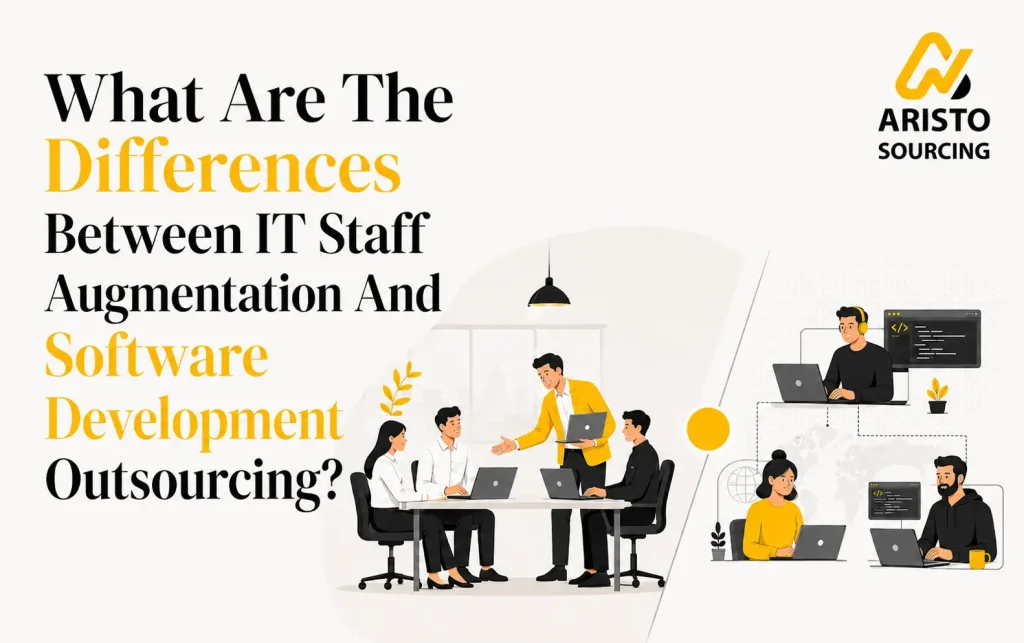
IT Staff Augmentation and Software Development Outsourcing both help businesses scale software development operations, but major differences appear in team structure, operational control, cost management, and project ownership models.
Team Structure
Team structure in IT Staff Augmentation integrates external developers directly into existing in-house engineering teams. Augmented engineers participate in internal meetings, sprint planning, communication workflows, and daily software development operations under the client’s management structure.
Team structure in Software Development Outsourcing usually remains separate from the client’s internal workforce because vendors manage dedicated external delivery teams independently. Outsourcing providers often assign their own project managers, developers, QA specialists, and technical leads to supervise execution processes.
Team structure also influences collaboration, communication, and project execution. According to Accelerance’s Global Software Outsourcing Trends & Rates Guide, 60% of U.S. companies outsource at least part of their application development, highlighting the growing reliance on external engineering teams that either integrate with in-house staff through IT staff augmentation or operate independently through software development outsourcing.
Engagement And Control Model
Engagement and Control Model in IT Staff Augmentation gives businesses direct authority over engineering priorities, software architecture, sprint execution, and development workflows. Internal managers supervise augmented developers exactly like permanent in-house software engineers throughout the development lifecycle.
Engagement and Control Model in Software Development Outsourcing shifts operational supervision toward the external vendor because outsourcing providers independently manage execution strategies, delivery timelines, staffing allocation, and technical coordination processes after receiving business requirements from the client.
The Engagement and Control Model strongly affects transparency, communication speed, and decision-making during software delivery. According to Deloitte’s 2024 Global Outsourcing Survey, 80% of executives plan to maintain or increase investment in third-party outsourcing, reflecting the growing strategic role of external technology partners. Businesses can then choose the engagement model that best fits their desired level of operational control, whether integrating augmented staff into internal teams or delegating end-to-end delivery to an outsourcing provider.
Cost Structure And Budget Predictability
Cost Structure and Budget Predictability in IT Staff Augmentation usually follows hourly, monthly, or resource-based pricing models connected to developer expertise, engagement duration, and workforce scaling requirements. Businesses maintain direct visibility into engineering expenses and internal resource utilization.
Cost Structure and Budget Predictability in Software Development Outsourcing commonly depends on fixed-price contracts, milestone-based billing, or dedicated-team agreements where vendors manage infrastructure, staffing, project coordination, and quality assurance costs within one external service model.
Cost Structure and Budget Predictability directly impact long-term software investment planning and operational efficiency. Grand View Research states businesses may reduce software development costs by 30–70% through outsourcing models, although management complexity and Management Responsibility still vary significantly between both engagement structures.
Management Responsibility
Management Responsibility in IT Staff Augmentation remains under the client’s internal leadership because businesses directly supervise augmented developers, sprint execution, engineering priorities, software architecture, and day-to-day development operations through existing management structures.
Management Responsibility in Software Development Outsourcing primarily belongs to the external vendor since outsourcing providers manage project coordination, team supervision, delivery planning, testing operations, and technical execution with limited client involvement in daily workflows.
Management Responsibility also affects communication overhead, operational transparency, and delivery accountability across software projects. According to Deloitte, 48% of businesses outsource to improve process efficiency and operational management, while companies needing tighter internal coordination often evaluate Scalability and Team Flexibility before selecting an engagement model.
Scalability And Team Flexibility
Scalability and Team Flexibility in IT Staff Augmentation allow businesses to quickly expand or reduce engineering capacity based on changing project requirements, technical demands, hiring gaps, or short-term software development priorities without restructuring internal operations.
Scalability and Team Flexibility in Software Development Outsourcing depend more on vendor resource availability, contractual agreements, delivery scope, and external project planning because outsourcing teams usually operate through predefined service structures and engagement terms.
Scalability and Team Flexibility influence long-term workforce planning, product delivery speed, and digital transformation strategies. According to Statista, 76% of companies globally use outsourcing or external technology partnerships to improve operational agility, workforce scalability, and faster access to specialized technical expertise.
Pros And Cons Of IT Staff Augmentation
IT Staff Augmentation helps businesses scale software development teams quickly, access specialized technical talent, and maintain operational control, but the model also creates management challenges, onboarding complexity, and long-term coordination demands.
Advantages Of IT Staff Augmentation
- Full Control And Oversight
Direct management authority allows businesses to supervise software development priorities, engineering workflows, sprint planning, and technical decisions without relying on external vendor leadership. - Rapid Scaling And Flexibility
Flexible workforce expansion helps companies quickly increase or reduce engineering capacity based on project timelines, software delivery requirements, or temporary resource shortages. - Access To Specialized Skills On Demand
Immediate technical expertise gives businesses faster access to experienced developers, DevOps engineers, cybersecurity specialists, and cloud professionals for niche software development needs. - Transparent And Predictable Cost Structure
Clear pricing visibility supports better software development budgeting through stable hourly or monthly engagement models with reduced hidden operational expenses. - Cultural And Process Alignment
Seamless internal collaboration becomes easier because external engineers follow existing Agile methodologies, communication systems, development standards, and organizational workflows. - Faster Time-To-Productivity
Quick onboarding efficiency helps experienced external developers contribute to active software projects almost immediately after integration into the internal engineering environment. - Lower Long-Term Commitment
Reduced hiring obligations allow businesses to meet short-term software development demands without permanent recruitment costs or expanded workforce management responsibilities.
Disadvantages Of IT Staff Augmentation
- Management Overhead Burden
Additional supervision responsibilities can increase internal management workload and coordination pressure. - Security And IP Risks
External developer access may create data security, compliance, and intellectual property concerns. - Onboarding And Ramp-Up Time
Initial onboarding periods may temporarily slow software development productivity and collaboration. - Hourly Cost Premium Vs In-House FTE
External engineering rates can sometimes exceed long-term full-time employee costs. - Inconsistency Across Engineers
Different external developers may follow varying coding practices, communication styles, and workflow approaches. - Less Commitment Than FTE
Short-term engagement models may reduce long-term organizational loyalty and project continuity.
Pros And Cons Of Software Development Outsourcing
Software Development Outsourcing helps businesses reduce development costs, access global engineering talent, and accelerate software delivery, but the model can also create communication challenges, reduced operational control, and vendor dependency risks.
Advantages Of Software Development Outsourcing
- Turnkey Delivery Without Management Overhead
External vendors handle project coordination, technical supervision, testing, and delivery operations with minimal internal management involvement. - Access To Global Talent Pool And Pre-Built Teams
Global outsourcing providers offer immediate access to experienced software engineers, QA specialists, DevOps experts, and established development teams. - Cost Savings On Long-Term Stable Work
Lower operational expenses help businesses reduce infrastructure, recruitment, training, and long-term workforce management costs. - Faster Time-To-Market For Defined Scope
Dedicated external teams accelerate software delivery timelines through established workflows, specialized expertise, and continuous development operations. - Focus On Core Business
Internal teams can prioritize strategic growth, customer experience, and business operations while vendors manage software development execution. - Risk Transfer To Vendor
Project delivery responsibilities, staffing management, and quality assurance obligations largely shift toward the outsourcing provider. - Scalability For Large-Scope Work
External vendors can quickly expand engineering resources to support enterprise software projects, digital transformation initiatives, and large-scale development requirements.
Disadvantages Of Software Development Outsourcing
- Reduced Control Over Execution
Limited operational visibility can reduce direct control over software development workflows, priorities, and engineering decisions. - Scope Creep And Change-Order Premiums
Project requirement changes may increase development costs through additional vendor pricing and revised delivery agreements. - Communication And Time-Zone Friction
Different time zones and communication practices can slow collaboration, feedback cycles, and decision-making processes. - Slower Start Time
Vendor onboarding, requirement analysis, and project planning stages may delay initial software development execution. - IP And Data Security Risks
External vendor access can create intellectual property, compliance, and sensitive data protection concerns. - Vendor Lock-In And Exit Difficulty
Long-term outsourcing relationships may create operational dependency and complex migration challenges during vendor transitions. - Quality Variability And Bench Rotation
Developer replacement and inconsistent engineering standards can affect software quality, continuity, and long-term project stability.
When To Choose IT Staff Augmentation
IT Staff Augmentation becomes the right choice when businesses need flexible software development support, specialized technical expertise, or temporary engineering expansion while maintaining direct control over development workflows, product strategy, and operational management. Different business scenarios often determine when staff augmentation delivers better value than traditional hiring or software development outsourcing.
Skill Gap On A Defined Stack
Skill gap on a defined stack becomes a major trigger for staff augmentation when internal engineering teams lack expertise in technologies like DevOps automation, cloud infrastructure, AI development, cybersecurity, blockchain systems, or enterprise software architecture. External specialists help businesses access niche technical skills without permanent hiring commitments.
Capacity Shortage During A Launch Crunch
Capacity shortage during a launch crunch often creates temporary software development pressure during product launches, migration projects, seasonal demand spikes, or accelerated release cycles. External engineers help internal teams maintain delivery speed and operational stability without overwhelming existing developers.
Pre-PMF Startup Iterating Weekly
Pre-PMF startup iterating weekly benefits from staff augmentation because early-stage startups frequently adjust product features, workflows, customer experience strategies, and software functionality before achieving stable product-market fit. Flexible engineering resources support rapid experimentation and continuous iteration.
Validating A New Role Before FTE Commitment
Validating a new role before FTE commitment allows businesses to evaluate technical requirements, workflow impact, and long-term hiring value before expanding permanent software engineering teams or increasing operational expenses.
Bridging Hiring Delays
Bridging hiring delays helps companies continue software development operations while recruiting senior developers, DevOps engineers, cloud architects, or cybersecurity specialists in highly competitive talent markets.
Funding-Stage Scaling
Funding-stage scaling increases demand for temporary engineering expansion because startups often accelerate software development immediately after investment rounds or rapid business growth periods.
Specialized One-Off Expertise
Specialized one-off expertise supports short-term technical initiatives such as cloud migration, infrastructure modernization, legacy system upgrades, compliance implementation, or enterprise platform integrations requiring advanced technical experience.
When To Choose Software Development Outsourcing
Software Development Outsourcing becomes the right choice when businesses need complete project execution, external engineering management, or scalable software delivery without building and supervising large in-house development teams. Outsourcing works best when companies prioritize operational efficiency, faster delivery, and reduced internal management responsibilities over direct engineering control.
Defined Deliverable With Stable Scope
Defined deliverables with a stable scope create an ideal outsourcing scenario because external vendors perform more effectively when software requirements, technical objectives, feature sets, and delivery expectations remain predictable throughout the development lifecycle. Stable project scope reduces operational confusion, delivery delays, and expensive change-order requests.
Lack Of Internal Engineering Leadership
Lack of internal engineering leadership often pushes businesses toward outsourcing when companies do not have experienced CTOs, technical architects, engineering managers, or software team leads to supervise complex development operations internally. External vendors provide structured technical leadership and delivery management.
Need For Turnkey Delivery Without Daily Management
Turnkey delivery without daily management becomes valuable when businesses prefer vendors to manage software engineering workflows, sprint execution, testing operations, infrastructure coordination, deployment processes, and quality assurance with minimal client-side supervision.
Project Scope Locked Before Development Starts
Project scope locked before development starts improves outsourcing efficiency because external vendors can estimate budgets, staffing requirements, technical resources, delivery timelines, and development milestones more accurately within fixed engagement models.
Acceptance Of Vendor-Controlled Daily Execution
Vendor-controlled daily execution works well for companies comfortable with external project managers, engineering leads, and dedicated software teams independently supervising development operations, technical decisions, workflow coordination, and day-to-day execution processes.
Specific Triggering Scenarios
Specific triggering scenarios often include enterprise application development, SaaS platform creation, legacy modernization projects, mobile application launches, digital transformation initiatives, QA automation programs, and large-scale cloud migration projects requiring fully managed external software delivery teams.
Which Model Gives More Control?
IT Staff Augmentation gives more control because businesses directly manage developers, engineering priorities, sprint execution, and software delivery through internal leadership. Software Development Outsourcing reduces operational oversight since vendors independently supervise technical execution and project management workflows. Greater control matters for companies with sensitive infrastructure or rapidly changing requirements. The global IT services outsourcing market may reach USD 2,158 billion by 2040.
When Should You Choose Outsourcing?
Choose Software Development Outsourcing when your business lacks internal technical leadership, requires turnkey software delivery, or wants external vendors to manage engineering workflows independently. Outsourcing performs best for fixed project scopes, non-core software functions, MVP development, and long-term operational cost optimization. Businesses should also prioritize outsourcing when vendor accountability, scalability, and risk transfer matter more than maintaining direct control over daily software development execution.
Is Staff Augmentation Better For Startups?
IT Staff Augmentation works best for startups with experienced CTOs, technical founders, or internal engineering leadership because businesses retain direct control over developers, sprint execution, and product workflows. Early-stage startups often use staff augmentation for flexible scaling and faster iteration. However, non-technical founders usually benefit more from Software Development Outsourcing since external vendors independently manage software development operations and delivery.