
The top IT outsourcing countries in 2026 include India, the Philippines, Vietnam, Poland, Egypt, South Africa, Bangladesh, and Others. A country earns its place on that list through three deciding lenses, including cost competitiveness, the depth of available talent, and time zone alignment with client teams.
New emerging destinations such as Egypt, South Africa, and Bangladesh are gaining ground as companies look to diversify beyond established hubs. Hourly rates span from as low as $8 in South Asia to over $150 for North American onshore delivery, with significant variation in different cost ranges depending on the country, role, and seniority level. In 2026, AI is also redefining what IT outsourcing means, shifting demand from commodity coding toward specialist machine learning and AI engineering talent.
What Makes a Country a Top IT Outsourcing Destination?
Qualifications that make a country a top IT outsourcing destination include cost efficiency, a deep STEM talent pool, strong English proficiency, favorable time zones, and solid legal frameworks for IP and data protection.
Offshore and onshore pricing gaps drive initial vendor selection, but the strongest outsourcing destinations score well across all five dimensions.
5 qualifications that make a country a top IT outsourcing destination are listed below.
- Cost and Hourly Rate Competitiveness: Cost and hourly rate competitiveness refers to the margin between what offshore or onshore providers charge and what equivalent labor costs are in the client’s home market, directly determining the financial case for outsourcing.
- Talent Pool Depth and STEM/IT Graduate Output: Talent pool depth and STEM/IT graduate output refer to the annual supply of qualified engineers, developers, and IT specialists a country produces, determining a vendor’s capacity to scale and backfill roles reliably.
- English Proficiency and Communication Skills: English proficiency and communication skills refer to how effectively a country’s IT workforce collaborates with English-speaking clients across written specifications, sprint reviews, and real-time problem-solving sessions.
- Time Zone Overlap with Clients: Time zone overlap with clients refers to the number of shared business hours available for real-time communication between the outsourcing team and the client, directly affecting collaboration speed and decision-making cycles.
- Political Stability, IP Protection, and Data Security: Political stability, IP protection, and data security refer to a country’s legal environment, including its intellectual property laws, cybersecurity regulations, and government predictability, that determines how safely proprietary work can be delivered offshore or onshore.
Offshore vs. Nearshore vs. Onshore IT Outsourcing: What’s the Difference?
The difference between offshore, nearshore, and onshore IT outsourcing is the geographic and time zone distance between the client and the outsourcing destination, which drives variation in cost, overlap, and collaboration model.
Offshore outsourcing engages teams in distant regions, such as India or Vietnam, for a US client, resulting in the largest cost gap but the least time zone overlap. Nearshore places delivery in adjacent regions, like Mexico for US companies, offering partial overlap at moderate savings. Onshore keeps all delivery within the client’s own country at the highest cost but with full time zone and regulatory alignment.

What Are the Top IT Outsourcing Countries in 2026?
The top IT outsourcing countries in 2026 include India, the Philippines, Vietnam, Poland, Ukraine, Romania, Mexico, Brazil, Argentina, Egypt, South Africa, and Bangladesh.
The top IT outsourcing countries in 2026 are listed below.
- India
- The Philippines
- Vietnam
- Poland
- Deep Technical Talent in Eastern Europe: Ukraine & Romania
- Nearshore Options for US Companies: Mexico, Brazil & Argentina
- Emerging Destinations: Egypt, South Africa & Bangladesh
1. India
India is the global powerhouse of IT outsourcing, known for massive scale, 24/7 follow-the-sun delivery, and decades of enterprise IT maturity. Core IT specialties include enterprise software development, cloud infrastructure, artificial intelligence and machine learning, cybersecurity, and large-scale business process management.
According to NASSCOM, India’s talent pool exceeds 5.4 million active IT professionals, supported by over 1.5 million engineering graduates entering the workforce each year. Typical hourly rates range from $10 to $40 depending on seniority, specialty, and vendor tier, one of the widest cost-advantage gaps globally. India is the right choice for large-scale, complex, long-duration projects that require round-the-clock delivery, access to a full spectrum of emerging destinations for AI and cloud specialists, and a mature ecosystem of enterprise-grade vendors.
2. The Philippines
The Philippines is the global leader in IT-enabled services and BPO outsourcing, distinguished by exceptional English fluency, strong customer-experience culture, and a high degree of cultural affinity with Western markets. Core IT specialties include customer support, technical helpdesk, software QA and testing, back-office automation, and content moderation.
According to data from IBPAP, the Philippine IT-BPO sector employs over 1.3 million workers and is sustained by roughly 100,000 new IT and business graduates entering the workforce annually. Typical hourly rates range from $10 to $30, positioning the Philippines as highly competitive for service-oriented delivery. The Philippines is the right choice for companies prioritizing client-facing roles, high-volume customer operations, or back-office functions where communication quality and cultural alignment with English-speaking markets drive outcomes.
3. Vietnam
Vietnam is a fast-growing IT outsourcing hub in Southeast Asia, recognized for strong software engineering talent, a youthful workforce, and competitive rates that undercut many comparable markets. Core IT specialties include mobile and web application development, QA and testing, embedded systems, and increasingly AI engineering and data processing.
According to TopDev (Vietnam’s leading tech recruitment platform), Vietnam graduates approximately 55,000 IT professionals annually, with a workforce noted for technical discipline and delivery consistency. Typical hourly rates sit between $15 and $40, offering solid quality-adjusted value for mid-complexity software work. Vietnam is the right choice for mid-market companies seeking reliable software development capacity in Asia-Pacific without the vendor-management complexity of larger, more fragmented outsourcing markets.
4. Poland
Poland is Eastern Europe’s most mature IT outsourcing destination, recognized for deep engineering expertise, a strong culture of R&D, and full EU regulatory alignment including GDPR. Core IT specialties include software architecture, fintech development, cybersecurity, ERP implementation, and product engineering.
According to data from ABSL, Poland’s active technology workforce exceeds 300,000 professionals, with Warsaw, Kraków, and Wrocław serving as the primary delivery hubs. Typical hourly rates range from $35 to $75, reflecting premium engineering quality relative to Asia but strong value against Western European or US onshore alternatives. Poland is the right choice for European clients or companies requiring GDPR-compliant delivery, advanced engineering depth, or proximity to Central and Western European time zones.
5. Deep Technical Talent in Eastern Europe: Ukraine & Romania
Ukraine and Romania offer highly concentrated engineering talent with a strong bias toward complex software development, algorithms, and systems engineering. According to the IT Ukraine Association, Ukraine’s IT sector employs over 285,000 developers, with pronounced expertise in embedded systems, blockchain, and AI/ML, having successfully transitioned operations to Western Ukraine or neighboring EU countries since 2022 to preserve delivery continuity.
According to data from ANIS (Romania’s Software and Services Industry Association), Romania supports a developer workforce of approximately 130,000, with deep expertise in automotive software, telecommunications, and enterprise IT, and is especially well-regarded among German and French clients due to EU alignment and time zone proximity. Hourly rates in both countries range from $25 to $65, delivering strong engineering quality relative to cost. Both are ideal for technically demanding projects requiring problem-solving depth, R&D collaboration, or niche domain engineering that commodity offshore markets cannot reliably deliver.
6. Nearshore Options for US Companies: Mexico, Brazil & Argentina
Mexico, Brazil, and Argentina collectively form the strongest nearshore IT outsourcing corridor for US-based companies, offering overlapping business hours, cultural familiarity, and rapidly growing technical capacity. Mexico is the most accessible option, with established software development clusters in Guadalajara and Monterrey and hourly rates between $30 and $60; its proximity enables same-day travel and real-time collaboration across US time zones.
Brazil offers the region’s largest developer talent pool, over 500,000 active professionals, with specializations in fintech, mobile development, and enterprise applications at rates of $25 to $55 per hour. Argentina delivers some of LATAM’s strongest engineering quality, with a notable emphasis on product development and AI, typically ranging from $30 to $65 per hour despite periodic economic volatility. These three markets are best suited for US companies that prioritize real-time Agile collaboration, sprint participation, and cultural alignment without full offshore time zone displacement.
7. Emerging Destinations: Egypt, South Africa & Bangladesh
Emerging destinations for IT outsourcing refer to countries that are growing their share of the global IT services market but have not yet reached the scale, vendor maturity, or brand recognition of established hubs like India or Poland. Some strong emerging destinations in the IT industry include Egypt, South Africa, and Bangladesh, each of which is building a distinct value proposition within its region.
Egypt has established itself as the leading IT outsourcing hub within the Middle East and North Africa region, with strengths in multilingual customer support, software development, and digital transformation services. Egypt’s government-backed tech education programs produce over 35,000 IT graduates annually, and hourly rates range from $10 to $30.
South Africa serves both the African continent and English-speaking Western markets with a strong BPO and financial services outsourcing track record, benefiting from European-aligned time zones, bilingual English capacity, and hourly rates between $15 and $35. According to the Bangladesh Investment Development Authority (BIDA), Bangladesh has emerged as one of South Asia’s most compelling low-cost outsourcing options, with an IT workforce now exceeding 650,000 professionals, a government-backed Digital Bangladesh infrastructure initiative, and hourly rates ranging from $8 to $25, among the most competitive globally, with particular depth in web development, data processing, and back-office services.
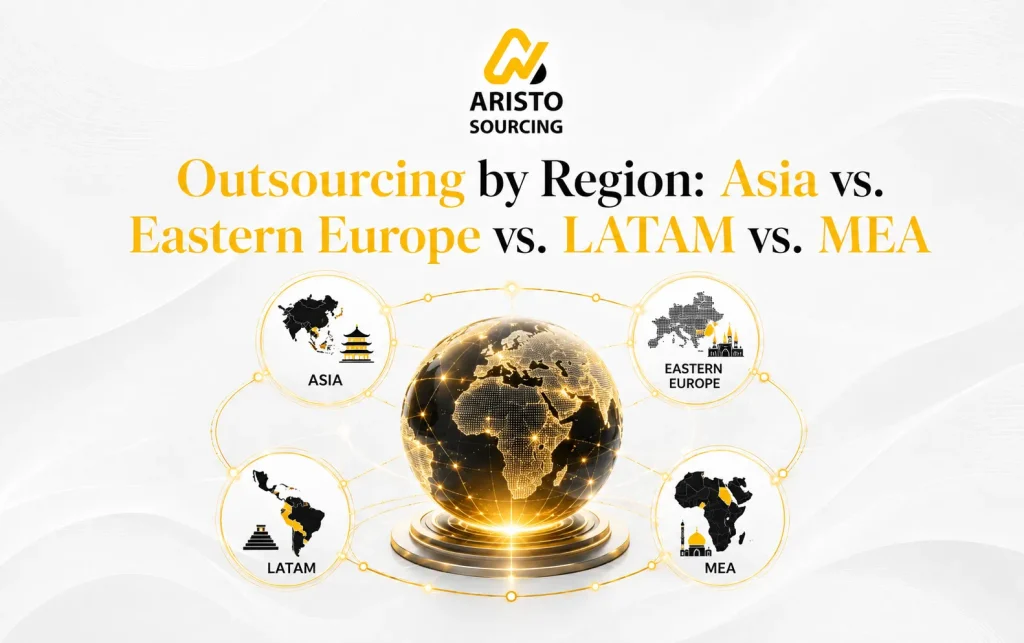
Outsourcing by Region: Asia vs. Eastern Europe vs. LATAM vs. MEA
The difference in outsourcing, depending on regions such as Asia, Eastern Europe, LATAM, and MEA, involves trade-offs between cost, engineering depth, time zone alignment, and regulatory environment, and no single region dominates across all four dimensions.
Outsourcing by region is explained in the table below.
| Region | Time Zone | Explanation |
|---|---|---|
| Asia (Pacific) | GMT+5:30 to +9 | Scale and lowest cost define this region. India, Vietnam, and the Philippines offer the largest global talent pool at $10–$45/hr. Cost depends on the country and the seniority tier — rates in Vietnam skew higher than Bangladesh but below India’s senior-level billing. |
| Eastern Europe | GMT+2 to +3 | Engineering depth and R&D capability characterize Eastern Europe. Poland, Romania, and Ukraine operate within or adjacent to EU frameworks, offering strong GDPR and IP alignment. Poland averages $35–$75/hr, Romania and Ukraine $25–$65/hr. |
| LATAM | GMT-3 to -6 | Nearshore time-zone overlap with the US and Canada is LATAM’s primary advantage. Mexico, Brazil, and Argentina enable real-time Agile collaboration that is impossible with Asia. Cost depends on the country, ranging from $25–$65/hr, with Argentina’s rates subject to currency conditions. |
| MEA (Middle East & Africa) | GMT+0 to +3 | MEA is an emerging region for value-based IT scaling. Egypt leads MENA, South Africa serves English-speaking markets with European time zone alignment, and Bangladesh anchors South Asia’s low-cost tier. Cost is from $8/hr in Bangladesh to $35/hr in South Africa. |
How Much Does IT Outsourcing Cost by Country?
The IT outsourcing cost is different in every country; for example, Asia-Pacific destinations such as India, Vietnam, and the Philippines range from $10 to $45 per hour, Eastern European markets run $25 to $75, and North American onshore delivery exceeds $100 per hour for most technology roles.
Beyond the sticker rate, the true cost of offshore outsourcing includes total cost of ownership factors such as onboarding time, quality rework cycles, management overhead, and vendor attrition, all of which can significantly erode headline savings.
The average hourly-rate ranges of IT outsourcing by region are listed below.
- Asia (India/Vietnam/Philippines) — $10–$45/hr: These markets offer the widest global cost advantage. According to NASSCOM’s 2024 Tech Sector Report and Everest Group’s IT Services Benchmarking data, mid-level Indian developer rates average $18–$30 per hour, while Vietnam and the Philippines cluster between $15–$35 depending on specialization and vendor size.
- Eastern Europe (Poland/Romania/Ukraine) — $25–$75/hr: Eastern European rates reflect premium engineering quality and EU regulatory alignment. Deloitte’s Global Outsourcing Survey places Poland’s mid-range developer billing between $40 and $60 per hour, with Romania and Ukraine running approximately $10–$20 lower at equivalent seniority levels.
- LATAM (Mexico/Brazil/Argentina) — $30–$65/hr: Latin American rates support nearshore business models for North American clients seeking real-time collaboration. Cost depends on the country; Argentina’s current economic conditions can produce favorable rate adjustments, while Mexico’s proximity commands a slight premium over Brazil and Argentina for many US buyers.
- North America (onshore) — $100–$200/hr: Onshore US rates reflect full employment costs including benefits, overhead, and local market salaries. Bureau of Labor Statistics data places the median US software developer salary above $130,000 annually, translating to effective billing rates well above $100 per hour, making offshore outsourcing the primary lever for cost reduction against this baseline.
Choosing a destination purely on sticker rate is a risky mistake. The cheapest offshore option often carries hidden costs in communication overhead, quality rework, talent attrition, and project management complexity that erode hard savings over time. The total cost of ownership, not the hourly rate, should govern country selection.

What Are the Risks of Offshore IT Outsourcing?
The risks of offshore IT outsourcing include communication and time zone gaps, talent attrition, IP and data security exposure, geopolitical instability, and quality variance between vendors. Understanding these offshore outsourcing risks is essential before choosing the right outsourcing country for any engagement.
The risks of offshore IT outsourcing are listed below.
- Communication / Time-zone Gaps: Communication and time-zone gaps refer to the compounding delays in decision-making, feedback cycles, and issue resolution that arise when client and vendor teams share few or no overlapping business hours, slowing sprint velocity and escalation response.
- Talent Attrition and Retention: Talent attrition and retention refers to the risk that experienced team members hired or trained for a project leave the vendor firm mid-engagement, disrupting delivery continuity and forcing costly knowledge transfer and ramp-up cycles.
- IP Protection and Data-security Exposure: IP protection and data-security exposure refers to the risk that proprietary source code, customer data, or trade secrets are inadequately protected by the outsourcing country’s legal frameworks or the vendor’s internal security controls.
- Geopolitical / Economic Instability: Geopolitical and economic instability refers to the risk that political events, currency shocks, or regional conflicts in an outsourcing country disrupt service delivery continuity, as demonstrated by the impact on Ukraine-based IT teams following 2022.
- Quality Variance Between Vendors: Quality variance between vendors refers to the wide disparity in engineering standards, process maturity, and output reliability that exists across outsourcing providers within the same country, even at similar price points and seniority levels, making vendor due diligence as important as country selection.
How to Choose the Right IT Outsourcing Country?
Choosing the right IT outsourcing country means matching a country’s specific strengths, whether that is scale, R&D depth, nearshore agile delivery, or emerging artificial intelligence capability to the project’s actual requirements, quality thresholds, and timeline constraints rather than defaulting to the lowest hourly rate.
Beyond cost, a rigorous evaluation must weigh total cost of ownership, English proficiency, time zone overlap, and the strength of IP and legal protections to choose the right outsourcing country with confidence. Running a small, scoped pilot engagement before committing to full-scale delivery is the most reliable validation step available, because no country analysis can substitute for live collaboration data with a real vendor team.
How Is AI Changing Where Companies Outsource IT?
AI is shifting IT outsourcing by redirecting demand away from commodity coding and routine back-office tasks toward specialized AI in IT outsourcing roles. This includes machine learning engineering, data science, and intelligent automation, fundamentally changing which outsourcing country destinations attract premium investment.
The value proposition of offshore delivery is moving from pure labor arbitrage toward high-skill AI talent access, benefiting countries like India, Poland, and Romania that have invested in AI education pipelines, research infrastructure, and industry partnerships. Automation is simultaneously absorbing portions of QA, data entry, and repetitive development work, pushing both clients and outsourcing countries to reposition their service offerings around higher-complexity, higher-value engagements.
What Is the Most Outsourced Country?
The most outsourced country for IT is India, which leads globally across IT outsourcing volume, IT services exports, top IT outsourcing countries rankings, and enterprise client concentration, according to NASSCOM. ALso, according to NASSCOM, India’s IT sector generates over $250 billion in annual revenue, with exports exceeding $190 billion, underpinned by an unmatched combination of global talent, flexible cost ranges, and a highly mature vendor ecosystem.
The Philippines holds the top position specifically within BPO and customer experience outsourcing, supported by AI-augmented service delivery and a deep English-language talent base, while India’s overall dominance is reinforced by its rapid expansion into emerging destinations of AI and cloud specialization. No country in 2026 threatens India’s aggregate leadership, though regional competitors in Eastern Europe, LATAM, and MEA are steadily closing the gap across specific verticals and client segments where talent depth and time zone proximity outweigh pure cost advantages.