

Most founders already know that social media networking drives the B2B pipeline. The research is unambiguous, the competitive evidence shows up in their own LinkedIn feeds, and the argument for investing in it needs no rehearsal here. The real problem is not awareness. Its execution: the daily, discipline-dependent workflow of publishing, engaging, prospecting, and tracking that stops producing results the moment it becomes inconsistent.
That inconsistency follows a predictable architectural pattern. Social media networking generates compounding returns when someone owns it as a full-time system. When founders absorb that system into an already-packed schedule, it breaks under the first sustained wave of operational pressure. The fix is not motivational. It’s structural: a Social Media Virtual Assistant proficient in LinkedIn Sales Navigator, content distribution frameworks, and CRM synchronization takes full ownership of the execution layer. At the same time, the founder retains strategic control and editorial voice.
This article covers what disciplined social media networking produces for B2B businesses, where the execution system breaks down, and exactly how to delegate the workflow without sacrificing the authenticity that makes it convert.

The Modern Reality of B2B Social Networking
Hootsuite’s 2026 Digital Report found that the average professional spends 2 hours and 48 minutes per day on social platforms. LinkedIn’s 2026 platform data shows that 80% of B2B leads generated through social media originate from its platform, with content engagement driving those leads through the funnel. The Sprout Social Index 2026 shows that brands publishing at least four times per week on LinkedIn see 2.7 times more organic reach than those publishing once or twice weekly.
B2B social networking in 2026 demands a narrow, platform-specific focus rather than a broad multi-platform presence. LinkedIn leads for professional outreach, Social Selling Index (SSI) development, and thought leadership positioning. YouTube drives long-form authority content that ranks in search and builds deep trust over time. X functions as a real-time commentary channel for industries where public discourse shapes credibility. Spreading effort thin across every platform dilutes all of them.
LinkedIn Sales Navigator sharpens this focus further. Its advanced filtering lets a sourcing team search by seniority level, company headcount, industry vertical, geographic region, and real-time buying signals like recent job changes, company funding events, or leadership transitions. Teams that prospect using Sales Navigator custom lists, rather than the standard LinkedIn search bar, consistently reach higher-quality targets and report shorter outreach-to-conversation timelines.
The Social Selling Index (SSI) quantifies how effectively a LinkedIn presence converts platform activity into business relationships. It scores across four dimensions: professional brand establishment, finding the right people, engaging with relevant insights, and building relationships that move forward. LinkedIn’s data shows that professionals with SSI scores above 75 create 45% more opportunities than those below that threshold and are 51% more likely to hit quota. SSI scores are measurable, trackable week over week, and directly improvable through the consistent daily activity a dedicated Social Media VA executes well.
Why Social Media Still Drives Real B2B Outcomes
The Edelman 2026 Trust Barometer found that 63% of buyers trust individual subject matter experts more than corporate brand messaging. For B2B service businesses, the founder’s personal LinkedIn presence generates more purchase trust than the company page does. That makes founder social visibility a direct revenue function, not a marketing side-project.
LinkedIn’s 2026 State of Sales Report found that 78% of social sellers outperform peers who don’t use social media as a sales channel, with a strong social presence correlating to 51% higher quota attainment. The mechanism behind these numbers is warm relationship building. When a prospect receives outreach from a founder whose thought leadership content they’ve been reading for three months, that conversation starts at a completely different point than cold outreach. The prospect already trusts the source. The friction in the first call drops significantly.
InMail optimization amplifies this further. Generic InMails, sent without prior engagement or profile research, produce 15 to 20% response rates on a strong day. Sequenced outreach, where a VA first warms the prospect through two to three weeks of genuine content engagement before sending a personalized InMail referencing specific details from the prospect’s profile or recent posts, consistently produces response rates 40 to 60% higher. That improvement compounds across a full prospect list and separates a social media program that looks active from one that actually generates pipeline.
Profile optimization forms the foundation of all of this. Before any outreach sequence runs, the VA audits and upgrades the founder’s LinkedIn profile: rewriting the headline to speak to the Ideal Client Profile’s outcomes rather than listing a job title, making the About section specific and conversion-focused, and populating the Featured section with content that proves domain expertise. A polished, ICP-facing profile converts profile visits into connection acceptances at significantly higher rates than a default corporate-style profile, which means every prospecting effort performs better before a single message goes out.
The Founder Bottleneck
A functional LinkedIn social selling program requires 8 to 12 hours of execution per week across content research and drafting, post scheduling, first-hour engagement monitoring, Sales Navigator prospecting, personalized outreach sequencing, CRM updates, and response tracking. For a founder managing a growing services business, that’s 20 to 30% of the working week spent on tasks that don’t require executive judgment. Every one of those tasks is delegable. Delegating the execution layer to a trained Social Media VA recovers those hours without reducing output quality, because the VA runs the system and the founder provides the substance.
The Three-Phase VA Execution Framework
At Aristo Sourcing, our VA teams structure social media networking delivery across three distinct execution phases, each with defined founder input requirements and VA ownership responsibilities. This separation is what allows a 20-minute weekly founder commitment to power a full-scale, active social selling program.
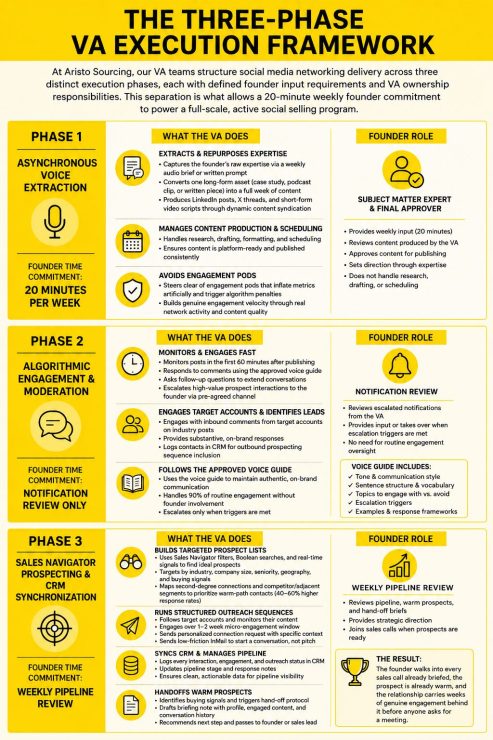
Phase 1: Asynchronous Voice Extraction Founder time commitment: 20 minutes per week
The VA extracts the founder’s raw expertise through a brief weekly audio brief or written prompt and converts that input into a full week of platform-ready content through a dynamic content syndication framework. A single long-form asset, whether a case study, a podcast clip, or a written position piece, produces multiple LinkedIn posts, X commentary threads, and short-form video scripts through structured repurposing. The founder acts as the subject matter expert and final approver. The VA handles research, drafting, formatting, and scheduling.
This phase also includes engagement pod avoidance, a technical discipline that matters for long-term LinkedIn account health. Engagement pods, networks of accounts that artificially inflate each other’s post metrics through coordinated liking and commenting, generate false reach signals that LinkedIn’s algorithm identifies and penalizes. A trained Social Media VA builds genuine engagement velocity through real network activity and content quality, not coordinated manipulation that risks account suppression.
Phase 2: Algorithmic Engagement and Moderation Founder time commitment: Notification review only
LinkedIn’s algorithm rewards posts that generate conversation within the first 60 minutes of publishing. The VA monitors the profile immediately after each post goes live, responds to comments using an approved voice guide, asks follow-up questions that extend the conversation thread, and escalates high-value prospect interactions directly to the founder via a pre-agreed notification channel.
Beyond post monitoring, this phase covers inbound comment engagement from target accounts. When a prospect within the ICP list comments on a trending post in the industry, the VA engages from the founder’s account with a substantive response and logs the contact in the CRM for inclusion in the outbound prospecting sequence. Community management becomes a lead identification function, not just a customer service one.
The approved voice guide underpinning this phase is a critical onboarding deliverable. It documents tone, sentence structure, vocabulary preferences, topics the founder engages with versus avoids, and escalation triggers that define when the VA stops, and the founder takes over. A well-built voice guide allows the VA to manage 90% of routine engagement without founder involvement while maintaining authentic, on-brand communication across every interaction.
Phase 3: Sales Navigator Prospecting and CRM Synchronization Founder time commitment: Weekly pipeline review
Using LinkedIn Sales Navigator advanced filters and Boolean search queries, the VA builds continuously refreshed custom lists of target prospects matching the founder’s Ideal Client Profile: industry, company size, seniority level, geographic location, and real-time buying signals. The list builds against competitor profiles, adjacent industry segments, and second-degree connection mapping to prioritize warm-path contacts where shared mutual connections improve response rates by 40 to 60%.
From each custom list, the VA runs a structured outreach sequence: follow the target account, monitor for content they publish, engage substantively over a one to two week micro-engagement window, then send a personalized connection request referencing a specific piece of content or shared professional context. After connection, the VA sends a low-friction InMail that opens a conversation rather than pitching a service.
Every interaction is logged in the CRM against the prospect’s record: engagement history, outreach status, response notes, and pipeline stage. The lead hand-off protocol triggers when a prospect shows clear buying signals. The VA drafts a briefing note covering the prospect’s profile summary, the content they engaged with, and the full context of the conversation to date, then passes it to the founder or internal sales lead with a recommended next step. The founder walks into every resulting sales call already briefed, the prospect is already warm, and the relationship carries weeks of genuine engagement behind it before anyone asks for a meeting.
What Aristo Sourcing’s Teams See in Practice
Across the social media management and VA engagements our teams support, the results from a disciplined execution system are clearly separate from founder-run efforts within 60 to 90 days. Founders running social selling themselves show strong early metrics that decay sharply during busy periods. VA-run programs show a calibration phase in weeks one through three as the voice guide settles, then build steadily through months two and three as the engagement rhythm establishes and the prospecting list warms up.
The SSI score serves as the most reliable early performance indicator. A well-executed VA program consistently moves a founder’s SSI from a typical starting point of 40 to 55 up to 70 to 80 within the first 90 days. That SSI improvement correlates directly with increased profile visibility in LinkedIn search, higher connection acceptance rates, and more frequent inbound messages from target-profile contacts. The SSI doesn’t measure vanity. It measures whether the LinkedIn infrastructure connecting social activity to pipeline growth is working.
Measuring What Your Social Media VA Delivers
The KPIs that reveal whether a B2B social media networking program produces business outcomes are more specific than follower counts or post impressions.
Connection acceptance rate measures whether outreach targeting and personalization work correctly. Engagement rate per post, calculated as total interactions divided by organic reach, shows whether content resonates with the specific ICP. Prospect-to-conversation rate tracks how many outreach sequences produce a genuine two-way exchange. Pipeline contribution from social-originated leads shows direct revenue impact. SSI score movement week over week tracks whether the LinkedIn infrastructure is strengthening or stalling.
A VA tracking these five metrics across 60 to 90 days generates enough data to identify exactly where the workflow underperforms and make precise adjustments. Most social media programs that produce disappointing results are never measured at this granularity. They tracked impressions, not outcomes, and never built the feedback loop that separates performing programs from ones that look active.
The Compounding Asset of Consistent Social Presence
A LinkedIn content presence built consistently over 12 months carries a different commercial weight than individual posts. When a potential client researches a founder’s name before a first call, they find months of expertise on display. When a journalist looks for a source, they find a consistent voice with a documented point of view. When a senior candidate evaluates the company, they find evidence of a founder who is engaged, opinionated, and present in their field.
LinkedIn’s 2026 platform data shows that company pages and personal profiles with consistent publishing histories, defined as six or more months of regular weekly posting, receive 5.6 times more follower growth than accounts with irregular publishing patterns. That growth compounds: a larger relevant following means each new post reaches more target-profile contacts, each outreach message lands in a more familiar inbox, and each sales conversation starts with a higher baseline of awareness.
Social media networking still matters in 2026. The evidence across lead generation, thought leadership, talent sourcing, and sales conversion is consistent and well-documented. What changed since the early days of social business strategy is the execution standard the market requires to compete. A Social Media VA proficient in LinkedIn Sales Navigator, InMail optimization, content distribution syndication, SSI development, and CRM synchronization gives B2B founders full access to those outcomes without the execution costs that break founder-run programs. The founder provides the expertise and the final voice. The VA provides the daily system that turns that expertise into a visible, compounding, revenue-generating presence.
Ready to Stop Being the Bottleneck in Your Own Growth?
Your social selling strategy doesn’t need more planning. It needs someone to run it every day while you focus on the work that actually requires you.
Aristo Sourcing places trained Social Media Virtual Assistants with B2B founders who are done losing 10-hour weeks to tasks a skilled VA can own completely. From LinkedIn Sales Navigator prospecting and InMail sequencing to content scheduling, CRM synchronization, and weekly pipeline reporting, your VA builds and maintains the execution system. At the same time, you show up for the conversations that close.
If your LinkedIn presence has been on the back burner for the last quarter, it’s not a priority problem. It’s a structural problem. We fix the structure.
Book a free discovery call with the Aristo Sourcing team and walk away with a clear picture of what a dedicated Social Media VA can execute for your business within the first 30 days.
References
Cialdini, R.B. (2021). Influence: The Psychology of Persuasion. 3rd edn. New York: Harper Business.
Edelman (2026). Edelman Trust Barometer 2026. Edelman. [Online] Available at: https://www.edelman.com/trust/trust-barometer [Accessed June 2026].
Expandi (2025) LinkedIn Outreach Benchmarks Report 2025. Expandi. [Online] Available at: https://expandi.io/blog/linkedin-outreach-benchmarks [Accessed June 2026].
Gartner (2025) B2B Buying Journey Research: How Buyers Make Decisions. Gartner Inc. [Online] Available at: https://www.gartner.com/en/sales/insights/b2b-buying-journey [Accessed June 2026].
Hootsuite and We Are Social (2026) Digital 2026 Global Overview Report. Hootsuite. [Online] Available at: https://www.hootsuite.com/resources/digital-trends [Accessed June 2026].
HubSpot (2026) State of Marketing Report 2026. HubSpot Inc. [Online] Available at: https://www.hubspot.com/state-of-marketing [Accessed June 2026].
LinkedIn (2026a) LinkedIn State of Sales Report 2026. LinkedIn Corporation. [Online] Available at: https://business.linkedin.com/sales-solutions/b2b-sales-strategy-guides/the-state-of-sales-report [Accessed June 2026].
LinkedIn (2026b) LinkedIn Social Selling Index: Platform Benchmarks 2026. LinkedIn Corporation. [Online] Available at: https://business.linkedin.com/sales-solutions/social-selling/social-selling-index-ssi [Accessed June 2026].
LinkedIn (2026c) LinkedIn Talent Trends Report 2026. LinkedIn Corporation. [Online] Available at: https://business.linkedin.com/talent-solutions/resources/talent-strategy [Accessed June 2026].
Sprout Social (2026). The Sprout Social Index 2026. Sprout Social Inc. [Online] Available at: https://sproutsocial.com/insights/index [Accessed June 2026].
Statista (2026). Daily time spent on social networking by internet users worldwide, 2012 to 2026. Statista. [Online] Available at: https://www.statista.com/statistics/433871/daily-social-media-usage-worldwide [Accessed June 2026].
