

Cutting costs is only part of why businesses outsource. Companies also turn to external providers for skills they don’t have in-house, faster scaling during growth or seasonal spikes, and round-the-clock coverage across time zones. This guide breaks down 10 real benefits businesses gain from outsourcing, along with 5 trade-offs worth weighing before signing a contract.
Deloitte’s Global Outsourcing Survey found that 80% of executives plan to maintain or increase their investment in third-party outsourcing, a sign the strategy is becoming more embedded in business planning rather than less. Customer service, IT, and finance functions tend to gain the most from outsourcing arrangements. By the end, you’ll know exactly which benefits apply to your business and when the trade-offs start to outweigh them.
Why Do Businesses Outsource?
Businesses outsource for four main reasons: lower costs, faster access to specialized talent, improved efficiency, and the ability to scale without hiring. Cost-cutting gets most of the credit, but it’s no longer the only driver, or even the main one for many companies.
Deloitte’s 2024 Global Outsourcing Survey found that skilled talent and agility now rank alongside cost reduction as key outsourcing drivers, with 83% of surveyed executives already using AI as part of their outsourced services. Speed, focus, and scale round out the picture: businesses outsource to launch faster, free internal teams for strategic work, and flex capacity up or down without the delays of hiring. See our complete guide to outsourcing for how the process works end to end. The 10 specific benefits driving this shift, starting with cost, are covered next.
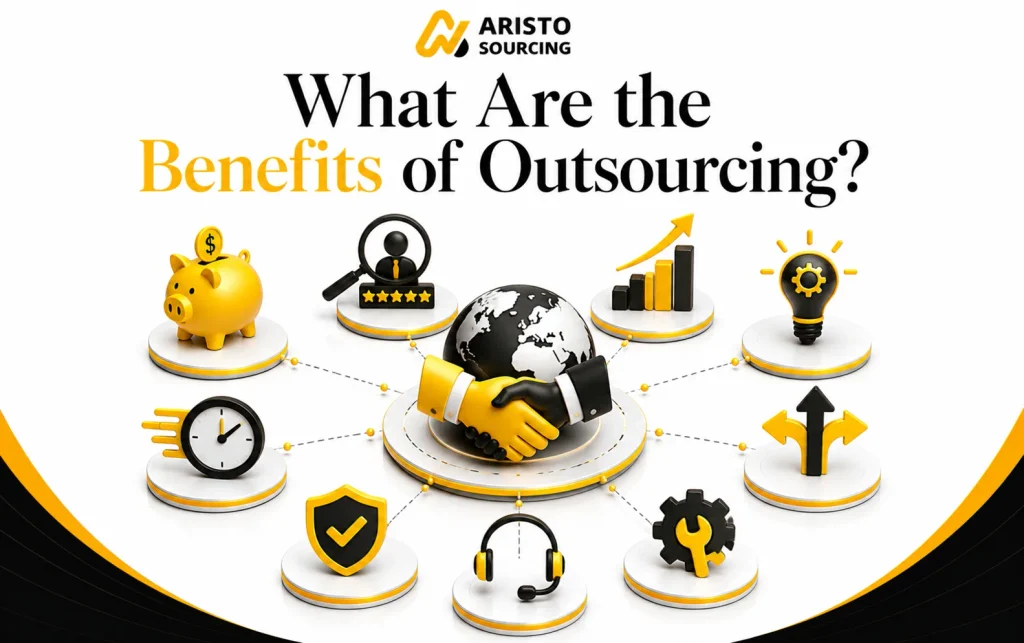
What Are the Benefits of Outsourcing?
Outsourcing delivers ten distinct advantages, and each one works through a different mechanism. Here’s how each pays off in practice, backed by real data.
1. Lower Labor and Operating Costs
Outsourcing cuts labor and operating costs by converting fixed salaries, benefits, and office overhead into a variable fee tied to work actually completed. A business pays for output rather than headcount, removing the cost of idle capacity during slow periods.
McKinsey’s research on business process outsourcing has documented cost reductions of up to 60% in strategic outsourcing relationships. Businesses with thin margins or high fixed costs gain the most. Cutting cost is the easiest benefit to measure, but it rarely explains why a company can’t find the right people to do the work in the first place, which is where specialized expertise comes in.
2. Access to Specialized Expertise
Outsourcing gives businesses access to specialized expertise by connecting them with providers who’ve already built deep, function-specific experience, whether in tax law, cybersecurity, or UX research. That experience would otherwise take years and multiple failed hires to develop internally.
ManpowerGroup’s 2025 Global Talent Shortage Survey found that nearly 75% of employers worldwide struggle to find the skilled talent they need. Businesses entering unfamiliar technical or regulatory territory gain the most. Depth of skill solves one problem, but finding that skill anywhere in the world, not just locally, solves a different one entirely.
3. Access to a Global Talent Pool
A global talent pool means a business can hire based on skill rather than geography, drawing from labor markets far beyond commuting distance from its own office. Local hiring caps a company at whatever talent happens to live nearby.
The scale of this shift shows up clearly in the numbers: IBPAP reported the Philippines’ IT-BPM sector alone employed 1.82 million workers in 2024, generating $38 billion in revenue. Companies in high-cost or talent-scarce local markets gain the most. Once a business can hire from anywhere, the next challenge becomes what to do with the internal time that decision frees up.
4. Focus on Core Business
Focus on core business means removing routine, non-strategic tasks from internal teams so leadership and specialists can concentrate on what actually differentiates the company. Every hour spent managing a task any outside provider could handle is an hour not spent on product or strategy.
Growth-stage companies benefit most from this shift, since leadership bandwidth is scarcest there and every hour matters more. Freed-up time only creates value if the outsourced work itself gets done well and quickly.
5. Increased Efficiency and Productivity
Increased efficiency and productivity comes from providers who specialize in one function and continuously refine how they do it, rather than juggling it alongside unrelated priorities. A dedicated team building the same workflow daily improves it in ways a generalist internal team rarely has time to.
Salesforce’s State of Service report found AI resolved 30% of service cases in 2025, a figure projected to reach 50% by 2027, largely driven by specialized providers adopting automation faster than typical in-house teams. Businesses with high-volume, repetitive workloads gain the most. Efficiency at a steady volume is one thing, but what happens when that volume suddenly changes is a separate test.
6. Scalability and Staffing Flexibility
Scalability and staffing flexibility let a business expand or shrink its outsourced workforce on demand, without the delays of hiring or the costs of layoffs. Providers absorb that volatility by reallocating staff across their client base as demand shifts.
A retailer can staff up for a holiday surge and scale back in January without carrying idle headcount the rest of the year. Companies with seasonal or unpredictable demand gain the most. Flexibility in headcount matters less if the work still takes too long to reach the customer, which is where speed comes in.
7. Faster Turnaround and Speed
Outsourcing speeds up turnaround by letting outsourced teams work in parallel with internal staff or across overlapping time zones, compressing timelines that would otherwise run one step at a time. A provider that’s already staffed and trained can start immediately, with none of the ramp-up a new internal hire would need.
Product launches and software releases especially benefit, since competitors are often racing toward the same deadline. Businesses in fast-moving industries gain the most. Speed during business hours still leaves a gap once the workday ends somewhere in the world.
8. 24/7 Availability
24/7 availability means a business can offer round-the-clock service by outsourcing to providers across different time zones, so support never depends on one office’s working hours. Handoffs between regions keep operations running through nights, weekends, and holidays without paying overtime.
Zendesk’s CX Trends 2026 report found that 74% of consumers now expect customer service to be available around the clock. Companies with international customer bases gain the most. Being available at all hours protects revenue day to day, but it doesn’t guard against a disruption that knocks out operations entirely.
9. Reduced Risk and Business Continuity
Reduced risk and business continuity come from spreading operations across a provider’s broader infrastructure and staff, rather than depending on one internal team as a single point of failure. If a key employee leaves or a local disruption hits, a provider’s larger bench can absorb the gap.
This matters most for companies in disaster-prone regions or those running lean with thin internal redundancy. Staying operational protects the business from disruption, but it doesn’t automatically make that business better than its competitors.
10. Competitive Advantage
Competitive advantage comes from combining outsourcing’s cost, speed, and expertise gains into an edge slower-moving competitors struggle to match. A business that outsources well can price more aggressively, launch faster, and serve customers better without matching that investment internally.
Grand View Research values the global call and contact center outsourcing market at $97.31 billion in 2024, projected to reach $163.86 billion by 2030, a sign that businesses adopting outsourcing early are positioning themselves ahead of competitors still weighing the decision. Lean, fast-scaling companies capture this advantage most fully. Together, these ten benefits show why outsourcing has moved well beyond a cost play alone.
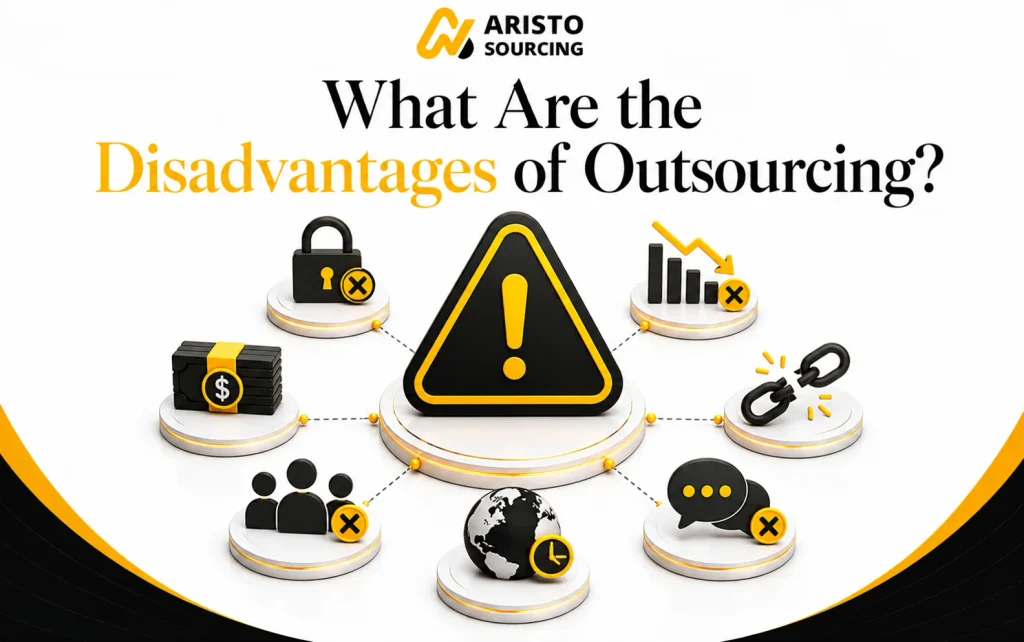
What Are the Disadvantages of Outsourcing?
Every advantage outsourcing offers comes with a corresponding risk, and ignoring that trade-off is how businesses end up in bad contracts. The five disadvantages below are common, but each has a practical way to manage it.
1. Loss of Direct Control
Loss of direct control happens because outsourcing hands day-to-day execution to a provider the business doesn’t directly manage. Decisions about pace, priorities, and small process changes shift outside the client’s immediate reach.
This risk grows worse in long, unsupervised contracts with no regular check-ins. Clear SLAs, defined escalation paths, and scheduled reporting cycles restore much of that visibility without pulling the work back in-house. A provider can be fully accountable on paper and still expose the business to a completely different kind of risk once sensitive data enters the picture.
2. Data Security and Confidentiality Risks
Outsourcing risks data security and confidentiality because sensitive information, from customer records to internal financials, now passes through a third party’s systems and staff. Every additional handler is another potential point of exposure.
The risk is highest with providers handling regulated data like healthcare or financial records without proper certifications. Vetting providers for compliance credentials such as SOC 2 or ISO 27001, and limiting data access to what’s strictly necessary, cuts this exposure significantly. Even a fully secure provider can still create friction if the two teams simply can’t communicate well.
3. Communication and Time-Zone Barriers
Communication and time-zone barriers refer to the delays and misunderstandings that surface when client and provider teams work in different time zones, languages, or cultural contexts. A question sent at the end of one team’s day might not get answered until the next.
Offshore arrangements with minimal overlapping work hours feel this the most, especially on urgent issues. Building in overlap hours, using shared project management tools, and setting clear documentation standards closes most of the gap. Poor communication also tends to surface in the fine print, particularly around costs that weren’t part of the original conversation.
4. Hidden Costs and Contract Complexity
Hidden costs and contract complexity describe the fees and clauses that emerge after signing, beyond the headline rate a business budgeted for. Setup charges, management fees, and scope changes can all add unplanned expense over the life of a contract.
Buyer guides citing Clutch’s 2026 Pricing Guide document setup fees ranging from a few hundred dollars for small engagements to $200,000 at enterprise-level BPOs, depending on complexity. Vague contracts with undefined scope make this worse. Requesting an itemized cost breakdown upfront and capping change-order fees keeps the total predictable.
5. Quality and Consistency Concerns
Quality and consistency concerns arise when a provider’s output varies from what the client expects, whether from staff turnover, unclear standards, or a rushed onboarding process. Inconsistent quality can undo the cost and time savings outsourcing was meant to deliver.
High-turnover providers or unvetted freelancers make this risk worse. Setting clear quality benchmarks, running a paid trial period, and requiring regular QA reviews before scaling the relationship keeps standards consistent. That covers the five main risks of outsourcing, all manageable with the right vetting and contract terms in place.
Which Business Functions Benefit Most from Outsourcing?
The business functions that benefit most from outsourcing are IT, software development, customer service, HR, payroll and accounting, marketing, manufacturing, and data entry. IT gains access to specialized infrastructure and cybersecurity talent most companies can’t justify hiring in-house. Software development benefits from tapping global engineering talent and running work in parallel to speed up release timelines.
Customer service gains round-the-clock coverage and lower cost-per-interaction at scale. HR and payroll or accounting benefit from compliance expertise and reduced administrative load, especially across multiple jurisdictions. Marketing gains specialized skills in areas like SEO, design, or paid media without building a full internal team. Manufacturing benefits from lower production costs and access to specialized equipment, while data entry gains speed and accuracy at high volume. Each function has its own dedicated breakdown of outsourcing benefits linked below.
Is Outsourcing Right for Your Business?
Outsourcing makes sense once one or more conditions apply: cost pressure is squeezing margins, the expertise a task needs doesn’t exist internally, demand is scaling faster than internal hiring can keep up, or non-core work is eating into time that should go toward strategy. Weigh that against the disadvantages covered above, since control, security, and communication all shift once a provider takes over.
The real decision comes down to three questions: which specific tasks are dragging on internal resources, what budget makes sense for handing them off, and how much day-to-day control the business is willing to give up. Providers like Aristo Sourcing, which specialize in vetted virtual assistant placements, can help answer those questions without committing to a long evaluation process first.
When Should You Not Outsource?
You should not outsource when the task is a core differentiator, meaning it’s part of what makes the business unique or defensible against competitors, since handing that work to a third party risks losing the edge it creates. Work involving proprietary strategy, unique product IP, or deep institutional knowledge built up over years usually falls into this category too.
Tasks that need tight daily oversight or context only an internal team has also tend to outsource poorly, since a provider can’t replicate years of accumulated company-specific judgment overnight. The same goes for any task where the cost of coordinating with an outside provider, in time, communication, and oversight, ends up higher than the savings outsourcing was supposed to deliver. If a task fits any of these patterns, the better next step is building internal capability rather than searching for a provider.