

Fifty-three percent of employees have experienced at least one payroll error. According to HiBob, 64% of those employees reported stress or workplace disruption as a result.
Payroll errors don’t just affect numbers. They damage the trust between employers and their teams, and they attract regulatory scrutiny that costs time and money to resolve.
Most payroll problems start long before processing day, with weak cutoffs, disorganized inputs, and founders running a high-stakes financial function without the systems to support it.
An outsourced payroll manager fixes the system, not just the calculations.
What an Outsourced Payroll Manager Does
An outsourced payroll manager is a remote financial specialist who takes full ownership of an organization’s pay cycles, compliance filings, and employee distributions, operating as a dedicated member of your team rather than a faceless service provider.
They manage payroll as a controlled pipeline with oversight at every stage:
- Inputs — timesheets, salary changes, commissions, bonuses, PTO, new hires, terminations
- Rules — overtime calculations, statutory deductions, benefit contributions, wage garnishments
- Processing — payroll engine calculations, tax table application, pay register review
- Payments — direct deposit execution, payslip distribution, third-party remittance
- Closeout — reconciliation, payroll journal export, compliance reporting, audit documentation
At every stage, they apply controls verifying inputs, flagging exceptions, enforcing approvals, and producing records that hold up under audit.
They treat payroll as a Human Capital Management (HCM) function, not an administrative task.
Why Growing Businesses Outsource Payroll
Compliance Carries Real Financial Risk
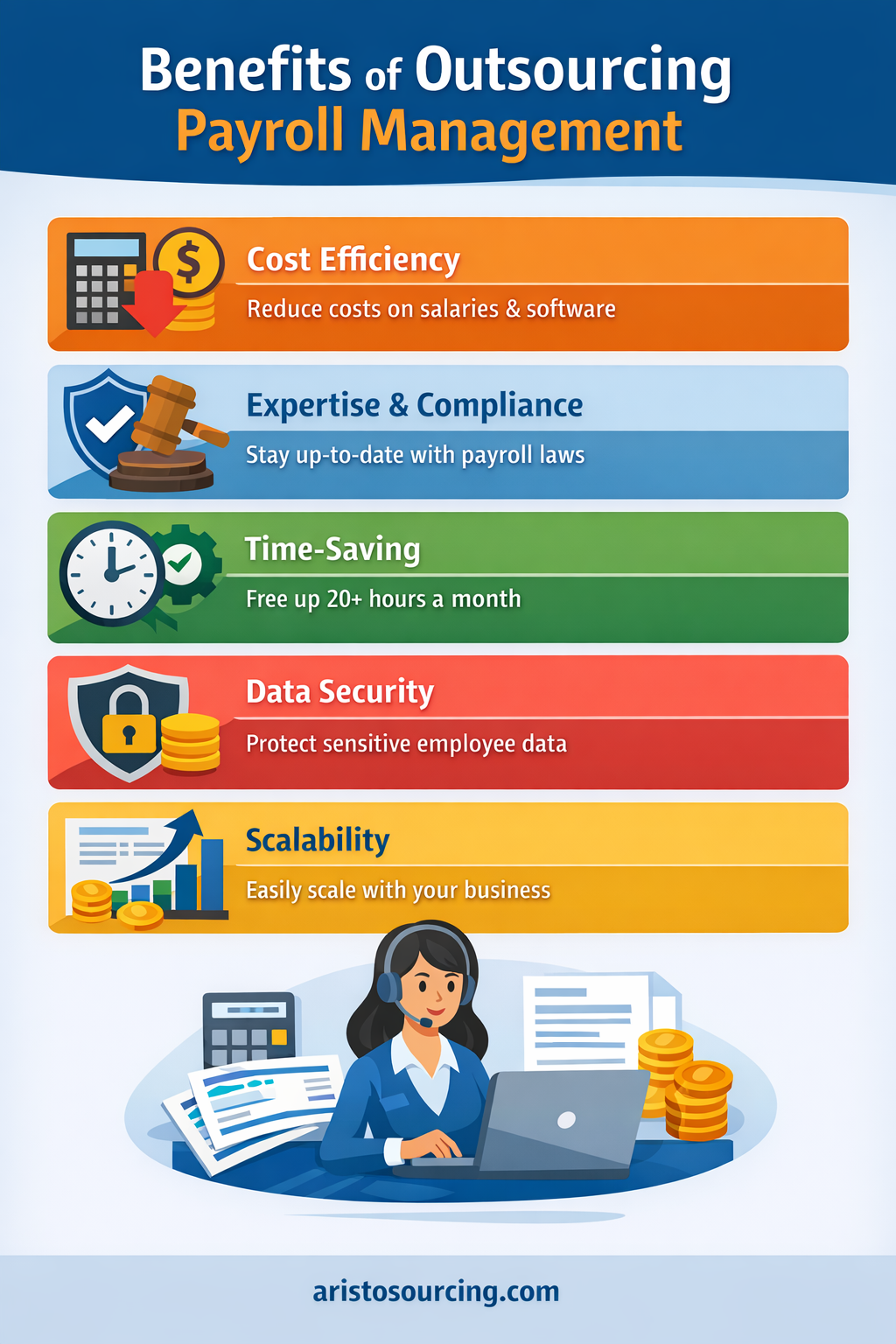
Payroll regulations change frequently and vary by jurisdiction. A 2023 survey found that 33% of small businesses received payroll penalties due to compliance mistakes.
An outsourced payroll manager tracks obligations across the relevant regulatory landscape:
- UK employers must submit a Full Payment Submission (FPS) to HMRC via Real Time Information (RTI) on or before each payday, and an Employer Payment Summary (EPS) by the 19th of the following month
- South African employers must issue SARS IRP5/IT3(a) certificates documenting remuneration and employees’ tax withheld
- US employers face state-by-state withholding obligations. Withholding applies based on where employees perform services, not where the company operates.
- IRS failure-to-deposit penalties escalate on a sliding scale, making payroll calendar discipline a direct financial obligation
As employment attorney Robin Samuel of Baker McKenzie has noted, “The complexity of payroll compliance has grown significantly as workforces go global and remote. The margin for error is smaller than most business owners realize.”
An outsourced payroll manager builds and enforces the compliance calendar, cutoff dates, submission deadlines, and remittance confirmations so regulatory obligations never slip.
The True Cost Is Your Time, Not a Line Item
The visible cost of in-house payroll is salary. The hidden cost is founder hours.
Businesses that outsource payroll recover an average of 20 hours per month previously absorbed by founders, HR directors, or bookkeepers managing manual processes. At a business owner’s effective hourly rate, that time carries dollar value that dwarfs a remote specialist’s monthly fee.
This is the Time Value argument, and it is separate from wage cost entirely. The Total Cost of Ownership (TCO) of in-house payroll includes software licenses, training overhead, error correction cycles, and the opportunity cost of senior people executing repetitive operational work.
Payroll Errors Erode Employee Trust
When payroll runs late or processes incorrectly, employees notice before anyone else does.
According to HiBob, 64% of employees who experienced a payroll error reported stress or workplace disruption. Repeat errors accelerate attrition, and replacing an employee costs between 50% and 200% of their annual salary, depending on the role.
An outsourced payroll manager applies structured validation before each pay run: checking overtime anomalies, verifying new hire setups, confirming termination adjustments, and reviewing the pay register against expected totals. Errors surface before payday, not after.
Outsourced Payroll Scales Without Adding Headcount
An outsourced model absorbs growth without internal hiring friction.
Whether you add employees, expand into a new jurisdiction, or manage a seasonal hiring peak, your outsourced payroll manager handles the increased complexity within the existing engagement. You expand the scope. You do not expand the headcount.
Outsourced Payroll Applies Stronger Security Than Most In-House Operations
Payroll data bank account details, tax identification numbers, and salary records attract business email compromise attacks precisely because the payoff is immediate.
Strong outsourced payroll managers apply Zero Trust principles to every sensitive action:
- Least privilege access — permissions scoped strictly to role requirements
- Multi-factor authentication (MFA) on all platform logins
- Dual approval for pay rate changes and bank account updates
- Out-of-band verification for urgent requests — no bank detail change approved from email alone
- Audit logs on every sensitive action — exports, rate changes, and system access events
Reputable professionals work within systems aligned to SOC 2 Type II or ISO/IEC 27001 standards. Most small businesses running payroll through spreadsheets and shared inboxes hold weaker controls than a well-managed outsourced function.
Payroll Continuity: The Risk Nobody Plans For
Most founders ensure their equipment, their premises, and their data. Very few ensure their payroll function.
When your one in-house payroll person goes on leave, falls ill, or resigns, payroll stops. Employees still expect to be paid on time. Regulators still expect submissions on deadline. The business absorbed an entirely preventable crisis.
Payroll Continuity Planning means structuring the payroll function so it runs regardless of individual absence. An outsourced payroll manager from Aristo Sourcing brings this resilience by default; they work within your documented SOPs, your cloud platforms, and your approval workflows, not inside their own head.
The function continues because the system is documented and transferable. No single person becomes a dependency.
This is the operational continuity argument for outsourcing that most payroll guides miss, and it applies to businesses of every size.
Outsourced Payroll Manager vs. Payroll Clerk: Understanding the Hierarchy
Understanding how an outsourced payroll manager differs from adjacent roles clarifies exactly what you are hiring for:
| Role | Primary Responsibility |
|---|---|
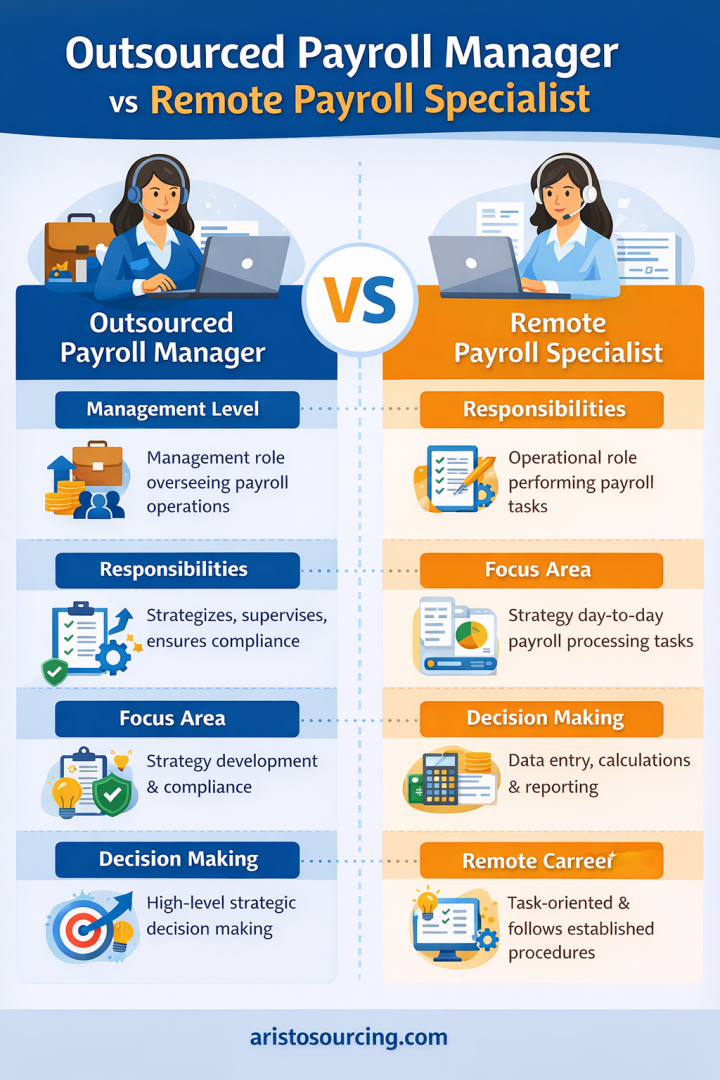
| Outsourced Payroll Manager | Owns strategy, compliance, reporting, and the payroll function end-to-end |
| Remote Payroll Specialist | Executes day-to-day processing — timesheets, deductions, data entry, payslip generation |
| Payroll Administrator | Validates inputs and controls the pay cycle within a defined system |
| Payroll Clerk | Handles data entry — a subset of payroll administration |
| Bookkeeper | Records transactions after the fact — payroll journals flow from the payroll function into bookkeeping, not the reverse |
| Employer of Record (EOR) | Becomes the legal employer of staff in a foreign jurisdiction — used when no local entity exists. An outsourced payroll manager handles the ongoing function once an entity or EOR structure is in place. |
In high-performing businesses, a payroll manager and a payroll specialist work together: the manager owns strategy, compliance, and oversight; the specialist executes daily tasks within that structure. This separation reduces errors, improves accountability, and produces a more auditable operation.
The Digital Workspace: How Aristo Payroll Managers Navigate Your Tech Stack
The tools matter. The person who operates them matters more.
Aristo Sourcing places payroll managers who arrive already proficient in the platforms your business runs, not generalists who need weeks of onboarding before they add value.
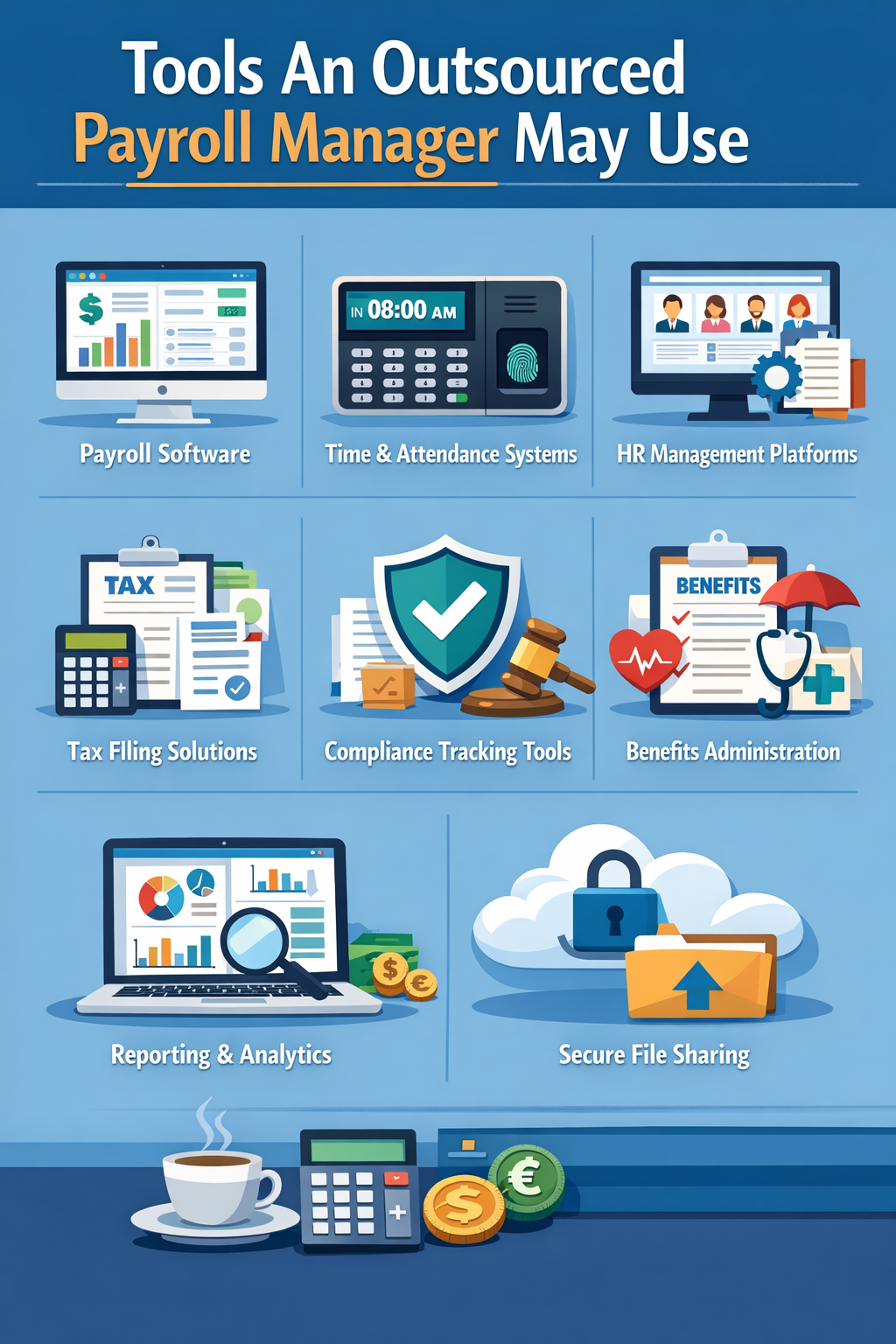
Payroll Processing — Sage, QuickBooks Payroll, ADP, Gusto for calculations, statutory reporting, and payslip generation
Time and Attendance — Hubstaff, Time Doctor for employee hours, overtime, and leave data that feeds accurately into the payroll engine
HRIS — BambooHR, Zoho People for centralizing employee records, contracts, and entitlements as the single source of truth for payroll inputs
Accounting Integration — Xero, QuickBooks, Sage Accounting, so payroll journals sync automatically to the general ledger, eliminating manual rekeying and month-end reconciliation errors
Compliance Portals — HMRC, SARS eFiling, and state payroll tax systems for real-time reporting and remittance confirmation
Collaboration — Slack, Microsoft Teams for approval workflows, change requests, and payroll calendar coordination with your internal team
Proficiency in this digital workspace is part of Aristo’s vetting standard; every candidate passes platform assessments before placement.
How to Build a High-Performing Outsourced Payroll Operation
Hiring the right payroll manager is the first step. Integration determines whether the function actually runs cleanly.
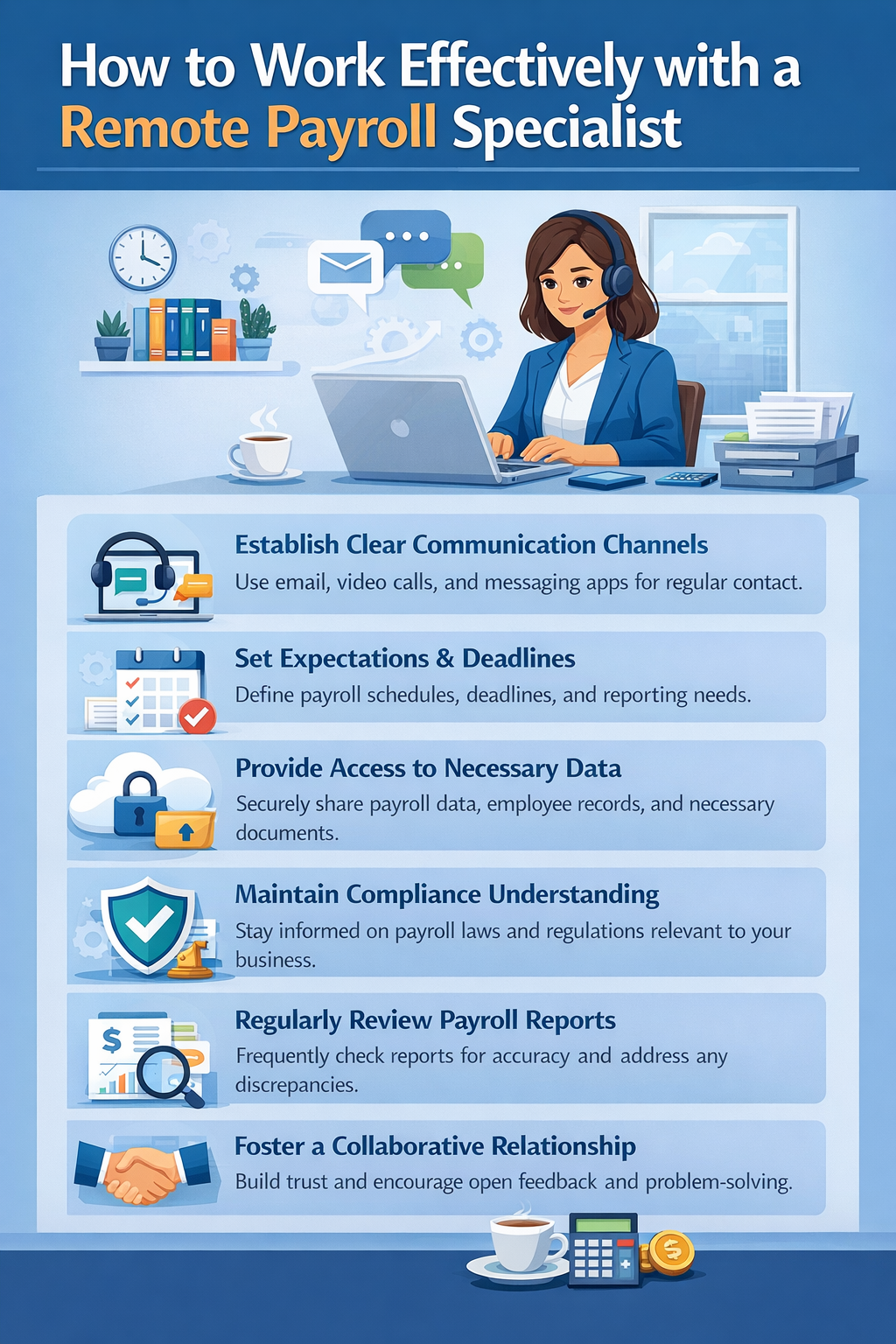
Standardize inputs before the first pay run. Define the format, source, and submission deadline for every payroll input: timesheets, bonuses, new hires, terminations, salary changes, and enforce the standard from day one.
Publish a payroll calendar and treat it as non-negotiable. Set cutoff dates, approval deadlines, and payment dates. Late inputs wait for the next cycle. The payroll calendar is a compliance document, not a preference.
Route all changes through structured approval workflows. Every pay rate update, bank account change, and new hire addition moves through a workflow with an approval field, effective date, and stored record—no change approved from a single email.
Document SOPs for every payroll scenario. Cover new employee onboarding, terminations, mid-period salary adjustments, and post-submission corrections. SOPs keep the function resilient to absence or team changes.
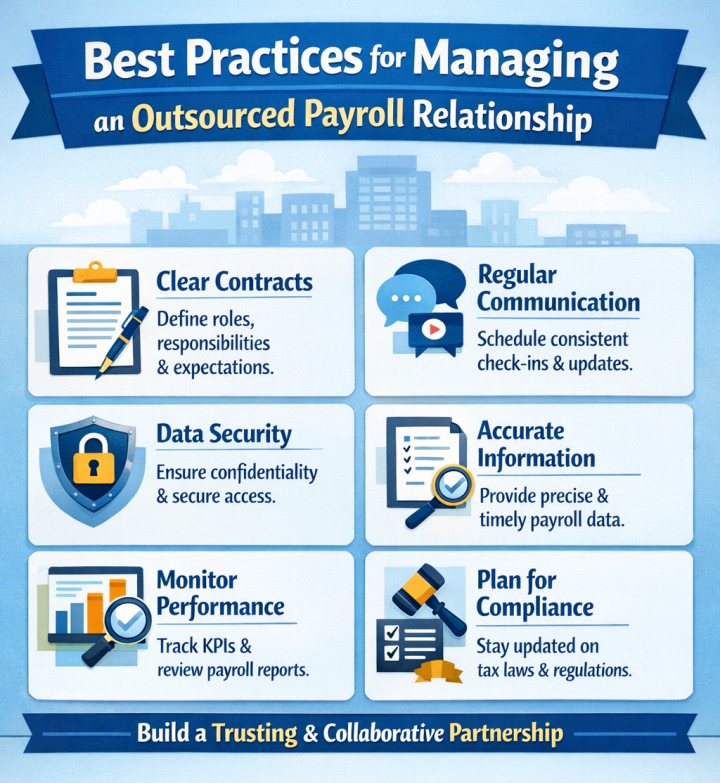
Set KPIs and review them on a regular cadence. Track processing accuracy rate, on-time payment rate, compliance submission timeliness, and corrections per pay cycle. Weekly check-ins maintain visibility without day-to-day operational involvement.
Retain full data access through cloud platforms. You and your employees can access payslips, tax documents, and leave balances at any time. You delegate the execution. You retain ownership of the data.
Common Payroll Outsourcing Mistakes — and How to Fix Them
Providing incomplete or last-minute data. Fix: Implement a fixed intake form with required fields and a hard cutoff. Consequence: Rushed inputs cause errors that surface after payday and damage employee trust.
Approving bank changes from a single email. Fix: Require dual approval and out-of-band verification for every bank detail update. Consequence: Business email compromise attacks divert entire pay runs to attacker-controlled accounts in a single transaction.
Skipping pay register reconciliation. Fix: Reconcile the pay register against bank outflows and accounting journals every pay cycle. Consequence: Variances accumulate silently and surface as unexplained discrepancies at month-end or audit.
Over-granting access inside payroll systems. Fix: Apply role-based permissions so that each team member accesses only what their role requires. Consequence: A single compromised account creates wide exposure across employee and financial data.
Running payroll through spreadsheets instead of integrated systems. Fix: Connect time tracking, HRIS, and the payroll engine through API integrations or controlled imports. Consequence: Manual rekeying creates data latency, version control errors, and an audit trail that does not hold up under scrutiny.
Accepting change requests through messaging apps or email threads. Fix: Route every payroll change through a structured workflow with approval fields, effective dates, and stored attachments. Consequence: Disputed changes leave no documentation, and fraudulent requests leave no evidence trail.
Three Scenarios Where an Outsourced Payroll Manager Transforms Operations
Scenario 1: Founder-managed payroll with repeat corrections. A 22-person services firm ran payroll through spreadsheets with ad hoc approvals. The founder spent over 15 hours per month managing it, and corrections occurred after nearly every pay run. After placing a remote payroll manager through Aristo Sourcing, the business implemented structured cutoffs, validation checks, and dual approval for pay changes. Correction cycles dropped to near zero. The founder redirected that time to revenue-generating work.
Scenario 2: Disconnected HR and finance tools create month-end chaos. A 60-person company tracked employee changes in their HRIS, logged time in a separate platform, and posted payroll journals to accounting manually. The payroll manager mapped the system of record, reduced manual data entry through controlled imports and API integrations, and standardized the journal export process. Month-end reconciliation time fell by over 60%.
Scenario 3: Scale-up expanding across multiple jurisdictions. A growing business hired across the US, UK, and South Africa with no consistent approach to compliance or reporting. The outsourced payroll manager documented data residency requirements under GDPR and POPIA, managed multi-state withholding logic for US employees, handled HMRC RTI submissions for UK staff, and coordinated SARS IRP5 certificate workflows for South African employees. The business resolved regulatory exposure that had been accumulating undetected for 18 months.
Leveraging Global Centers of Excellence: The Aristo Sourcing Advantage
Geography creates a cost opportunity. Vetted competence creates the business result.
Aristo Sourcing places payroll managers from two talent markets that consistently meet Western business standards for compliance depth, communication, and systems proficiency.
South Africa produces payroll professionals trained in SARS compliance, POPIA data protection obligations, and international payroll software. Aristo screens for C1/C2 English proficiency, the professional fluency level that allows candidates to handle technical compliance conversations, manage approval workflows, and communicate directly with senior stakeholders without friction.
South African payroll professionals bring direct experience in multi-currency payroll, audit-grade documentation, and the compliance expectations of UK and European businesses. GMT+2 gives UK and European clients near-real-time collaboration across the full working day.
The Philippines supplies finance and accounting professionals with hands-on proficiency in QuickBooks, ADP, Gusto, and Xero — the dominant platforms of US and Australian businesses. Philippine payroll managers understand both the 13th-month pay obligations for local employees and the full payroll function requirements of international clients. The talent pool carries depth in HRIS administration and payroll certification.
This is labor arbitrage done properly, not selecting the cheapest available option, but accessing a global talent pool where high competence and lower wage structures intersect. The Payroll Outsourcing ROI for Aristo clients reflects both the cost differential and the quality standard, not one at the expense of the other.
Aristo has placed finance and payroll professionals across the UK, US, Europe, and Australia since 2014, with a client retention rate above 93%.

Frequently Asked Questions
What are the legal risks of managing payroll in-house without a specialist?
In-house teams without dedicated payroll expertise make predictable errors: tax non-compliance, overtime miscalculation, and incorrect worker classification between contractor and employee. An outsourced payroll manager reduces this risk through regular compliance audits, jurisdiction-specific regulatory knowledge, and strict submission calendars that prevent IRS failure-to-deposit penalties and HMRC RTI late filings.
How does an outsourced payroll manager handle year-end tax filings?
Beyond monthly processing, they oversee the full fiscal year transition: generating W-2 and 1099 forms for US businesses, issuing HMRC P60S for UK employees, and producing SARS IRP5 certificates for South African staff. They reconcile annual payroll tax returns and confirm all payroll liabilities are settled before the year closes, eliminating the tax-season crunch that overwhelms SME owners running payroll internally.
Can an outsourced payroll manager integrate with my existing accounting software?
Yes. Aristo payroll managers work within your existing tech stack. They bridge payroll platforms Gusto, ADP, Sage, QuickBooks Payroll, and general ledger accounting software Xero, QuickBooks, Sage Accounting, so every pay run syncs automatically to your financial statements without manual journal entries.
What is the difference between an outsourced payroll manager and an Employer of Record?
An outsourced payroll manager handles administration, calculations, and compliance for staff within an entity you already operate. An Employer of Record becomes the legal employer of your staff in a foreign country, used when you hire internationally without a local entity. An outsourced payroll manager handles the ongoing function once that structure is in place.
How do I maintain visibility over my payroll data when outsourcing?
Cloud-based payroll and HR platforms give you and your employees 24/7 access to payslips, tax documents, and leave balances. You delegate the execution to the outsourced manager while retaining full data ownership. Most Aristo-placed payroll managers produce weekly or monthly payroll summaries as a standard reporting deliverable.
What security standards should I expect?
Look for professionals who apply Zero Trust principles: least privilege access, MFA, dual approval for sensitive changes, audit logs on all system activity, and out-of-band verification for bank detail changes. At the vendor level, SOC 2 Type II certification and ISO/IEC 27001 alignment are the benchmarks for information security governance in payroll operations.
How does an outsourced payroll manager handle multi-jurisdiction payroll?
They track state or country-specific withholding obligations, manage tax registrations across relevant jurisdictions, apply reciprocity rules where applicable, and document remittance confirmations for each authority. For businesses with employees across multiple US states or international locations, this expertise prevents exposure that would otherwise accumulate undetected.
What return on investment should I expect?
Calculate Payroll Outsourcing ROI by subtracting the service fee from the full Total Cost of Ownership (TCO) of your current in-house payroll: software licenses, internal labor hours, compliance penalty risk, and correction overhead per pay cycle. Most SMEs find the hidden cost of a founder or HR director spending 20+ hours monthly on payroll processing far exceeds the fee for a dedicated remote specialist before accounting for improved audit readiness and reduced penalty exposure.