
A virtual assistant (VA) is a remote professional who handles administrative, technical, or creative work for a business from outside the business’s office. The term virtual assistant also names AI software such as Siri, Alexa, and Google Assistant, but this page covers the human virtual assistant that businesses hire for support work.
The page covers what a virtual assistant is, what a virtual assistant does, the main types of virtual assistants, the skills a virtual assistant needs, how much a virtual assistant costs, how a virtual assistant compares with an executive assistant, an in-house employee, and a freelancer, when and how to hire a virtual assistant, how AI is changing the virtual assistant role, and what a virtual assistant job involves. Business owners and managers use this virtual assistant meaning, duties, and types breakdown to decide whether to hire a VA and which kind of VA fits their workload.
Remote support has become a standard part of how companies staff operations. Deloitte’s 2024 Global Outsourcing Survey reports that 56% of organizations outsource front-office functions and that improved access to talent (42%) is now the most cited reason for outsourcing, ahead of cost reduction.
What Is a Virtual Assistant?
A virtual assistant is a remote professional, usually an independent contractor or remote employee, who provides administrative, technical, or creative support to clients from outside the client’s office. A virtual assistant works inside the business as a support function, not as a decision-maker: the virtual assistant executes tasks, maintains systems, and handles communication, while the business owner or manager sets priorities and approves outcomes.
Virtual assistants work under three employment forms. A freelance virtual assistant works independently for several clients through marketplaces or direct contracts, an agency-placed virtual assistant is recruited and managed through a provider of virtual assistant services, and a dedicated full-time virtual assistant works exclusively for one business during set hours. The term virtual assistant became widely known after Tim Ferriss described delegating work to remote assistants in The 4-Hour Workweek (2007).
What Does a Virtual Assistant Do?
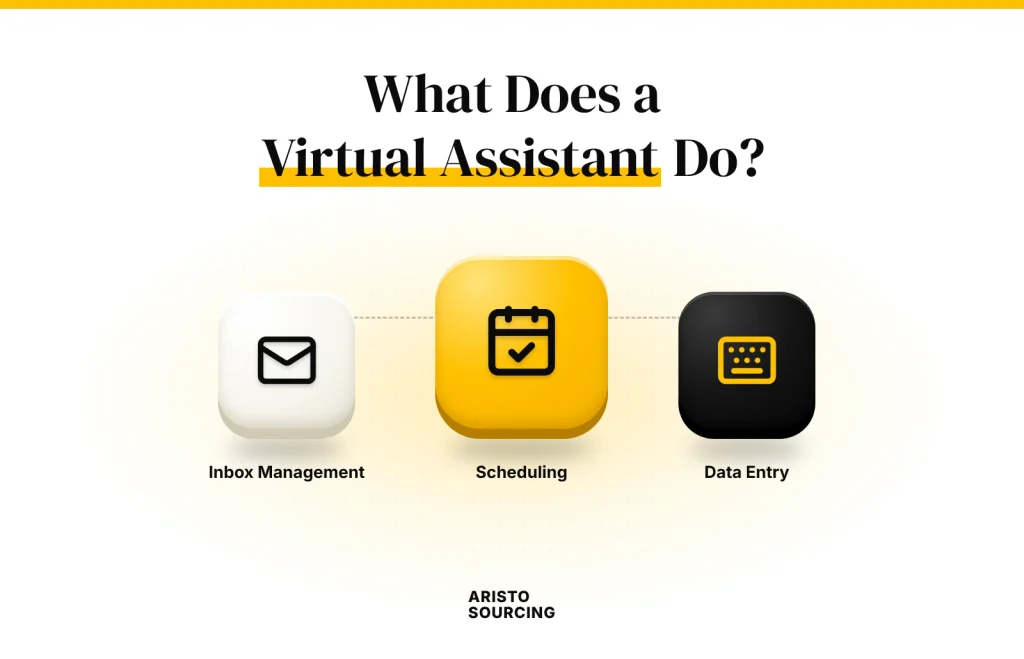
A virtual assistant handles the recurring digital work that keeps a business running, including inbox management, scheduling, data entry, customer support, bookkeeping, social media, lead generation, and research. The exact duties depend on the virtual assistant’s specialization and the business’s workflow.
The eight core task categories of a virtual assistant are listed below.
- Email and Inbox Management: The virtual assistant sorts, answers, and archives email so urgent messages reach the owner first.
- Calendar and Travel Management: The virtual assistant books meetings, resolves scheduling conflicts, and arranges flights and accommodation.
- Data Entry and Document Preparation: The virtual assistant updates databases, spreadsheets, and records, and prepares reports, proposals, and templates.
- Customer Service Support: The virtual assistant answers customer emails, chats, and calls and follows up on open tickets.
- Bookkeeping and Invoicing: The virtual assistant records transactions, sends invoices, and tracks payments.
- Social Media and Content Support: The virtual assistant schedules posts, responds to comments, and formats content.
- Lead Generation and CRM Updates: The virtual assistant researches prospects, updates CRM records, and sends follow-up sequences.
- Research and Project Coordination: The virtual assistant gathers information, tracks project tasks, and reminds team members of deadlines.
A practical rule of thumb applies to every task category: digital, repeatable, and documented work suits a virtual assistant, while work that needs physical presence or final business judgment does not.
What Are the Main Types of Virtual Assistants?
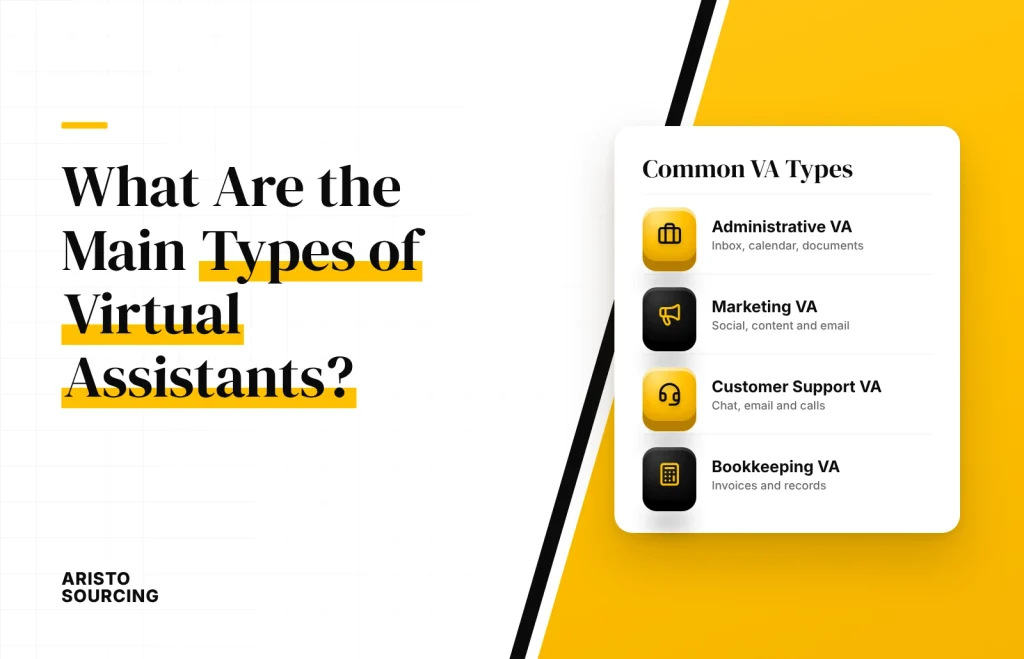
The main types of virtual assistants are administrative, executive, customer service, social media and marketing, bookkeeping, technical, and real estate virtual assistants. Types of virtual assistants differ by specialization, not by location, so each type can work from any country under any hiring model. Each specialization is covered in depth in the guide to types of virtual assistants.
The seven main types of virtual assistants are listed below.
- Administrative Virtual Assistant
- Executive Virtual Assistant
- Customer Service Virtual Assistant
- Social Media and Marketing Virtual Assistant
- Bookkeeping Virtual Assistant
- Technical Virtual Assistant
- Real Estate Virtual Assistant
1. Administrative Virtual Assistant
An administrative virtual assistant is a remote assistant who handles general office and organizational tasks for a business. An administrative virtual assistant manages email, schedules appointments, enters data, and prepares documents. An administrative virtual assistant commonly uses Google Workspace, Microsoft 365, Slack, and project management tools such as Asana or Trello. Small business owners, solo professionals, and busy teams hire an administrative virtual assistant most often.
2. Executive Virtual Assistant
An executive virtual assistant is a remote assistant who supports a senior leader with high-priority communication and scheduling. An executive virtual assistant manages the executive’s calendar, filters correspondence, prepares meeting materials, and coordinates travel. An executive virtual assistant commonly uses Google Workspace, Microsoft Outlook, Zoom, and travel booking platforms. Founders, CEOs, and senior executives hire an executive virtual assistant most often.
3. Customer Service Virtual Assistant
A customer service virtual assistant is a remote assistant who handles customer questions and support requests for a business. A customer service virtual assistant answers emails and live chats, resolves order issues, processes returns, and updates support tickets. A customer service virtual assistant commonly uses help desk platforms such as Zendesk, Gorgias, or Freshdesk and live chat tools. E-commerce stores, SaaS companies, and service businesses hire a customer service virtual assistant most often.
4. Social Media and Marketing Virtual Assistant
A social media and marketing virtual assistant is a remote assistant who supports a business’s online marketing activity. A social media and marketing virtual assistant schedules posts, engages with followers, formats blog content, and compiles campaign reports. A social media and marketing virtual assistant commonly uses Meta Business Suite, Canva, Buffer or Hootsuite, and email marketing platforms. Coaches, agencies, and consumer brands hire a social media and marketing virtual assistant most often.
5. Bookkeeping Virtual Assistant
A bookkeeping virtual assistant is a remote assistant who records and organizes a business’s financial transactions. A bookkeeping virtual assistant categorizes expenses, reconciles bank accounts, creates invoices, and tracks accounts payable and receivable. A bookkeeping virtual assistant commonly uses QuickBooks, Xero, and spreadsheet software. Small businesses, e-commerce brands, and accounting firms hire a bookkeeping virtual assistant most often.
6. Technical Virtual Assistant
A technical virtual assistant is a remote assistant who handles website, software, and system support tasks. A technical virtual assistant updates websites, manages plugins, sets up automations, and troubleshoots software issues. A technical virtual assistant commonly uses WordPress, Shopify, Zapier, and basic HTML and CSS editors. Online businesses, agencies, and SaaS startups hire a technical virtual assistant most often.
7. Real Estate Virtual Assistant
A real estate virtual assistant is a remote assistant who supports real estate agents, brokers, and property managers. A real estate virtual assistant manages property listings, follows up with leads, schedules showings, and coordinates transaction paperwork. A real estate virtual assistant commonly uses MLS platforms, real estate CRMs such as Follow Up Boss, and e-signature tools. Real estate agents, brokerages, and property investors hire a real estate virtual assistant most often.
What Skills Should a Virtual Assistant Have?
A virtual assistant should have strong written and spoken communication, organization and time management, computer and tool skills, reliability and discretion, and the ability to solve problems without supervision. Written and spoken communication matters most because a virtual assistant handles client and customer messages without in-person context. Organization and time management let a virtual assistant juggle tasks across time zones and deadlines. Computer and tool skills cover Google Workspace, Microsoft 365, CRM systems, and accounting software, depending on the role. Reliability, discretion, and data security habits protect the business’s accounts, files, and customer data. Problem-solving without supervision allows a virtual assistant to keep work moving when the owner is unavailable.
What Qualifications Do You Need to Be a Virtual Assistant?
Most virtual assistant roles require a high school diploma, proven work experience, and strong computer skills rather than a specific degree. Degrees help for specialist virtual assistant roles such as bookkeeping or legal support, where accounting or paralegal knowledge is required. Short courses in office software, social media management, or bookkeeping strengthen a virtual assistant’s profile for both the hiring business and the job seeker. Proven experience, work samples, and references matter more than certificates, so businesses hiring a virtual assistant should test skills directly, and job seekers should build a portfolio of completed tasks.
How Much Does a Virtual Assistant Cost?
A virtual assistant costs between about $4 and $100 per hour, depending on the hiring model, the virtual assistant’s location, and specialization. Pricing guides published by VA providers in 2026 place offshore freelance virtual assistants hired directly at about $4 to $8 per hour and Philippines-based VA agencies at about $8 to $15 per hour. The same guides place US-based general virtual assistants at about $25 to $45 per hour and US-based executive or specialist virtual assistants at about $45 to $100 per hour. Dedicated offshore virtual assistants are usually billed monthly, with providers such as Aristo Sourcing charging a $400 monthly fee on top of the virtual assistant’s salary. An in-house hire costs more: the Bureau of Labor Statistics reports a median annual wage of $48,310 for US secretaries and administrative assistants in May 2025, before benefits, payroll taxes, and office costs. The full breakdown of virtual assistant pricing by hiring model covers hidden costs and contract terms.
How Does a Virtual Assistant Get Paid?
A virtual assistant gets paid through an hourly rate, a monthly retainer, or a per-task or per-project fee. Freelance virtual assistants invoice clients directly, usually weekly or monthly, based on tracked hours or agreed packages. When a business hires through an agency or staffing provider, the provider pays the virtual assistant’s salary and bills the business one monthly invoice that covers salary and service fees. Offshore virtual assistants commonly receive payment through international bank transfers, global payroll providers, or payment platforms such as Wise and Payoneer.
How Much Money Can You Make Being a Virtual Assistant?
Virtual assistants earn between about $13 and $30 per hour in the United States, with an average of $19.70 per hour according to Payscale data updated in June 2026. Virtual assistant pay depends on location, specialization, and employment model. US-based virtual assistants with executive, bookkeeping, or technical specializations earn at the upper end of the range, while general administrative virtual assistants earn closer to the average. Offshore virtual assistants in countries such as the Philippines earn less in absolute terms, because client rates for offshore VAs start well below US rates, but those earnings often exceed local office wages.
Virtual Assistant vs Executive Assistant vs In-House Employee: What Is the Difference?
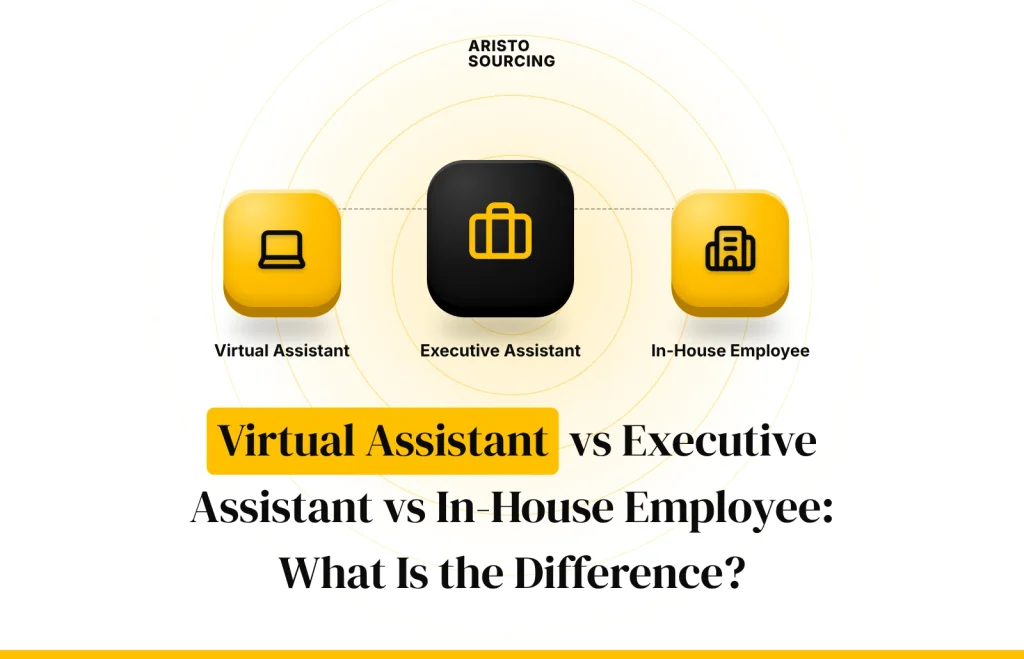
The difference between a virtual assistant, an executive assistant, and an in-house employee is that a virtual assistant is a delivery model, an executive assistant is a role type, and an in-house employee is an employment arrangement. A virtual assistant works remotely; an executive assistant provides senior-level support to a leader; an in-house employee works on-site and sits on the company’s payroll. The three differ in location, cost, scope, and control, and the categories overlap: a virtual assistant can be an executive assistant delivered remotely, and an executive assistant can be an in-house employee. The Bureau of Labor Statistics reports a median annual wage of $76,590 for US executive secretaries and executive administrative assistants in May 2025, which sets the in-house benchmark for senior support roles.
The comparison between a virtual assistant, an executive assistant, and an in-house employee is presented in the table below.
| Factor | Virtual Assistant | Executive Assistant | In-House Employee | Explanation |
| Location | Remote | Remote or on-site | On-site | Location defines the virtual assistant model |
| Cost | Lowest, hourly or monthly fee | Highest of the support roles | Salary plus benefits and office costs | Offshore VAs cost less than domestic hires |
| Scope | Defined task list | Senior leader support | Full job description | Executive assistants handle higher-stakes work |
| Control | Managed through tools and SOPs | Direct reporting to one leader | Direct supervision | In-house staff give the most direct control |
Virtual Assistant vs Freelancer: Which Should You Hire?
A virtual assistant differs from a freelancer in commitment, client focus, and type of work. A freelancer works on a project basis for several clients at once and manages their own schedule and methods. A dedicated virtual assistant fills an ongoing role and integrates into one team’s tools, meetings, and workflows. Freelancers suit one-off tasks such as a logo design or a single research project, while dedicated virtual assistants suit recurring work such as daily inbox management, customer support, or weekly bookkeeping.
When Should a Business Hire a Virtual Assistant?
A business should hire a virtual assistant when the owner or team spends several hours each week on repetitive administrative work that does not need their expertise. Slipping response times on email, customer inquiries, or sales follow-ups signal that the team has run out of capacity. Growth that outpaces internal capacity without budget for an in-house hire is another clear trigger. The work must also be digital and documentable, so a virtual assistant can learn it from written processes and complete it remotely.
What Does a Virtual Assistant Job Description Include?
A virtual assistant job description includes a role summary, the reporting line, duties and responsibilities, required skills and tools, working hours, KPIs, and the pay model. The role summary explains the purpose of the position and names the person the virtual assistant reports to. The duties and responsibilities section lists the recurring tasks the virtual assistant will own. The required skills and tools section names the software, language level, and experience the role needs. The working hours section sets the shift and the time-zone overlap with the business. Finally, the job description defines the KPIs, the review cadence, and whether pay is hourly, monthly, or per task.
What Should You Not Delegate to a Virtual Assistant?
You should not delegate final business decisions, licensed professional work, uncontrolled access to sensitive data, or undocumented processes to a virtual assistant. Final decisions and strategy stay with the owner or leadership team because the virtual assistant supports execution, not direction. Licensed work such as legal advice, tax filing, and clinical decisions requires a qualified professional. Unrestricted access to bank accounts, payroll systems, or personal customer data should not be given without access controls, password managers, and audit trails. Processes with no standard operating procedure should be documented first, because a virtual assistant cannot reliably repeat work that exists only in the owner’s head.
What Is a Virtual Assistant Agency?
A virtual assistant agency is a company that recruits, vets, and places virtual assistants with client businesses. A virtual assistant agency differs from a freelance marketplace because the agency handles candidate vetting, payroll, and replacement, while a marketplace leaves those tasks to the business. Virtual assistant agencies use two placement models: a managed model, where the agency supervises the virtual assistant’s work, and a dedicated model, where the business directs a full-time virtual assistant day to day. Aristo Sourcing, founded in January 2014, follows the dedicated model, recruiting full-time virtual assistants from the Philippines and South Africa for more than 1,000 businesses, with full recruitment and vetting, a replacement guarantee, and a free consultation.
How Do You Hire a Virtual Assistant?
You hire a virtual assistant by listing recurring tasks, choosing a hiring model, writing the job description, vetting candidates, preparing SOPs and tool access, and starting with one workflow.
The six steps to hire a virtual assistant are listed below.
- List the recurring tasks to delegate and estimate the weekly hours each task takes.
- Choose a hiring model: a freelancer, a VA agency, or a dedicated virtual assistant.
- Write the job description with duties, tools, hours, KPIs, and pay.
- Vet candidates for communication, reliability, and task-specific skills through interviews and test tasks.
- Prepare standard operating procedures and set up secure tool access.
- Start with one workflow, review output weekly, and add tasks as the virtual assistant proves reliable.

How Is AI Changing the Virtual Assistant Role?
AI is changing the virtual assistant role by automating drafting, transcription, scheduling suggestions, and data cleanup, which shifts virtual assistants toward judgment, client communication, and running AI tools. AI writing tools produce first drafts of emails and documents, meeting assistants transcribe calls, and scheduling tools suggest meeting times, so the virtual assistant reviews, corrects, and approves output instead of creating it from scratch. Deloitte’s 2024 Global Outsourcing Survey reports that 83% of executives already use AI as part of their outsourced services, which makes AI tool skills a core requirement for virtual assistants. The virtual assistant meaning, duties, and types described on this page remain the same, but each type of virtual assistant now delivers more output per hour by combining human judgment with AI tools.
What Is a Virtual Assistant Job?
A virtual assistant job is a remote support role in which a person performs administrative, technical, or creative tasks for one or more businesses, either as a freelancer or as an employee placed through an agency. Virtual assistant jobs usually follow a client’s business hours, run on tools such as Google Workspace, Slack, and CRM software, and serve clients such as small business owners, agencies, and e-commerce brands. For businesses, the virtual assistant job model means access to trained support staff without the cost of an in-house hire.
What Does a Virtual Assistant Do on a Daily Basis?
A virtual assistant on a daily basis triages the inbox, checks the calendar, completes scheduled tasks, replies to customers, updates data, and closes the day with a report.
The daily routine of a general virtual assistant is listed below.
- Start of Day: The virtual assistant triages the inbox, flags urgent messages, and checks the calendar for the day’s meetings and deadlines.
- Core Work Block: The virtual assistant completes scheduled tasks, answers customer replies, and updates spreadsheets, CRM records, and project boards.
- End of Day: The virtual assistant sends an end-of-day report summarizing completed work and sets the next day’s priorities with the client.