
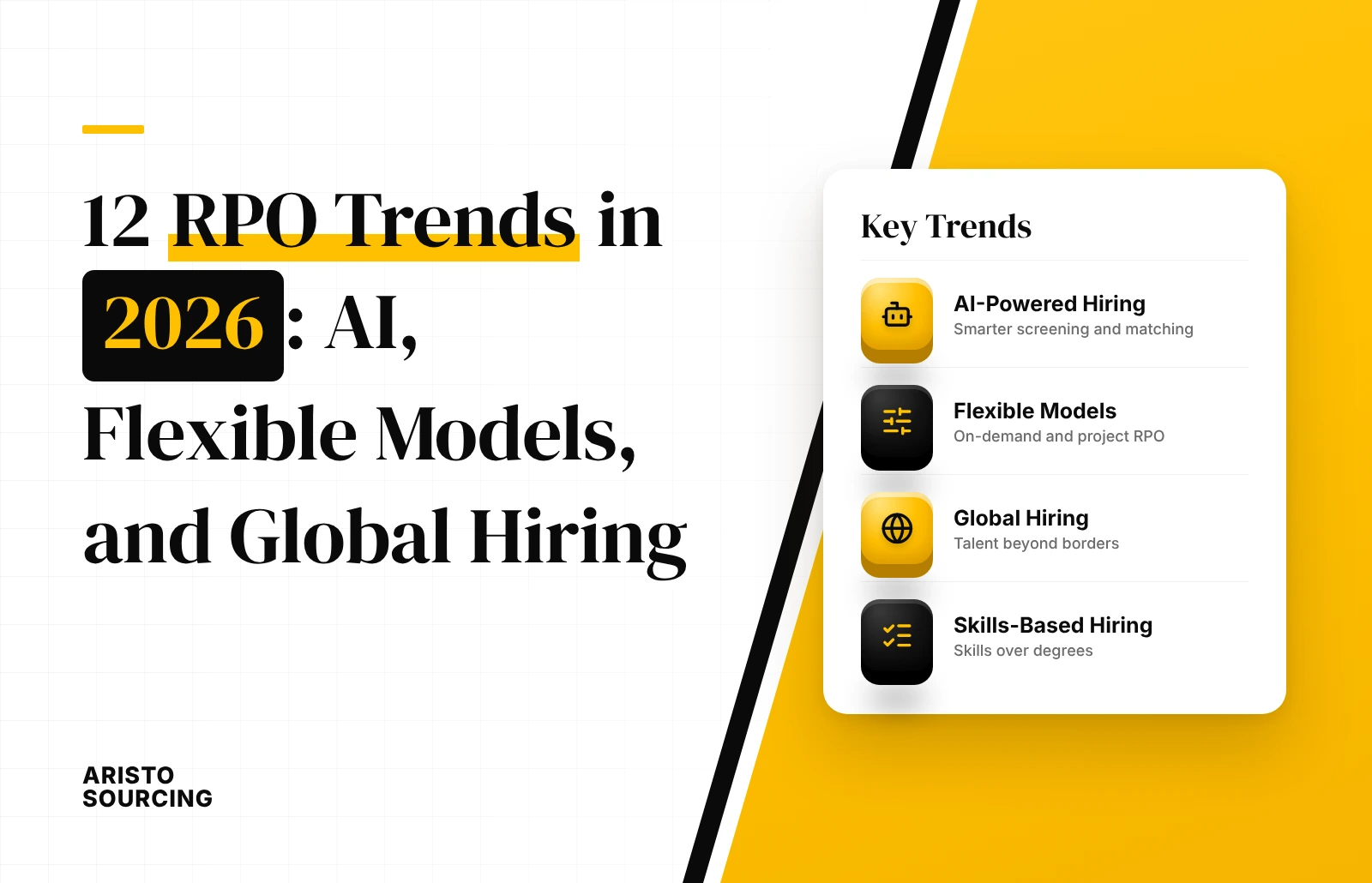
Recruitment process outsourcing trends are the shifts in how RPO providers source candidates, price their services, and deliver hiring programs. Recruitment process outsourcing (RPO) is the practice of contracting all or part of a company’s recruiting process to an external recruiting specialist. The 12 RPO trends in 2026 cluster around three dominant shifts: AI and automation in screening and scheduling, flexible project-based and modular RPO models, and cross-border global hiring.
This page covers what is driving RPO growth in 2026, the 12 top recruitment process outsourcing trends, the challenges that could slow RPO adoption, and where the RPO market is heading. Each trend builds on the basic recruitment process outsourcing model, in which the provider owns defined recruiting stages under a long-term contract.
The RPO market keeps growing in 2026. According to Global Market Insights, the recruitment process outsourcing market reached USD 11 billion in 2025 and is projected to grow at a 9.9% CAGR to USD 25.8 billion by 2034.
What Is Driving Recruitment Process Outsourcing Growth in 2026?
Recruitment process outsourcing growth in 2026 is driven by talent shortages in tech and healthcare, cost pressure on in-house talent acquisition teams, fluctuating hiring demand, adoption of AI recruiting technology, and hiring across borders. Talent shortages push employers toward RPO providers with specialist recruiter networks. Cost pressure makes a variable RPO fee more attractive than a fixed internal recruiting team. Fluctuating hiring demand favors providers that scale recruiting capacity up and down. AI recruiting technology is expensive to build in-house, so employers buy it through RPO providers. Hiring across borders requires compliance and sourcing reach that most internal teams lack.
The market size and the regions and industries that lead RPO adoption are covered in the two sections below.
How Big Is the RPO Market in 2026?
The RPO market is worth about USD 12 billion in 2026, based on Global Market Insights’ USD 11 billion 2025 figure and its 9.9% CAGR forecast to USD 25.8 billion by 2034. Global Market Insights reports that North America held about 40% of the RPO market in 2024 and that the United States accounted for about 79% of North American revenue, or USD 3.29 billion. Other research firms publish higher figures because they define the market more broadly: Mordor Intelligence sizes the wider recruitment outsourcing market at USD 14.43 billion in 2026, and Grand View Research projects the RPO market at USD 24.32 billion by 2030. The gap between sources comes from scope, since some reports include staffing-adjacent recruiting services that others exclude.
Which Regions and Industries Lead RPO Adoption?
North America leads RPO adoption by region, Asia Pacific grows fastest, and IT and telecom, BFSI, manufacturing, and healthcare lead RPO adoption by industry. Global Market Insights reports that North America held about 40% of the RPO market in 2024, while Asia Pacific held more than 21% and is growing at about 10.7% CAGR, the fastest of any region. By industry, Global Market Insights notes that IT and telecom, BFSI, and manufacturing and automotive together held 52% of the RPO market in 2024. Mordor Intelligence reports that IT and telecom alone accounted for 31.05% of the recruitment outsourcing market in 2025.
What Are the Top Recruitment Process Outsourcing Trends in 2026?
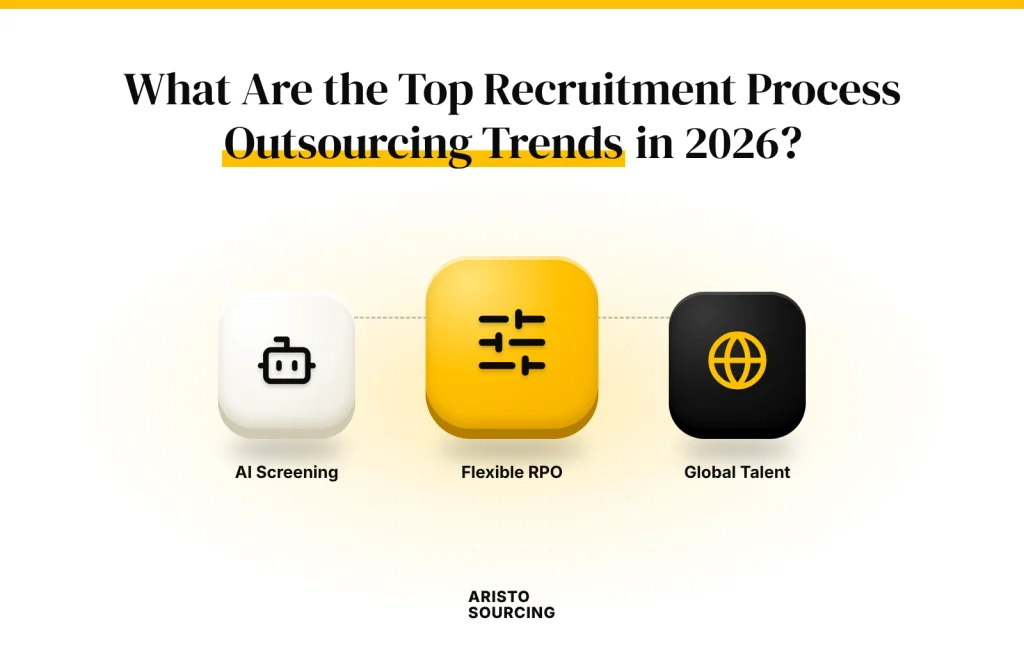
The top recruitment process outsourcing trends in 2026 are AI and automation, flexible RPO models, outcome-based pricing, data-driven hiring, global talent acquisition, skills-based hiring, retention support, candidate experience, total talent management, provider consolidation, SME adoption, and specialized RPO for skills shortages. RPO in 2026 is moving from a fixed, full-cycle contract toward an AI-supported, flexible, and outcome-linked service that hires across borders.
The 12 top recruitment process outsourcing trends in 2026 are listed below.
- AI and Automation in Screening and Scheduling
- Shift to Flexible, Project-Based, and Modular RPO
- Outcome-Based and Performance-Linked Pricing
- Data-Driven Hiring and Real-Time Analytics
- Cross-Border, Offshore, and Global Talent Acquisition
- Skills-Based Hiring and Quality of Hire
- Retention, Onboarding, and Internal Mobility
- Candidate Experience and Employer Branding
- Total Talent Management: RPO and MSP Converge
- Provider Consolidation Reshapes the RPO Market
- Small and Mid-Sized Businesses Enter the RPO Market
- Healthcare and Tech Skills Shortages Drive Specialized RPO
1. AI and Automation in Screening and Scheduling
AI and automation in RPO refers to the use of AI tools for candidate sourcing, resume screening, interview scheduling, and candidate messaging. The trend is driven by high-volume hiring, where recruiters cannot manually review thousands of applications within service-level deadlines. AI and automation change RPO delivery by moving routine screening and scheduling to software, so recruiters spend more time on candidate assessment and offer closing. For RPO buyers, AI and automation mean faster time to fill and the need to audit how each provider’s AI tools make screening decisions. Deloitte’s 2024 Global Outsourcing Survey reports that 83% of executives already use AI as part of their outsourced services.
2. Shift to Flexible, Project-Based, and Modular RPO
Flexible RPO refers to engagement models that let employers buy only the recruiting scope they need, including end-to-end, project, on-demand, and modular (selective) RPO. The trend is driven by fluctuating hiring demand, which makes fixed multiyear full-cycle contracts expensive in slow hiring periods. Flexible RPO changes delivery by letting providers deploy recruiters for a defined project or take over single stages, such as sourcing or screening, while the internal team keeps the rest. For RPO buyers, flexible RPO means lower commitment and the ability to scale recruiting capacity with business cycles. Insight Global, for example, offers project RPO engagements that run from 3 to 18 months (vendor offering).
3. Outcome-Based and Performance-Linked Pricing
Outcome-based RPO pricing refers to fee structures tied to hiring results, such as filled roles, quality of hire, or retention, rather than to a fixed management fee. The trend is driven by buyers who want providers to share hiring risk after years of paying management fees regardless of results. Outcome-based pricing changes delivery by pushing RPO providers to focus recruiter effort on the roles and metrics that trigger payment. For RPO buyers, outcome-based pricing means closer alignment between provider incentives and hiring goals, along with the need for clear metric definitions in the contract. Outcome-based RPO pricing usually combines a reduced base fee with payments released when agreed hiring results are met.
4. Data-Driven Hiring and Real-Time Analytics
Data-driven hiring in RPO refers to the use of recruiting analytics and real-time dashboards to manage hiring performance. The trend is driven by leadership demand for visibility into time to fill, cost per hire, source effectiveness, and pipeline health. Data-driven hiring changes delivery by giving clients live access to recruiting metrics instead of monthly static reports. For RPO buyers, data-driven hiring means faster course correction when sources or recruiters underperform. Insight Global reports that its RPO programs typically cut time to hire by about 30% and cost per hire by about 25% (vendor claim).
5. Cross-Border, Offshore, and Global Talent Acquisition
Global talent acquisition in RPO refers to cross-border hiring delivered through offshore and nearshore sourcing teams, remote hiring programs, and employer of record (EOR) partners for compliance. The trend is driven by talent shortages in home markets and by the normalization of remote work for knowledge roles. Global talent acquisition changes delivery by extending RPO providers’ sourcing reach into new countries and adding EOR arrangements that employ hires legally without a local entity. For RPO buyers, global talent acquisition means a larger candidate pool and the need to verify each provider’s in-country compliance coverage. Deloitte reports that improved access to talent (42%) is now the most cited reason companies outsource, ahead of cost reduction.
6. Skills-Based Hiring and Quality of Hire
Skills-based hiring in RPO refers to selecting candidates by verified skills and assessments rather than degrees or job titles. The trend is driven by talent shortages that make degree requirements an unnecessary filter on qualified candidates. Skills-based hiring changes delivery by adding skills assessments, work samples, and structured interviews to the RPO screening stage. For RPO buyers, skills-based hiring means wider candidate pools and a stronger focus on quality of hire as a contract metric. Skills-based hiring also gives RPO buyers a measurable basis for quality-of-hire targets in service level agreements.
7. Retention, Onboarding, and Internal Mobility
Retention support in RPO refers to providers extending their scope beyond the offer into onboarding, early retention, and internal mobility programs. The trend is driven by the cost of early attrition, which erases the value of a completed hire within months. Retention support changes delivery by adding onboarding coordination, new-hire check-ins, and internal candidate sourcing to RPO contracts. For RPO buyers, retention support means measuring RPO providers on 6-month and 12-month retention, not only on filled roles. Insight Global reports 91% 12-month retention in one large US retail RPO program (vendor case study).
8. Candidate Experience and Employer Branding
Candidate experience in RPO refers to the quality of communication, speed, and fairness that candidates receive during an outsourced hiring process. The trend is driven by candidates sharing hiring experiences publicly and by competitive markets where slow or impersonal processes lose top candidates. Candidate experience changes delivery by adding chatbots for instant updates, faster scheduling, and employer branding content to RPO programs. For RPO buyers, candidate experience means auditing the provider’s communication standards because candidates see the RPO provider as the employer. Candidate experience also shapes employer brand perception, because rejected candidates remain potential customers and future applicants.
9. Total Talent Management: RPO and MSP Converge
Total talent management refers to one program that manages both permanent hiring through RPO and contingent workforce hiring through a managed service provider (MSP), which administers temporary staff, contractors, and staffing suppliers. The trend is driven by employers that want one view of all labor costs and talent sources. Total talent management changes delivery by combining RPO recruiters, MSP program managers, and direct sourcing pools under one provider. For RPO buyers, total talent management means fewer vendor contracts and the ability to fill roles with the right worker type. Providers offering both RPO and MSP include Allegis Global Solutions, ManpowerGroup Talent Solutions through TAPFIN, Hudson RPO, and Randstad Enterprise.
10. Provider Consolidation Reshapes the RPO Market
Provider consolidation refers to mergers and acquisitions that combine RPO providers into larger talent solutions firms. The trend is driven by providers seeking broader service scope, AI investment capacity, and global delivery reach. Recent deals show the pattern: Korn Ferry completed its acquisition of AMS on September 1, 2026, Kelly combined the RPO operations of KellyOCG and Sevenstep in February 2025, and Orion Talent acquired Novotus in 2016 and Accolo in 2019. Provider consolidation changes delivery by offering broader service scope from one provider and by reducing the number of independent mid-size RPO providers. For RPO buyers, provider consolidation means checking service continuity, account team stability, and contract terms during integration.
11. Small and Mid-Sized Businesses Enter the RPO Market
SME adoption of RPO refers to small and mid-sized businesses buying recruitment process outsourcing that was once used mainly by large enterprises. The trend is driven by on-demand and project RPO models that lower the entry cost, as described in trend 2, and by the fact that many SMEs have no in-house talent acquisition team. SME adoption changes delivery by pushing RPO providers to offer shorter contracts, smaller minimums, and modular services. For RPO buyers, SME adoption means more provider options sized for limited hiring volume. Mordor Intelligence projects the SME segment of the recruitment outsourcing market to grow at a 14.18% CAGR through 2031, while large organizations still held 57.85% of 2025 revenue.
12. Healthcare and Tech Skills Shortages Drive Specialized RPO
Specialized RPO refers to RPO programs built around one hard-to-fill talent segment, such as nurses and clinicians in healthcare or AI, cybersecurity, and engineering roles in technology. The trend is driven by persistent shortages that general recruiters cannot fill within acceptable time frames. Specialized RPO changes delivery by adding niche recruiter networks, credential and license verification, and faster time to fill for scarce roles. For RPO buyers, specialized RPO means choosing providers by segment depth rather than by overall size. Specialized RPO providers also verify licenses and certifications before candidate submission, which lowers compliance risk for regulated roles.
What Challenges Could Slow RPO Growth?
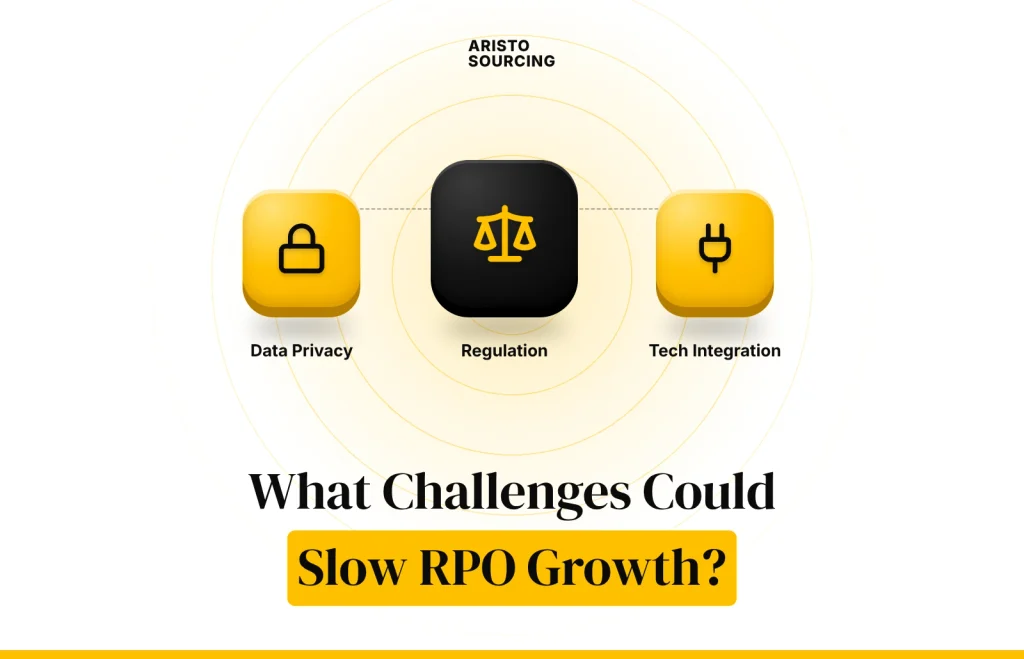
The challenges that could slow RPO growth are integration with legacy HR systems, data privacy and security regulation, and pay-transparency laws. Each challenge adds cost, time, or compliance work to RPO programs and can delay buying decisions.
The three challenges that could slow RPO growth are listed below.
- Integration With Legacy HR Systems
- Data Privacy and Security Regulation
- Pay-Transparency Laws
1. Integration With Legacy HR Systems
Integration with legacy HR systems refers to the technical work of connecting an RPO provider’s recruiting tools with the client’s existing ATS and HCM platforms. The challenge slows RPO growth because data silos, duplicate candidate records, and custom integrations lengthen implementation and raise setup costs. RPO providers respond with prebuilt connectors and API-based integration, while buyers respond by cleaning candidate data and defining system ownership before implementation starts.
2. Data Privacy and Security Regulation
Data privacy and security regulation refers to laws that govern how RPO providers collect, store, process, and use candidate data and hiring AI. The challenge slows RPO growth because GDPR and CCPA restrict cross-border data transfers, NYC Local Law 144 requires bias audits for automated employment decision tools, and the EU AI Act classifies AI systems used in recruitment as high-risk. RPO providers respond with data processing agreements, bias audits, and documented AI governance, while buyers respond by adding data protection and AI audit clauses to RPO contracts.
3. Pay-Transparency Laws
Pay-transparency laws refer to rules that require employers to disclose salary ranges and restrict how pay is discussed during hiring. The challenge slows RPO growth because US state laws in Colorado, California, New York, and Washington require salary ranges in job postings, and the EU Pay Transparency Directive, with a June 7, 2026 transposition deadline, requires pay ranges and bans questions about candidates’ salary history. RPO providers respond by updating job posting templates and offer workflows, while buyers respond by finalizing pay bands before RPO providers post roles.
What Is the Future of Recruitment Process Outsourcing?
The future of recruitment process outsourcing is a larger, more automated, and more consolidated market in which RPO and contingent workforce programs merge into total talent services. Global Market Insights projects the RPO market to reach USD 25.8 billion by 2034, more than double its 2025 size. AI agents will handle a larger share of the recruiting workflow, from sourcing outreach to scheduling and first-round screening, while human recruiters focus on assessment, hiring manager advice, and closing. RPO and MSP programs will continue to merge into total talent programs, and provider consolidation will continue as large firms buy specialist and regional RPO providers. The 12 RPO trends in 2026 point in the same direction: AI, flexible models, and global hiring will define how employers buy recruitment process outsourcing for the rest of the decade.
RPO vs In-House Talent Acquisition: How Are Trends Shifting the Balance?
RPO trends are shifting the balance between outsourced and in-house talent acquisition by giving RPO providers an advantage in scale, AI tooling, global reach, and variable cost. In-house talent acquisition still holds the advantage in employer brand control, culture fit assessment, and long-term ownership through internal talent acquisition centers of excellence. Many employers now land on hybrid co-sourcing, in which the internal team owns strategy and key roles while an RPO provider handles volume and hard-to-fill segments. The complete trade-off is covered in the comparison of in-house recruitment vs outsourcing.
What Do RPO Trends Mean for Your Hiring Strategy?
RPO trends mean companies should match the RPO model to hiring volume and demand swings, ask how providers use AI and data, and tie contracts to hiring outcomes. A company with seasonal or project hiring benefits from project or on-demand RPO rather than a multiyear full-cycle contract. A company evaluating providers should ask which recruiting stages each provider automates and how clients access hiring data. A company signing a new contract should link part of the fee to outcomes such as filled roles and retention.
How Should You Evaluate an RPO Partner Against These Trends?
To evaluate an RPO partner against 2026 trends, check the provider’s AI and automation stack, engagement flexibility, pricing terms, analytics access, global compliance coverage, and retention support. The AI and automation stack should match trend 1 and include documented bias testing. Flexible engagement models from trend 2 should let the company scale scope without renegotiating the whole contract. Outcome-based pricing terms from trend 3 should link fees to agreed hiring results. Reporting and analytics access from trend 4 should give real-time dashboards rather than monthly static reports. Global delivery and compliance coverage from trend 5 should cover every hiring country, and retention and onboarding support from trend 7 should extend past the offer stage. Contract terms, SLAs, and exit clauses should be reviewed against the same criteria before shortlisting the best recruitment process outsourcing companies.

How Do RPO Trends Fit Into Wider Recruiting and Outsourcing?
RPO trends are one part of the broader shift in recruiting and HR outsourcing toward automation, flexible models, and global talent sourcing. The same forces that reshape RPO also reshape payroll, benefits administration, and HR operations, which are covered in the wider review of HR outsourcing trends. Two recruiting frameworks connect RPO trends to everyday hiring practice: the 5 C’s of recruitment and the 80/20 rule in recruiting.
What Are the 5 C’s of Recruitment?
The 5 C’s of recruitment are competence, capability, compatibility, character, and commitment, a hiring framework attributed to Alan Hall, founder of MarketStar. Frameworks for the 5 C’s vary by source, but this version focuses on whether a candidate can do the job, can grow into it, fits the team, holds the right values, and will stay. The framework ties directly to trend 6, because skills-based hiring tests competence and capability, and to trend 8, because a strong candidate experience helps employers assess compatibility and commitment.
What Is the 80/20 Rule in Recruiting?
The 80/20 rule in recruiting means that about 80% of hiring results come from about 20% of sources, roles, or recruiter activities, an application of the Pareto principle. A small number of job boards or referral channels usually produce most quality hires, and a small number of critical roles usually drive most business impact. The 80/20 rule ties back to trend 1 because AI screening and recruitment process automation free recruiter time for the critical 20% of roles and candidates that need human judgment.